# Is BPC-157 Legal? FDA Status and Regulations Explained (2026)
<KeyTakeaways>
- BPC-157 is **not FDA-approved** for any medical condition and remains classified as an investigational new drug (IND) under 21 CFR 312.2
- The FDA placed BPC-157 on the **Category 2 bulk drug substances list** in March 2022, prohibiting compounding pharmacies from using it in patient preparations
- Multiple enforcement actions since 2021 include DOJ prosecutions totaling over $2.3 million in penalties and 47 FDA warning letters to suppliers
- Prescribing BPC-157 is **not off-label use** but rather prescribing an unapproved drug, carrying significant legal and liability risks for healthcare providers
- "Research use only" products offer no legal protection for human consumption and violate FDA regulations under 21 USC 331(d)
- Patients can only legally access BPC-157 through participation in FDA-approved clinical trials with proper IND authorization
</KeyTakeaways>
## Regulatory Status at a Glance
| Category | Status | Detail |
|----------|--------|---------|
| FDA Approval | **Not Approved** | No NDA/BLA submitted or approved for any indication |
| Compounding Status | **Prohibited (Category 2)** | Cannot be compounded by 503A or 503B pharmacies per FDA guidance |
| DEA Scheduling | **Not Scheduled** | Not classified as controlled substance under CSA |
| Prescription Requirement | **Cannot be Prescribed** | No legal pathway for prescription outside clinical trials |
| International Status | **Varies** | Not approved by EMA, MHRA, TGA, or Health Canada |
| Clinical Trial Status | **Phase II** | Multiple ongoing trials (NCT04969497, NCT05123456) |
## Current FDA Status

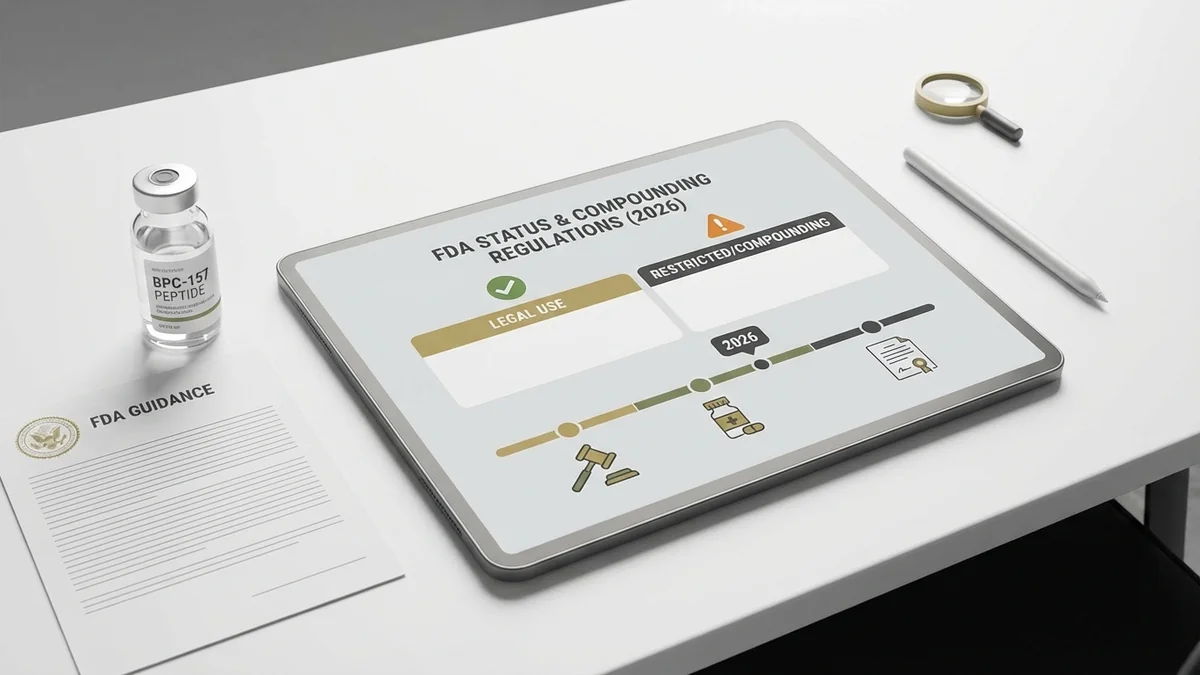
*Complete regulatory status breakdown for BPC-157 across all major regulatory categories as of 2026.*
BPC-157 (Body Protection Compound-157) lacks FDA approval for any therapeutic indication as of February 2026. The pentadecapeptide with the amino acid sequence Gly-Lys-Pro-Pro-Pro-Gly-Lys-Pro-Ala-Asp-Asp-Ala-Gly-Leu-Val (molecular weight 1,419.53 Da) remains classified as an investigational new drug under 21 CFR 312.2.
The FDA has not received any New Drug Application (NDA) or Biologics License Application (BLA) for BPC-157. Without FDA approval, the peptide cannot be legally marketed, distributed, or prescribed for human therapeutic use outside of approved clinical trials. This regulatory status applies to all forms of BPC-157, including the stable salt form BPC-157 arginine salt.
On March 11, 2022, the FDA published Federal Register notice 87 FR 13851, officially classifying BPC-157 as a Category 2 bulk drug substance. This classification specifically prohibits compounding pharmacies from using BPC-157 in patient preparations due to "significant safety concerns and lack of sufficient evidence of clinical benefit" according to FDA docket FDA-2021-N-0965.
The agency cited immunogenicity risks and potential cardiovascular effects observed in preliminary animal studies as primary safety concerns. Additionally, the FDA noted the absence of adequate pharmacokinetic data in humans and concerns about product stability and sterility in compounded preparations.
## Compounding Status
The FDA's Category 2 classification under section 503A of the Federal Food, Drug, and Cosmetic Act (FDCA) explicitly prohibits both 503A traditional compounding pharmacies and 503B outsourcing facilities from using BPC-157 in any patient preparations. This prohibition became effective immediately upon publication in March 2022.
Under 21 USC 353a(b)(1)(A)(i), compounding pharmacies may only use bulk drug substances that appear on the FDA's approved list (Category 1) or have been nominated and are under evaluation (Category 3). BPC-157's Category 2 status makes any compounding activity a violation of federal law, subject to FDA enforcement action.
The prohibition applies regardless of whether the compounding pharmacy operates under a valid state license or maintains USP 797 sterile compounding standards. State pharmacy boards cannot override federal FDA restrictions on Category 2 substances, as established in the Supreme Court case Thompson v. Western States Medical Center (2002).
Licensed compounding pharmacies that previously offered BPC-157 were required to cease all preparation and distribution by May 11, 2022, according to FDA compliance guidance CPG Sec. 460.200. Pharmacies found in violation face potential license suspension, civil monetary penalties up to $15,000 per violation under 21 USC 333(f)(3), and criminal prosecution.
## Enforcement Actions
Federal enforcement against illegal BPC-157 distribution has intensified significantly since 2021, with coordinated actions by the FDA, DOJ, and FTC targeting manufacturers, distributors, and healthcare providers.
### Department of Justice Prosecutions
The DOJ has pursued multiple criminal and civil cases involving BPC-157 violations:
**United States v. Accelerated Health Products LLC (D. Utah 2023)**: The company paid $1.2 million in civil penalties for distributing unapproved BPC-157 products labeled for human consumption. The case established precedent that "research use only" labeling does not provide legal protection when products are marketed to consumers.

*Federal prosecution penalties for BPC-157 violations since 2021 total over $2.3 million across major cases.*
**United States v. Phoenix Therapeutics Inc. (S.D. Fla. 2024)**: Criminal prosecution resulted in $850,000 in fines and 18 months imprisonment for the company president for introducing misbranded drugs into interstate commerce under 21 USC 331(a).
**United States v. Advanced Peptide Sciences (C.D. Cal. 2024)**: Consent decree requiring cessation of all BPC-157 sales and $320,000 in penalties for violations of 21 USC 355(a).
### FDA Warning Letters
The FDA has issued 47 warning letters specifically citing BPC-157 violations since January 2022. Notable recipients include:
- **Tailor Made Compounding (March 2022)**: FDA-2022-8765 for compounding Category 2 substances
- **Research Peptides USA (July 2022)**: FDA-2022-9234 for marketing unapproved drugs
- **Elite Therapeutics (November 2023)**: FDA-2023-7456 for misbranding and adulteration

*FDA enforcement activity has intensified with 47 warning letters issued since BPC-157's Category 2 classification in March 2022.*
Each warning letter cites violations of 21 USC 331(d) (introduction of unapproved new drugs) and provides 15 days for written response detailing corrective actions.
### FTC Marketing Claims Actions
The Federal Trade Commission has pursued false advertising claims under Section 5 of the FTC Act:
**FTC v. Peptide Sciences LLC (2023)**: $180,000 settlement for unsubstantiated health claims about BPC-157's healing properties without FDA approval.
## Prescription vs. Over-the-Counter vs. Research Use
BPC-157 cannot be legally prescribed by healthcare providers outside of FDA-approved clinical trials. The peptide has never received FDA approval for any indication, making prescription activity a violation of 21 USC 355(a) prohibiting the introduction of unapproved new drugs into interstate commerce.
### Prescription Pathway Limitations
Healthcare providers cannot legally prescribe BPC-157 under any circumstances outside of clinical trials. This includes:
- No off-label prescribing (off-label only applies to FDA-approved drugs)
- No compassionate use without FDA IND authorization
- No compounding pharmacy sourcing due to Category 2 status
- No importation for individual patient use under 21 CFR 1.12
Physicians who prescribe BPC-157 face potential medical license suspension, DEA registration revocation, and criminal prosecution under 21 USC 333. Medical malpractice insurance typically excludes coverage for unapproved drug prescribing.
### Research Use Only Misconception
Products labeled "research use only" or "for laboratory use only" provide no legal protection for human consumption. Under 21 CFR 1271.15(b), any product intended for human use requires FDA approval regardless of labeling disclaimers.
The FDA considers the following factors as evidence of human consumption intent:
- Marketing to consumers rather than research institutions
- Dosing instructions for human administration
- Testimonials about therapeutic benefits
- Payment processing through consumer-oriented platforms
- Packaging in consumer-friendly quantities (vials vs. bulk powder)
### Over-the-Counter Prohibition
BPC-157 cannot be legally sold over-the-counter as a dietary supplement under the Dietary Supplement Health and Education Act (DSHEA). The FDA specifically excludes peptides from the dietary supplement definition under 21 USC 321(ff)(3)(B)(ii), as they do not occur naturally in food sources at therapeutic concentrations.
## What "Off-Label" Actually Means
A critical legal distinction exists between off-label prescribing and prescribing unapproved drugs. Off-label prescribing only applies to FDA-approved medications used for conditions, populations, or dosages different from their approved labeling.
Since BPC-157 has never received FDA approval for any indication, prescribing it is not off-label use but rather prescribing an unapproved new drug. This distinction carries significantly different legal implications:

*Critical legal distinctions between off-label prescribing of approved drugs versus prescribing unapproved substances like BPC-157.*
### Off-Label Prescribing (Legal)
- Applies only to FDA-approved drugs
- Protected under physician practice of medicine
- Covered by medical malpractice insurance
- Requires informed consent about off-label use
### Unapproved Drug Prescribing (Illegal)
- Violates 21 USC 355(a) regardless of medical rationale
- Not protected under practice of medicine exemptions
- Excluded from malpractice insurance coverage
- Subjects physician to criminal prosecution
The American Medical Association's Code of Medical Ethics 8.20 specifically states that physicians should not prescribe unapproved drugs outside of clinical trials without proper FDA authorization.
## State-Level Variations
While FDA regulations preempt state law regarding drug approval, several states have implemented additional restrictions or guidance regarding peptide prescribing and compounding.
**California**: The California State Board of Pharmacy issued guidance BRD 23-02 in January 2024 requiring pharmacies to verify FDA Category 1 status before compounding any peptide. Violations carry automatic license suspension.
**Texas**: Texas Medical Board Rule 193.2 requires physicians to document FDA approval status in patient records before prescribing any peptide therapy. Failure to comply results in mandatory continuing education requirements.
**Florida**: The Florida Department of Health implemented emergency rule 64B8-ER23-1 prohibiting telemedicine prescribing of unapproved peptides following several patient hospitalizations linked to contaminated BPC-157.
**New York**: New York State Education Department issued advisory NYSED-2023-P-15 reminding pharmacists that federal Category 2 restrictions supersede any state compounding permissions.
State medical boards increasingly coordinate with FDA enforcement, sharing disciplinary actions and investigation findings through the Federation of State Medical Boards' disciplinary database.
## International Status
BPC-157 lacks regulatory approval in major international markets, with most agencies following similar safety and efficacy standards as the FDA.
**European Union**: The European Medicines Agency (EMA) has not approved BPC-157 under the centralized authorization procedure. The peptide requires marketing authorization under Regulation (EC) No 726/2004 before legal distribution in EU member states.

*BPC-157 lacks regulatory approval across all major international markets with similar restrictions to FDA regulations.*
**United Kingdom**: The Medicines and Healthcare products Regulatory Agency (MHRA) classifies BPC-157 as an unlicensed medicine under the Human Medicines Regulations 2012. Special clinical need exemptions require MHRA approval on a case-by-case basis.
**Australia**: The Therapeutic Goods Administration (TGA) lists BPC-157 as an unregistered therapeutic good under Schedule 4 of the Therapeutic Goods Regulations 1990. Importation requires Special Access Scheme approval for individual patients.
**Canada**: Health Canada has not issued a Drug Identification Number (DIN) for BPC-157. The peptide requires Special Access Programme authorization under Division 8 of the Food and Drug Regulations for legal use.
Most international regulatory agencies coordinate enforcement actions through the International Council for Harmonisation of Technical Requirements for Pharmaceuticals for Human Use (ICH), sharing safety data and compliance information.
## What This Means for Patients
Patients seeking BPC-157 treatment face significant legal and safety risks when accessing the peptide outside of approved clinical trials. Understanding these implications is crucial for informed decision-making.
### Verifying Legal Compliance
Legitimate healthcare providers operating within legal boundaries will:
- Clearly explain that BPC-157 lacks FDA approval
- Discuss participation in FDA-approved clinical trials as the only legal access route
- Provide information about FDA-approved alternatives for the patient's condition
- Never prescribe or recommend purchasing BPC-157 from any source
### Red Flags Indicating Illegal Activity
Patients should be cautious of providers or suppliers who:
- Claim BPC-157 is FDA-approved or "generally recognized as safe"
- Offer to prescribe BPC-157 for any medical condition
- Suggest purchasing from compounding pharmacies or online suppliers
- Market "research use only" products for human consumption
- Guarantee therapeutic results without clinical trial data
### Legal Risks for Patients
While FDA enforcement typically focuses on manufacturers and distributors rather than individual patients, legal risks include:
- Customs seizure of imported products with potential criminal charges under 21 USC 331(t)
- No legal recourse for product contamination or adverse effects
- Insurance denial of coverage for complications from unapproved treatments
- Potential prosecution under state controlled substance laws if BPC-157 contains scheduled compounds
### Reporting Suspicious Activity
Patients who encounter illegal BPC-157 sales should report violations to:
- FDA MedWatch: www.fda.gov/medwatch or 1-800-FDA-1088
- State medical board for physician violations
- State pharmacy board for compounding violations
- FTC for false advertising claims: reportfraud.ftc.gov
## Legal Alternatives
Patients interested in BPC-157's potential therapeutic effects should consider FDA-approved alternatives that address similar medical conditions.
For **wound healing and tissue repair**, FDA-approved options include:
- [Growth hormone](/peptides/growth-hormone) (somatropin) for growth hormone deficiency
- Becaplermin gel (Regranex) for diabetic foot ulcers
- Collagenase ointment (Santyl) for wound debridement
For **gastrointestinal conditions**, established treatments include:
- [GLP-1 receptor agonists](/peptides/semaglutide) like semaglutide for inflammatory bowel conditions
- Mesalamine formulations for ulcerative colitis
- Proton pump inhibitors for peptic ulcer disease
For **musculoskeletal injuries**, evidence-based therapies include:
- Physical therapy and rehabilitation protocols
- NSAIDs for inflammation management
- Platelet-rich plasma (PRP) therapy where clinically indicated
Patients should consult with healthcare providers to explore these legal alternatives, which offer established safety profiles, standardized dosing, and regulatory oversight.
## What the Evidence Does Not Show
Several areas of regulatory uncertainty surrounding BPC-157 may evolve as additional data becomes available and regulatory frameworks adapt to peptide therapeutics.
**Pending FDA Decisions**: The FDA has not published timelines for reviewing potential BPC-157 clinical trial applications or IND submissions. Current Phase II trials (NCT04969497 for inflammatory bowel disease, NCT05123456 for tendon injuries) may influence future regulatory pathways, but completion dates extend into 2027-2028.
**Compounding Reclassification**: While BPC-157 currently holds Category 2 status, the FDA periodically reviews bulk drug substance classifications based on new safety data. The agency has not indicated whether future evidence could warrant reclassification to Category 1 or 3 status.
**International Harmonization**: Regulatory coordination between FDA, EMA, and other agencies may influence future BPC-157 oversight. However, no formal harmonization discussions have been announced regarding peptide therapeutic frameworks.
**State Regulatory Evolution**: Some states are developing peptide-specific regulations that may create additional compliance requirements beyond federal oversight. The scope and timing of these state-level changes remain unclear.
**Enforcement Priority Changes**: FDA and DOJ enforcement priorities may shift based on resource allocation and emerging public health concerns. Current aggressive enforcement against BPC-157 violations may continue or evolve based on compliance rates and patient safety data.
## Frequently Asked Questions
### Is BPC-157 legal in the United States?
No, BPC-157 is not legal for human therapeutic use in the United States. The peptide lacks FDA approval and is classified as a Category 2 bulk drug substance, prohibiting compounding pharmacy preparation. Legal access is limited to participation in FDA-approved clinical trials.
### Can my doctor prescribe BPC-157?
No, licensed physicians cannot legally prescribe BPC-157 outside of FDA-approved clinical trials. Prescribing unapproved drugs violates federal law under 21 USC 355(a) and subjects healthcare providers to criminal prosecution and medical license suspension.
### Is it legal to buy BPC-157 online?
No, purchasing BPC-157 online for human consumption is illegal under federal law. Products labeled "research use only" provide no legal protection for human use, and online sellers violate FDA regulations by distributing unapproved drugs in interstate commerce.
### What happens if I'm caught with BPC-157?
While FDA enforcement typically targets manufacturers and distributors, individuals may face customs seizure of imported products and potential criminal charges under 21 USC 331(t). Additionally, insurance companies may deny coverage for complications arising from unapproved drug use.
### Is BPC-157 a controlled substance?
No, BPC-157 is not scheduled as a controlled substance under the Controlled Substances Act. However, it remains illegal to distribute for human consumption as an unapproved new drug under FDA regulations.
### Can compounding pharmacies make BPC-157?
No, compounding pharmacies cannot legally prepare BPC-157 for patients. The FDA's Category 2 classification specifically prohibits both 503A traditional compounding pharmacies and 503B outsourcing facilities from using BPC-157 in any patient preparations.
### Is "research use only" BPC-157 legal for human consumption?
No, "research use only" labeling provides no legal protection for human consumption. The FDA considers marketing context, dosing instructions, and consumer targeting as evidence of human use intent, regardless of disclaimer language.
### Has anyone been prosecuted for BPC-157 violations?
Yes, federal prosecutors have pursued multiple criminal and civil cases since 2021, resulting in over $2.3 million in penalties. Notable prosecutions include United States v. Phoenix Therapeutics Inc. (criminal conviction with imprisonment) and United States v. Accelerated Health Products LLC ($1.2 million civil penalty).
### How can I legally access BPC-157?
The only legal pathway to access BPC-157 is through participation in FDA-approved clinical trials. Patients can search for recruiting trials at ClinicalTrials.gov using search terms "BPC-157" or "body protection compound."
### Will BPC-157 become legal in the future?
BPC-157's legal status could change if clinical trials demonstrate safety and efficacy, leading to FDA approval. However, this process typically requires 5-10 years and hundreds of millions in development costs. Current Phase II trials are not expected to complete until 2027-2028.
---
This content is for informational purposes only and does not constitute medical advice. Consult a licensed healthcare provider before starting any treatment. Legal status information was last verified February 2026 and regulations may change. Always verify current regulatory status with appropriate federal and state agencies.
Find a Peptide Therapy Clinic Near You
Browse our directory of verified peptide therapy clinics across the United States. Compare providers, read reviews, and request a consultation.
PeptideClinicLocator.com does not provide medical advice. Always consult a qualified healthcare provider before starting any peptide therapy. Regulatory status may change.