Sermorelin: Dosage, Benefits, FDA Status & Clinics (2026)
Sermorelin
Compoundable
Growth Hormone Releasing Hormone
Anti-AgingGrowth Hormone
Last reviewed September 2026·MyPeptideMatch Team
What Is Sermorelin?
Sermorelin is the most direct way to tell your pituitary gland to make more growth hormone — without bypassing the system entirely. It's a synthetic 29-amino acid peptide that mirrors the first 29 residues of endogenous growth hormone releasing hormone (GHRH), which is enough to fully activate the GHRH receptor and trigger GH secretion from the pituitary.[1]
That distinction matters. Direct human growth hormone (HGH) injections flood your system with exogenous GH, bypassing your body's feedback loops. Sermorelin works upstream — it asks your pituitary to do the work, which means the GH release remains pulsatile, regulated, and responsive to normal physiological signals like sleep, exercise, and blood glucose. You get GH production that looks more like what a healthy 30-year-old produces rather than a flat pharmacological dose.
Sermorelin has a longer history than most peptides discussed in anti-aging clinics. It was previously marketed as Geref (Serono) and held FDA approval for the treatment of idiopathic growth hormone deficiency in children. That brand was voluntarily discontinued in 2008 — not due to safety concerns, but for commercial reasons. Today it remains legally available through licensed compounding pharmacies by prescription, making it one of the more accessible options in the growth hormone secretagogue category.
Key Takeaways
Sermorelin is a 29-amino acid GHRH analog that stimulates your pituitary to release growth hormone through your body's own feedback-regulated system.
It's compoundable in the US as a component of a previously FDA-approved drug — legal by prescription through licensed compounding pharmacies.
Unlike direct HGH injections, sermorelin preserves the natural pulsatile pattern of GH release and doesn't suppress your pituitary's own function.
Side effects are generally mild — injection site reactions, flushing, and headache are the most commonly reported.
WADA prohibits sermorelin in competitive sport; its metabolites are detectable in urine and are actively monitored in anti-doping programs.[2]
Class
Growth Hormone Releasing Hormone (GHRH) Analog
Amino Acid Sequence
29 amino acids (residues 1–29 of endogenous GHRH)
CAS Number
86168-78-7
FDA Status
Formerly approved (Geref); compounded by prescription through licensed pharmacies
Administration
Subcutaneous injection
Typical Dose (Practitioner Range)
200–500 mcg subcutaneously, nightly or 5×/week — dosing in humans has not been established in clinical trials; practitioner-reported ranges vary.
Half-life
~10–20 minutes (reported half-life; mechanism involves stimulation of endogenous GH secretion rather than sustained exogenous hormone replacement)
Primary Uses
Growth hormone deficiency, anti-aging, body composition
WADA Status
Prohibited (S2 — Peptide Hormones, Growth Factors, Related Substances)[2]
Typical Dosing — Practitioner & Community Ranges
There are no current published randomized controlled trials establishing an official therapeutic dose of sermorelin for adult anti-aging or body composition use. The ranges below reflect what practitioners commonly use based on available clinical literature, compounding pharmacy protocols, and published practitioner guidance.[1]
Not derived from adult RCT data
Dosing ranges for sermorelin in adult anti-aging and body composition contexts are not derived from large randomized clinical trials. They represent practitioner consensus and compounding pharmacy protocols. Dosing should always be individualized by a licensed healthcare provider based on IGF-1 levels and clinical response.
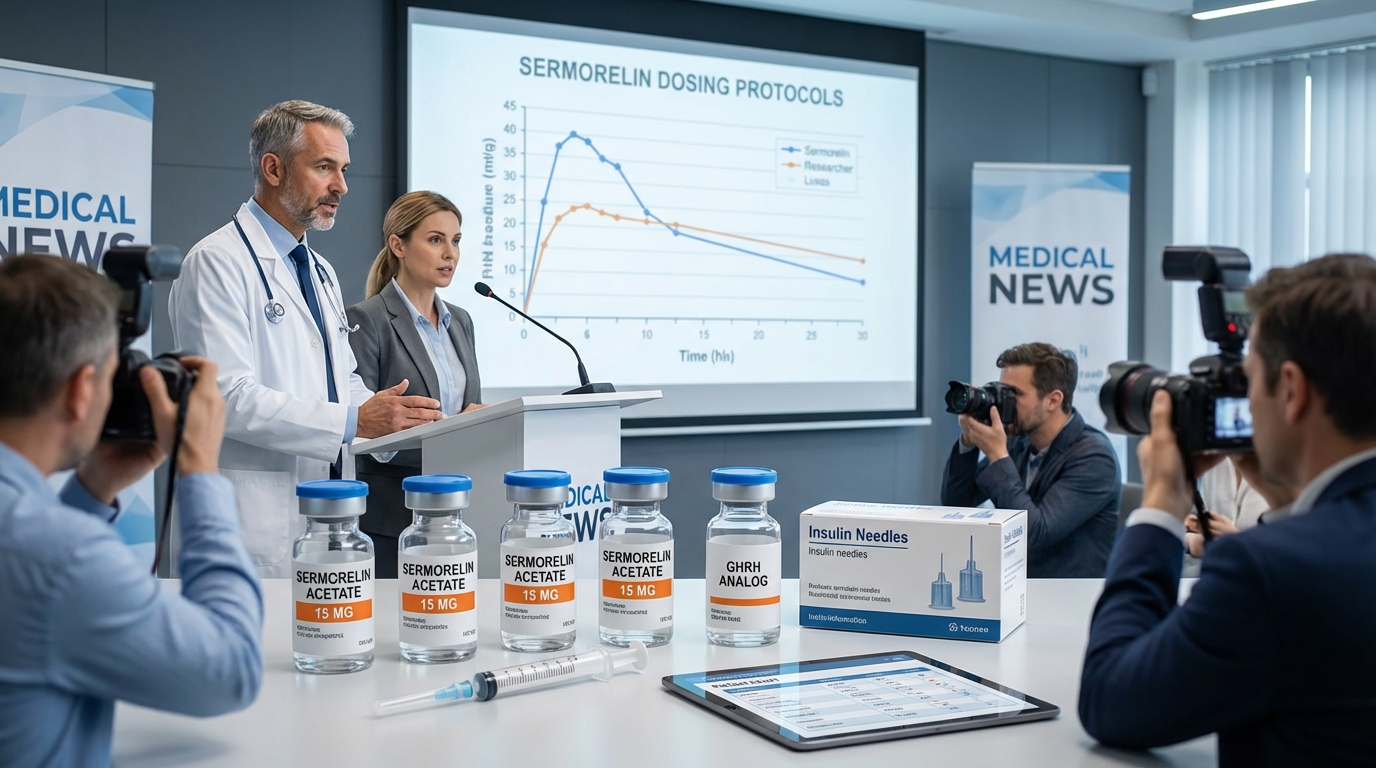
The most widely used protocol involves 200–500 mcg injected subcutaneously before sleep, either nightly or 5 nights per week. Sermorelin dosing protocols in clinical use have not been established in published human clinical trials; typical practitioner-reported doses range from 200–500 mcg subcutaneously, though timing and frequency vary by clinical context. Timing before bed is deliberate: it aligns the pharmacological GHRH pulse with the body's largest natural GH release, which occurs during slow-wave sleep. Stacking the drug-induced stimulus on top of the physiological one produces a larger combined GH pulse than either would alone.
Some practitioners use lower doses — 100–200 mcg — for patients who are new to GH secretagogues or who show strong IGF-1 responses at minimal doses. Others combine sermorelin with a growth hormone releasing peptide (GHRP) such as ipamorelin to stimulate GH release through a second, complementary receptor pathway simultaneously. Dosing practices for sermorelin have not been established in rigorous clinical trials in humans. Some practitioners may report using varied doses, but specific dose ranges and combination strategies lack peer-reviewed evidence. This combination approach is common in clinical practice because GHRH and GHRP act synergistically — together they produce a GH pulse larger than either compound alone.
Sermorelin: Common Dosing Approaches in Practice
Parameter
Monotherapy
With GHRP (e.g., Ipamorelin)
Pediatric GHD (historical)
Typical dose
200–500 mcg
100–300 mcg sermorelin
0.03 mg/kg/day
Frequency
5–7 nights/week
5–7 nights/week
Daily
Timing
Before sleep
Before sleep
Before sleep
Route
Subcutaneous
Subcutaneous
Subcutaneous
Monitoring
IGF-1 levels
IGF-1 levels
IGF-1 + growth velocity
Response is typically monitored through serum IGF-1 (insulin-like growth factor 1), which reflects average GH output over time. Most practitioners aim to bring IGF-1 into the upper third of the age-adjusted reference range rather than simply maximizing it. The dose is titrated accordingly — not set and forgotten.
What Makes Sermorelin Different
Most compounds in the growth hormone space either replace GH directly or mimic ghrelin to trigger GH release. Sermorelin does neither. It's a direct structural analog of your own GHRH — the signal your hypothalamus sends to your pituitary every day. That makes it mechanistically the most physiologically faithful option in the secretagogue category.
Why the pulsatile pattern matters
Growth hormone doesn't work the same way when it's delivered as a flat dose versus released in pulses. Many of GH's anabolic and metabolic effects depend on peak-to-trough amplitude, not just total exposure. Sermorelin preserves this pulse architecture. Direct HGH injections don't — they produce supraphysiological peaks followed by sustained elevated levels that can trigger feedback suppression and receptor desensitization over time.
The practical implication: patients using sermorelin long-term don't suppress their own pituitary function the way they would with exogenous HGH. When you stop sermorelin, your hypothalamic-pituitary axis is still intact. That's not a minor point — it's the reason many practitioners prefer GHRH analogs for younger patients or for anyone who may want to cycle off treatment.
Sermorelin also has a meaningful track record compared to newer secretagogues. Its metabolites are well-characterized in biological matrices, its degradation profile is documented,[3] and its clinical use in pediatric GHD gave it a safety dataset that most peptides in this category simply don't have.
How Does Sermorelin Work?
Your hypothalamus produces GHRH in pulses — roughly every 3–5 hours, with the largest pulse coinciding with slow-wave sleep. That GHRH travels a short distance to the anterior pituitary and binds to GHRH receptors (GHRHR) on somatotroph cells, triggering the synthesis and release of growth hormone into circulation.[1]
Sermorelin is the first 29 amino acids of the 44-residue endogenous GHRH molecule. Those first 29 residues contain the full receptor-binding domain — everything beyond position 29 is involved in extending the peptide's half-life in circulation, not in receptor activation. So sermorelin binds the GHRHR with comparable affinity to native GHRH, triggers the same downstream signaling cascade (primarily through adenylyl cyclase and cAMP elevation), and produces a GH pulse that is qualitatively indistinguishable from a natural one.[1]
Because it's shorter than native GHRH, sermorelin is degraded faster — its half-life is on the order of minutes rather than the longer persistence of native GHRH in circulation. Sermorelin's pharmacokinetic half-life in humans has not been established in clinical literature; comparative degradation rates versus native GHRH are not documented in available sources. That brevity is actually a feature: it means the stimulus is sharp and pulsatile rather than sustained. The pituitary gets a clear signal, releases GH, and then returns to baseline. No prolonged receptor occupancy, no feedback suppression from continuous stimulation.
The GH released in response to sermorelin then acts on liver and peripheral tissues to stimulate IGF-1 production. IGF-1 is the primary mediator of most of GH's anabolic effects — protein synthesis, lipolysis, bone mineral density maintenance, and tissue repair. It also feeds back to suppress further GHRH and GH release, which is why the system is self-limiting in a way that exogenous HGH is not.
What the Clinical Evidence Actually Shows
The strongest evidence base for sermorelin comes from its historical use in pediatric growth hormone deficiency, where it was FDA-approved and studied in controlled trials. In adults, the published evidence is thinner — but what exists is directionally consistent with the mechanism.
A 2006 review published in Clinical Interventions in Aging examined sermorelin specifically as an approach to adult-onset growth hormone insufficiency.[1] The authors argued that sermorelin's physiological stimulation of GH release offered advantages over direct HGH replacement, particularly in preserving pituitary feedback regulation and reducing the risk of GH-related adverse effects from supraphysiological dosing. The review highlighted improvements in body composition, sleep quality, and energy as outcomes reported in clinical use, though the evidence base for adults at that time was largely observational rather than from large RCTs.
In the context of male hypogonadism and metabolic syndrome, growth hormone secretagogues including sermorelin have been examined as adjunctive therapies.[4] The rationale is that hypogonadal men frequently have concurrent GH axis dysfunction — low testosterone and low GH output often coexist — and addressing both simultaneously may produce better body composition outcomes than testosterone alone. The 2020 review in Translational Andrology and Urology noted that GH secretagogues show promise in this population but emphasized that clinical data remains limited and further controlled trials are needed.[4]
Sermorelin also appears in the emerging literature on therapeutic peptides in orthopedics and tissue repair, where growth hormone secretagogues are discussed as potential adjuncts for musculoskeletal recovery.[5] The evidence here is largely mechanistic and early-stage — promising, but not yet at the level of controlled human trials.
What the Evidence Does Not Show
Large adult RCTs — There are no published Phase 3 randomized controlled trials of sermorelin for adult anti-aging or body composition endpoints. The evidence in adults is primarily observational, case series, or expert review.
Long-term safety data in adults — Most clinical experience is short-to-medium term. We don't have decade-scale safety data for continuous adult use.
Direct head-to-head comparisons with HGH — No published RCT directly compares sermorelin to exogenous HGH for adult body composition or anti-aging outcomes. Claims about superiority to HGH are mechanistically plausible but not proven in controlled trials.
Cognitive and mood outcomes — Practitioners frequently report patient improvements in mental clarity and mood, but these endpoints have not been formally studied in sermorelin trials.
Optimal dosing for adults — No dose-finding RCT has established the optimal dose, frequency, or duration for adult use. Current protocols are based on clinical experience and extrapolation from pediatric data.
Side Effects — What to Actually Expect
Sermorelin's side effect profile is generally mild compared to direct HGH, partly because the pituitary's feedback systems prevent the kind of GH excess that drives HGH-related adverse effects.
Common, especially early in treatment:
Injection site reactions — Redness, mild swelling, or itching at the injection site are the most frequently reported effects. Rotating injection sites (abdomen, thigh, upper arm) minimizes this significantly.
Flushing — A warm sensation or facial flushing shortly after injection, typically resolving within 30–60 minutes. More common at higher doses.
Headache — Reported by some patients, particularly early in treatment. Usually transient and dose-related.
Fatigue or drowsiness — Given the nighttime dosing protocol, some patients notice increased sleepiness after injection. This is generally considered a feature rather than a problem — it may reflect improved sleep architecture driven by the GH pulse.
At stable dose:
Water retention — Mild edema, particularly in the hands or feet, can occur as GH levels rise. This usually resolves as the body adjusts. Persistent or significant edema warrants dose adjustment.
Transient hypoglycemia — GH has complex effects on glucose metabolism. Some patients notice mild blood sugar fluctuations, particularly if injecting without food. Monitoring is appropriate in patients with metabolic concerns.
Rare but worth knowing:
Antibody formation — Long-term use of any exogenous peptide carries a theoretical risk of antibody development that could reduce efficacy over time. Long-term use of exogenous peptides carries a theoretical risk of antibody development; however, specific documentation of antibody formation with sermorelin in pediatric populations is not established in available clinical literature.
Pituitary tumor risk — Theoretical concern with any GH-stimulating agent. Sermorelin should not be used in patients with active pituitary tumors or a history of intracranial neoplasms.
If you notice persistent edema, significant joint pain, or any visual changes while using sermorelin, contact your prescribing provider promptly — these can be signs of GH excess that warrant dose reduction or discontinuation.
Regulatory & Access Status
Legal access: Compounding pharmacy by prescription
Sermorelin was the active ingredient in an FDA-approved drug that was never withdrawn for safety reasons, so licensed compounding pharmacies can prepare and dispense it with a valid prescription from a licensed US healthcare provider. This is a legal, regulated pathway — not a gray market.
The original brand-name sermorelin product, Geref (Serono), was FDA-approved for pediatric growth hormone deficiency and voluntarily withdrawn from the market in 2008 for commercial reasons — not due to safety or efficacy concerns. That withdrawal didn't eliminate the compound's legal status; it simply shifted access to the compounding pathway that exists today.
What this means practically: you need a prescription from a licensed physician, nurse practitioner, or other prescribing provider. Telehealth clinics that specialize in hormone optimization can prescribe sermorelin following appropriate evaluation, which typically includes baseline IGF-1 testing, a clinical assessment, and a discussion of treatment goals. The compounding pharmacy fills the prescription and ships directly to you, typically as a lyophilized powder with bacteriostatic water for reconstitution.
Athletes subject to WADA jurisdiction should be aware that sermorelin is prohibited under the S2 category (Peptide Hormones, Growth Factors, Related Substances and Mimetics).[2] Its metabolites — including the fragments Sermorelin (1-11), Sermorelin (13-20), and Sermorelin (22-29) — have been characterized for anti-doping detection purposes and are actively monitored.[3] Detection windows in urine are being refined as analytical methods improve.[2]
Buying sermorelin from overseas suppliers or research chemical vendors without a prescription is a different matter entirely — it bypasses the legal compounding pathway and introduces significant quality and purity risks. The compounding pharmacy route exists for a reason: use it.
FAQ
How long does it take for sermorelin to work?
Most patients don't notice dramatic changes in the first few weeks — sermorelin works by gradually restoring a more youthful GH secretion pattern, not by flooding the system. Sleep quality is typically the first thing people notice improving, usually around weeks 3–6. Body composition changes — reduced fat, improved muscle tone — generally take 3–6 months of consistent use to become apparent. IGF-1 levels usually show measurable increases within 4–8 weeks of starting treatment. The timeline and nature of sermorelin's clinical effects have not been established in human trials; claims about onset of action and sleep quality improvements lack published dose-response data in humans.
Can sermorelin be combined with other peptides?
Yes, and combination protocols are common in clinical practice. The most frequently used pairing is sermorelin with a GHRP such as ipamorelin or GHRP-2. These two classes act on different receptors — GHRH receptors and ghrelin receptors, respectively — and their effects on GH release are synergistic. Some practitioners also use sermorelin alongside testosterone replacement therapy in hypogonadal men, since low testosterone and GH insufficiency frequently coexist.[4]
Is sermorelin the same as CJC-1295?
No. Both are GHRH analogs, but CJC-1295 is a modified version engineered to have a much longer half-life — days rather than minutes — through drug affinity complex (DAC) technology or other modifications. Sermorelin produces a sharp, short GH pulse that mimics the natural hypothalamic signal. CJC-1295 produces sustained GHRH receptor stimulation. The clinical implications of this difference are debated; some practitioners prefer sermorelin's more physiological pulsatility, while others prefer the convenience of less frequent dosing with longer-acting analogs. Both are GHRH analogs; CJC-1295 is reported to be engineered with a longer half-life through DAC technology or other modifications, though human pharmacokinetic data comparing the two directly is limited.
Who is a good candidate for sermorelin therapy?
Adults with documented or symptomatic GH insufficiency — typically presenting as reduced muscle mass, increased central adiposity, poor sleep, low energy, and declining IGF-1 levels — are the primary candidates. A prescribing provider will typically confirm low-normal or below-range IGF-1 before initiating treatment. Sermorelin is generally not appropriate for patients with active malignancy, pituitary tumors, or pregnancy. Age is not a strict contraindication, but the treatment rationale is strongest in middle-aged adults experiencing age-related GH axis decline.
Does sermorelin suppress your own GH production?
No — this is one of its key advantages over exogenous HGH. Because sermorelin works through your pituitary's own machinery and remains subject to normal feedback inhibition, it doesn't suppress endogenous GH production. The pituitary retains its responsiveness to native GHRH signals throughout treatment. If you discontinue sermorelin, your baseline GH secretion returns to where it was before — you haven't traded away your own function.
Related Peptides & Comparisons
Sermorelin sits within a broader family of GHRH analogs and growth hormone secretagogues. Its closest structural relative is tesamorelin — a GHRH analog with an added trans-3-hexenoic acid group that extends its half-life and is FDA-approved for HIV-associated lipodystrophy. Tesamorelin has a more robust clinical evidence base in adults, but its approved indication is narrow and its compounding status differs from sermorelin's.
For practitioners looking at the GHRP side of the equation, ipamorelin is the most commonly paired companion to sermorelin — selective for GH release with minimal effect on cortisol or prolactin. CJC-1295 is the longer-acting GHRH analog alternative for patients who prefer less frequent dosing. If you're trying to understand how these compounds compare and which protocol makes sense for a given patient profile, see our sermorelin vs. CJC-1295 comparison and sermorelin vs. ipamorelin guide.
GHRH Analogs & GH Secretagogues: How They Compare
Parameter
Sermorelin
Tesamorelin
Ipamorelin
Class
GHRH analog
GHRH analog
GHRP / ghrelin mimetic
Half-life
~10–20 min, half-life not established in human clinical data
~26–38 min
~2 hours, half-life not established in human clinical data
FDA status
Compoundable
Approved (lipodystrophy)
Not approved
GH release mechanism
GHRHR agonism
GHRHR agonism
Ghrelin receptor agonism
Pulsatile release?
Yes
Yes
Yes
Typical frequency
Nightly
Daily
Nightly
References
Walker RF. "Sermorelin: a better approach to management of adult-onset growth hormone insufficiency?" Clin Interv Aging. 2006;1(4):307-308. PMID: 18046908
Handelsman DJ, Heather A. "Advances in the detection of growth hormone releasing hormone synthetic analogs." Drug Test Anal. 2021;14(3):395-408. PMID: 34665524
Thevis M, et al. "In-house standards derived from doping peptides: Enzymatic and serum stability and degradation profile of GHRP and GHRH-related peptides." Biomed Chromatogr. 2023;37(12):e5745. PMID: 37688464
Patel AS, Leong JY, Ramos L, Ramasamy R. "Beyond the androgen receptor: the role of growth hormone secretagogues in the modern management of body composition in hypogonadal males." Transl Androl Urol. 2020;9(2):236-247. PMID: 32257855
Borrelli MR, et al. "Therapeutic Peptides in Orthopaedics: Applications, Challenges, and Future Directions." J Am Acad Orthop Surg Glob Res Rev. 2026;10(1). PMID: 41490200
This content is for informational purposes only and does not constitute medical advice. Consult a licensed healthcare provider before starting any treatment.
Sermorelin Dosage Calculator
This free peptide calculator shows the exact insulin-syringe units to draw for Sermorelin. Enter your vial size, bacteriostatic water and target dose — it’s pre-loaded with common Sermorelin reconstitution defaults, so you can adjust any field to match your own vial.
Preset: Sermorelin
Vial and BAC water defaults are prefilled. Choose your dose below.
Save this calculation to your free tracker. Calculators stay anonymous — sign in only to save.
Dose reminders
Injection logging
Vial countdown
Where to Buy Sermorelin Online (Legally, 2026)
Sermorelin is a compoundable peptide, which means licensed 503A pharmacies in the US can prepare it under individual physician prescriptions. Below are 6 legitimate telehealth clinics that prescribe Sermorelin after a clinical consultation. Programs start around $73/month.
These are licensed US telehealth clinics that prescribe Sermorelin for patient use. Some links are affiliate links; editorial selection is independent. See our affiliate disclosure.
Dosing protocol
Protocol
Week-by-week dosing, reconstitution steps, supplies checklist, and cycle tips.
MyPeptideMatch.com does not provide medical advice. Always consult a qualified healthcare provider before starting any peptide therapy. Regulatory status may change.