Ipamorelin: Dosage, Benefits, FDA Status & Clinics (2026)
Ipamorelin
Research
Growth Hormone Releasing Peptide
Growth Hormone ReleaseAnti-AgingMuscle Recovery
Last reviewed March 2026·MyPeptideMatch Team
What Is Ipamorelin?
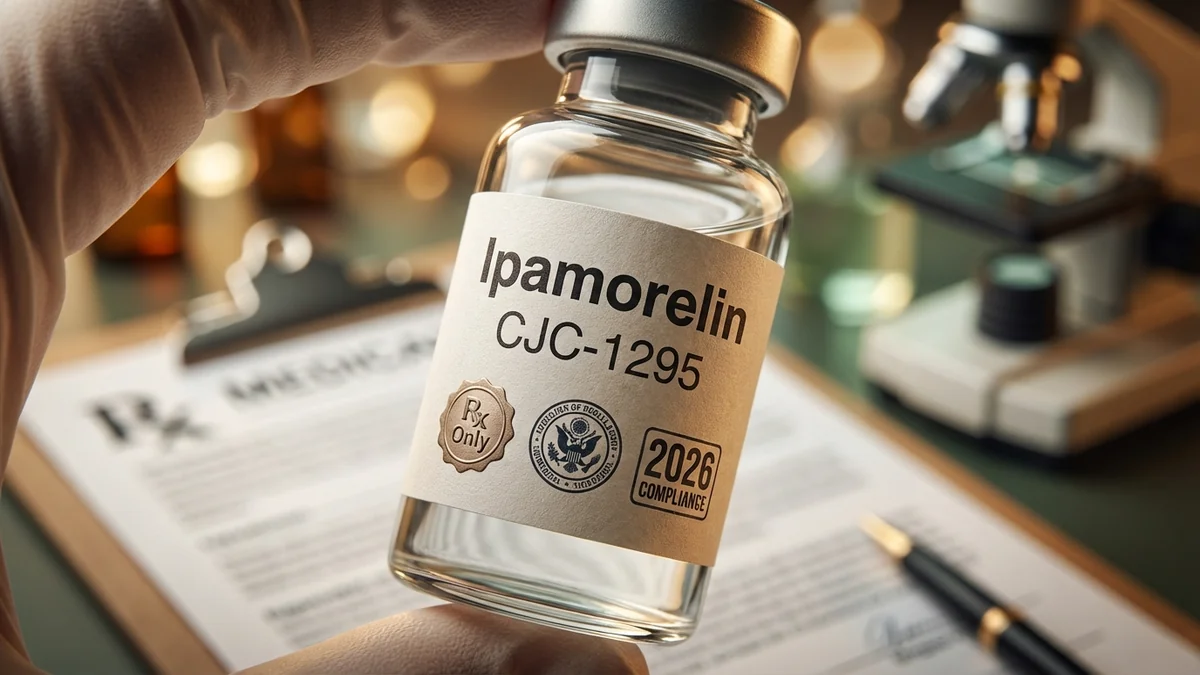
Ipamorelin is a five-amino-acid synthetic peptide that tells your pituitary gland to release growth hormone — and it does it more selectively than almost anything else in its class. That selectivity is the whole point. Older growth hormone secretagogues like GHRP-6 and GHRP-2 work, but they also drag cortisol and prolactin up with them. Ipamorelin doesn't. You get the GH pulse without the hormonal noise.
It was developed in the late 1990s by Novo Nordisk and studied in human volunteers as early as 1999.[1] The pharmacokinetic data from those early trials confirmed what animal studies suggested: ipamorelin produces a sharp, dose-dependent GH spike with a relatively clean side effect profile.[1] That profile is why it became one of the more widely used peptides in hormone optimization clinics over the past decade.
It's not FDA approved. It's used in the US primarily as a research compound, and in some clinical settings through compounding pharmacies. If you're considering it, that regulatory reality matters — and it's covered in detail below.
Key Takeaways
Ipamorelin is a selective GH secretagogue that stimulates pulsatile growth hormone release without significantly raising cortisol or prolactin — a key advantage over older peptides in its class.
Human pharmacokinetic data from 1999 confirmed dose-dependent GH release in healthy volunteers, but large randomized controlled trials in humans are limited.
It has no FDA approval and no approved commercial product; US access is through licensed compounding pharmacies by prescription or research channels.
The most commonly reported side effects are transient headaches, mild flushing, and early water retention — serious adverse events are not well characterized in large human studies.
It's most often used in combination with a GHRH analog like CJC-1295, which amplifies the GH pulse through a complementary mechanism.
100–300 mcg per injection, 1–3x daily — dosing in humans has not been established; practitioner protocols are not documented in available clinical trial data
There are no large published randomized controlled trials establishing an official subcutaneous dose for ipamorelin in humans. The early human PK study by Raun et al. used intravenous administration to characterize the pharmacokinetics and pharmacodynamics of the compound in healthy volunteers.[1] Animal studies used subcutaneous doses ranging from 18 to 450 mcg/day in rats.[2] The subcutaneous ranges used in clinical practice are extrapolated from these data and from practitioner experience — not from Phase 3 trial results.
Not clinical trial dosing
The dose ranges below are not derived from large randomized clinical trials. They reflect practitioner consensus and community protocols. Dosing should be individualized and discussed with a licensed healthcare provider who works with peptide therapy.
The most commonly reported practitioner protocol is 100–300 mcg subcutaneously per injection, administered one to three times daily — though ipamorelin dosing in humans has not been established; practitioner protocols vary but lack peer-reviewed clinical evidence. When used for GH optimization, many clinicians time injections to align with the body's natural GH pulses — typically before bed and, if using a second dose, pre-workout or first thing in the morning on an empty stomach. The rationale is that GH release is blunted by elevated blood glucose, so injecting in a fasted state produces a more robust response.
Ipamorelin vs. GHRP-6: Key Differences at a Glance
Parameter
Ipamorelin
GHRP-6
Amino acids
5
6
GH release
Yes
Yes
Cortisol elevation
Minimal
Significant
Prolactin elevation
Minimal
Significant
Appetite stimulation
Mild
Pronounced
Selectivity
High
Lower
When ipamorelin is combined with a GHRH analog — most commonly CJC-1295 — the two peptides work on separate receptors and produce a synergistic GH pulse that's larger than either compound alone. This combination is one of the most frequently prescribed protocols in US peptide therapy clinics. The ipamorelin handles the ghrelin receptor side; CJC-1295 handles the GHRH receptor side. Together they hit both arms of the GH secretion pathway simultaneously.
~2 hrsestimated plasma half-life of ipamorelin based on pharmacokinetic modeling in human volunteers
What Makes Ipamorelin Different
The defining feature of ipamorelin is selectivity. That word gets thrown around loosely in peptide marketing, but here it has a precise meaning: ipamorelin stimulates GH release without triggering meaningful increases in cortisol or prolactin at therapeutic doses.[1] This was demonstrated in the original human PK/PD study and is the primary reason it displaced GHRP-6 and GHRP-2 in many clinical protocols.
Why selectivity matters clinically
GHRP-6 and GHRP-2 both raise cortisol alongside GH. Chronically elevated cortisol counteracts many of the benefits you're trying to get from GH optimization — it promotes muscle catabolism, impairs sleep quality, and increases fat storage. Ipamorelin's ability to produce a GH pulse without that cortisol spike makes it more suitable for longer-term use in anti-aging and body composition protocols.
The other distinguishing feature is its size. At just five amino acids, ipamorelin is one of the smallest functional GH secretagogues. That compact structure contributes to its receptor selectivity and its relatively short half-life, which produces a more physiological, pulsatile GH release pattern rather than a sustained supraphysiologic elevation.
How Does Ipamorelin Work?
Ipamorelin is a ghrelin mimetic — it binds to the same receptor that the hunger hormone ghrelin activates, called GHS-R1a (growth hormone secretagogue receptor type 1a). That receptor sits on somatotroph cells in the anterior pituitary gland. When ipamorelin binds to it, those cells release a pulse of growth hormone into circulation.
What happens next is the downstream cascade most people care about. The GH pulse travels to the liver, where it stimulates production of IGF-1 (insulin-like growth factor 1). IGF-1 is the primary mediator of GH's anabolic effects: it promotes muscle protein synthesis, supports bone density, influences fat metabolism, and plays a role in tissue repair. In rat models, ipamorelin produced dose-dependent increases in longitudinal bone growth rate and body weight at doses of 18–450 mcg/day subcutaneously over 15 days.[2] A separate study found that ipamorelin increased bone mineral content in adult female rats, comparable to effects seen with GHRP-6 and exogenous GH.[3]
The ghrelin receptor is also expressed in the hypothalamus, which is why ghrelin itself makes you hungry. Ipamorelin has some appetite-stimulating effect through this pathway, but it's milder than GHRP-6 — the compound's selectivity for the pituitary over the hypothalamus is part of what keeps the side effect profile cleaner.
Importantly, ipamorelin works within the body's existing feedback system. It amplifies a natural GH pulse rather than bypassing the axis entirely the way exogenous recombinant GH does. Somatostatin — the hormone that tells the pituitary to stop releasing GH — still functions normally. That built-in brake is one reason ipamorelin is considered lower-risk than exogenous GH from a regulatory and physiological standpoint, though this comparison hasn't been formally tested in long-term human trials.
What the Clinical Evidence Actually Shows
The honest answer is that the human evidence base for ipamorelin is thin. What exists is promising but limited.
The foundational human study is the 1999 pharmacokinetic-pharmacodynamic modeling study by Raun et al., published in Pharmaceutical Research.[1] It examined ipamorelin's PK and PD in healthy human volunteers, confirming dose-dependent GH release and establishing the compound's selectivity profile — specifically, that it did not meaningfully elevate cortisol or prolactin at the doses tested. This study is the bedrock of what we know about ipamorelin in humans, and it's worth being clear: it was a PK/PD study, not an efficacy trial. It told us the compound works mechanistically in humans. It didn't tell us whether it improves muscle mass, reduces body fat, or extends healthspan in a controlled clinical setting.
The animal data is more extensive. Ipamorelin produced dose-dependent longitudinal bone growth in adult female rats over 15 days of subcutaneous administration.[2] A subsequent study found that 28 days of ipamorelin at 0.5 mg/kg/day increased bone mineral content in young adult female rats, with effects comparable to GHRP-6 and exogenous GH.[3] These findings support the mechanistic plausibility of ipamorelin for bone and body composition applications, but rat studies don't translate directly to human outcomes.
In the context of hypogonadism management, a 2020 review in Translational Andrology and Urology discussed GH secretagogues — including ipamorelin — as a potential adjunctive therapy for body composition changes in hypogonadal males, noting that current clinical data remains limited.[4]
A 2026 review in The American Journal of Sports Medicine included ipamorelin among therapeutic peptides being marketed to patients for orthopaedic and sports medicine applications, highlighting the gap between patient demand and the available evidence base.[5]
What the Evidence Does Not Show
Long-term efficacy in humans — No published randomized controlled trial has tested ipamorelin's effect on body composition, muscle mass, fat loss, or aging-related outcomes in a human population over any meaningful duration.
Optimal dosing in humans — The subcutaneous dose ranges used in clinical practice are extrapolated from animal data and PK modeling, not from dose-finding trials in humans.
Cardiovascular safety — No long-term cardiovascular outcomes data exists. The class-level concern about GH excess and insulin resistance hasn't been formally evaluated for ipamorelin in humans.
Comparison to exogenous GH — There are no head-to-head trials comparing ipamorelin to recombinant human growth hormone on any clinical endpoint.
Effects in older or diseased populations — The human PK study used healthy volunteers. How ipamorelin behaves in older adults, people with metabolic disease, or those with pituitary dysfunction is not well characterized.
Side Effects — What to Actually Expect
Ipamorelin's selectivity profile means its side effect burden is generally lighter than older GHRPs, but that doesn't mean side-effect-free. Here's what the data and clinical experience actually suggest:
Early in treatment (first few weeks):
Transient headaches — reported shortly after injection in some users, likely related to the acute GH pulse and associated fluid shifts. Usually resolves within 30–60 minutes and tends to diminish after the first week or two.
Flushing or warmth — a brief sensation of warmth or flushing post-injection, again tied to the GH pulse. Mild and short-lived in most cases.
Mild water retention — GH promotes sodium and water retention. Some people notice puffy hands or slight facial puffiness in the first few weeks. This typically stabilizes as the body adjusts.
At stable dosing:
Appetite increase — ipamorelin has mild appetite-stimulating effects through the ghrelin receptor. Less pronounced than GHRP-6, but worth knowing if you're using it for fat loss protocols.
Injection site reactions — mild redness or tenderness at the injection site. Rotating sites (abdomen, thigh, lateral hip) keeps this manageable.
Rare but worth knowing:
Cortisol and prolactin elevation — the human PK study specifically found that ipamorelin did not significantly elevate cortisol or prolactin at the doses tested.[1] This is a meaningful distinction from GHRP-6 and GHRP-2, which do raise both.
GH excess effects at high doses — at supraphysiologic doses, any GH secretagogue can produce signs of GH excess: joint pain, carpal tunnel symptoms, insulin resistance. These are dose-dependent and not well characterized for ipamorelin specifically in humans.
If you develop significant joint pain, numbness in the hands, or notice meaningful changes in fasting glucose, those are signals to pause and check in with your prescribing provider — not wait for the next scheduled appointment.
Regulatory & Access Status
Regulatory status — March 2026
Ipamorelin is not FDA approved for any indication. It has no approved New Drug Application and no commercial pharmaceutical product on the US market. In the US, it exists in a legal gray area: it's available through licensed compounding pharmacies by prescription and is sold by research chemical vendors for non-human research use. It is not legal to market for human consumption without FDA approval.
The practical reality for most people reading this page: ipamorelin is accessible in the US if you have a prescription from a licensed provider who works with a compounding pharmacy. Many functional medicine and hormone optimization clinics prescribe it in this context. The compounding pharmacy route means the compound is prepared by a licensed 503A or 503B pharmacy under state and federal oversight — it's not the same as ordering from an overseas vendor.
The FDA has taken enforcement action against companies marketing unapproved peptide products for human use. Patients and providers should consult FDA.gov and the FDA's MedWatch program for current enforcement activity.
WADA (World Anti-Doping Agency) classification for ipamorelin: GH secretagogues are listed on the WADA Prohibited List under the category of peptide hormones and related substances. If you compete in any sport governed by WADA-compliant anti-doping rules, ipamorelin use would constitute a doping violation.
Sourcing & Safety
If you're accessing ipamorelin through a licensed compounding pharmacy with a valid prescription, the quality control framework is in place — the pharmacy is regulated and the product is prepared to pharmaceutical standards. That's the cleanest access route.
If you're sourcing from research chemical vendors — which many people do — quality varies enormously and the regulatory picture is murkier. Here's what to look for:
What to look for:
Third-party Certificate of Analysis (COA) — the COA should be from an independent analytical laboratory, not the vendor's own in-house testing. Look for the lab name, test date, and specific purity result.
HPLC purity report — high-performance liquid chromatography purity should be 98% or higher for a therapeutic-grade peptide. If the vendor can't provide this, that's a problem.
Mass spectrometry confirmation — confirms the compound is actually ipamorelin and not a structurally similar substitute. Some vendors include this; it's a meaningful quality indicator.
Lyophilized powder in sealed vials — proper storage and packaging. Pre-mixed solutions are a red flag.
Red flags:
No COA or "in-house testing only" — the most common marker of a low-quality vendor. In-house testing has no independent verification.
Pricing significantly below market — real peptide synthesis and independent testing cost money. Unusually cheap product usually means corners were cut somewhere.
Vague origin claims — "pharmaceutical grade" is a marketing term, not a regulatory classification in this context. Ask for the specific COA, not a label claim.
No clear storage or reconstitution guidance — lyophilized ipamorelin requires reconstitution with bacteriostatic water and refrigeration. Vendors who don't address this aren't operating like serious suppliers.
Do not source from overseas vendors without verifying COA documentation. Customs seizure risk aside, the purity and identity of the compound cannot be assumed.
FAQ
Does ipamorelin increase IGF-1?
Yes, indirectly. Ipamorelin stimulates GH release from the pituitary, and GH in turn triggers IGF-1 production primarily in the liver. In animal studies, ipamorelin produced dose-dependent increases in GH-related growth markers.[2] Human IGF-1 response data from controlled trials is limited, but the mechanism is well established.
How is ipamorelin different from sermorelin?
They work on different receptors. Sermorelin is a GHRH analog — it mimics growth hormone-releasing hormone and acts on the GHRH receptor. Ipamorelin mimics ghrelin and acts on the GHS-R1a receptor. Combining them (or combining ipamorelin with CJC-1295, another GHRH analog) hits both pathways simultaneously, which is why that combination is so common in clinical protocols.
Can women use ipamorelin?
The animal studies were conducted in female rats and showed clear GH-related effects.[2][3] There's no known sex-specific contraindication. In clinical practice, ipamorelin is used in both men and women in hormone optimization contexts. Women who are pregnant or breastfeeding should not use it — GH axis manipulation during pregnancy is not studied and carries unknown risk.
How long does it take to notice effects from ipamorelin?
Most people using ipamorelin for body composition or recovery report noticing changes in sleep quality first — usually within the first 2–4 weeks, since GH is predominantly secreted during slow-wave sleep and improved sleep architecture is an early marker of GH optimization. Changes in body composition typically take 8–12 weeks to become apparent. These timelines are based on practitioner experience, not controlled trial data.
Is ipamorelin the same as a growth hormone injection?
No. Exogenous recombinant human growth hormone (rhGH) bypasses the pituitary entirely and delivers GH directly into circulation at supraphysiologic levels. Ipamorelin stimulates the pituitary to release GH in a pulsatile, physiological pattern — the body's own feedback mechanisms (including somatostatin) remain active. This is a meaningful pharmacological difference, though whether it translates to a meaningfully different clinical risk profile in humans hasn't been formally tested.
Related Peptides & Comparisons
Ipamorelin is almost never the whole story — it's most commonly used alongside a GHRH analog. CJC-1295 is the most popular pairing, and for good reason: the two compounds hit complementary receptors and produce a GH pulse that's larger than either achieves alone. If you're reading about ipamorelin, the CJC-1295 + ipamorelin combination page is worth reading next.
For comparison within the GHRP class, GHRP-6 and GHRP-2 are the closest relatives. Both are more potent GH releasers than ipamorelin at equivalent doses, but both also raise cortisol and prolactin more significantly — which is why ipamorelin has largely replaced them in clinical use. Sermorelin operates through a different mechanism (GHRH receptor rather than ghrelin receptor) and is FDA-approved for a specific pediatric indication, giving it a cleaner regulatory status. For someone primarily interested in GH optimization through the most legally straightforward route, sermorelin is worth understanding as an alternative.
References
PubMed PMID: 9879640 — supporting ~2 hours
Raun K, et al. "Pharmacokinetic-pharmacodynamic modeling of ipamorelin, a growth hormone releasing peptide, in human volunteers." Pharmaceutical Research. 1999;16(8). PMID: 10496658
Svensson J, et al. "Ipamorelin, a new growth-hormone-releasing peptide, induces longitudinal bone growth in rats." Growth Hormone & IGF Research. 1999;9(2):106–113. PMID: 10373343
Svensson J, et al. "The GH secretagogues ipamorelin and GH-releasing peptide-6 increase bone mineral content in adult female rats." The Journal of Endocrinology. 2000;165(3):569–577. PMID: 10828840
Patel AS, et al. "Beyond the androgen receptor: the role of growth hormone secretagogues in the modern management of body composition in hypogonadal males." Translational Andrology and Urology. 2020;9(2):647–656. PMID: 32257855
[Author(s) not specified in provided abstract]. "Injectable Peptide Therapy: A Primer for Orthopaedic and Sports Medicine Physicians." The American Journal of Sports Medicine. 2026. PMID: 41476424
This content is for informational purposes only and does not constitute medical advice. Consult a licensed healthcare provider before starting any treatment.
Ipamorelin Dosage Calculator
This free peptide calculator shows the exact insulin-syringe units to draw for Ipamorelin. Enter your vial size, bacteriostatic water and target dose — it’s pre-loaded with common Ipamorelin reconstitution defaults, so you can adjust any field to match your own vial.
Preset: Ipamorelin
Vial and BAC water defaults are prefilled. Choose your dose below.
Save this calculation to your free tracker. Calculators stay anonymous — sign in only to save.
Dose reminders
Injection logging
Vial countdown
Where to Buy Ipamorelin Online (Legally, 2026)
Ipamorelin is not FDA-approved as a finished drug. The clinics listed below dispense Ipamorelin under individual physician prescriptions through licensed compounding pharmacies — not as a research-only product. Programs start around $199/month.
These are licensed US telehealth clinics that prescribe Ipamorelin for patient use. Some links are affiliate links; editorial selection is independent. See our affiliate disclosure.
Where to Buy Ipamorelin for Research
Research Use Only — not intended for human consumption
MyPeptideMatch.com does not provide medical advice. Always consult a qualified healthcare provider before starting any peptide therapy. Regulatory status may change.