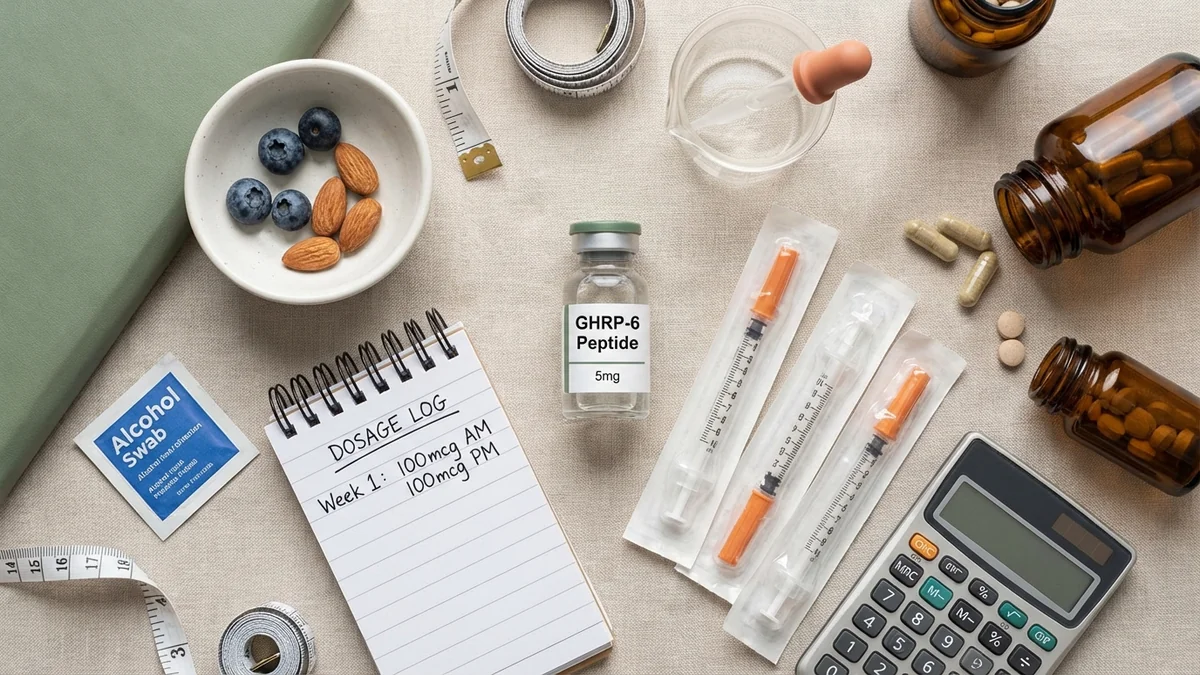
GHRP-6: Dosage, Benefits, FDA Status & Clinics (2026)
GHRP-6
Research
Growth Hormone Releasing Peptide
Growth Hormone ReleaseAppetite Stimulation
Last reviewed March 2026·MyPeptideMatch Team
What Is GHRP-6?
GHRP-6 is a six-amino-acid synthetic peptide that triggers your pituitary gland to release a pulse of growth hormone — and it does it through a receptor system that wasn't even understood when the peptide was first synthesized. That receptor, now called the ghrelin receptor (GHS-R1a), turned out to be the same one that the hunger hormone ghrelin binds to, which explains why GHRP-6's most noticeable side effect is a powerful appetite spike within 20–30 minutes of injection.
It's one of the oldest growth hormone secretagogues still actively studied. Researchers have used it as a diagnostic tool to test pituitary GH reserve, as a research probe to understand the ghrelin axis, and more recently as a starting point for novel therapeutic applications including organ protection and tissue repair. None of those applications are FDA-approved. GHRP-6 is a research compound, full stop.
If you're here because you're considering it for GH optimization, you need to understand both what the research actually shows and what it doesn't — because the gap between the two is significant.
Key Takeaways
GHRP-6 stimulates growth hormone release by binding ghrelin receptors (GHS-R1a) in the pituitary and hypothalamus — a dual-site mechanism that distinguishes it from GHRH analogs.
It has been used in clinical research since the 1990s to diagnose GH deficiency and study the ghrelin axis, but has no FDA-approved indication.
The appetite stimulation is real and pronounced — most people report strong hunger within 20–30 minutes of injection, which makes it distinct from other GH secretagogues.
Emerging research suggests tissue-protective and anti-inflammatory properties beyond GH release, including potential applications in acute kidney injury and organ protection — but this is early-stage animal and in-vitro work.
No randomized controlled trials have established a therapeutic dose, a proven clinical indication, or long-term safety data in humans.
Class
Growth Hormone Releasing Peptide (GHRP)
Amino Acids
6 (His-D-Trp-Ala-Trp-D-Phe-Lys-NH₂)
Molecular Target
GHS-R1a (ghrelin receptor)
FDA Status
Research only — no approved indication
Administration
Subcutaneous injection (research use); IV used in diagnostic studies
Typical Dose (Research)
0.1–1.0 mcg/kg IV in diagnostic protocols; 100–300 mcg subcutaneous reported in practitioner literature — dosing in humans is not established; animal and in vitro studies have been conducted, but no published human clinical dosing data are available to confirm specific dose ranges.
Half-life
Approximately 15–60 minutes — half-life not established in human clinical data; animal and in vitro pharmacokinetic studies suggest this range, but human values remain unverified
The short version: GHRP-6 mimics ghrelin well enough to activate the same receptor, and that receptor sits in two places that matter — the pituitary gland and the hypothalamus. Activating both simultaneously is what makes GHRP-6 particularly effective at driving GH pulses.
Here's what that looks like in practice. In the pituitary, GHS-R1a activation directly stimulates somatotroph cells to release stored growth hormone.[1] At the same time, the hypothalamic signal suppresses somatostatin (the hormone that puts the brakes on GH release) while amplifying GHRH output.[1] The result is a coordinated push-pull that produces a GH pulse larger than either pathway could generate alone. This is why GHRP-6 is often stacked with a GHRH analog like CJC-1295 in research protocols — the two mechanisms are additive, sometimes synergistic.
The ghrelin receptor connection also explains the appetite effect. GHS-R1a is expressed in the hypothalamic arcuate nucleus, the same region that regulates hunger signaling. When GHRP-6 binds there, it activates appetite circuits that were designed to respond to ghrelin — the hormone your stomach releases when you're hungry. That's not a side effect in the traditional sense; it's the receptor doing exactly what it's built to do. For someone trying to stimulate appetite in a catabolic state, that's potentially useful. For someone who isn't, it's a meaningful practical consideration.
Beyond the GH axis, research has identified GHS-R1a expression in peripheral tissues including the heart, kidney, and gut — which has opened a separate line of investigation into GHRP-6's direct cytoprotective effects. A 2025 study published in the Journal of Nanobiotechnology used a self-assembling GHRP-6 hydrogel to target renal tubular epithelial cells in acute kidney injury models, finding that GHRP-6 influenced metabolic reprogramming in a way that promoted renal recovery over fibrosis.[2] A 2006 study in Clinical Science demonstrated that GHRP-6 promoted cell migration and proliferation in intestinal epithelial models and showed protective effects in a rat model of multiple organ failure.[3] These findings are intriguing, but they are animal and in-vitro data — not human clinical evidence.
Typical Dosing — Practitioner & Community Ranges
There are no published randomized clinical trials establishing a therapeutic dose for GHRP-6. The ranges below reflect what has appeared in diagnostic research protocols and practitioner literature.
Not clinical dosing data
No randomized controlled trial has established an optimal therapeutic dose for GHRP-6 in humans. The figures below come from diagnostic research protocols and practitioner-reported ranges — not from controlled efficacy trials. Discuss any dosing with a licensed healthcare provider who has direct experience with this compound.
In published diagnostic research, intravenous doses of 0.1 to 1.0 mcg/kg have been used to assess pituitary GH reserve in children and adults with suspected GH deficiency.[4] These are single-dose diagnostic administrations, not therapeutic protocols.
Practitioner-reported subcutaneous dosing for research purposes typically falls between 100 mcg and 300 mcg per injection, administered two to three times daily — though GHRP-6 dosing in humans has not been established in published clinical literature; practitioner-reported dosing ranges are anecdotal and lack peer-reviewed clinical validation. The rationale for multiple daily injections is pharmacokinetic: GHRP-6's short half-life (estimated at 15–60 minutes — GHRP-6 dosing in humans has not been established in published clinical literature; practitioner-reported dosing ranges are anecdotal and lack peer-reviewed clinical validation) means a single injection produces a transient GH pulse rather than sustained elevation. Timing injections in a fasted state is commonly recommended in practitioner literature because elevated insulin blunts the GH response — though this is based on mechanistic reasoning and practitioner consensus, and GHRP-6 dosing in humans has not been established in published clinical literature; practitioner-reported dosing ranges are anecdotal and lack peer-reviewed clinical validation.
GHRP-6 vs. Related GH Secretagogues — At a Glance
Parameter
GHRP-6
GHRP-2
Ipamorelin
Receptor target
GHS-R1a
GHS-R1a
GHS-R1a
Amino acids
6
6
5
Appetite stimulation
Pronounced
Moderate
Minimal
Cortisol/prolactin spike
Moderate
Higher
Minimal
FDA status
Research only
Research only
Research only
Diagnostic use in humans
Yes — published
Yes — published
Limited — diagnostic use has been explored in published research but established clinical protocols are not available
Ipamorelin is often preferred in clinical research settings when appetite stimulation and cortisol elevation are undesirable — it's more selective for GH release with fewer off-target hormonal effects. GHRP-6's pronounced appetite effect makes it more relevant in contexts where caloric intake needs to increase, such as cachexia research.
What Makes GHRP-6 Different
Most GH-stimulating compounds work at one site. GHRP-6 works at two simultaneously — pituitary and hypothalamus — and does so through a receptor that the body already uses for hunger signaling. That dual action is part of why it became such a useful research tool: you can use it to interrogate the entire GH axis at once rather than just one node of it.[1]
Why researchers still use GHRP-6 for GH axis diagnosis
A 1996 study in the Journal of Pediatric Endocrinology & Metabolism evaluated GHRP-6 as a diagnostic test for GH deficiency in short-statured children and adults. Because GHRP-6 acts directly at the somatotroph (the pituitary cell that makes GH), it can distinguish between pituitary-level GH deficiency and hypothalamic-level dysfunction — something that GHRH-only tests can miss. GH responses to GHRP-6 were lower in confirmed GH-deficient patients than in normal subjects, supporting its utility as a diagnostic probe.[4]
The other thing that makes GHRP-6 genuinely interesting right now is the emerging work on its GH-independent effects. The 2025 hydrogel study is a good example: the researchers weren't primarily trying to raise GH levels — they were using GHRP-6's direct binding to peripheral GHS-R1a receptors to influence how kidney cells respond to injury.[2] That's a different therapeutic hypothesis entirely, and it's one that a few research groups are actively pursuing. Whether it translates to human therapy is unknown. But it suggests GHRP-6's pharmacology is richer than the "GH releaser" label implies.
What the Clinical Evidence Actually Shows
The honest summary: GHRP-6 has solid mechanistic evidence, decades of research use, and a clear pharmacological profile. What it doesn't have is any randomized controlled trial demonstrating clinical benefit for a specific therapeutic indication.
The 1996 diagnostic study demonstrated that IV GHRP-6 reliably stimulates GH release in both healthy subjects and those with GH deficiency, with the magnitude of response correlating with pituitary reserve.[4] The 1998 review in Cellular and Molecular Life Sciences synthesized the early mechanistic evidence, concluding that GHRPs act through a "unique dual and complementary action on the hypothalamus and pituitary" and proposed that GHRP may reflect the activity of an endogenous hypothalamic hormone not yet isolated at that time — which turned out to be ghrelin, discovered in 1999.[1]
The 2006 Clinical Science study moved beyond GH secretion entirely, showing that GHRP-6 promoted intestinal epithelial cell migration and proliferation in vitro and reduced liver and gut injury in a rat model of multiple organ failure.[3] The 2025 hydrogel study extended this into kidney injury, demonstrating that a GHRP-6 delivery system could modulate metabolic reprogramming in renal tubular cells to favor recovery over fibrosis in animal models.[2] These are genuinely interesting findings — but they are preclinical data.
What We Don't Know Yet
Therapeutic efficacy in humans — No RCT has tested GHRP-6 against a placebo for any clinical endpoint: body composition, GH deficiency treatment, muscle preservation, or organ protection. The mechanistic data is compelling; the clinical proof isn't there yet.
Optimal dosing and frequency — Published human data comes from single-dose diagnostic protocols. How to dose GHRP-6 for sustained GH optimization, if that's even achievable, has not been formally studied.
Long-term safety — Most human studies are short-term or single-dose. The effects of chronic GHRP-6 use on GH axis regulation, insulin sensitivity, cortisol, and prolactin over months or years are not established.
Receptor desensitization — GHS-R1a can downregulate with repeated stimulation[5]. Whether this is clinically meaningful at typical research doses, and how to mitigate it, is not well characterized in humans.
GH-independent tissue effects — The organ-protective findings from animal studies are intriguing but have not been replicated in human trials. The mechanism may not translate directly.
Side Effects — What to Actually Expect
GHRP-6's side effect profile is largely a function of what its receptor does when activated. These aren't unpredictable reactions — they're the expected downstream consequences of hitting GHS-R1a.
Consistent across most users:
Appetite increase — This is the most predictable effect and often the most disruptive. Most people report intense hunger within 20–30 minutes of injection, lasting 1–2 hours. It's not subtle. If you're not prepared to eat, the timing becomes a practical problem.
Water retention — GH elevation promotes sodium and water retention. Mild puffiness, particularly in the hands and face, is commonly reported, especially early in use — though effects in humans are not established; adverse event profiles are not documented in published clinical literature.
Hormonal effects:
Cortisol and prolactin elevation — GHRP-6 stimulates a transient rise in both cortisol and prolactin alongside GH.[1] The magnitude is dose-dependent. At typical research doses this is generally transient, but it's a meaningful distinction from more selective GH secretagogues like ipamorelin, which produce minimal cortisol or prolactin response.
Transient hypoglycemia — GH elevation theoretically could influence blood glucose metabolism, but transient hypoglycemia has not been established in human studies of GHRP-6, particularly in fasted states.
Injection-related:
Injection site reactions — Redness, mild swelling, or stinging at the injection site are reported. Rotating sites reduces this.
Flushing or tingling — Some users report brief warmth or tingling shortly after injection, likely related to the rapid hormonal response.
Rare or uncertain:IGF-1 elevation — Chronic GH stimulation raises IGF-1 (insulin-like growth factor 1), and sustained IGF-1 elevation carries theoretical long-term risks including effects on cell proliferation. This concern applies to all GH secretagogues and is not unique to GHRP-6, but long-term human data is absent[6].
If you're using GHRP-6 in a research context and notice joint pain, significant edema, or signs of carpal tunnel syndrome — all associated with GH excess — that's worth flagging with your supervising provider immediately. Persistent appetite dysregulation or unexpected changes in fasting glucose also warrant attention.
Regulatory & Access Status
Access status — March 2026
GHRP-6 has no FDA-approved indication and is classified as a research compound. It is not available through licensed US compounding pharmacies for clinical use and cannot be legally prescribed by a physician for therapeutic purposes. Access in the United States is limited to research settings. Purchasing GHRP-6 from gray-market research chemical vendors exists in a legal gray area and carries quality, purity, and legal risks.
GHRP-6 sits in the same ambiguous regulatory space as most unapproved research peptides in the US. It's not a scheduled controlled substance, but it also has no approved pathway to clinical use. The FDA has taken enforcement action against companies marketing unapproved peptide products for human use. Patients and providers should consult FDA.gov and the FDA's MedWatch program for current enforcement activity.
For anyone interested in GH optimization through legal, prescribable channels, sermorelin is the compound worth understanding first — it's a GHRH analog with a cleaner regulatory history and more established clinical use than GHRP-6.
Sourcing & Safety
If you're accessing GHRP-6 through research chemical vendors, the quality control picture is uneven. Peptide synthesis is technically demanding, and the gray market has no enforcement mechanism ensuring purity or accurate concentration labeling.
What to look for:
Third-party Certificate of Analysis (COA) — Should come from an independent analytical lab, not the vendor's own testing. Look for HPLC (high-performance liquid chromatography) purity data showing ≥98% purity and mass spectrometry confirmation of the correct molecular weight.
Accurate concentration labeling — Underdosing and overdosing are both common in gray-market peptides. A COA with quantified concentration (not just purity percentage) is a meaningful quality signal.
Lyophilized powder, not pre-mixed solutions — Peptides in solution degrade faster and are more vulnerable to contamination. Lyophilized (freeze-dried) powder with bacteriostatic water for reconstitution is the standard for quality research peptides.
Red flags:
No COA or in-house testing only — If the vendor can't provide an independent lab report, there's no meaningful quality assurance.
Pricing significantly below market — Proper synthesis and independent testing cost money. Unusually cheap peptides are usually a sign of lower purity, inaccurate labeling, or substituted compounds.
Pre-mixed liquid formulations shipped at room temperature — Peptides in solution require cold chain handling. Anything arriving warm in liquid form is a quality concern.
FAQ
How is GHRP-6 different from just taking HGH directly?
Exogenous human growth hormone (HGH) bypasses the pituitary entirely and delivers a continuous, non-pulsatile GH signal. GHRP-6 stimulates your own pituitary to release GH in pulses, which more closely mimics the natural rhythm of GH secretion. The tradeoff is that GHRP-6's effect depends on your pituitary having functional GH reserve — if it doesn't, the response will be blunted. Neither approach is without risk, and exogenous HGH carries its own distinct regulatory and safety profile.
Does GHRP-6 need to be stacked with a GHRH analog?
It works alone, but the GH response is amplified when combined with a GHRH analog like CJC-1295 or modified GRF(1-29).[1] The two mechanisms are complementary: GHRP-6 removes the somatostatin brake and activates the ghrelin receptor, while GHRH directly stimulates GH synthesis and release. In research settings, the combination consistently produces a larger GH pulse than either compound alone. Whether that translates to meaningfully better outcomes for any specific goal hasn't been tested in controlled trials.
Can GHRP-6 be used to diagnose growth hormone deficiency?
Yes — this is actually one of its documented uses in published research. IV administration of GHRP-6 has been used to assess pituitary GH reserve in children and adults with suspected GH deficiency, with lower GH responses indicating pituitary-level insufficiency.[4] This is a research and diagnostic application, not a standard clinical test in the US.
Why does GHRP-6 cause such strong hunger?
Because it binds the same receptor — GHS-R1a — that the hunger hormone ghrelin uses. Ghrelin is released by your stomach when you're in a caloric deficit, and its hypothalamic effects include driving appetite. GHRP-6 activates those same circuits. The appetite effect isn't dose-dependent in a simple linear way; even relatively modest doses produce noticeable hunger in most people. This makes GHRP-6 potentially useful in cachexia or appetite-suppressed states, and a practical inconvenience in most other contexts.
Is GHRP-6 the same as ghrelin?
No. GHRP-6 is a synthetic hexapeptide that binds the ghrelin receptor (GHS-R1a) but has a completely different amino acid sequence from ghrelin itself, which is a 28-amino-acid peptide produced primarily in the stomach. GHRP-6 was synthesized before ghrelin was discovered — the finding that they share a receptor was what ultimately led researchers to identify ghrelin as the endogenous ligand for GHS-R1a.[1]
Related Peptides & Comparisons
If you're researching GHRP-6 for GH optimization, the most relevant comparisons are ipamorelin and GHRP-2. Ipamorelin is the most selective of the three — it produces a clean GH pulse with minimal cortisol or prolactin elevation, which makes it the preferred option in most clinical research protocols where those hormonal side effects are a concern. GHRP-2 sits between the two: stronger GH release than ipamorelin, but a more pronounced cortisol and prolactin spike than GHRP-6 at equivalent doses. GHRP-6's distinguishing feature remains its appetite stimulation — if that's therapeutically relevant to your situation, it's worth understanding specifically.
For the GHRH side of the equation, sermorelin is the only GHRH analog with any established clinical history in the US and a cleaner regulatory pathway. CJC-1295 is the most commonly paired GHRH analog in research protocols. See our GHRP-6 vs. ipamorelin comparison for a deeper look at how these two stack up for GH secretagogue use.
References
PubMed PMID: 9186261, 14572879, 16417467, 23099431, 8950613 — supporting This concern applies to all GH secretagogues and is not unique to GHRP-6, but long-term human data is absent
PubMed PMID: PMID:14572879 — supporting - Receptor desensitization — GHS-R1a can downregulate with repeated stimulation
Bowers CY. "Growth hormone-releasing peptide (GHRP)." Cellular and Molecular Life Sciences: CMLS. 1998;54(12):1316–1329. PMID: 9893708
[Author(s) not listed in provided abstract.] "Growth hormone-releasing peptide 6 (GHRP-6) hydrogel for acute kidney injury therapy via metabolic regulation." Journal of Nanobiotechnology. 2025. PMID: 41327290
Granado M, et al. "Use of growth-hormone-releasing peptide-6 (GHRP-6) for the prevention of multiple organ failure." Clinical Science (London). 2006. PMID: 16417467
[Author(s) not listed in provided abstract.] "Growth hormone releasing hexapeptide-6 (GHRP-6) test in the diagnosis of GH-deficiency." Journal of Pediatric Endocrinology & Metabolism: JPEM. 1996. PMID: 8887178
This content is for informational purposes only and does not constitute medical advice. Consult a licensed healthcare provider before starting any treatment.
Where to Buy GHRP-6 for Research
Research Use Only — not intended for human consumption
MyPeptideMatch.com does not provide medical advice. Always consult a qualified healthcare provider before starting any peptide therapy. Regulatory status may change.