Tesamorelin is one of the few therapeutic peptides that's actually FDA-approved — and that distinction matters enormously. While most peptides in this space exist in a gray zone of compounding pharmacy access or research-only status, tesamorelin earned a genuine approval in November 2010 for a specific, well-documented problem: the accumulation of excess visceral abdominal fat in HIV-positive patients with lipodystrophy.[1]
It's a synthetic analog of growth hormone-releasing hormone (GHRH) — the signal your hypothalamus sends to your pituitary gland when it wants more growth hormone produced. Tesamorelin mimics that signal, prompting your pituitary to release GH in a pulse pattern that's much closer to natural physiology than direct GH injections. That mechanism is why it's attracted interest well beyond its approved indication.
Sold under the brand names EGRIFTA SV and EGRIFTA, it's prescribed by HIV specialists and, increasingly, discussed in the context of broader metabolic and body composition optimization. What the evidence actually supports — and where it runs out — is worth understanding clearly before you read anything else on this page.
Key Takeaways
Tesamorelin is FDA-approved (EGRIFTA SV / EGRIFTA) specifically for reducing excess abdominal fat in HIV-positive adults with lipodystrophy — one of very few peptides with a real FDA indication.
It works by stimulating your own pituitary gland to release growth hormone, rather than replacing GH directly — which preserves the natural pulsatile pattern of GH secretion.
Phase 3 clinical trials showed meaningful reductions in visceral adipose tissue (VAT) in HIV lipodystrophy patients; off-label use for visceral fat in non-HIV populations exists but has limited published evidence.
Common side effects include injection site reactions, joint pain, and fluid retention; glucose monitoring is warranted during use.
It's available by prescription in the US; off-label prescribing occurs but is not FDA-sanctioned.
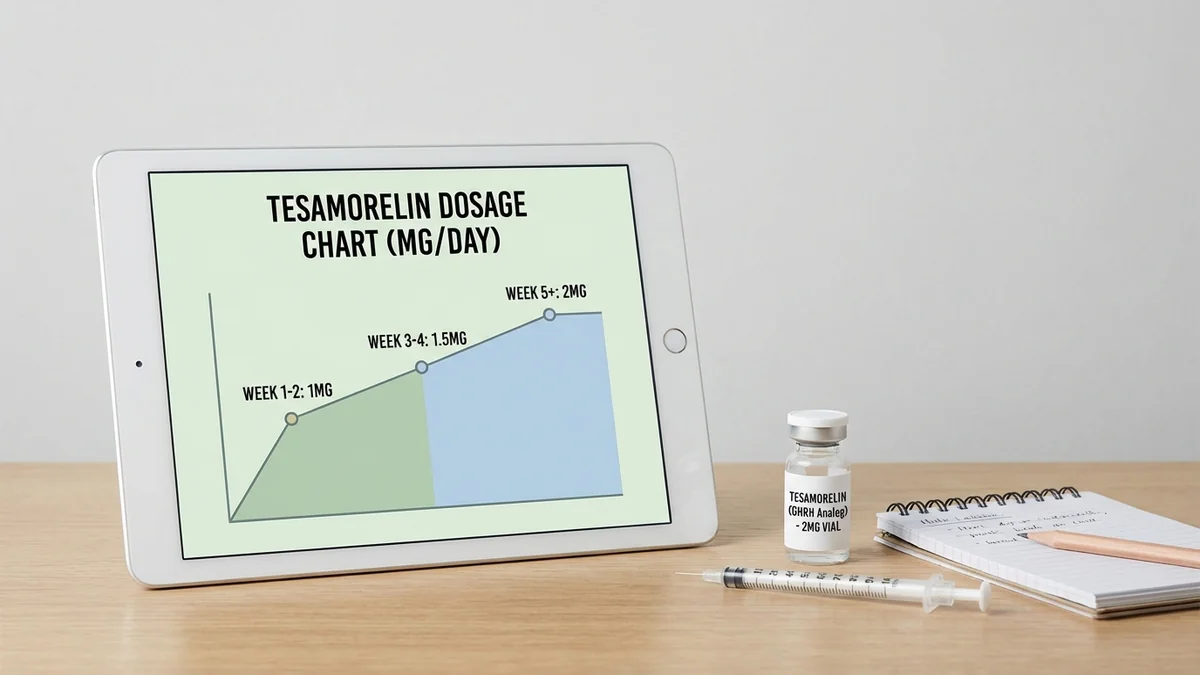
The approved dose is 2 mg subcutaneously once daily.[2] That's not a range — that's the dose studied in the Phase 3 trials that earned FDA approval, and it's what the prescribing information specifies. There's no established escalation protocol the way you'd see with GLP-1 agonists; patients start at 2 mg and stay there.
2 mg/dayFDA-approved tesamorelin dose — subcutaneous injection, once daily, for HIV-associated lipodystrophy
Injections are given subcutaneously into the abdomen. Rotating injection sites within the abdominal area reduces the risk of localized lipohypertrophy or skin changes. Unlike some peptides that require refrigeration and complex reconstitution, EGRIFTA SV is a ready-to-use formulation — a practical improvement over the original lyophilized powder that required mixing before each injection.
Timing relative to meals doesn't appear to significantly affect efficacy based on available data, but most protocols suggest morning administration to align with the body's natural GH secretion pattern — though the optimal timing relative to meals hasn't been established in clinical trials, and clinical data supporting this specific timing strategy are limited.
In the Phase 3 trials, treatment was evaluated at 26 and 52 weeks. Patients who responded and continued treatment maintained their VAT reductions; those who discontinued saw fat return over time — which has real implications for how long someone needs to stay on it.[3]
Off-label use in non-HIV populations has been explored at similar doses (approximately 1.4–2 mg/day subcutaneous), but evidence in these populations remains limited to small trials and case reports rather than large randomized controlled trials.
What Makes Tesamorelin Different
Most peptides that stimulate growth hormone do so through the ghrelin receptor — that's the GHRP family (GHRP-2, GHRP-6, ipamorelin). Tesamorelin works through an entirely different pathway: the GHRH receptor. These two systems are complementary in physiology, which is why some practitioners combine them, but tesamorelin's GHRH-receptor specificity means it drives GH release through the same upstream signal your hypothalamus uses naturally.
The practical consequence of that mechanism is selectivity. Tesamorelin produces a GH pulse that's physiologically patterned — not a sustained elevation, but a pulse followed by normal suppression. That matters because sustained GH elevation is what drives side effects like insulin resistance and acromegalic changes. A pulsatile pattern is gentler on glucose metabolism, which is one reason tesamorelin's metabolic side effect profile looks more manageable than direct GH therapy.
Why the HIV lipodystrophy indication is clinically meaningful
HIV-associated lipodystrophy is a specific metabolic syndrome — characterized by accumulation of visceral abdominal fat, loss of peripheral fat, and dyslipidemia — that affects a significant portion of people on antiretroviral therapy. Before tesamorelin, there was no approved pharmacological treatment for the visceral fat component. That's the gap it was designed to fill, and the Phase 3 data confirmed it could fill it.
The other thing that makes tesamorelin unusual in the peptide space: it's been studied with the rigor of a pharmaceutical drug. Phase 3 randomized controlled trials, peer-reviewed publications, FDA review — not just animal data and forum reports. That doesn't mean it's right for every use case, but it does mean the evidence base is real.
How Does Tesamorelin Work?
Your hypothalamus releases GHRH in pulses throughout the day — most prominently during deep sleep — which signals the pituitary gland to secrete growth hormone. GH then travels to the liver and other tissues, triggering the production of IGF-1 (insulin-like growth factor 1). IGF-1 is the primary downstream driver of GH's effects on body composition: it promotes lipolysis (fat breakdown) and lean mass preservation.
Tesamorelin is a stabilized synthetic version of the 44-amino acid GHRH peptide. The natural GHRH molecule degrades rapidly in plasma — its half-life is only a few minutes — which makes it impractical as a therapeutic. Tesamorelin addresses this by adding a trans-3-hexenoic acid group to the N-terminus of the peptide, which protects it from dipeptidyl peptidase IV (DPP-IV) degradation and extends its functional duration.[3]
When you inject tesamorelin subcutaneously, it binds to GHRH receptors on somatotroph cells in the anterior pituitary. Those cells respond by synthesizing and releasing GH. The GH pulse then drives IGF-1 production, and elevated IGF-1 levels are what produce the visceral fat reduction seen in trials.
Critically, tesamorelin doesn't bypass the pituitary's feedback mechanisms. If IGF-1 levels rise too high, the pituitary responds by reducing GH output — the same negative feedback loop that operates normally. This self-regulating quality is part of why its side effect profile differs from exogenous GH administration, where you're overriding that feedback entirely.
What the Clinical Evidence Actually Shows
The foundational evidence comes from two Phase 3 randomized, placebo-controlled trials that supported the 2010 FDA approval. Both enrolled HIV-positive adults with lipodystrophy and measurable visceral fat accumulation, and both used 2 mg/day subcutaneous tesamorelin over 26 weeks.[2]
Across these trials, tesamorelin produced statistically significant reductions in visceral adipose tissue measured by CT scan. The VAT reduction was clinically meaningful — not just a marginal statistical signal — and was accompanied by improvements in the waist-to-hip ratio and patient-reported body image outcomes.[3]
A 2024 study published in AIDS examined tesamorelin's efficacy specifically in people with HIV who are on integrase inhibitor (INSTI)-based regimens — the current standard of care for most HIV patients, since the original Phase 3 trials predate INSTIs' dominance.[4] That's an important gap to fill, because antiretroviral regimens affect metabolic parameters, and a drug tested on older regimens might perform differently in today's patients. The 2024 data supported tesamorelin's continued efficacy in this updated treatment context.[4]
What the trials also showed: the VAT reduction is not permanent. Patients who discontinued tesamorelin after 26 weeks saw visceral fat return toward baseline over the following months.[3] This isn't a drug you take for a cycle and then stop — maintaining the benefit requires ongoing treatment, which has real implications for cost, access, and long-term safety monitoring.
Triglyceride levels and some lipid parameters improved in treated patients alongside VAT reduction, which matters because HIV lipodystrophy carries elevated cardiovascular risk.[3] Whether those lipid improvements translate to hard cardiovascular outcomes hasn't been established in a dedicated outcomes trial.
What We Don't Know Yet
Non-HIV populations — The entire clinical trial dataset is in HIV-positive adults with lipodystrophy. Off-label use in otherwise healthy people with visceral obesity has no comparable RCT evidence.
Long-term safety beyond 52 weeks — Phase 3 trials ran to 52 weeks. We don't have systematic data on what happens at 3, 5, or 10 years of continuous use.
Cardiovascular outcomes — Lipid improvements are encouraging, but no dedicated cardiovascular outcomes trial exists for tesamorelin. The link between VAT reduction and hard CV events in this population remains inferential.
Malignancy risk — GH and IGF-1 stimulation raises theoretical concerns about tumor promotion. This is a class-level concern for all GH-axis therapies; no tesamorelin-specific malignancy signal has been established, but the absence of long-term data means this can't be fully ruled out.
Combination with antiretrovirals beyond INSTIs — The 2024 INSTI study is reassuring, but HIV treatment continues to evolve and future regimen interactions haven't been characterized.
Side Effects — What to Actually Expect
Tesamorelin's side effect profile reflects its mechanism: you're raising GH and IGF-1, and the consequences of that elevation — however physiologically patterned — are what drive most adverse effects.
During initial treatment:
Injection site reactions — Redness, swelling, or discomfort at the injection site are the most commonly reported issues. Rotating sites within the abdomen reduces this considerably.
Fluid retention (edema) — Peripheral edema, particularly in the legs and hands, occurs in some patients. This is a GH-class effect; it typically improves as the body adjusts.
Joint and muscle pain — Arthralgias and myalgias are reported, again consistent with GH-axis stimulation. Usually mild to moderate.[3]
At stable dose:
Glucose intolerance — Elevated GH levels can reduce insulin sensitivity. Patients with pre-existing glucose dysregulation need monitoring. This is the most clinically significant metabolic concern.
Elevated IGF-1 — Expected and measurable; the question is whether levels stay within a reasonable range. Periodic IGF-1 monitoring is standard practice.
Paresthesias — Tingling or numbness, particularly in the hands, has been reported. Consistent with fluid retention and carpal tunnel-like effects seen with GH elevation.
Rare but worth knowing:
Hypersensitivity reactions — Allergic reactions including rash and urticaria have been reported. Anaphylaxis is rare but possible.
Tumor stimulation concern — Tesamorelin is contraindicated in patients with active malignancy, pituitary tumors, or any condition where GH stimulation would be harmful. This is not a theoretical concern to dismiss — it's in the prescribing information for a reason.
If you develop significant edema, new joint pain that's worsening over weeks, or any signs of glucose dysregulation (increased thirst, frequent urination, fatigue), that's worth a conversation with your prescriber — not something to wait out.
Regulatory & Access Status
FDA-approved prescription medication
Tesamorelin is FDA-approved under the brand names EGRIFTA SV and EGRIFTA for the reduction of excess abdominal fat in HIV-infected adult patients with lipodystrophy. It requires a valid prescription from a licensed US healthcare provider. The approved indication is specific — it does not cover general visceral fat reduction or body composition optimization in non-HIV patients.
The approval pathway matters here. Tesamorelin went through full Phase 3 clinical trials and FDA review before reaching the market — it's not a compounded peptide or a research chemical. That means it's manufactured to pharmaceutical standards, has an established prescribing information document, and is dispensed through licensed pharmacies.
Off-label prescribing by physicians is legal in the US. Clinicians in the hormone optimization and longevity space do prescribe tesamorelin off-label for visceral fat reduction in non-HIV patients, typically at the same 2 mg/day dose used in trials. This practice is not FDA-sanctioned, and insurance coverage for off-label use is essentially nonexistent — meaning patients pay out of pocket, and costs can be substantial.
Compounded versions of tesamorelin have circulated in the peptide therapy market. The FDA's position on compounding GHRH analogs has tightened in recent years, and patients sourcing compounded tesamorelin should verify that their compounding pharmacy is operating within current FDA guidance. The brand-name product from Theratechnologies remains the only FDA-approved formulation.
No — they're both GHRH analogs, but they're different peptides. Sermorelin is a 29-amino acid fragment of GHRH; tesamorelin is a full 44-amino acid GHRH analog with a chemical modification that extends its stability. Tesamorelin has FDA approval for a specific indication and a full Phase 3 evidence base. Sermorelin is available through compounding pharmacies but has no current FDA-approved indication.
How long does it take to see results with tesamorelin?
In the Phase 3 trials, statistically significant VAT reductions were measurable at 26 weeks.[3] Most patients don't notice dramatic changes in the first few weeks — this isn't a drug with a fast visible effect. The meaningful body composition changes accumulate over months of consistent use.
What happens when you stop taking tesamorelin?
Visceral fat returns. The Phase 3 data showed that patients who discontinued after 26 weeks saw their VAT levels trend back toward baseline over the following months.[3] This isn't a permanent fix — it requires ongoing use to maintain the effect, which is a meaningful consideration for anyone evaluating whether this treatment makes sense for their situation.
Can tesamorelin raise IGF-1 to unsafe levels?
Tesamorelin raises IGF-1 as part of its mechanism — that's expected. In clinical trials, IGF-1 levels increased but generally remained within or near the normal physiological range for most patients.[3] Monitoring IGF-1 periodically during treatment is standard practice to confirm levels aren't exceeding the upper range of normal. Your prescriber should be ordering these labs.
Does tesamorelin affect blood sugar?
It can. Elevated GH reduces insulin sensitivity, and glucose dysregulation is a documented concern with tesamorelin use.[3] Patients with pre-existing type 2 diabetes or impaired fasting glucose need closer monitoring. This doesn't mean tesamorelin is off the table for people with metabolic concerns, but it does mean glucose management needs to be part of the conversation with your prescriber before starting.
Related Peptides & Comparisons
If tesamorelin's mechanism interests you — stimulating your own GH rather than replacing it — the natural comparisons are sermorelin and CJC-1295, both of which are also GHRH analogs available through compounding pharmacies. Sermorelin has the longest track record in clinical use; CJC-1295 is often combined with ipamorelin for a synergistic GH pulse. Neither has the Phase 3 evidence base or FDA approval that tesamorelin carries.
On the GHRP side, ipamorelin works through the ghrelin receptor rather than the GHRH receptor — a complementary mechanism that some practitioners combine with GHRH analogs to amplify GH release. MK-677 (ibutamoren) is an oral GH secretagogue that also works through the ghrelin pathway and produces sustained GH elevation rather than pulsatile release.
GHRH Analogs: How Tesamorelin Compares
Parameter
Tesamorelin
Sermorelin
CJC-1295
FDA Status
Approved (HIV lipodystrophy)
No current approval
No approval
Mechanism
GHRH receptor agonist
GHRH receptor agonist
GHRH receptor agonist
Amino acids
44 (modified)
29
30 (modified)
Dosing
2 mg/day SubQ
0.2–0.3 mg/day SubQ
1.4 mg subcutaneous injection once daily (FDA-approved); alternative dosing of 1 mg or 2 mg daily has been studied
Freda PU. "Tesamorelin." Nature Reviews Drug Discovery. 2011;10(2):95-96. PMID: 21283099
Stanley TL, Grinspoon SK. "Effects of growth hormone-releasing hormone on visceral fat, metabolic, and cardiovascular indices in human studies." Drugs. 2011;71(11):1479-1501. PMID: 21668043
Khatib MN, et al. "Tesamorelin: a growth hormone-releasing factor analogue for HIV-associated lipodystrophy." The Annals of Pharmacotherapy. 2012;46(2):240-247. PMID: 22298602
Mallon P, et al. "Efficacy and safety of tesamorelin in people with HIV on integrase inhibitors." AIDS. 2024. PMID: 38905488
Familiari A, et al. "Injectable Peptide Therapy: A Primer for Orthopaedic and Sports Medicine Physicians." The American Journal of Sports Medicine. 2026. PMID: 41476424
This content is for informational purposes only and does not constitute medical advice. Consult a licensed healthcare provider before starting any treatment.
Tesamorelin Dosage Calculator
This free peptide calculator shows the exact insulin-syringe units to draw for Tesamorelin. Enter your vial size, bacteriostatic water and target dose — it’s pre-loaded with common Tesamorelin reconstitution defaults, so you can adjust any field to match your own vial.
Preset: Tesamorelin
Vial and BAC water defaults are prefilled. Choose your dose below.
Save this calculation to your free tracker. Calculators stay anonymous — sign in only to save.
Dose reminders
Injection logging
Vial countdown
Where to Buy Tesamorelin Online (Legally, 2026)
Looking to buy Tesamorelin online? Because Tesamorelin is FDA-approved, licensed US telehealth clinics can prescribe and ship it after a clinical consultation. We've vetted 2 options that operate transparently in 2026 — see real customer ratings and pricing below. Programs start around $139/month.
These are licensed US telehealth clinics that prescribe Tesamorelin for patient use. Some links are affiliate links; editorial selection is independent. See our affiliate disclosure.
Where to Buy Tesamorelin for Research
Research Use Only — not intended for human consumption
MyPeptideMatch.com does not provide medical advice. Always consult a qualified healthcare provider before starting any peptide therapy. Regulatory status may change.