Tesamorelin Dosage Guide: How Much Should You Take? (2026)
Key Takeaways
- Standard Tesamorelin dosage ranges from 1-2 mg administered subcutaneously once daily, typically in the evening
- The peptide has a half-life of approximately 26-38 minutes with subcutaneous bioavailability of 4-7%[1]
- Most clinical protocols use 12-26 week cycles with gradual dose escalation starting at 1 mg daily
- Tesamorelin is FDA-approved as EGRIFTA SV and EGRIFTA WR for reducing excess abdominal fat in adults with HIV-associated lipodystrophy; every other use discussed here is off-label
- Administration requires 29-31 gauge insulin syringes with injection site rotation between abdomen, thigh, and upper arm
- Clinical evidence shows peak growth hormone response occurs 30-60 minutes post-injection with effects lasting 2-4 hours[2]
- Medical supervision is essential due to the peptide's potent effects on growth hormone axis and potential contraindications
How Tesamorelin Works in the Body
Tesamorelin functions as a synthetic analog of growth hormone-releasing hormone (GHRH) with enhanced stability through the addition of trans-3-hexenoic acid at the N-terminus.[1] The peptide binds specifically to GHRH receptors in the anterior pituitary gland, stimulating endogenous growth hormone (GH) secretion through cyclic adenosine monophosphate (cAMP) signaling pathways. This mechanism preserves the natural pulsatile pattern of GH release, unlike exogenous growth hormone administration.
The pharmacokinetic profile of Tesamorelin directly influences dosing protocols. After subcutaneous injection, the peptide reaches peak plasma concentrations within 15-30 minutes and maintains a half-life of 26-38 minutes.[1] The relatively short half-life necessitates daily administration to maintain therapeutic effects, as growth hormone levels return to baseline within 4-6 hours post-injection.
Subcutaneous bioavailability ranges from 4-7%, meaning that only a small fraction of the administered dose reaches systemic circulation.[1] This low bioavailability, combined with the peptide's molecular weight of 5,135 Da, requires precise dosing calculations to achieve therapeutic plasma concentrations. The peptide undergoes rapid enzymatic degradation by dipeptidyl peptidase-4 (DPP-4) and other proteases, which contributes to its short duration of action and safety profile.
Standard Tesamorelin Dosage Ranges (By Form)
Tesamorelin is primarily available as a lyophilized powder for reconstitution and subcutaneous injection. The standard pharmaceutical preparation contains 1 mg or 2 mg of active peptide per vial, requiring reconstitution with sterile water or bacteriostatic water before administration.
| Form | Dose Range | Frequency | Bioavailability | Notes |
|---|---|---|---|---|
| Subcutaneous Injection | 1-2 mg | Once daily | 4-7% | Standard clinical form |
| Intramuscular | 1-2 mg | Once daily | 8-12% | Limited clinical data |
| Oral | Not available | N/A | <1% | Peptide degradation in GI tract |
| Topical | Not available | N/A | <0.1% | Molecular size prevents absorption |
| Intranasal | Research only | Experimental | 2-3% | Under investigation |
The subcutaneous route remains the gold standard for Tesamorelin administration due to consistent absorption kinetics and established safety data from clinical trials.[1] Intramuscular injection may provide slightly higher bioavailability (8-12%) but lacks extensive clinical validation and may cause increased injection site reactions. Oral formulations are not viable due to rapid peptide degradation by gastric acid and digestive enzymes.
Clinical protocols typically utilize pre-filled syringes or require reconstitution of lyophilized powder immediately before injection. The reconstituted solution maintains stability for 24-48 hours when refrigerated at 2-8°C, though most practitioners recommend same-day administration to ensure maximum potency.[4]
Tesamorelin Dosage Chart
The chart below consolidates the protocols described in the rest of this guide into a single reference. Only the first row describes an FDA-approved regimen; the others summarise how the peptide has been dosed in research settings and are not treatment recommendations.
| Scenario | Starting dose | Maintenance dose | Frequency | Timing | Typical duration |
|---|---|---|---|---|---|
| HIV-associated lipodystrophy (approved use) | 2 mg daily, or 1 mg for a 1-2 week run-in where a clinic titrates | 2 mg | Once daily | Evening | 26 weeks, then reassess[1] |
| Metabolic and hepatic-fat research protocols | 1 mg daily | 1-2 mg | Once daily | Evening | 12-52 weeks[3] |
| Protocols where tolerance is the limiting factor | 1 mg daily | Hold at 1 mg, escalate only if well tolerated | Once daily | Evening | Reassess at 12 weeks |
Three points are worth reading off the chart. The approved dose is a flat 2 mg — it is not weight-based, so a larger patient does not take more. The dose is daily rather than several times a week, because the 26-38 minute half-life means a missed day is a genuinely missed pulse. And the evening timing exists to place the induced growth hormone pulse alongside the body's own nocturnal release rather than on top of a daytime trough.
Reconstitution and Syringe Units
The most common dosing error is arithmetic rather than clinical: the vial is measured in milligrams, the syringe is marked in units, and the conversion depends entirely on how much bacteriostatic water was added. The same 2 mg dose can be 50 units or 100 units depending on the dilution.
On a U-100 insulin syringe, 100 units is 1 mL. Concentration is simply vial strength divided by diluent volume, and the units to draw are the dose divided by that concentration, multiplied by 100.
| Vial strength | Bacteriostatic water added | Concentration | Draw for 1 mg | Draw for 2 mg |
|---|---|---|---|---|
| 2 mg | 1.0 mL | 2 mg/mL | 50 units (0.5 mL) | 100 units (1.0 mL) |
| 2 mg | 2.0 mL | 1 mg/mL | 100 units (1.0 mL) | Two 100-unit draws |
| 5 mg | 2.0 mL | 2.5 mg/mL | 40 units (0.4 mL) | 80 units (0.8 mL) |
| 5 mg | 2.5 mL | 2 mg/mL | 50 units (0.5 mL) | 100 units (1.0 mL) |
| 10 mg | 2.0 mL | 5 mg/mL | 20 units (0.2 mL) | 40 units (0.4 mL) |
| 10 mg | 5.0 mL | 2 mg/mL | 50 units (0.5 mL) | 100 units (1.0 mL) |
A 10 mg vial reconstituted with only 2 mL concentrates the peptide to 5 mg/mL, which puts a 1 mg dose at 20 units — a small enough volume that a half-unit of draw error is a five percent dose error. Diluting the same vial with 5 mL moves the same dose to 50 units, where the same absolute error matters far less. Where accuracy matters more than the number of injections a vial yields, the more dilute preparation is the safer choice.
If you would rather not do the arithmetic by hand, the peptide reconstitution calculator performs the same conversion, the BAC water calculator works out diluent volumes, and the units converter translates between millilitres and syringe units.
Reconstitute by running the water slowly down the inside wall of the vial rather than directly onto the powder, and swirl rather than shake — tesamorelin is a peptide and mechanical agitation denatures it.
Tesamorelin Dosage by Use Case
HIV-Associated Lipodystrophy
The FDA-approved indication for Tesamorelin involves treating excess abdominal fat in HIV-positive patients with lipodystrophy. Clinical trials established a standard dose of 2 mg administered subcutaneously once daily, typically in the evening to mimic natural growth hormone circadian rhythms.[1] The pivotal Phase III trials enrolled 816 patients and demonstrated significant reductions in visceral adipose tissue after 26 weeks of treatment.
Patient selection criteria include confirmed HIV infection, antiretroviral therapy for at least 8 weeks, and evidence of abdominal fat accumulation. Many clinics prescribe a 2-week titration period starting at 1 mg daily before escalating to the full 2 mg maintenance dose to assess individual tolerance and minimize side effects.
Research Applications in Metabolic Health
Research protocols investigating Tesamorelin for metabolic applications typically employ doses ranging from 1-2 mg daily for 12-52 week periods.[2] Studies examining effects on hepatic fat content have used 2 mg daily for 12 months, showing significant reductions in liver fat percentage and improvements in hepatic insulin sensitivity. These protocols often include comprehensive metabolic monitoring including glucose tolerance testing, lipid panels, and body composition analysis via DEXA scan.
Clinical research centers commonly implement a run-in period of 4 weeks at 1 mg daily before dose escalation, particularly in metabolically compromised patients. This approach allows assessment of growth hormone response through IGF-1 monitoring and identification of patients who may require dose modifications.
Investigational Use in Aging and Body Composition
Research investigating Tesamorelin's effects on age-related changes in body composition typically employs doses of 1-1.5 mg daily for 6-12 month periods. These studies focus on improvements in lean body mass, bone density, and metabolic parameters in healthy aging adults. The lower dosing reflects the enhanced growth hormone sensitivity observed in older populations and reduced clearance rates.
Protocols in this population often incorporate detailed body composition monitoring via DEXA scanning at 4-8 week intervals, along with comprehensive safety assessments including cardiac function evaluation and cancer screening. Many research centers utilize a dose-finding approach, starting at 0.5 mg daily and titrating based on IGF-1 response and clinical tolerance.
Cognitive Function Research
Emerging research examining Tesamorelin's potential cognitive benefits typically uses doses of 1-2 mg daily for 6-12 month periods.[5] These studies primarily focus on HIV-associated neurocognitive disorders, where growth hormone deficiency may contribute to cognitive decline. The dosing protocols mirror those used for lipodystrophy treatment but incorporate extensive neuropsychological testing and brain imaging assessments.
Clinical protocols in this area often require 3-6 month treatment periods to observe meaningful cognitive changes, as neuroplasticity and synaptic remodeling occur gradually. Many studies implement crossover designs with 4-8 week washout periods to minimize carryover effects and establish baseline cognitive function.
Dosing for Fat Loss and Abdominal Fat
The evidence base behind tesamorelin is specifically about visceral fat. In the pooled phase 3 analysis, 2 mg daily reduced visceral adipose tissue in patients with HIV-associated lipodystrophy,[1] and a separate randomised trial found the same dose reduced both visceral fat and liver fat.[3] That is why 2 mg daily is the figure quoted everywhere: it is the dose that was actually tested.
Two caveats matter before generalising this to ordinary weight loss. Every trial was conducted in people with HIV-associated lipodystrophy, which is a specific pattern of fat redistribution rather than general adiposity, so the effect size does not transfer automatically. And the trials measured visceral fat on imaging, not scale weight — tesamorelin is not a weight-loss drug in the sense that a GLP-1 agonist is, and studies did not show meaningful reductions in total body weight. There is no established dose for cosmetic fat loss in people without lipodystrophy, because that population has not been studied.
Dosing for Bodybuilding and Muscle Growth
This is a common search and it deserves a direct answer: there is no established tesamorelin dose for bodybuilding, because no trial has tested it for that purpose. Protocols circulating in training communities generally reuse the approved 1-2 mg daily figure, which is an inference from the lipodystrophy trials rather than a finding about muscle.
What the evidence does support is mechanistic and modest. Tesamorelin raises endogenous growth hormone and IGF-1,[5] and higher IGF-1 is associated with anabolic signalling. But raising IGF-1 is not the same as demonstrating that lean mass increases, and the trials were not designed or powered to measure hypertrophy. Anyone extrapolating from the approved dose should understand they are extrapolating.
Dose escalation beyond 2 mg has no supporting data. The pituitary GHRH receptor response is saturable, so past a certain point additional peptide raises side effect and cost exposure without a corresponding increase in growth hormone output.
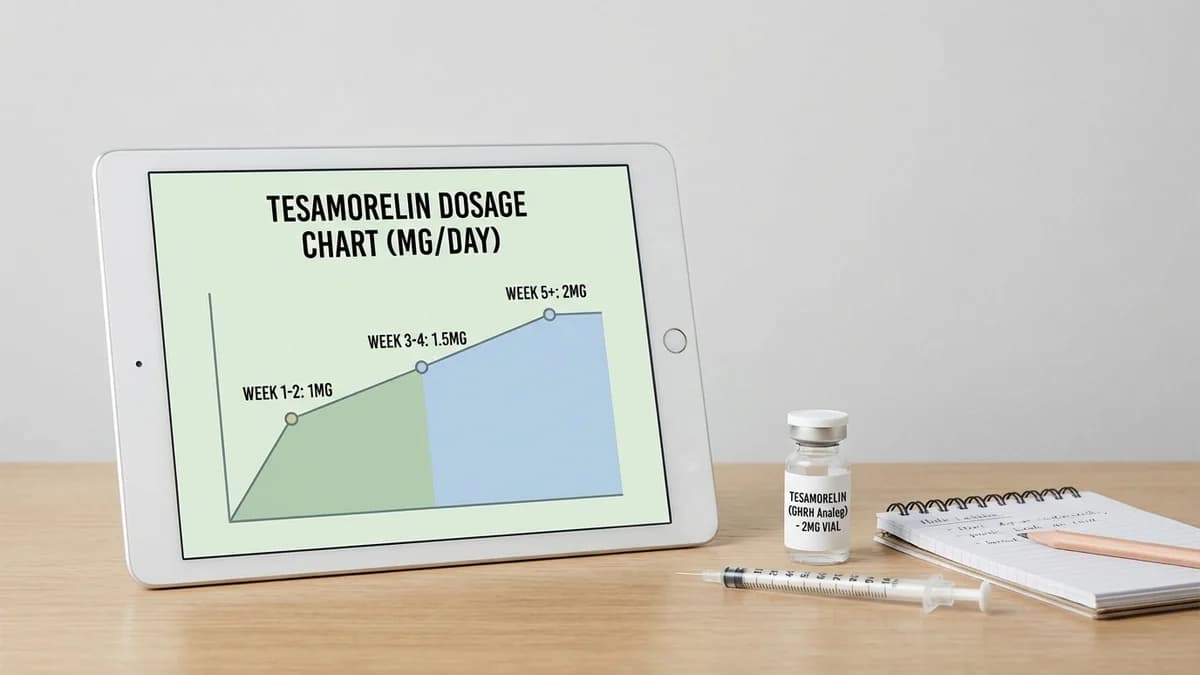
Titration Protocol: How to Ramp Up Safely
Proper dose escalation minimizes side effects while optimizing therapeutic response. The standard titration protocol begins with a reduced dose to assess individual tolerance and growth hormone responsiveness through IGF-1 monitoring.
| Week | Dose | Frequency | Notes |
|---|---|---|---|
| 1-2 | 0.5 mg | Once daily (evening) | Assess initial tolerance |
| 3-4 | 1.0 mg | Once daily (evening) | Monitor for side effects |
| 5-6 | 1.5 mg | Once daily (evening) | Optional intermediate step |
| 7+ | 2.0 mg | Once daily (evening) | Target maintenance dose |
The initial 0.5 mg dose allows assessment of individual sensitivity to growth hormone stimulation and identification of patients prone to fluid retention, joint pain, or glucose intolerance.[1] IGF-1 levels should be measured at baseline and after 2-4 weeks of treatment to confirm biological response and guide dose adjustments.
Patients experiencing significant side effects during titration should maintain their current dose for an additional 1-2 weeks before considering further escalation. Common tolerance indicators include morning joint stiffness, peripheral edema, or fasting glucose elevation >10% from baseline. Clinical protocols typically recommend holding dose escalation if IGF-1 levels exceed 2.5 times the upper limit of normal for age and gender.
Some practitioners implement a more gradual approach for elderly patients or those with multiple comorbidities, increasing doses by 0.25 mg increments every 2-3 weeks. This conservative strategy reduces the risk of adverse events while allowing time for physiologic adaptation to increased growth hormone levels.
How Long Should You Take Tesamorelin?
Clinical evidence supports treatment cycles ranging from 12-52 weeks, with most protocols utilizing 26-week cycles followed by structured evaluation periods.[1] The optimal treatment duration depends on therapeutic goals, individual response, and safety considerations specific to each patient's medical history.
During weeks 1-4, patients typically experience initial metabolic changes including mild increases in lean body mass and subtle improvements in energy levels. IGF-1 levels generally increase 2-3 fold from baseline during this period, serving as a biomarker for treatment response. Many patients report improved sleep quality and recovery from exercise within the first month of treatment.
Weeks 6-12 represent the period of maximal body composition changes, with significant reductions in visceral adipose tissue and increases in lean body mass becoming apparent through DEXA scanning.[2] Clinical trials demonstrate that 70-80% of the total treatment effect occurs within the first 12 weeks, with more gradual improvements continuing through 26 weeks.
Extended treatment beyond 26 weeks requires careful risk-benefit assessment, as long-term safety data remains limited. Some research protocols have safely administered Tesamorelin for 52 weeks, but these studies included intensive monitoring for glucose intolerance, joint problems, and potential malignancy screening.[3]
Discontinuation of Tesamorelin typically does not require gradual tapering, as the peptide does not suppress endogenous growth hormone production. However, patients may experience gradual reversal of treatment benefits over 3-6 months following cessation. Some clinical protocols implement maintenance strategies using reduced dosing (1 mg every other day) or intermittent cycling to preserve long-term benefits while minimizing exposure duration.
Administration Protocol: How to Inject Tesamorelin
Proper injection technique ensures optimal absorption and minimizes local adverse reactions. Tesamorelin requires subcutaneous administration using 29-31 gauge insulin syringes with 1/2 inch needles for most patients, though 5/16 inch needles may be appropriate for very lean individuals.
Injection Site Selection and Rotation: The abdomen provides the most consistent absorption, with injection sites located at least 2 inches from the navel and avoiding the area within 1 inch of any scars or stretch marks. The outer thigh (middle third of the vastus lateralis muscle) serves as an alternative site, particularly for patients with limited abdominal subcutaneous tissue. The upper arm (posterior aspect of the triceps region) can be used but may be difficult for self-administration and shows slightly variable absorption kinetics.
Systematic site rotation prevents lipodystrophy and maintains consistent absorption patterns. Most protocols recommend an 8-site rotation system, using each site once before returning to the first location. Sites should be separated by at least 1 inch to allow tissue recovery between injections.
Step-by-Step Administration Process:
-
Preparation: Remove Tesamorelin from refrigeration 15-30 minutes before injection to allow warming to room temperature, which reduces injection discomfort and improves mixing if reconstitution is required.
-
Hand Hygiene: Wash hands thoroughly with soap and water, then dry with a clean towel or allow to air dry completely.
-
Reconstitution (if using lyophilized powder): Add 2.1 mL of sterile water or bacteriostatic water slowly down the side of the vial to avoid foaming. Gently swirl—never shake—until completely dissolved. The final concentration should be approximately 1 mg/mL.
-
Dose Drawing: Using a new insulin syringe, draw the prescribed dose plus an additional 0.1 mL to account for dead space in the needle hub. Remove air bubbles by gently tapping the syringe and pushing the plunger until a small drop appears at the needle tip.
-
Site Preparation: Clean the injection site with an alcohol pad using a circular motion from center outward. Allow the area to dry completely (30-60 seconds) to prevent stinging upon injection.
-
Injection Technique: Pinch the skin to create a fold, insert the needle at a 45-90 degree angle (depending on subcutaneous fat thickness), and inject slowly over 5-10 seconds. Maintain pressure on the plunger for an additional 5 seconds before withdrawing the needle.
-
Post-Injection Care: Apply gentle pressure with a clean gauze pad if bleeding occurs. Do not massage the injection site, as this may affect absorption kinetics.
-
Disposal: Place the used syringe immediately into a sharps container. Never recap needles or reuse syringes.
Timing Considerations: Optimal injection timing occurs 2-3 hours after the evening meal to minimize interference with natural growth hormone pulsatility and reduce potential gastrointestinal side effects.[4] Most clinical protocols recommend administration between 8-10 PM to align with circadian growth hormone patterns. Consistency in timing helps maintain stable plasma levels and improves treatment adherence.
Storage Requirements: Unreconstituted Tesamorelin vials require refrigeration at 36-46°F (2-8°C) and protection from light. Once reconstituted, the solution maintains potency for 24-48 hours when refrigerated, though same-day use is preferred. Frozen storage is not recommended as freeze-thaw cycles can damage the peptide structure and reduce biological activity.
Stacking Tesamorelin for Enhanced Results
Tesamorelin combinations with other peptides require careful consideration of mechanism overlap, safety interactions, and regulatory status. Each peptide in a stack must be obtained legally and used under appropriate medical supervision.
Tesamorelin + Sermorelin Stack
This combination pairs two growth hormone-releasing peptides with complementary mechanisms. Sermorelin acts as a shorter GHRH analog with a half-life of 8-12 minutes, while Tesamorelin provides more sustained stimulation with its 26-38 minute half-life.[1] Typical protocols use 100-300 mcg of Sermorelin in the morning and 1-2 mg of Tesamorelin in the evening to provide pulsatile growth hormone stimulation throughout the day.
The mechanistic rationale involves maintaining more physiologic growth hormone patterns while potentially reducing individual peptide doses. Some research suggests this approach may minimize tachyphylaxis and preserve pituitary responsiveness over extended treatment periods. However, clinical evidence for combination protocols remains limited, and combination use is off-label for both peptides and belongs under medical supervision.
Tesamorelin + GHRP-2 Combination
Growth hormone-releasing peptides (GHRPs) like GHRP-2 work synergistically with GHRH analogs by acting on different receptor pathways. GHRP-2 stimulates growth hormone release through the ghrelin receptor, while Tesamorelin activates GHRH receptors, potentially providing additive effects on growth hormone secretion.[5]
Common protocols utilize 100-300 mcg of GHRP-2 administered 2-3 times daily alongside 1-2 mg of Tesamorelin once daily. The timing typically involves GHRP-2 injections before meals (to maximize the peptide's effects on an empty stomach) and Tesamorelin in the evening. This combination requires careful monitoring of IGF-1 levels and glucose metabolism, as the combined growth hormone stimulation may increase diabetes risk.
Tesamorelin + CJC-1295 Protocol
CJC-1295 represents a long-acting GHRH analog with an extended half-life of 6-8 days when conjugated with Drug Affinity Complex (DAC). This combination provides sustained baseline growth hormone elevation through CJC-1295 while Tesamorelin delivers more acute stimulation for specific timing needs.
Typical protocols use 2-4 mg of CJC-1295 DAC administered once or twice weekly, combined with 1 mg of Tesamorelin daily. The extended half-life of CJC-1295 may reduce the frequency of Tesamorelin administration in some protocols, with some practitioners using Tesamorelin only 3-4 times per week when combined with the longer-acting analog.
Factors That Affect Your Tesamorelin Dosage
Body Weight and Composition
Tesamorelin dosing typically follows a fixed-dose approach rather than weight-based calculations, as clinical trials established efficacy using standard 1-2 mg daily doses across varying body weights.[1] However, patients with significantly elevated body mass index (>35 kg/m²) may require dose adjustments due to altered pharmacokinetics and increased volume of distribution.
Subcutaneous fat thickness affects injection depth and absorption kinetics. Patients with minimal subcutaneous tissue (<1 cm skinfold thickness) may require shorter needles (5/16 inch) and more superficial injection angles to avoid intramuscular administration. Conversely, individuals with substantial subcutaneous fat may need longer needles (1/2 inch) and 90-degree injection angles to ensure proper subcutaneous placement.
Age-Related Considerations
Growth hormone responsiveness decreases with age, potentially requiring dose modifications in elderly patients (>65 years). Baseline IGF-1 levels typically decline by 1-2% annually after age 30, and pituitary sensitivity to GHRH stimulation may be reduced in older adults.[2] Some clinical protocols start elderly patients at 0.5-1 mg daily and titrate more gradually based on IGF-1 response and clinical tolerance.
Pediatric applications remain investigational, as Tesamorelin's effects on growth plates and pubertal development have not been established. The peptide should not be used in patients under 18 years without specific research protocols and comprehensive safety monitoring.
Renal and Hepatic Function
Kidney function significantly affects Tesamorelin clearance, as the peptide undergoes partial renal elimination. Dedicated dose-adjustment data for renal impairment has not been published, and the approved labelling does not specify a reduced dose. Anyone with reduced kidney function should have dosing set by the prescribing clinician rather than adjusted from a general guide. Severe renal impairment (GFR <30 mL/min/1.73m²) represents a relative contraindication requiring specialized nephrology consultation before treatment initiation.
Hepatic metabolism plays a lesser role in Tesamorelin elimination, but patients with moderate to severe liver disease (Child-Pugh Class B or C) may experience altered growth hormone metabolism and increased risk of glucose intolerance. Baseline liver function tests should be obtained, and patients with active hepatitis or cirrhosis require enhanced monitoring throughout treatment.
Concurrent Medications
Glucocorticoid medications can significantly blunt growth hormone response to Tesamorelin stimulation. Patients receiving prednisone equivalent doses >10 mg daily may require higher Tesamorelin doses (up to 3 mg daily) to achieve therapeutic IGF-1 levels.[4] The interaction appears dose-dependent, with higher steroid doses causing greater growth hormone suppression.
Insulin and oral hypoglycemic agents may require dose adjustments during Tesamorelin treatment, as growth hormone can induce insulin resistance and elevate fasting glucose levels. Patients with diabetes should undergo intensified glucose monitoring, particularly during the first 4-8 weeks of treatment when metabolic effects are most pronounced.
Gender Differences
Women typically demonstrate higher growth hormone responsiveness to GHRH stimulation compared to men, potentially allowing for lower effective doses.[5] Estrogen status significantly influences this response, with premenopausal women showing greater sensitivity than postmenopausal women or men. Some clinical protocols reduce initial dosing by 25% in premenopausal women to account for enhanced responsiveness.
Pregnancy and breastfeeding represent absolute contraindications to Tesamorelin use, as growth hormone effects on fetal development and milk production have not been established. Women of reproductive age should use effective contraception during treatment and for at least 30 days following discontinuation.
Common Dosing Mistakes to Avoid
Skipping Titration and Starting Too High
The most frequent dosing error involves initiating treatment at the full 2 mg dose without proper titration. This approach increases the risk of fluid retention, joint pain, and glucose intolerance, leading to treatment discontinuation in 15-20% of patients who skip the gradual escalation process.[1] Proper titration starting at 0.5-1 mg daily allows physiologic adaptation and identification of individual sensitivity patterns.
Patients eager for rapid results often pressure providers to accelerate dose escalation, but clinical data demonstrates that rushing titration provides no additional benefit while significantly increasing adverse event rates. The growth hormone axis requires 2-4 weeks to adapt to increased stimulation, making gradual dose increases both safer and more effective.
Inconsistent Injection Timing
Erratic administration timing disrupts the natural circadian rhythm of growth hormone release and may reduce treatment efficacy. Clinical trials establishing Tesamorelin's effectiveness used consistent evening dosing, typically 2-3 hours after dinner.[2] Patients who frequently vary injection times by more than 2-3 hours show reduced IGF-1 response and less consistent body composition improvements.
Some patients attempt to "make up" for missed doses by doubling the next injection, which can cause acute side effects including severe fluid retention and hypoglycemia. Missed doses should be administered as soon as remembered if within 12 hours, or skipped entirely if more than 12 hours have elapsed.
Improper Storage and Handling
Temperature excursions represent a major cause of treatment failure, as Tesamorelin loses biological activity when exposed to heat or repeated freeze-thaw cycles. Patients who leave reconstituted peptide at room temperature for more than 2-3 hours may experience reduced efficacy due to protein degradation.[3] Proper refrigeration at 2-8°C maintains potency for the recommended storage duration.
Vigorous shaking during reconstitution can denature the peptide structure and reduce biological activity. The powder should be reconstituted by adding diluent slowly down the vial wall and gently swirling until dissolved. Foaming during mixing indicates protein denaturation and potential loss of potency.
Ignoring Injection Site Rotation
Repeated injection into the same anatomical location can cause lipodystrophy, characterized by either fat accumulation (lipohypertrophy) or fat loss (lipoatrophy) at injection sites. These changes affect absorption kinetics and can create visible cosmetic deformities.[4] Proper site rotation using an 8-point system prevents tissue damage and maintains consistent drug absorption.
Some patients develop preferences for certain injection sites due to comfort or convenience, but this practice should be discouraged. Each injection site should be used only once every 7-10 days to allow complete tissue recovery and prevent long-term complications.
Self-Adjusting Doses Without Medical Supervision
Patients may attempt to modify their Tesamorelin dose based on perceived results or side effects without consulting their healthcare provider. Dose reductions in response to minor side effects may prevent achievement of therapeutic benefits, while dose increases beyond established ranges can cause serious adverse events including diabetic ketoacidosis or severe fluid retention.[5]
All dose modifications should be guided by objective measures including IGF-1 levels, body composition analysis, and comprehensive metabolic panels. Patient-reported outcomes alone are insufficient for making dosing decisions, as subjective improvements may not correlate with biological response markers.
Using Prohibited or Unregulated Sources
Perhaps the most serious mistake involves obtaining Tesamorelin from unregulated sources or using the peptide outside appropriate medical supervision. Tesamorelin is a prescription medicine, and any use beyond its approved HIV-lipodystrophy indication is off-label, so it requires oversight by a clinician familiar with growth hormone physiology and the potential complications.
Counterfeit or contaminated peptides pose significant health risks including infection, allergic reactions, and unpredictable pharmacologic effects. Patients should only obtain Tesamorelin through legitimate research institutions or qualified medical providers who can ensure product quality and appropriate monitoring.
What Tesamorelin Costs and How to Access It
Tesamorelin is a prescription medicine in the United States, so cost depends on whether it is dispensed as the branded product or prepared by a compounding pharmacy, and on what a given plan covers.
| Route | What it is | What drives the price |
|---|---|---|
| EGRIFTA SV / EGRIFTA WR | The FDA-approved branded product | Specialty pharmacy pricing; often subject to prior authorisation |
| Compounded tesamorelin | Prepared by a compounding pharmacy against a prescription | Vial strength, pharmacy, and quantity dispensed |
| Telehealth peptide clinics | Prescription plus dispensing bundled into a programme fee | Consultation and membership costs on top of the drug |
Because tesamorelin's approved indication is narrow, insurance coverage is generally tied to a documented HIV-associated lipodystrophy diagnosis. Off-label use is typically self-funded, which is the main reason the compounded market exists. Compounded peptides are not FDA-approved products and their potency and purity depend on the individual pharmacy, so the sourcing question matters more here than it would for a branded drug.
If you are comparing providers, our clinic finder lists practices by location and the peptides they work with.