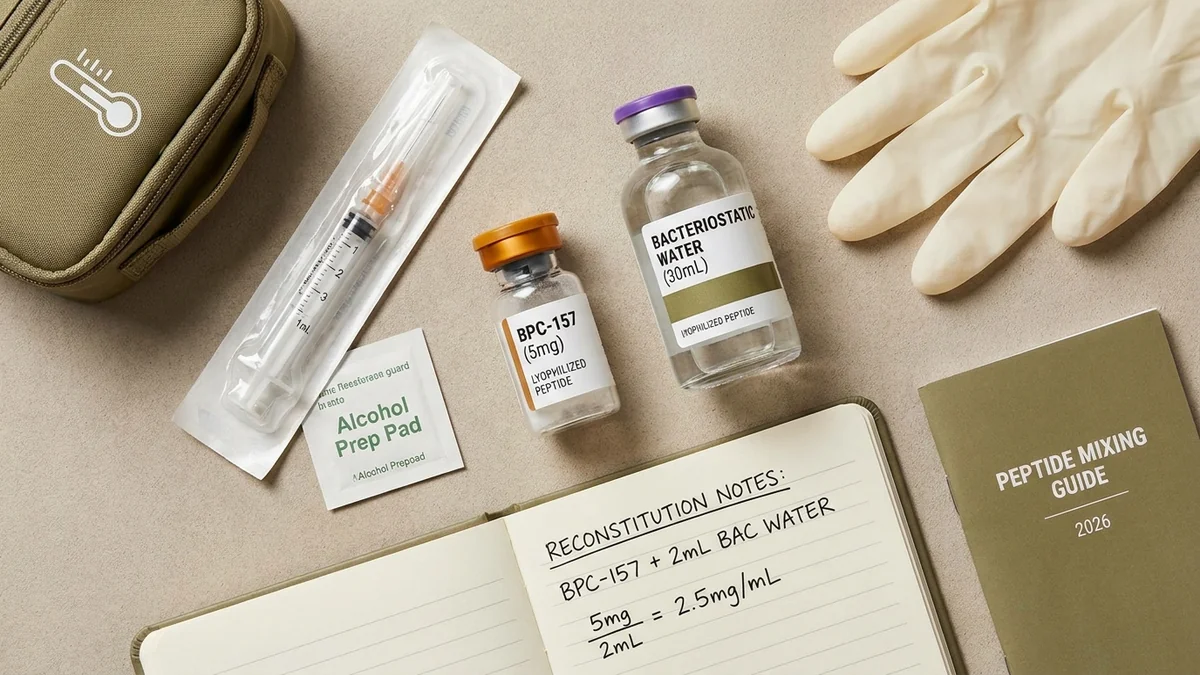
MK-677, also called ibutamoren, is a pill that makes your pituitary gland release more growth hormone. It does this by copying ghrelin, the hormone that signals hunger. Merck designed it in the 1990s as an oral alternative to injected growth hormone and tested it in a series of placebo-controlled trials, some lasting up to two years.[1][2]
Most of those trials used 25 mg once a day. At that dose MK-677 reliably raised growth hormone and IGF-1. In the largest long-term study, older adults gained about a kilogram and a half of fat-free mass compared with placebo, but they got no stronger, and their blood sugar went up.[2] Trials in hip fracture and Alzheimer's disease failed, and one was stopped early because of a possible heart failure signal.[9][10][11]
MK-677 was never approved. The FDA now lists it as a substance that presents significant safety risks for compounding pharmacies.[14]
- MK-677 (ibutamoren) is an oral, non-peptide drug that acts on the ghrelin receptor to boost the body's own growth hormone pulses. It is not a SARM, a steroid or a peptide.
- Most human trials used 25 mg by mouth once a day. Doses from 2 mg to 50 mg were tested, the higher ones only for days to weeks.
- In the two-year Nass trial, 25 mg a day raised IGF-1 to young-adult levels and increased fat-free mass by 1.1 kg (placebo: a 0.5 kg loss), with no gain in strength or function.
- Common side effects were increased appetite, mild leg swelling and muscle pain. Blood sugar rose and insulin sensitivity fell.
- A hip-fracture trial was stopped early for a congestive heart failure signal. The FDA cites that trial in listing ibutamoren as a significant safety risk.
| Common Name | MK-677 |
| Other Names | Ibutamoren, ibutamoren mesylate, MK-0677, L-163,191, LUM-201 |
| Class | Non-peptide growth hormone secretagogue (ghrelin receptor agonist) |
| Route | Oral, once daily in trials |
| Developed by | Merck Research Laboratories |
| Human Trials | Several randomized, placebo-controlled trials, from one week to two years |
| Most-Studied Dose | 25 mg once daily |
| FDA Status | Not approved; listed as presenting significant safety risks for compounding |
| In Sport | Prohibited at all times (WADA S2) |
What Is MK-677?
Merck's chemists published the design of MK-677, then called L-163,191, in 1995. In rat pituitary cells it released growth hormone the same way the injected peptide GHRP-6 does, and in dogs it raised growth hormone after oral doses as low as 0.125 mg/kg without much effect on other hormones.[1] That oral activity was the point. Earlier growth hormone-releasing peptides had to be injected.
Because it is sold online next to bodybuilding compounds, people ask what kind of drug it is:
- Is MK-677 a peptide? No. It is a small "peptidomimetic" molecule that mimics a peptide's effect, which is why it survives digestion and works as a pill. It often appears on peptide sites, including this one, because it is used alongside growth hormone peptides like ipamorelin.
- Is MK-677 a SARM? No. SARMs act on the androgen receptor. MK-677 acts on the ghrelin receptor and has no androgen activity. The US military's supplement safety program notes that products often pair it with SARMs or label it as one.[15]
- Is MK-677 a steroid? No. It is not a hormone and not related to testosterone.
Lumos Pharma later tested the same molecule under the name LUM-201 as an oral treatment for children with growth hormone deficiency.[13]
How Does MK-677 Work?
MK-677 binds the growth hormone secretagogue receptor, the receptor ghrelin normally activates. That signal tells the pituitary to release growth hormone, and growth hormone in turn makes the liver produce IGF-1, which carries out many of growth hormone's effects on muscle, bone and fat.
What sets it apart from injected growth hormone is that it works through the body's own release pattern. In a 24-hour blood sampling study, MK-677 made each growth hormone pulse larger and raised the lowest levels between pulses, but it didn't add more pulses.[3] A 2018 review in Sexual Medicine Reviews notes that this pulsatile release stays under the body's negative feedback, which may help prevent the very high growth hormone levels that injections can cause.[12]
Ghrelin is also the body's main hunger signal, which explains the most common side effect: people get hungrier.
MK-677 Dosage: What the Trials Used
No approved dose
MK-677 is not approved for any use, so no dose has been established as safe or effective. The figures below are what controlled studies gave their participants, not dosing advice.
Almost every MK-677 trial settled on 25 mg by mouth once a day. Researchers chose it after dose-finding studies showed the effect on growth hormone rising with the dose.
| Study | Who took part | Daily dose | How long | Main finding |
|---|---|---|---|---|
| Chapman 1996[3] | 32 healthy adults, 64 to 81 | 2, 10 or 25 mg | 2 and 4 weeks | Dose-dependent rise in GH; 25 mg brought IGF-1 into the young-adult range |
| Chapman 1997[4] | 9 GH-deficient men, 17 to 34 | 10 or 50 mg | 4 days | IGF-1 up 52% on 10 mg and 79% on 50 mg |
| Copinschi 1997[7] | 8 young and 6 older adults | 2, 5 or 25 mg at bedtime | 1 to 2 weeks | More deep and REM sleep on 25 mg |
| Murphy 1998[6] | 8 healthy volunteers on a calorie-restricted diet, 24 to 39 | 25 mg | 7 days | Protein loss from dieting reversed |
| Svensson 1998[5] | 24 obese men | 25 mg | 8 weeks | Fat-free mass up, body fat unchanged |
| Murphy 1999[8] | 187 adults 65 and older | 5 to 50 mg | 2 to 9 weeks | Bone turnover markers up |
| Nass 2008[2] | 65 healthy adults, 60 to 81 | 25 mg | 2 years | Fat-free mass +1.1 kg vs. placebo -0.5 kg |
| Sevigny 2008[11] | 563 people with Alzheimer's | 25 mg | 12 months | No effect on the disease |
| Adunsky 2011[10] | 123 hip-fracture patients | 25 mg | Up to 24 weeks | Stopped early for a heart failure signal |
MK-677 dosage per day
The once-daily 25 mg dose comes from the first long study in older adults. Over two weeks, 25 mg a day nearly doubled average 24-hour growth hormone (up 97%) and raised IGF-1 from 141 to 219 µg/L, then to 265 µg/L at four weeks. The 2 mg and 10 mg doses had smaller effects.[3]
10 mg vs. 25 mg vs. 50 mg
Lower doses still work. In young men with growth hormone deficiency, 10 mg a day raised IGF-1 by 52% in four days.[4] The "MK-677 50 mg study" people search for is usually one of two short trials. In the first, five of those same men took 50 mg for four days, and IGF-1 rose 79%.[4] In the second, 30 healthy older adults took 25 mg a day for two weeks and then 50 mg for two weeks.[8] No trial has run 50 mg for longer, so there is no long-term safety data above 25 mg.
When to take MK-677
The trials used one dose a day. The sleep study gave it at bedtime.[7] No study has compared morning and evening dosing for effect or side effects, so the common advice to take it at night rests on that sleep study and on the appetite effect, not on a head-to-head test.
MK-677 cycle length
The trials didn't cycle MK-677. They gave it every day, for one week up to two years.[2][6] The effect didn't fade with time. In the Alzheimer's trial, IGF-1 was 60% above baseline at six weeks and 73% above it at 12 months.[11] The "8 to 12 weeks on, then off" cycles you see online don't come from any published study.
Measuring a liquid dose
The trial drug was a tablet. Many products sold online are liquids, and the dose depends on the concentration printed on the label:
mL to take = dose in mg ÷ concentration in mg/mL
For a liquid labeled 25 mg/mL, 10 mg is 0.4 mL and 25 mg is 1 mL. The math is only as good as the label. FDA testing has found ibutamoren in products that didn't list it at all, so an unregulated product's stated strength can't be taken on trust.[16]
MK-677 Side Effects
The best safety data comes from the two-year Nass trial, where 25 mg a day was "generally well tolerated" in healthy older adults.[2] "Well tolerated" still came with measurable changes:
- Increased appetite. The most frequent side effect, which faded after a few months.[2]
- Mild swelling in the lower legs and muscle pain. Both were mild and temporary.[2]
- Higher blood sugar. Fasting glucose rose by an average of 5 mg/dL over a year, and insulin sensitivity fell.[2] In the four-week study of older adults, fasting glucose went from 5.4 to 6.8 mmol/L, about 97 to 123 mg/dL.[3] In obese men, fasting glucose stayed the same but glucose tolerance tests got worse at two and eight weeks.[5] Young men with growth hormone deficiency had higher insulin levels and higher blood sugar after meals.[4]
- Weight gain. People on MK-677 gained 2.7 kg over a year, against 0.8 kg on placebo, and more of the extra fat went to their arms and legs.[2]
- Cortisol and prolactin. Cortisol rose by about 1.7 µg/dL in the Nass trial.[2] Shorter studies found no lasting cortisol change.[3][5][6] In older adults, prolactin rose 23% but stayed in the normal range.[3]
The most serious signal came from frail patients. A 123-person trial in older adults recovering from hip fracture "was terminated early due to a safety signal of congestive heart failure in a limited number of patients," and the authors concluded MK-677 "has an unfavorable safety profile in this patient population."[10] That is the trial the FDA cites in its safety listing.[14]
Long-term cancer risk is unknown. IGF-1 drives cell growth, and the 2018 review called for studies of cancer incidence and death with long-term use, which haven't been done.[12]
The trial results point to people who should be especially careful: anyone with diabetes, prediabetes or insulin resistance; anyone with heart failure or fluid retention; people with a history of cancer; and anyone pregnant, breastfeeding or under 18. Athletes in tested sports should know it is banned. The trials monitored IGF-1, fasting glucose and insulin, and a doctor would look at the same markers.
MK-677 Results: What the Trials Found
People searching for "MK-677 before and after" want to know what changes and when. Here is what the controlled trials measured, in the order it happened:
- First dose: Growth hormone peaks. In young adults, peak growth hormone was 55.9 µg/L after the first dose and 22.6 µg/L after a week, so the spike shrinks while daily levels stay raised.[6]
- One week: In young adults dosed at bedtime, deep (stage IV) sleep lasted about 50% longer and REM sleep over 20% longer than on placebo. Older adults had nearly 50% more REM sleep after two weeks.[7]
- One week, during a diet: Healthy adults eating 18 kcal per kg a day stopped losing protein. Their nitrogen balance went from negative to slightly positive (+0.31 g/day vs. -1.48 g/day on placebo).[6]
- Two to four weeks: IGF-1 reaches young-adult levels.[3]
- Eight weeks: In obese men, fat-free mass increased and IGF-1 was about 40% higher. Total and visceral fat didn't change. Metabolic rate rose at two weeks but not at eight.[5]
- Nine weeks: In older adults with functional impairment, markers of bone formation and breakdown rose (osteocalcin up 29%), a sign of faster bone turnover. Bone density wasn't measured.[8]
- 12 months (the Nass trial): Fat-free mass up 1.1 kg against a 0.5 kg loss on placebo. No change in belly fat, total fat, strength or physical function. LDL cholesterol fell slightly. The two-year results confirmed the first year.[2]
Where MK-677 didn't work
Raising IGF-1 didn't translate into clinical benefit in the two patient groups Merck tested at scale:
- Hip fracture recovery. In a 161-patient trial, IGF-1 rose 84% (17% on placebo) with no significant difference in recovery of function.[9] In the later 123-patient trial, gait speed improved but stair climbing and most other measures didn't, and the trial was stopped for the heart failure signal.[10]
- Alzheimer's disease. In 563 patients over 12 months, IGF-1 rose 73% with no effect on memory, daily function or the progression of the disease.[11]
MK-677 vs. Other Growth Hormone Secretagogues
The compounds MK-677 usually gets compared with are injected peptides. MK-677 is taken by mouth.
MK-677 vs. Injected Growth Hormone Peptides
| Parameter | MK-677 | Ipamorelin | Tesamorelin |
|---|---|---|---|
| Type | Non-peptide ghrelin receptor agonist | Ghrelin receptor peptide (GHRP) | GHRH analog peptide |
| Route | Oral, once daily | Injection | Injection |
| Human evidence | Several randomized trials up to 2 years | Limited human data | Phase 3 trials |
| FDA status | Not approved; listed as a significant safety risk for compounding | Not approved | Approved (EGRIFTA) for HIV-associated lipodystrophy |
MK-677 vs. tesamorelin. These work through different receptors. Tesamorelin copies growth hormone-releasing hormone and is FDA approved to reduce excess belly fat in HIV-associated lipodystrophy. MK-677 copies ghrelin, is unapproved, and didn't reduce visceral fat in its trials.[2][5] No study has compared them directly.
MK-677 vs. ipamorelin. Ipamorelin acts on the same ghrelin receptor but is an injected peptide with much less human trial data than MK-677.
Stacking. No published human study has tested MK-677 combined with peptides like CJC-1295 or sermorelin, or with SARMs like RAD-140. MK-677 raises blood sugar on its own, and what a combination does to it hasn't been measured. SARMs are also illegal in supplements and banned in sport.[15]
Is MK-677 Legal? Regulatory & Access Status
Access status as of October 2026
MK-677 is not FDA approved for any use. None of the 4,754 active clinics in our directory lists it among the peptides they offer.
- Not approved. MK-677 has never been approved for any use, and the FDA states that ibutamoren's "safety and efficacy have not been established."[16]
- Not compoundable in practice. The FDA lists ibutamoren mesylate among bulk drug substances that "may present significant safety risks" for compounding, under section 503A since September 29, 2023 and section 503B since December 29, 2022. Its stated reason: "potential for congestive heart failure in certain patients."[14]
- Not a legal supplement. The Department of Defense's Operation Supplement Safety program says MK-677 is an unapproved drug and "not legal for use as an ingredient in dietary supplements or any other consumer or commercial products."[15] In September 2025 the FDA warned consumers that a children's "growth" supplement contained undeclared ibutamoren.[16]
- Banned in sport. WADA lists ibutamoren (MK-677) by name among growth hormone secretagogues prohibited at all times.[17]
Most MK-677 sold online is labeled "for research use only." That label means no one has checked the product for strength, purity or contamination.
Sourcing & Safety
Since there's no approved product, the checks that matter are about what is actually in the bottle:
- An independent certificate of analysis (COA) from a named third-party lab, dated and tied to your batch.
- HPLC purity and mass spectrometry confirming ibutamoren mesylate.
- A clear concentration on liquids, since that sets every dose.
Red flags include products that call MK-677 a SARM, promise fat loss (it didn't reduce body fat in trials), or are sold as dietary supplements, which isn't legal.[2][15]
FAQ
What is MK-677?
MK-677, also called ibutamoren or ibutamoren mesylate, is an oral drug that makes the pituitary gland release more growth hormone. Merck developed it in the 1990s. It copies the hunger hormone ghrelin at the ghrelin receptor. It was tested in several placebo-controlled human trials but was never approved by the FDA for any use.
Is MK-677 a peptide, a SARM or a steroid?
None of the three. MK-677 is a small non-peptide molecule, which is why it works as a pill. It is not a SARM, because it doesn't act on the androgen receptor, and it is not an anabolic steroid. It is often sold next to SARMs and sometimes mislabeled as one.
What is the MK-677 dosage per day?
Most human trials used 25 mg by mouth once a day, including the two-year Nass trial in older adults. Trials also tested 2, 5, 10 and 50 mg. The 50 mg dose was only given for a few days to two weeks. No dose is approved, so these are the amounts researchers studied, not a recommendation.
Should you take MK-677 at night or in the morning?
Trials gave it once a day. The sleep study gave it at bedtime and found more deep sleep and REM sleep. No study has compared morning and night dosing head to head.
How long does MK-677 take to work?
Growth hormone rises after the first dose. In older adults on 25 mg a day, IGF-1 was in the young-adult range by two weeks and higher again at four weeks. Fat-free mass gains showed up at eight weeks in obese men and at 12 months in the Nass trial.
How long can you take MK-677? Do you need to cycle it?
Trials ran continuously for one week up to two years, and IGF-1 stayed raised at 12 months. No study tested on-and-off cycles, so online cycle lengths don't come from research.
What are the side effects of MK-677?
In the two-year Nass trial, the most common side effects were more appetite, which faded after a few months, and mild, temporary swelling in the lower legs and muscle pain. Fasting blood sugar rose and insulin sensitivity fell. A trial in older hip-fracture patients was stopped early because of a possible heart failure signal.
Does MK-677 raise blood sugar?
Yes. In older adults, fasting glucose rose from 5.4 to 6.8 mmol/L (about 97 to 123 mg/dL) after four weeks on 25 mg a day. Over a year in the Nass trial the average rise was smaller, 5 mg/dL, with lower insulin sensitivity. In obese men, fasting glucose didn't change but glucose tolerance tests got worse.
Is MK-677 legal or FDA approved?
MK-677 is not FDA approved. The FDA lists ibutamoren mesylate among bulk substances that present significant safety risks for compounding, citing congestive heart failure, and it is not a legal dietary supplement ingredient. WADA bans it in sport at all times.
Is MK-677 better than tesamorelin?
They are different kinds of drugs. Tesamorelin is an injected GHRH analog that is FDA approved for excess belly fat in HIV-associated lipodystrophy. MK-677 is an unapproved oral ghrelin-receptor drug. No trial has compared them.
Related Peptides & Comparisons
For injected compounds that act on the growth hormone axis, see ipamorelin, GHRP-6 and hexarelin, which use the same ghrelin receptor, and sermorelin, CJC-1295 and tesamorelin, which copy growth hormone-releasing hormone. For the wider picture, see our guides to hormone optimization and anti-aging and longevity.
References
- Patchett AA, Nargund RP, Tata JR, et al. "Design and biological activities of L-163,191 (MK-0677): a potent, orally active growth hormone secretagogue." Proc Natl Acad Sci U S A. 1995;92(15):7001-7005. PMID: 7624358
- Nass R, Pezzoli SS, Oliveri MC, et al. "Effects of an oral ghrelin mimetic on body composition and clinical outcomes in healthy older adults: a randomized trial." Ann Intern Med. 2008;149(9):601-611. PMID: 18981485
- Chapman IM, Bach MA, Van Cauter E, et al. "Stimulation of the growth hormone (GH)-insulin-like growth factor I axis by daily oral administration of a GH secretogogue (MK-677) in healthy elderly subjects." J Clin Endocrinol Metab. 1996;81(12):4249-4257. PMID: 8954023
- Chapman IM, Pescovitz OH, Murphy G, et al. "Oral administration of growth hormone (GH) releasing peptide-mimetic MK-677 stimulates the GH/insulin-like growth factor-I axis in selected GH-deficient adults." J Clin Endocrinol Metab. 1997;82(10):3455-3463. PMID: 9329386
- Svensson J, Lönn L, Jansson JO, et al. "Two-month treatment of obese subjects with the oral growth hormone (GH) secretagogue MK-677 increases GH secretion, fat-free mass, and energy expenditure." J Clin Endocrinol Metab. 1998;83(2):362-369. PMID: 9467542
- Murphy MG, Plunkett LM, Gertz BJ, et al. "MK-677, an orally active growth hormone secretagogue, reverses diet-induced catabolism." J Clin Endocrinol Metab. 1998;83(2):320-325. PMID: 9467534
- Copinschi G, Leproult R, Van Onderbergen A, et al. "Prolonged oral treatment with MK-677, a novel growth hormone secretagogue, improves sleep quality in man." Neuroendocrinology. 1997;66(4):278-286. PMID: 9349662
- Murphy MG, Bach MA, Plotkin D, et al. "Oral administration of the growth hormone secretagogue MK-677 increases markers of bone turnover in healthy and functionally impaired elderly adults." J Bone Miner Res. 1999;14(7):1182-1188. PMID: 10404019
- Bach MA, Rockwood K, Zetterberg C, et al. "The effects of MK-0677, an oral growth hormone secretagogue, in patients with hip fracture." J Am Geriatr Soc. 2004;52(4):516-523. PMID: 15066065
- Adunsky A, Chandler J, Heyden N, et al. "MK-0677 (ibutamoren mesylate) for the treatment of patients recovering from hip fracture: a multicenter, randomized, placebo-controlled phase IIb study." Arch Gerontol Geriatr. 2011;53(2):183-189. PMID: 21067829
- Sevigny JJ, Ryan JM, van Dyck CH, et al. "Growth hormone secretagogue MK-677: no clinical effect on AD progression in a randomized trial." Neurology. 2008;71(21):1702-1708. PMID: 19015485
- Sigalos JT, Pastuszak AW. "The Safety and Efficacy of Growth Hormone Secretagogues." Sex Med Rev. 2018;6(1):45-53. PMID: 28400207
- Bright GM, Thorner MO. "A GH Secretagogue Receptor Agonist (LUM-201) Elicits Greater GH Responses than Standard GH Secretagogues in Subjects of a Pediatric GH Deficiency Trial." Horm Res Paediatr. 2022;95(1):76-81. PMID: 35354138
- US Food and Drug Administration. "Certain Bulk Drug Substances for Use in Compounding that May Present Significant Safety Risks." Content current as of April 22, 2026. fda.gov
- Operation Supplement Safety, Uniformed Services University. "Performance Enhancing Substance: MK-677 (Ibutamoren)." opss.org
- US Food and Drug Administration. "Agebox iKids Growth Day Formula may be harmful due to hidden ingredient." September 23, 2025. fda.gov
- World Anti-Doping Agency. "The Prohibited List," S2.2.4 Growth hormone secretagogues. wada-ama.org
This content is for informational purposes only and does not constitute medical advice. Consult a licensed healthcare provider before starting any treatment.