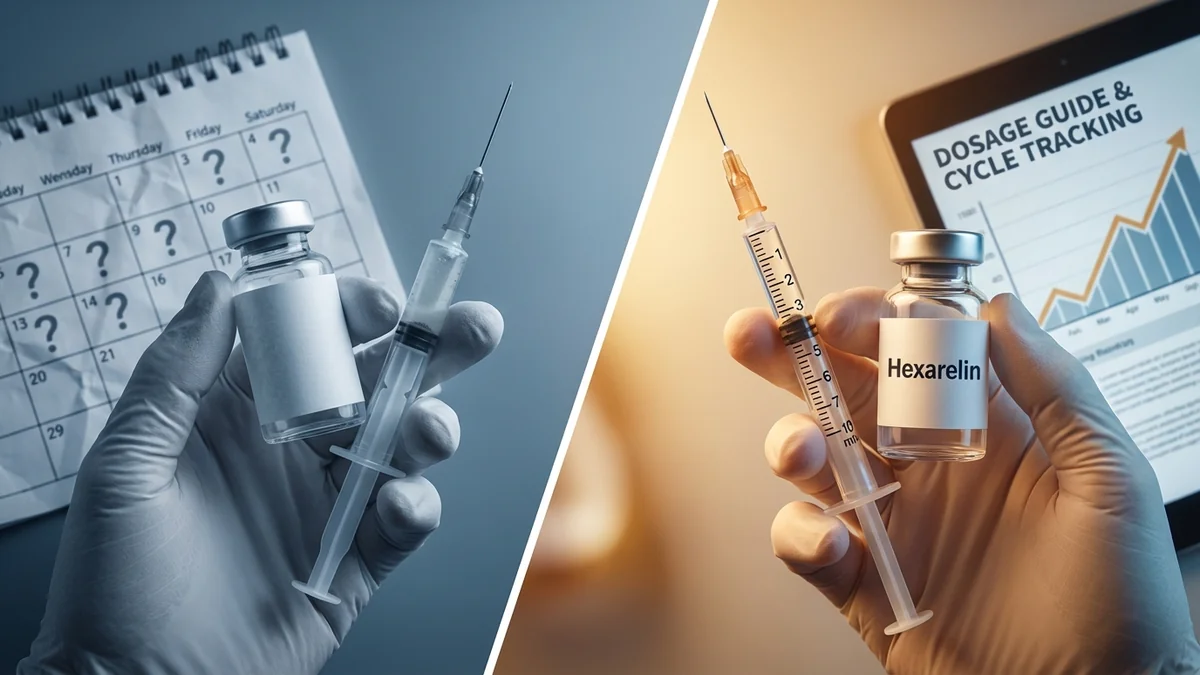
Hexarelin: Dosage, Benefits, FDA Status & Clinics (2026)
Hexarelin
Research
Growth Hormone Releasing Peptide
Growth Hormone ReleaseMuscle RecoveryAnti-Aging
Last reviewed September 2026·MyPeptideMatch Team
What Is Hexarelin?
Hexarelin is one of the most potent growth hormone-releasing peptides (GHRPs) ever synthesized — and it does something no other GHRP does: it has a second, completely separate mechanism that protects the heart directly, independent of growth hormone entirely.
It's a synthetic six-amino acid peptide developed in the 1990s that mimics ghrelin's ability to stimulate GH secretion from the pituitary.[1] What researchers didn't expect was that hexarelin also binds the CD36 receptor in cardiac tissue, a pathway that appears to mediate meaningful cardioprotective effects in ischemia models.[2] That dual-receptor profile — GHSR plus CD36 — is what makes hexarelin genuinely interesting beyond the rest of the GHRP class.
It has no FDA approval, no compounding pathway, and sits firmly in research-compound territory. If you're reading this to understand what the science says, you're in the right place.
Key Takeaways
Hexarelin is a synthetic 6-amino acid GHRP that produces some of the strongest acute GH pulses in its class by binding the growth hormone secretagogue receptor (GHSR).[1]
It's the only GHRP with documented binding to the CD36 cardiac receptor, giving it direct cardioprotective properties separate from its GH-releasing activity.[2]
Desensitization is a real limitation — continuous use blunts the GH response, making cycling protocols essential for maintaining efficacy.[3]
Hexarelin has no FDA approval and no legal compounding pathway in the US; it is a research-only compound.
Animal and early human data suggest potential in cardiac protection, kidney injury, and anti-aging applications, but large-scale human trials are absent.
Research only — no approved indication, no compounding pathway
Administration
Subcutaneous injection (research use); IV in clinical studies
Typical Dose (Research Range)
1–2 mcg/kg IV (clinical studies); ~100–200 mcg subcutaneous — dosing in humans has not been established; animal and preclinical studies have employed various doses, but no validated human clinical dosing exists.
Half-life
~30–60 minutes — half-life in humans: not established; preclinical data suggest a short elimination profile
Primary Uses
GH stimulation, muscle recovery, cardioprotection, anti-aging research
What Makes Hexarelin Different?
Most GHRPs — GHRP-2, GHRP-6, ipamorelin — work by one mechanism: they bind GHSR in the pituitary and hypothalamus and trigger a GH pulse. That's the whole story. Hexarelin does that too, and it does it more potently than most of its class.[3] But the CD36 binding is what separates it.
The CD36 pathway — why it matters
CD36 is a scavenger receptor expressed in cardiac muscle, vascular smooth muscle, and macrophages. When hexarelin binds CD36 in the heart, it activates downstream signaling that reduces cell death during ischemia — the oxygen deprivation that causes heart attack damage. This effect has been demonstrated in animal models and is independent of GH levels entirely.[2] It means hexarelin could theoretically benefit patients with low GH and patients with normal GH who have cardiac risk — two very different populations.
The anti-aging angle is also more specific than the generic "GH boosts = anti-aging" narrative. A 2014 review of longevity mechanisms specifically cited hexarelin alongside caloric restriction and TOR pathway modulation as one of the more promising leads in aging biology research.[4] That's a meaningful distinction from marketing language — it reflects where the actual scientific attention has been directed.
And then there's the kidney data. A 2023 study found hexarelin reduced apoptosis (programmed cell death) in ischemic acute kidney injury via the MDM2/p53 pathway — a completely different mechanism again, suggesting the peptide's organ-protective effects extend beyond the heart.[5]
How Does Hexarelin Work?
Hexarelin's primary job is to mimic ghrelin — the "hunger hormone" that also happens to be a powerful GH secretagogue. When hexarelin binds GHSR in the pituitary gland and hypothalamus, it triggers the pituitary to release a pulse of growth hormone into circulation.[1] That GH pulse then drives downstream effects: IGF-1 production in the liver, protein synthesis in muscle, lipolysis in fat tissue.
What makes hexarelin chemically interesting is that it's more stable than ghrelin itself.[2] Ghrelin is an endogenous 28-amino acid peptide that degrades quickly; hexarelin's 6-amino acid structure is more resistant to enzymatic breakdown, which is part of why researchers have found it useful as a pharmacological tool.
The CD36 story is separate and worth understanding on its own terms. CD36 is expressed heavily in the heart and blood vessels — tissues where you wouldn't necessarily expect a GH-releasing peptide to have much to do. When hexarelin binds CD36 in cardiac cells, it appears to activate anti-apoptotic pathways that reduce the cell death cascade triggered by ischemia and reperfusion injury.[2] This isn't a GH-mediated effect. It's a direct receptor interaction in the heart that would happen even in a GH-deficient or GH-normal patient.
The MDM2/p53 pathway finding in kidney injury adds a third layer.[5] MDM2 is a negative regulator of p53 — the protein that, when activated, drives cells toward apoptosis. Hexarelin appears to upregulate MDM2, which suppresses p53 activity and reduces programmed cell death in ischemic kidney tissue. Whether this translates to clinical benefit in humans remains an open question.
What the Clinical Evidence Actually Shows
The honest summary: the human evidence for hexarelin is early-stage and primarily focused on GH secretion dynamics, not clinical outcomes. The cardioprotective and organ-protective findings are largely from animal models.
The foundational human pharmacology work comes from a 1996 study in Clinical Endocrinology that characterized the GH response to repeated hexarelin administration.[3] The study administered two intravenous boluses of hexarelin, GHRH (growth hormone releasing hormone), or a combination, and tracked pituitary responsiveness over time. The key finding: repeated hexarelin dosing produces desensitization — the GH response diminishes with continuous administration. Crucially, the pituitary retained its responsiveness to GHRH even after hexarelin-induced desensitization, which suggests the blunting occurs at or above the level of GHSR rather than at the pituitary itself.[3] That distinction matters practically: cycling off hexarelin while maintaining GHRH sensitivity means recovery of the GH axis is possible.
A 2008 review in the Journal of Endocrinological Investigation characterized hexarelin as a "multi-receptor peptide" — acknowledging that the GHSR and CD36 pathways give it a pharmacological profile that doesn't fit cleanly into the standard GHRP framework.[6]
The cardiovascular evidence was synthesized in a 2014 review in the Journal of Geriatric Cardiology, which documented hexarelin's peripheral distribution in heart and blood vessels and its CD36-mediated cardioprotective effects.[2] This review noted that hexarelin is chemically more stable and functionally more specific than ghrelin in some cardiac contexts — a meaningful distinction when thinking about therapeutic applications.
The 2023 kidney injury paper used an ischemia/reperfusion model to demonstrate that hexarelin reduced apoptosis via MDM2/p53 signaling.[5] This is animal data, and the authors explicitly noted that the mechanism in human AKI remains unclear.
What We Don't Know Yet
Human outcomes data — Every cardioprotective and renoprotective finding comes from animal models. No randomized controlled trials in humans exist for these indications.
Optimal dosing and cycling protocols — The desensitization finding tells us continuous use is problematic, but no published human trials have established what cycling schedule best preserves GH response.
Long-term safety — There are no long-term human safety studies. Effects on cortisol, prolactin, and insulin sensitivity over months or years are not characterized in published literature.
CD36-mediated effects in humans — The cardiac receptor binding is well-documented in animal tissue. Whether this translates to measurable cardioprotection in human patients hasn't been tested in a clinical trial.
Comparison to other GHRPs — Head-to-head trials comparing hexarelin to GHRP-2, GHRP-6, or ipamorelin in humans don't exist. Potency comparisons are largely extrapolated from animal studies.
Typical Dosing — Practitioner & Community Ranges
There are no published randomized clinical trials establishing an official subcutaneous dosing protocol for hexarelin. The figures below reflect what practitioners and researchers commonly report, based on available protocol guides and the clinical pharmacology literature.
Not clinical dosing guidance
The ranges described here are not derived from randomized controlled trials. Human research used intravenous administration at 1–2 mcg/kg to assess acute GH secretion.[3] Subcutaneous dosing ranges reflect practitioner consensus and have not been validated in controlled human studies. Discuss any dosing decisions with a licensed healthcare provider.
In the 1996 clinical study, hexarelin was administered intravenously at doses designed to produce measurable GH pulses, with the primary endpoint being pituitary responsiveness over repeated dosing.[3] Subcutaneous use in research and practitioner settings is typically reported in the range of 100–200 mcg per injection, administered once to twice daily — though subcutaneous dosing in humans has not been established in clinical trials; dosing ranges reported in research and practitioner settings lack peer-reviewed clinical validation — and this is not derived from published RCT data.
The desensitization finding is the most practically important dosing consideration. Continuous daily use blunts the GH response — this isn't theoretical, it was documented in the 1996 clinical work.[3] Most practitioners who work with hexarelin use cycling protocols: common patterns include 8–12 weeks on followed by 4 weeks off — though cycling protocols for hexarelin have not been established in human clinical trials; practitioner-reported patterns are anecdotal and not validated by peer-reviewed evidence — and no published trial has validated a specific cycle length for preserving efficacy.
Combining hexarelin with a GHRH analog like CJC-1295 is frequently reported in practitioner settings because the two mechanisms are thought to be synergistic — though the synergistic mechanism between GHSR agonism and GHRH receptor stimulation in combination regimens has not been established in human clinical studies, and this claim has not been validated in controlled trials. The 1996 study actually documented this synergy in the IV context, showing that hexarelin plus GHRH produced a greater GH response than either alone.[3]
Hexarelin vs. Related GHRPs — Key Differences
Parameter
Hexarelin
GHRP-2
Ipamorelin
Receptor targets
GHSR + CD36
GHSR
GHSR
GH pulse potency
Very high
High
Moderate
Cortisol/prolactin elevation
Moderate
Moderate-high
Minimal
Desensitization risk
High
Moderate
Low
Cardioprotective data
Yes (animal/in vitro)
No
No
FDA status
Research only
Research only
Research only
Side Effects — What to Actually Expect
Hexarelin's side effect profile follows the general GHRP pattern, with a few specific concerns tied to its higher potency and the desensitization issue.
With initial and ongoing use:
Increased appetite — GHSR activation mimics ghrelin's orexigenic (hunger-stimulating) effect. This is dose-dependent and typically noticeable within 30–60 minutes of injection.
Water retention — GH-mediated sodium retention is common with all potent GHRPs. Expect some puffiness, particularly in the early weeks of use.
Elevated cortisol and prolactin — Hexarelin stimulates cortisol and prolactin release alongside GH, a pattern shared with GHRP-2 but largely absent with ipamorelin.[6] This is one reason ipamorelin is often preferred for long-term protocols despite hexarelin's greater potency.
Transient fatigue or sedation — Reported after injection in some users, though CNS effects including potential fatigue or sedation have not been systematically documented in human studies; such effects remain theoretical based on ghrelin-mimicking mechanisms.
With prolonged continuous use:
GH axis desensitization — The most clinically significant concern. Documented in human research: continuous hexarelin administration progressively blunts the GH response.[3] This is why cycling is considered essential.
Potential IGF-1 elevation — Hexarelin is a GHS-R agonist with demonstrated GH-stimulating activity in preclinical models; sustained GH elevation theoretically raises IGF-1, but human efficacy, safety, and monitoring requirements have not been established in clinical trials.
Rare but worth knowing:
Injection site reactions — Mild redness or tenderness at the subcutaneous injection site; rotating sites reduces this.
Hypoglycemia risk — GH has complex effects on insulin sensitivity. Injecting on an empty stomach and monitoring for lightheadedness is reasonable practice, though safety monitoring practices for hexarelin in humans have not been established, as the peptide remains in research stage with no published human clinical trial data available.
If you experience persistent joint pain, significant edema, or symptoms of elevated intracranial pressure (headache, visual changes), stop use and consult a physician — these are known class-level concerns with sustained GH elevation.
Regulatory & Access Status
Access status — US, as of September 2026
Hexarelin has no FDA approval for any indication and no legal commercial pathway in the United States. It is not available through licensed compounding pharmacies. The FDA classifies hexarelin as a research compound. In the US, it is legally available only for laboratory research purposes, not for human administration outside of an approved clinical trial. We are not aware of any Phase 2 or Phase 3 clinical trials currently recruiting participants for hexarelin in the US.
This matters practically. Unlike some peptides — BPC-157, for instance, which occupies a similar research-only status but has a more established gray market — hexarelin is less commonly encountered in the US peptide market. Overseas vendors do sell it as a research chemical, but purity, sterility, and accurate concentration are unverified in the absence of independent third-party testing.
The FDA has taken enforcement action against companies marketing unapproved peptide products for human use. Patients and providers should consult FDA.gov and the FDA's MedWatch program for current enforcement activity.
Sourcing & Safety
If you're going to source hexarelin from a research chemical vendor — and many people reading this will, regardless of the regulatory reality — the following information is what keeps you safer.
What to look for:
Third-party Certificate of Analysis (COA) — Must come from an independent analytical laboratory, not the vendor's own in-house testing. The COA should specify purity by HPLC (high-performance liquid chromatography), confirm the correct molecular weight by mass spectrometry, and show the test date.
HPLC purity ≥ 98% — This is the minimum acceptable threshold for a peptide intended for injection. Many low-cost vendors sell 90–95% purity material that contains unknown impurities.
Sterility testing — Subcutaneous injection bypasses the gut's protective barriers entirely. Bacteriostatic water reconstitution does not sterilize a contaminated lyophilized powder. Look for vendors who provide sterility test results.
Accurate concentration labeling — Underdosing is extremely common in the research chemical market. Independent testing has found significant discrepancies between labeled and actual peptide content, though no independent testing data on labeled versus actual peptide content discrepancies is available in clinical or regulatory sources.
Red flags:
No COA, or "available upon request" with no actual document — If it's not posted publicly or immediately available, treat it as absent.
Price significantly below market — Proper synthesis, lyophilization, and third-party testing cost money. Unusually cheap peptides almost always reflect shortcuts somewhere in that chain.
No clear reconstitution guidance — A vendor selling injectable research peptides with no guidance on bacteriostatic water, storage temperature, or reconstitution volume is not operating with patient safety in mind.
Claims about human dosing or therapeutic benefit on vendor websites — This is an FDA marketing violation and signals a vendor willing to cut regulatory corners elsewhere too.
What the Evidence Does Not Show
Clinical efficacy in humans for any indication — Every organ-protective finding (cardiac, renal) comes from animal models. No human RCT has tested hexarelin for any therapeutic endpoint.
Validated subcutaneous dosing protocols — Human pharmacology studies used IV administration. The subcutaneous dosing ranges circulating in practitioner communities have not been validated in published clinical trials.
Long-term safety — No study has followed human subjects on hexarelin for more than a few months. Effects on the HPA axis, prolactin dysregulation, or IGF-1-related risks over years are unknown.
Superiority over other GHRPs — Hexarelin's greater potency comes with greater cortisol/prolactin stimulation and higher desensitization risk. Whether the tradeoff produces better outcomes than ipamorelin or GHRP-2 has never been tested head-to-head in humans.
Anti-aging outcomes in humans — The 2014 longevity review citing hexarelin was a theoretical framework paper, not a clinical trial.[4] The mention reflects scientific interest, not demonstrated human benefit.
FAQ
How does hexarelin compare to ipamorelin?
Hexarelin produces a stronger acute GH pulse than ipamorelin, but at a cost: it also raises cortisol and prolactin, which ipamorelin largely doesn't. Hexarelin also desensitizes the GH axis more aggressively with continuous use. Most practitioners favor ipamorelin for long-term protocols and reserve hexarelin for shorter, higher-intensity cycles or for its potential cardioprotective properties specifically.
Can hexarelin be prescribed by a doctor in the US?
No. Hexarelin has no FDA approval and no compounding pharmacy pathway. A US physician cannot legally prescribe it. If a clinic is offering hexarelin as a prescribed treatment, that's a significant red flag about their regulatory compliance overall.
Does hexarelin really protect the heart?
The CD36-mediated cardioprotective mechanism is real and documented in animal models and in vitro cardiac tissue.[2] Whether it translates to meaningful protection in human patients hasn't been tested in a clinical trial. The science is genuinely interesting; the human evidence simply doesn't exist yet.
Why does hexarelin stop working over time?
Continuous GHSR stimulation downregulates the receptor — the pituitary becomes less responsive to the signal. This was documented directly in human subjects in 1996.[3] Cycling off hexarelin allows receptor sensitivity to recover. The good news: GHRH responsiveness is preserved even during hexarelin desensitization, so the pituitary isn't permanently blunted.
Is hexarelin the same as GHRP-6?
No. Both are GHRPs that bind GHSR, but they're structurally different compounds with different potency profiles, different side effect patterns, and — critically — hexarelin has the CD36 cardiac receptor binding that GHRP-6 lacks.[2] GHRP-6 is more commonly associated with pronounced hunger stimulation; hexarelin's appetite effects are present but generally considered somewhat less intense — though comparative appetite effects between hexarelin and GHRP-6 in humans have not been established; such comparisons are based on limited preclinical data and practitioner reports rather than controlled human studies.
Related Peptides & Comparisons
If hexarelin's GH-stimulating properties are what you're after, ipamorelin is the most commonly used alternative — lower cortisol and prolactin stimulation, minimal desensitization, and a cleaner side effect profile make it the default choice for most practitioners running GH optimization protocols. GHRP-2 sits between the two in terms of potency and side effect burden.
For the cardioprotective angle specifically, BPC-157 is the other compound with meaningful organ-protective data in animal models, though its mechanism is entirely different (primarily angiogenesis and tissue repair rather than receptor-mediated cardiac protection). The two are sometimes combined in practitioner protocols targeting recovery and cardiovascular resilience, though hexarelin combination protocols have been reported in practitioner use but lack peer-reviewed clinical evidence.
If you're evaluating the full GHRP landscape — including how hexarelin stacks up against peptides that work via the GHRH receptor rather than GHSR — see our GHRP vs. GHRH comparison guide.
References
Ghigo E, et al. "Growth hormone-releasing peptides." European Journal of Endocrinology. 1994;131(5):445-460. PMID: 7952167
Yang S, et al. "The cardiovascular action of hexarelin." Journal of Geriatric Cardiology. 2014;11(3):253-258. PMID: 25278975
Leal-Cerro A, et al. "The effect of repeated administration of hexarelin, a growth hormone releasing peptide, and growth hormone releasing hormone on growth hormone responsivity." Clinical Endocrinology. 1996;45(1):15-20. PMID: 8762732
Dato S, et al. "We are ageing." BioMed Research International. 2014;2014:674232. PMID: 25045704
Zhang Y, et al. "Hexarelin alleviates apoptosis on ischemic acute kidney injury via MDM2/p53 pathway." European Journal of Medical Research. 2023;28(1):399. PMID: 37710348
Muccioli G, et al. "Hexarelin: a multi-receptor peptide." Journal of Endocrinological Investigation. 2008;31(8):procs. PMID: 18787392
This content is for informational purposes only and does not constitute medical advice. Consult a licensed healthcare provider before starting any treatment.
Where to Buy Hexarelin for Research
Research Use Only — not intended for human consumption
MyPeptideMatch.com does not provide medical advice. Always consult a qualified healthcare provider before starting any peptide therapy. Regulatory status may change.