How to Reconstitute BPC-157: Step-by-Step Mixing Guide (2026)
Key Takeaways
- Reconstitution means dissolving lyophilized (freeze-dried) BPC-157 powder in a liquid diluent — typically bacteriostatic water (BAC water) — to create an injectable solution at a known concentration in mcg/mL.
- Bacteriostatic water (0.9% benzyl alcohol) is the standard diluent for BPC-157 because it inhibits microbial growth and allows multi-dose use over 14–28 days when refrigerated at 36–46°F (2–8°C).
- You'll need a 29–31 gauge insulin syringe, 70% isopropyl alcohol swabs, the lyophilized BPC-157 vial, a vial of BAC water, and a sharps container — all sourced from a licensed pharmacy or medical supplier.
- Never shake a reconstituted peptide vial. Shaking causes protein aggregation and degrades the peptide. Gentle swirling only.
- BPC-157 is currently classified as a Category 2 Prohibited compound by the FDA, meaning it has no approved commercial pathway in the US. It is available outside of clinical trials only through research-use channels. See the BPC-157 legality guide for current regulatory details.
- This guide is for educational purposes. Reconstitution should only be performed under the direction of a licensed healthcare provider. Use our clinic finder to locate a qualified peptide therapy provider.
What Does Reconstitution Mean?
Peptides like BPC-157 are manufactured and shipped as lyophilized powder — a freeze-dried solid — rather than as a ready-to-inject liquid. That's not an accident. Lyophilization removes nearly all water from the peptide, which dramatically slows degradation: an unreconstituted vial of BPC-157 stored at -4°F (-20°C) can remain stable for 12–24 months, whereas a reconstituted solution at refrigerator temperature (36–46°F / 2–8°C) is typically usable for only 14–28 days.
Reconstitution reverses that process. You're adding a precise volume of sterile diluent to the powder to create a solution at a known concentration — say, 500 mcg per 0.1 mL — so that every injection delivers a consistent, measurable dose.
BPC-157 is a synthetic pentadecapeptide (15 amino acids) with the sequence Gly-Glu-Pro-Pro-Pro-Gly-Lys-Pro-Ala-Asp-Asp-Ala-Gly-Leu-Val, originally isolated from human gastric juice.[1] Its molecular weight is approximately 1,419.5 Da. Because it's a relatively small peptide, it dissolves readily in aqueous diluents — but the method of adding that diluent still matters enormously, as you'll see below.
For background on BPC-157's mechanism of action, clinical research, and tissue-repair applications, see the BPC-157 peptide encyclopedia page.
What You Need to Reconstitute BPC-157
Get everything on this list before you start. Stopping mid-procedure to find a supply creates contamination risk.
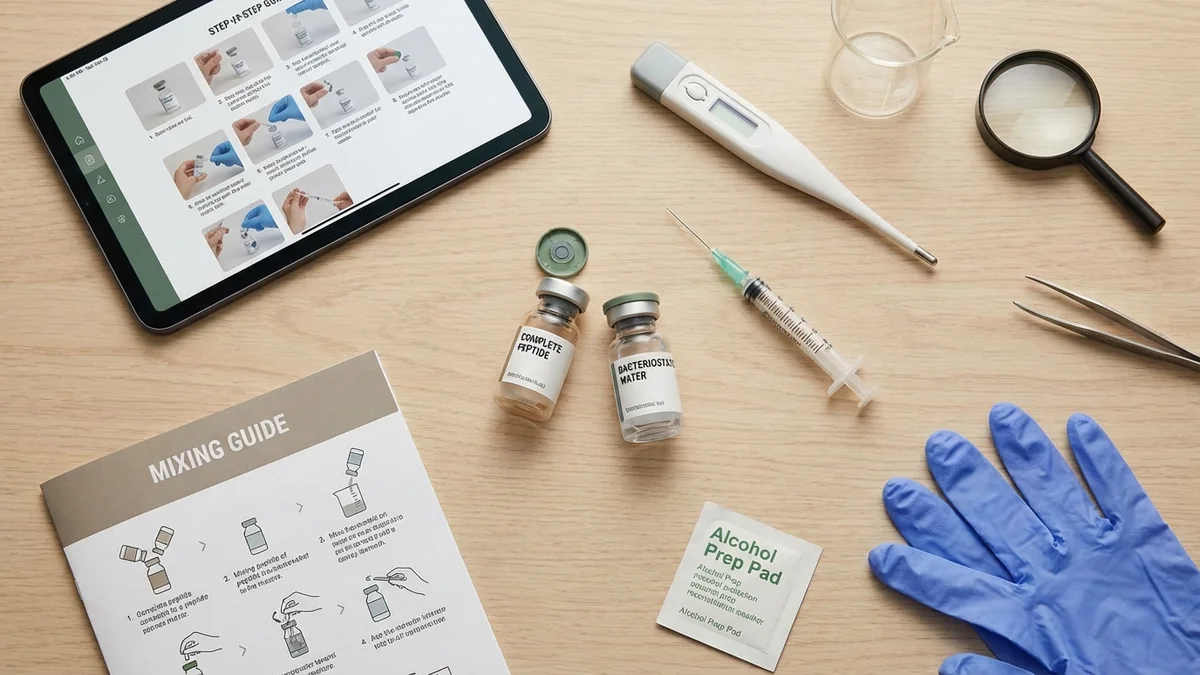
Bacteriostatic water (BAC water): A sterile water preparation containing 0.9% benzyl alcohol as a preservative. The benzyl alcohol inhibits bacterial and fungal growth, making the reconstituted vial safe for multi-dose use over 14–28 days. Source this from a licensed pharmacy — not from a research chemical vendor. Standard vial sizes are 10 mL and 30 mL.
70% isopropyl alcohol swabs: Used to sterilize rubber stoppers before needle insertion. 70% concentration is the standard for surface disinfection in clinical settings — higher concentrations (91–99%) actually evaporate too quickly to be as effective.
29–31 gauge insulin syringes: A 29-gauge needle works for drawing and injecting. Many patients prefer 31-gauge for subcutaneous injection because the smaller bore reduces injection-site discomfort. Standard insulin syringe barrel sizes are 0.3 mL (30 units), 0.5 mL (50 units), and 1.0 mL (100 units). For BPC-157 doses in the 200–500 mcg range, a 0.3 mL or 0.5 mL syringe gives you the most precise volume control.
The lyophilized BPC-157 vial: Typically 5 mg (5,000 mcg) per vial, though 2 mg and 10 mg vials exist. Confirm the labeled amount before calculating your concentration.
Sharps container: Required for safe disposal of used needles. Most states require sharps disposal in an approved container — check your state's guidelines through your local pharmacy or health department.
Clean, well-lit workspace: A hard, non-porous surface (glass, stainless steel, or a clean countertop) wiped down with 70% isopropyl alcohol. Good lighting lets you see the solution clearly during and after reconstitution.
Choosing the Right Diluent
Not all diluents are interchangeable. The wrong choice can limit shelf life, introduce contamination risk, or — in the case of certain peptides — affect solubility. For BPC-157, bacteriostatic water is the standard clinical recommendation.
| Diluent | Preservative | Multi-Use? | Shelf Life After Mixing | Best For |
|---|---|---|---|---|
| Bacteriostatic water (BAC water) | 0.9% benzyl alcohol | Yes | 14–28 days at 36–46°F (2–8°C) | BPC-157, most research peptides, multi-dose vials |
| Sterile water for injection | None | No — single use only | Use immediately or discard | Single-dose injections, peptides sensitive to benzyl alcohol |
| 0.9% sodium chloride (normal saline) | None | No — single use only | Use immediately or discard | Specific clinical applications, IV preparations |
| Acetic acid 0.1–1% | None | No | Use immediately or discard | Peptides with poor aqueous solubility (e.g., some growth hormone fragments) |
For BPC-157 specifically: BAC water is the correct choice for any multi-dose vial. The 0.9% benzyl alcohol preservative is critical — without it, a reconstituted vial becomes a contamination risk within 24–48 hours at refrigerator temperature, and immediately at room temperature. Sterile water is acceptable only if you're drawing a single dose immediately after mixing and discarding the remainder, which is wasteful given typical vial sizes.
One practical note: benzyl alcohol can be irritating at higher concentrations, but at 0.9% in BAC water, injection-site reactions are uncommon at subcutaneous volumes under 1 mL.
Step-by-Step Reconstitution Instructions
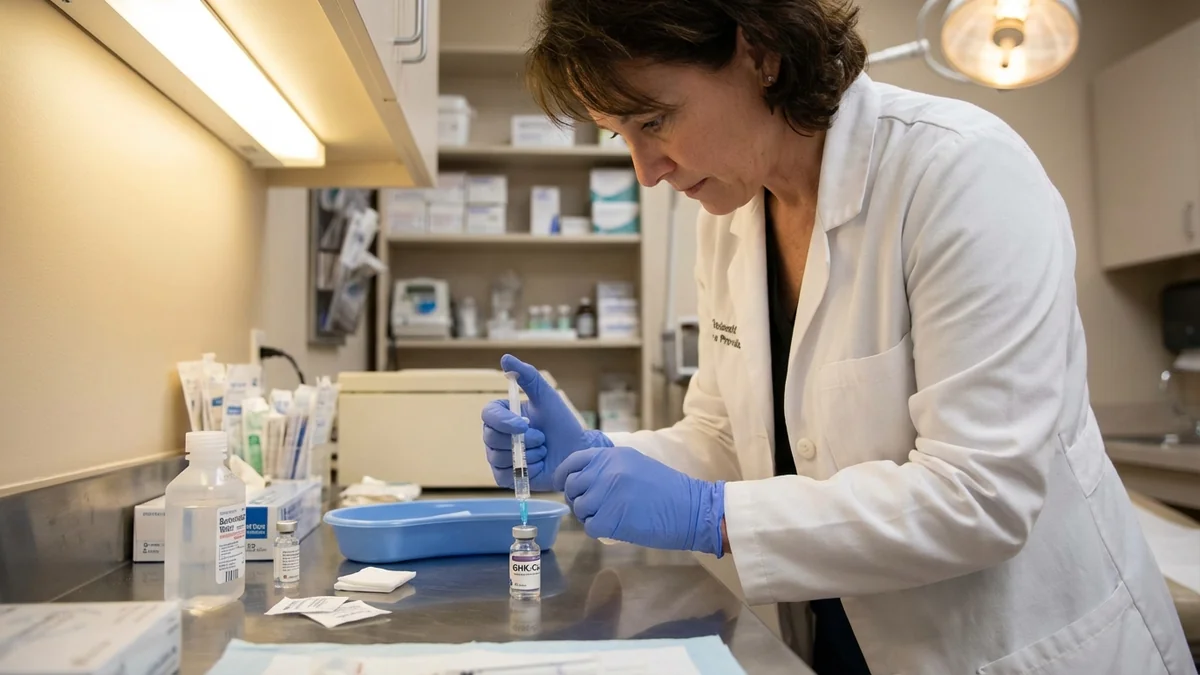
This is the procedure used in clinical and compounding pharmacy settings. Follow it in order.
-
Wash your hands with soap and water for at least 20 seconds. Dry with a clean paper towel, not a cloth towel.
-
Gather all supplies on your cleaned, well-lit workspace. Confirm the BPC-157 vial label: peptide name, lot number, and mg amount. Confirm the BAC water vial is within its expiration date.
-
Clean the rubber stopper of the BPC-157 vial with a fresh 70% isopropyl alcohol swab using a firm circular motion. Let it air-dry for 10 seconds — inserting a needle through a wet stopper can push alcohol into the vial.
-
Clean the rubber stopper of the BAC water vial with a second, separate alcohol swab. Same technique, same 10-second dry time.
-
Draw the correct volume of BAC water into a clean syringe. See the reconstitution calculator section below for the specific volume based on your vial size and target concentration. Pull back the plunger slowly to avoid introducing air bubbles.
-
Insert the needle into the BPC-157 vial at a 45-degree angle, with the bevel (the angled tip) pointed toward the glass wall of the vial — not aimed at the powder cake at the bottom.
-
Depress the plunger slowly, letting the BAC water run down the inside wall of the vial. The goal is a gentle stream along the glass, not a direct jet onto the powder. Direct high-pressure contact with the powder creates shear forces that can denature the peptide — disrupting its tertiary structure and reducing bioactivity.
-
Remove the syringe gently and set it aside in the sharps container if you're done drawing, or cap it if you'll use it again for the same vial.
-
Swirl the vial gently with a slow rolling motion between your palms. Do not shake. Shaking introduces air bubbles and mechanical stress that causes protein aggregation — essentially clumping the peptide into insoluble particles that won't inject properly and won't be bioavailable.
-
Wait 1–2 minutes for complete dissolution. BPC-157 at typical vial concentrations (5 mg in 1–3 mL) dissolves readily. The final solution should be clear and colorless, similar in appearance to water.
-
Inspect the solution by holding the vial up to light. If you see cloudiness, visible particles, or any color other than clear, do not use it. Continue gentle swirling for another 60 seconds. If it remains cloudy or particulate, discard it — this indicates either a contamination issue or peptide degradation.
-
Label the vial immediately with: date reconstituted, peptide name (BPC-157), concentration in mcg/mL, and expiration date (14–28 days from reconstitution date for BAC water). Use a permanent marker or a pre-printed label.
-
Refrigerate immediately at 36–46°F (2–8°C). Do not leave the reconstituted vial at room temperature for more than 30 minutes.
BPC-157 Reconstitution Calculator
This is the math you actually need. The formula is simple:
Concentration (mcg/mL) = Total peptide amount (mcg) ÷ Volume of diluent added (mL)
Volume to inject (mL) = Desired dose (mcg) ÷ Concentration (mcg/mL)
On a standard U-100 insulin syringe, 0.1 mL = 10 units. That's your baseline unit for thinking about injection volumes.
Scenario 1: 5 mg vial + 2 mL BAC water (most common clinical setup)
- Vial contains: 5 mg = 5,000 mcg of BPC-157
- BAC water added: 2 mL
- Concentration: 5,000 mcg ÷ 2 mL = 2,500 mcg/mL
- Per 0.1 mL (10 units on insulin syringe): 250 mcg
To inject 500 mcg: 500 ÷ 2,500 = 0.2 mL (20 units) To inject 250 mcg: 250 ÷ 2,500 = 0.1 mL (10 units)
Scenario 2: 5 mg vial + 1 mL BAC water (more concentrated)
- Vial contains: 5,000 mcg
- BAC water added: 1 mL
- Concentration: 5,000 mcg ÷ 1 mL = 5,000 mcg/mL
- Per 0.1 mL (10 units): 500 mcg
To inject 500 mcg: 500 ÷ 5,000 = 0.1 mL (10 units) To inject 250 mcg: 250 ÷ 5,000 = 0.05 mL (5 units)
Note: At this concentration, you're working with very small volumes (5 units on an insulin syringe). This requires a precise syringe and careful technique — small measurement errors translate to proportionally larger dose errors.
Scenario 3: 5 mg vial + 3 mL BAC water (more dilute, easier measurement)
- Vial contains: 5,000 mcg
- BAC water added: 3 mL
- Concentration: 5,000 mcg ÷ 3 mL = 1,667 mcg/mL
- Per 0.1 mL (10 units): 167 mcg
To inject 500 mcg: 500 ÷ 1,667 = 0.30 mL (30 units) To inject 250 mcg: 250 ÷ 1,667 = 0.15 mL (15 units)
Scenario 4: Working backward from a target dose
You want to inject exactly 200 mcg per dose. You've reconstituted a 5 mg vial with 2 mL BAC water (concentration: 2,500 mcg/mL).
200 mcg ÷ 2,500 mcg/mL = 0.08 mL = 8 units on a U-100 insulin syringe.
Quick-Reference Concentration Table
| BAC Water Added | Concentration | Volume for 200 mcg | Volume for 500 mcg | Volume for 1,000 mcg |
|---|---|---|---|---|
| 1 mL | 5,000 mcg/mL | 0.04 mL (4 units) | 0.10 mL (10 units) | 0.20 mL (20 units) |
| 2 mL | 2,500 mcg/mL | 0.08 mL (8 units) | 0.20 mL (20 units) | 0.40 mL (40 units) |
| 3 mL | 1,667 mcg/mL | 0.12 mL (12 units) | 0.30 mL (30 units) | 0.60 mL (60 units) |
| 5 mL | 1,000 mcg/mL | 0.20 mL (20 units) | 0.50 mL (50 units) | 1.00 mL (100 units) |
All volumes assume a 5 mg (5,000 mcg) vial. Adjust proportionally for 2 mg or 10 mg vials.
How Much Bacteriostatic Water to Add
The volume of BAC water you add directly determines your concentration — and that choice involves a real trade-off.
1 mL: Highest concentration (5,000 mcg/mL for a 5 mg vial). Each dose is a very small injection volume, which some patients prefer. The downside: you're working with 5–10 unit measurements on an insulin syringe, where even a half-unit error changes your dose by 25–50 mcg. This setup works well for experienced users who need precise small-volume injections.
2 mL: The most common clinical recommendation for BPC-157. At 2,500 mcg/mL, a 500 mcg dose is 0.2 mL (20 units) — a comfortable, easy-to-measure volume on any insulin syringe. This is the setup most compounding pharmacies and peptide therapy clinics use as their default.
3 mL: More dilute, larger injection volumes, but easier to measure accurately. A 500 mcg dose at 1,667 mcg/mL is 30 units — straightforward to pull on a 0.5 mL syringe. Some practitioners prefer this for patients new to self-injection, since the larger volume is more forgiving of minor measurement imprecision.
5 mL: Rarely used clinically. The injection volumes become large enough (0.5–1.0 mL per dose) that subcutaneous injections may cause more discomfort and local tissue pressure. Not recommended for routine use.
The practical recommendation: Start with 2 mL. It gives you a workable concentration, comfortable injection volumes, and straightforward math. If your prescribed dose is 250 mcg, that's 10 units — easy to see on any insulin syringe.
For more on typical dosing ranges, see the BPC-157 dosage guide.
Administration Protocol
BPC-157 is administered via subcutaneous injection — meaning into the fat layer just below the skin, not into muscle. Typical prescribed doses range from 200–1,000 mcg/day, with 500 mcg/day being the most commonly reported clinical dose.[1]
Needle gauge: 29–31 gauge. A 31-gauge, 5/16-inch (8 mm) needle is a common choice for subcutaneous injection — short enough to stay in the subcutaneous layer without reaching muscle, fine enough to minimize discomfort.
Injection sites: Rotate among the abdomen (at least 2 inches from the navel), outer thigh, and flank. Rotating sites prevents lipohypertrophy — the localized fat thickening that develops from repeated injections in the same spot. Keep a simple log of which site you used each day.
Injection technique:
- Pinch a fold of skin between your thumb and forefinger at the injection site.
- Insert the needle at a 45-degree angle (or 90 degrees if you have adequate subcutaneous fat).
- Release the skin fold.
- Aspirate briefly — pull back the plunger slightly. If blood appears, withdraw and choose a new site. If no blood, proceed.
- Inject slowly over 5–10 seconds.
- Withdraw the needle at the same angle it entered.
- Apply gentle pressure with a clean swab for 10–15 seconds. Do not rub — rubbing can cause bruising.
Timing: Most practitioners report BPC-157 on an empty stomach or at least 30 minutes before meals, though the pharmacokinetic rationale for this timing in subcutaneous administration is not well-established in human clinical data. Some protocols split the daily dose into two injections (morning and evening).
For injection site guidance and rotation diagrams, see the complete peptide reconstitution guide.
Storage After Reconstitution
Get this wrong and you've wasted your peptide. These aren't conservative guidelines — they're the conditions under which the benzyl alcohol preservative in BAC water actually does its job.
Temperature: 36–46°F (2–8°C). That's a standard household refrigerator. The back of the refrigerator (not the door) maintains the most stable temperature. Door shelves experience temperature fluctuations every time the refrigerator opens.
Light protection: UV light degrades peptide bonds. Store the reconstituted vial in its original cardboard box, or wrap it in aluminum foil. Don't leave it on the refrigerator shelf uncovered.
Shelf life:
- BAC water reconstitution: 14–28 days at 36–46°F (2–8°C) (note: published shelf-life data specific to BPC-157 in bacteriostatic water is limited; this range reflects general compounding-pharmacy guidance for peptides)
- Sterile water reconstitution: single use only — inject immediately and discard the remainder
- Unreconstituted lyophilized powder: 12–24 months at -4°F (-20°C)
Signs of degradation — discard immediately if you see any of these:
- Cloudiness or turbidity (clear solution that has become hazy)
- Visible particulate matter (floating particles or precipitate)
- Color change (any yellow, brown, or pink tint — reconstituted BPC-157 should be clear and colorless)
- Unusual odor when the vial is opened
Never freeze reconstituted peptides. Ice crystal formation physically ruptures the peptide's molecular structure. The lyophilized powder can be frozen; the reconstituted solution cannot.
Travel: If you're traveling with reconstituted BPC-157, use an insulated cooler with ice packs to maintain 36–46°F. For air travel, keep it in your carry-on — checked luggage holds can reach temperatures outside the safe range. If you're traveling with a physician-prescribed peptide, carry a copy of the prescription and a letter from your provider. TSA guidelines for injectable medications allow syringes and vials in carry-on luggage when accompanied by medication labels.
Expired reconstituted peptide: Do not inject peptide past its labeled expiration date. Dispose of the vial contents by diluting with water and flushing (check local regulations), and place the vial and used syringes in your sharps container.
Common Reconstitution Mistakes
1. Spraying water directly onto the powder. The jet of liquid hitting the powder cake creates shear forces that mechanically disrupt the peptide's structure. Always aim the stream at the glass wall.
2. Shaking the vial. This is the most common mistake and one of the most damaging. Vigorous shaking introduces air-water interfaces that cause protein aggregation — the peptide clumps into insoluble particles. If you've shaken a vial, inspect it carefully. Visible cloudiness or foam means the peptide has likely been compromised.
3. Using the wrong volume of BAC water. Adding 5 mL when you intended 2 mL gives you a concentration of 1,000 mcg/mL instead of 2,500 mcg/mL — meaning every dose you inject is 60% lower than intended. Always double-check your math before drawing.
4. Skipping the alcohol swab step. The rubber stopper is not sterile out of the box. Every needle insertion that bypasses a swab introduces contamination risk. In a multi-dose vial used over 14–28 days, that risk compounds with every injection.
5. Storing at room temperature. Room temperature (68–77°F / 20–25°C) accelerates peptide degradation significantly. A reconstituted vial left on a countertop for 24 hours may still look clear, but its potency will have declined. Refrigerate immediately after reconstitution and after every use.
6. Reusing syringes. A needle used once is already dulled — the microscopic tip deformation is invisible but causes more tissue trauma on subsequent injections. Reusing also introduces contamination risk. One syringe, one use.
7. Using expired bacteriostatic water. BAC water has an expiration date. Expired BAC water may have degraded benzyl alcohol — meaning reduced preservative efficacy — and potentially altered pH that can affect peptide stability. Check the expiration date before every reconstitution.
8. Using the injection syringe to draw from the vial repeatedly. If you use the same syringe to inject and then re-enter the vial for your next dose, you're introducing skin flora and potential contaminants into the vial with every draw. Use a dedicated draw syringe, or draw your dose fresh each time with a new syringe.
Reconstitution vs. Pre-Mixed Peptides
Lyophilized (requires reconstitution): This is the standard format from compounding pharmacies and most clinical suppliers. The powder is stable for 12–24 months when stored at -4°F (-20°C), making it practical to ship and store. You control the concentration by choosing your reconstitution volume. The trade-off is that reconstitution requires technique and equipment.
Pre-mixed/ready-to-use: Some telehealth peptide clinics ship peptides pre-reconstituted as a convenience. The shelf life is shorter (typically 14–28 days from the clinic's reconstitution date), and you have no control over the concentration. These preparations are typically more expensive per dose. If you receive a pre-mixed vial, confirm the concentration in mcg/mL with your provider before calculating doses.
Why legitimate clinics teach reconstitution: A provider who teaches you to reconstitute your own peptides is giving you a skill that translates across multiple compounds and treatment cycles. It also means you can verify the concentration yourself. Clinics that ship only pre-mixed vials without explaining the concentration math are making it harder for you to be an informed patient.
Find a qualified provider through the MyPeptideMatch clinic finder or browse telehealth peptide clinics if you prefer remote consultation.
What the Evidence Does Not Show
BPC-157 has a substantial body of preclinical research — animal studies showing accelerated tendon healing, gut mucosal repair, and anti-inflammatory effects.[2],[3],[4],[5] A 2025 literature and patent review described its "pleiotropic beneficial effects in various preclinical models" including tissue injury, inflammatory bowel disease, and CNS disorders.[1] A 2025 systematic review in the HSS Journal examined its emerging use in orthopaedic sports medicine.[3]
What that research does not show — at least not yet:
No completed, published Phase II or Phase III human clinical trials for BPC-157 in any indication have been identified in the published literature as of mid-2026. The overwhelming majority of efficacy data comes from rodent models. Translating animal study results to human outcomes is not straightforward, and the dose-response relationships established in rats do not map directly to human dosing.
Optimal human dosing is not established. The 200–1,000 mcg/day range cited in practitioner-reported protocols is not derived from dose-finding clinical trials in humans. It reflects extrapolation from animal studies and accumulated clinical observation — not the same evidentiary standard as an FDA-approved drug.
Long-term safety data in humans is limited. The 2025 review noted that "only a few side effects have been reported following its administration,"[1] which is a reasonable characterization of the current data — but limited reporting is not the same as confirmed safety. Long-term human data simply doesn't exist yet at the scale needed to characterize rare adverse events.
The FDA's Category 2 Prohibited classification reflects the agency's determination that BPC-157 lacks sufficient evidence for approved use. That status is current as of this writing and should be confirmed at FDA.gov before making any clinical decisions.
Safety and Legal Considerations
BPC-157 is classified as a Category 2 Prohibited compound by the FDA, meaning it has no approved commercial pathway in the US and is not available through licensed compounding pharmacies for human use. The FDA has taken enforcement action against companies marketing unapproved BPC-157 products. Patients and providers should consult FDA.gov and the FDA's MedWatch program for current enforcement activity.
Most people sourcing BPC-157 in the US do so through research-use vendors — that's the practical reality for this compound right now. If that's your situation, the quality considerations below apply directly to you.
Pharmaceutical-grade bacteriostatic water must come from a licensed pharmacy or medical supplier. BAC water from unverified sources may have incorrect benzyl alcohol concentrations, non-sterile manufacturing, or incorrect pH — any of which can compromise the reconstituted peptide or cause injection-site reactions.
Peptide purity matters enormously. Research-use peptide vendors vary widely in quality. Third-party certificate of analysis (CoA) from an independent lab — not the vendor's own testing — is the minimum standard for verifying peptide identity, purity (>98% by HPLC), and absence of contaminants. Incorrect labeling (a vial labeled as 5 mg that contains 2 mg, or contains a different peptide entirely) has been documented in the research chemical market.
Sharps disposal: Used syringes and needles must be disposed of in an approved sharps container. Most states prohibit disposal of sharps in regular household trash. Many pharmacies offer sharps take-back programs. Check your state's regulations — requirements vary significantly.
For a full breakdown of BPC-157's regulatory status, see the BPC-157 legal status guide.
FAQ
Can I use regular tap water or distilled water instead of bacteriostatic water? No. Tap water is not sterile and contains minerals, chlorine, and microorganisms that will contaminate your peptide and create serious infection risk when injected. Distilled water is sterile but has no preservative — it's single-use only, and even then, it's not the standard for injectable preparations. Use pharmaceutical-grade bacteriostatic water or sterile water for injection (single-dose only) from a licensed pharmacy.
How long does reconstituted BPC-157 last? With bacteriostatic water (0.9% benzyl alcohol), 14–28 days at 36–46°F (2–8°C) is the standard guidance for peptides generally. If you reconstituted with sterile water (no preservative), use it immediately and discard the rest. Label every vial with the reconstitution date and a calculated expiration date so you're never guessing.
Can I travel with reconstituted BPC-157? Yes, with planning. Use an insulated cooler with ice packs to maintain 36–46°F during transit. For air travel, keep it in your carry-on — checked luggage can experience temperature extremes. TSA permits injectable medications in carry-on bags. If you're traveling with a prescription, carry the prescription documentation and a provider letter. If your BPC-157 is not from a licensed pharmacy (i.e., research-use), be aware that the legal status at your destination may differ from the US.
What if the powder doesn't dissolve completely? Continue gentle swirling for 2–3 minutes. BPC-157 should dissolve readily in BAC water at room temperature. If you see persistent cloudiness or particles after 5 minutes of gentle swirling, do not inject — this suggests either a manufacturing quality issue with the peptide, contamination, or a diluent problem. Discard the vial.
Can I mix BPC-157 with other peptides in the same syringe? Some practitioners report combining BPC-157 with TB-500 (thymosin beta-4) in the same injection, citing complementary mechanisms of action in tissue repair.[4] However, combining peptides in a single syringe introduces compatibility variables — pH interactions, potential aggregation — that haven't been formally studied. If your provider has specifically prescribed a combination protocol, follow their guidance. Don't combine peptides on your own initiative without clinical direction.
How do I know if my reconstituted peptide has gone bad? The visual inspection checklist: the solution should be clear and colorless. Discard immediately if you see cloudiness, visible particles, any color change (yellow, brown, or pink), or if the solution has an unusual odor. When in doubt, discard. The cost of a vial is far less than the risk of injecting a degraded or contaminated solution.
What syringe size should I use? For BPC-157 subcutaneous injection, a 29–31 gauge, 5/16-inch (8 mm) needle on a 0.3 mL or 0.5 mL insulin syringe is standard. The 0.3 mL syringe (30 units) is ideal for doses in the 200–500 mcg range when reconstituted at 2,500 mcg/mL (2 mL BAC water in a 5 mg vial), as your injection volume will be 8–20 units — well within the syringe's range and easy to read accurately.
Does it matter how fast I add the water during reconstitution? Yes. Add the BAC water slowly — over 30–60 seconds for a 2 mL volume. A fast, forceful injection of liquid creates turbulence and shear stress at the powder-liquid interface. Slow addition along the glass wall minimizes mechanical disruption to the peptide structure.
Can I reconstitute a full vial ahead of time for an entire treatment cycle? If your cycle is 14–28 days and you're using BAC water, reconstituting the full vial at the start of the cycle is reasonable — that's exactly what the 14–28 day shelf life is designed for. Label the vial with the expiration date. Don't reconstitute more than 28 days' worth at once, and don't use the vial past its labeled expiration date regardless of how it looks.
What should the solution look like after mixing? Clear and colorless — essentially indistinguishable from water. There should be no cloudiness, no foam (if there's foam, you may have shaken it), no color, and no visible particles. If the original powder was white and the solution is anything other than clear after complete dissolution, something is wrong.
References
-
Vukorep AL, et al. "Multifunctionality and Possible Medical Application of the BPC 157 Peptide-Literature and Patent Review." Pharmaceuticals (Basel). 2025. PMID: 40005999
-
Borrelli F, et al. "Gastric pentadecapeptide body protection compound BPC 157 and its role in accelerating musculoskeletal soft tissue healing." Cell and Tissue Research. 2019. PMID: 30915550
-
Emerging Use of BPC-157 in Orthopaedic Sports Medicine: A Systematic Review. HSS Journal: The Musculoskeletal Journal of Hospital for Special Surgery. 2025. PMID: 40756949
-
Gwyer D, et al. "Intra-Articular Injection of BPC 157 for Multiple Types of Knee Pain." Alternative Therapies in Health and Medicine. 2021. PMID: 34324435
-
Stable Gastric Pentadecapeptide BPC 157 and Wound Healing. Frontiers in Pharmacology. 2021. PMID: 34267654
This guide is for educational purposes only and does not constitute medical advice. Peptide reconstitution should only be performed under the guidance of a licensed healthcare provider. Never self-prescribe or self-administer peptides without medical supervision. Use our clinic finder to find a qualified peptide therapy provider near you.
Related Tools
Find a Peptide Therapy Clinic Near You
Browse our directory of verified peptide therapy clinics across the United States. Compare providers, read reviews, and request a consultation.
Looking to buy BPC-157 for research?
Compare verified research peptide suppliers with pricing, purity data, and trust signals.
MyPeptideMatch.com does not provide medical advice. Always consult a qualified healthcare provider before starting any peptide therapy. Regulatory status may change.