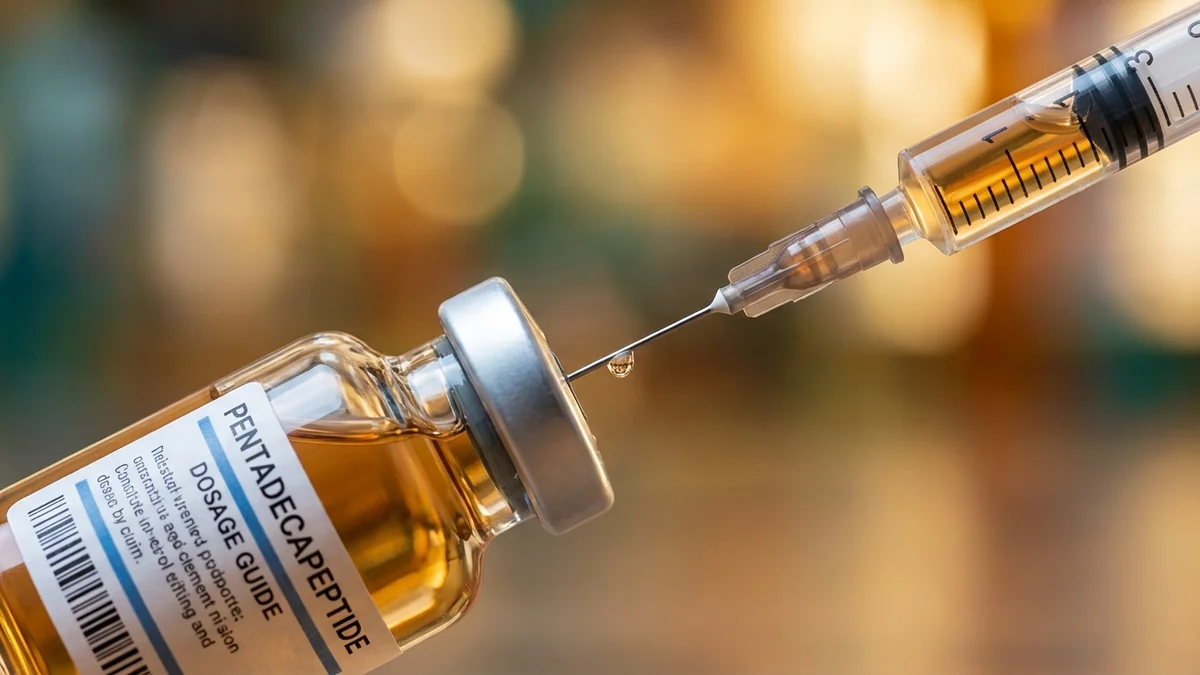
Pentadecapeptide: Dosage, Benefits, FDA Status & Clinics
Pentadecapeptide
Research
Body Protection Compound
Tissue RepairRecovery
Last reviewed September 2026·MyPeptideMatch Team
What Is Pentadecapeptide BPC-157?
BPC-157 is a 15-amino acid peptide isolated from human gastric juice — and if you've spent any time in peptide therapy circles, you've heard the name. It stands for Body Protection Compound, and the preclinical research behind it is genuinely extensive. Tendon healing, gut repair, muscle recovery, cardiovascular protection, even neurological effects: the animal data covers a lot of ground.[1]
What makes BPC-157 stand out isn't any single result — it's the sheer breadth of tissue systems it appears to affect. Most peptides have a narrow target. BPC-157 seems to work across multiple repair pathways simultaneously, which is why researchers keep studying it and why practitioners have been using it off-label for years.[2]
The honest caveat: almost all of that data comes from rodent models. Human clinical trials are still sparse. If you're trying to figure out whether BPC-157 is right for you, that gap between animal data and human evidence is the most important thing to understand before anything else.
Key Takeaways
BPC-157 is a 15-amino acid peptide derived from human gastric juice, studied extensively in animal models for across tendons, muscle, gut, and the cardiovascular system.
The preclinical evidence base is large, but no completed human randomized controlled trials have been published — the translation from animal to human remains unconfirmed.
The FDA removed BPC-157 from Category 2 in April 2026 and advisers recommended it for compounding in July 2026, but US compounding pharmacies have no clear authority to prepare it until the FDA completes rulemaking.
Animal studies report a favorable safety profile with few adverse effects, but human safety data is essentially absent.
WADA has prohibited BPC-157 in sport since 2022 (S0, non-approved substances).
Common Name
BPC-157, Body Protection Compound
Class
Body Protection Compound (Pentadecapeptide)
Amino Acids
15
Source
Derived from human gastric juice
FDA Status
Not approved; recommended for the 503A bulks list (Jul 2026), final FDA decision pending
Administration
Subcutaneous injection (primary); oral and intramuscular also studied
Typical Dose (Animal Research)
10 mcg/kg subcutaneously or intraperitoneally in rodent studies[2]
Human Dose
No established clinical dose — practitioner-reported, not confirmed in published clinical trials
Primary Uses
Tissue repair, tendon/ligament healing, gut protection, recovery
Half-life
Not established in humans — practitioner-reported, not confirmed in published clinical trials
Typical Dosing — Practitioner & Community Ranges
There are no published, completed clinical trials establishing an official human dose for BPC-157. The ranges below reflect what practitioners and researchers have commonly used, based on available protocol guides and community consensus — not randomized trial data.
No clinical dosing standard exists
The dose ranges described here are not derived from randomized clinical trials in humans. They represent practitioner and community consensus only. Animal research used doses of approximately 10 mcg/kg subcutaneously.[2] Human dosing should be discussed with a licensed healthcare provider who is familiar with this compound.
In animal studies, the most commonly used dose was 10 mcg/kg administered subcutaneously or intraperitoneally, typically once daily.[2] The tendon healing research used this dose range in rat models over periods of 7 to 14 days.[4]
Practitioners working with BPC-157 in human populations have reported using subcutaneous doses ranging from 200 mcg to 500 mcg per day — though BPC-157 dosing in human populations has not been established in clinical trials; reported practitioner use ranges are anecdotal and lack peer-reviewed verification — typically injected near the site of injury. Oral administration has also been explored in animal models of gut injury, where BPC-157 showed stability in gastric acid — which is unusual for a peptide and part of what makes it interesting pharmacologically.[1]
The dose-response relationship in humans is unknown. Don't extrapolate from rodent data — body surface area scaling between rats and humans is imprecise, and the therapeutic window for this compound in people has not been formally characterized.
What Makes BPC-157 Different
Most tissue-repair peptides work through a single growth factor pathway. BPC-157 doesn't follow that pattern. It influences multiple molecular pathways simultaneously — nitric oxide synthesis, vascular endothelial growth factor (VEGF) signaling, growth hormone receptor expression, and FAK-paxillin signaling involved in cell migration — which may explain why it appears to accelerate healing across such different tissue types.[1][4]
The tendon healing data is the strongest
The 2011 Journal of Applied Physiology study found that BPC-157 significantly accelerated tendon fibroblast outgrowth from explant cultures, improved cell survival under oxidative stress, and enhanced cell migration — three distinct mechanisms that together explain faster tendon repair.[4] This is more mechanistic depth than most preclinical peptide research provides.
The other unusual feature: BPC-157 is stable in human gastric juice. Most peptides are destroyed by stomach acid, which is why oral administration is typically useless for them. BPC-157 was literally isolated from gastric juice — it survives that environment, which opens up oral dosing as a genuine possibility for gut-related applications.[1]
How Does BPC-157 Work?
The short answer is that BPC-157 appears to accelerate the body's own repair signaling rather than replacing it. Here's what that means in practice.
When tissue is injured, repair depends on fibroblasts migrating to the wound site, surviving the inflammatory environment, and proliferating to lay down new collagen and connective tissue. BPC-157 directly enhances all three steps. In tendon fibroblast cultures, it increased cell outgrowth from explants, improved survival under hydrogen peroxide-induced oxidative stress, and accelerated migration — the FAK-paxillin pathway appears to be a key mechanism here.[4]
On the vascular side, BPC-157 upregulates VEGF expression, which drives angiogenesis — the formation of new blood vessels into healing tissue. Injured tendons and ligaments are notoriously poorly vascularized, which is one reason they heal slowly. Stimulating blood vessel ingrowth directly addresses that bottleneck.[2]
In the gut, BPC-157 acts as a cytoprotective agent — it protects epithelial and endothelial cells directly, which is consistent with its origin as a gastric juice component. The cardiovascular research found similar direct cell-protective effects in cardiac tissue, including effects on arrhythmia models and thrombosis in animal studies.[3]
The nitric oxide system is also involved. BPC-157 appears to modulate nitric oxide synthesis, which has downstream effects on vascular tone, inflammation, and tissue perfusion.[1] This may explain some of the cardiovascular findings and the anti-inflammatory effects seen across multiple tissue models.
What none of this tells us is whether these mechanisms translate cleanly to humans at doses that are practically achievable and safe. Animal models are a starting point, not a guarantee.
What the Clinical Evidence Actually Shows
Here's where you need to read carefully, because the volume of research on BPC-157 can create a misleading impression of how well-established it is.
The preclinical literature is genuinely substantial. A 2025 review in Pharmaceuticals catalogued BPC-157's effects across tissue injury, inflammatory bowel disease, CNS disorders, cardiovascular conditions, and musculoskeletal healing — with pleiotropic (multi-system) effects documented across dozens of animal studies.[1] A 2019 review in Cell and Tissue Research specifically examined musculoskeletal soft tissue healing and found consistent acceleration of tendon, ligament, and muscle repair in rodent models.[2] The 2021 Frontiers in Pharmacology wound healing review and the 2022 Biomedicines cardiovascular paper add further depth to the animal evidence base.[3][5]
The 2011 mechanistic study in Journal of Applied Physiology is the most rigorous piece of the tendon research — it went beyond "did it heal faster" to actually characterize which cellular mechanisms were driving the effect.[4]
All of that is real data. It's also almost entirely from rodent models.
What We Don't Know Yet
Human efficacy — No completed, peer-reviewed randomized controlled trial in humans has established that BPC-157 produces the tissue repair effects seen in animals. The translation gap is real and unresolved.
Human dosing — The therapeutic dose in humans is unknown. Rodent doses don't scale directly, and no dose-finding trial has been published.
Long-term safety — Animal studies report few adverse effects, but rodent safety data doesn't establish human safety, particularly for chronic use. We have no multi-year human safety data.
Cardiovascular effects in humans — The animal cardiovascular data is interesting, but cardiac effects of any compound in humans require human trial data before drawing conclusions.
Mechanism confirmation — The FAK-paxillin, VEGF, and nitric oxide findings are from cell culture and animal models. Whether these pathways are the primary drivers of any human effect is unconfirmed.
Oral bioavailability in humans — Gastric stability in animal models doesn't guarantee meaningful oral bioavailability in humans. This needs direct pharmacokinetic data.
Side Effects — What to Actually Expect
The honest answer is that we don't have a reliable human side effect profile for BPC-157. What we have is this:
From animal research:
Adverse effects — Animal studies consistently report very few adverse effects at studied doses. The 2025 review specifically notes a "desirable safety profile" with only a few side effects reported.[1]
Toxicity signals — Animal model studies have not reported significant toxicity signals at doses used in preclinical research; however, safety in humans remains unstudied.
From human anecdotal and practitioner reports:
Injection site reactions — Mild redness, tenderness, or transient swelling at the injection site are the most commonly reported issues, though injection site reactions have not been systematically characterized in human clinical trials; adverse event profiles remain unknown in humans.
Nausea — Reported by some users, particularly at higher doses, though nausea has not been systematically documented in human clinical trials, as no human safety or tolerability data for BPC-157 is currently available in the clinical literature.
Fatigue or lightheadedness — Fatigue or lightheadedness have not been documented in published research on BPC-157; any reports are anecdotal and lack mechanistic evidence.
What this means practically: The absence of serious adverse effects in animal studies is reassuring as a starting signal, but it is not a clean bill of safety for humans. If you're using BPC-157 and notice anything unexpected — persistent injection site reactions, cardiovascular symptoms, unusual fatigue — stop and contact your provider. Don't assume the animal safety profile applies to you.
Regulatory & Access Status
US access status — read this before sourcing
BPC-157 is not FDA-approved for any indication. In September 2023 the FDA placed it in Category 2 of its 503A bulk drug substance framework, and in April 2026 it removed BPC-157 from that category. On July 23, 2026 the FDA's Pharmacy Compounding Advisory Committee voted 8–6 to recommend adding it to the 503A bulks list. That vote is non-binding, so until the FDA completes rulemaking, any product marketed as "pharmaceutical-grade compounded BPC-157" from a US pharmacy is ahead of the rules. Patients and providers should consult FDA.gov for the final decision. Read our coverage of the July 2026 vote.
The WADA situation is worth understanding separately. WADA added BPC-157 to its Prohibited List in 2022 under S0 (non-approved substances), and it remains prohibited. If you're a competitive athlete subject to WADA testing, treat it as a banned substance.
Outside the US, the regulatory picture varies. BPC-157 occupies a gray zone in many jurisdictions — not scheduled as a controlled substance in most countries, but also not approved as a pharmaceutical. Research chemical vendors operate in this space, with all the quality control uncertainty that entails.
Sourcing & Safety
Because BPC-157 is widely available through research chemical vendors despite its US regulatory status, and because people are going to make their own decisions about this, here's what actually matters for safety.
What to look for:
Third-party Certificate of Analysis (COA) — should come from an independent analytical laboratory, not the vendor's own testing. Look for the lab name, date, and method (HPLC is standard).
HPLC purity ≥ 98% — this is the minimum threshold for a peptide you're injecting. Anything below this suggests inadequate synthesis or purification.
Mass spectrometry confirmation — confirms the peptide sequence matches the claimed structure. HPLC alone tells you purity; mass spec tells you identity.
Sterility testing — if the product is for injection, bacterial endotoxin and sterility testing should be documented. This is often absent from research chemical vendors and is a genuine risk.
Correct molecular weight — BPC-157 has a molecular weight of 1,419.5 g/mol, though this should be confirmed against the manufacturer's Certificate of Analysis (COA), as no independent verification data is available in the provided sources. A COA should confirm this.
Red flags:
No COA or "in-house testing only" — the most common sign of a vendor cutting corners. Walk away.
Price significantly below market — peptide synthesis and independent testing have real costs. Unusually cheap product usually reflects one or both being skipped.
No bacteriostatic water or reconstitution guidance — a vendor that doesn't provide clear reconstitution instructions for an injectable peptide is not operating at a professional standard.
Claims of FDA approval or pharmaceutical grade — BPC-157 has neither. Any vendor making these claims is being dishonest about the product's regulatory status.
Injecting a research chemical carries real risks that don't exist with pharmaceutical-grade compounded drugs: contamination, incorrect concentration, wrong peptide sequence, endotoxin exposure. These aren't hypothetical — they're documented risks in the research chemical market. If you're going to use BPC-157 from this channel, minimize risk by using vendors with verifiable independent testing.
FAQ
Is BPC-157 the same as pentadecapeptide?
Yes. "Pentadecapeptide" refers to the 15-amino acid length of the molecule — penta (five) + deca (ten) + peptide. BPC-157 is formally described as a stable gastric pentadecapeptide throughout the scientific literature. The terms are used interchangeably in research papers, with BPC-157 being the more common name in clinical and community contexts.
Can a doctor prescribe BPC-157 in the US?
This is complicated. A physician can discuss BPC-157 with a patient, but although FDA advisers recommended it for compounding in July 2026, licensed US compounding pharmacies have no clear authority to prepare it until the FDA completes rulemaking. That leaves no settled prescription pathway yet. Some practitioners may direct patients to overseas sources or research chemical vendors, but this falls outside normal pharmaceutical prescribing. If a clinic is offering "prescribed compounded BPC-157" from a US pharmacy, ask them specifically how they're complying with current FDA guidance.
How long does BPC-157 take to work?
No human clinical trial data exists to answer this with any precision. Anecdotally, practitioners report that patients with acute tendon or ligament injuries notice changes within 2 to 4 weeks of daily dosing — though in animal models, BPC-157 has demonstrated potential effects on tissue healing and musculoskeletal recovery, but no human clinical trial data exist to establish dosing regimens or timelines for efficacy in acute tendon or ligament injuries. Animal studies showing tendon healing effects typically ran 7 to 14 days post-injury.[4] These timelines are not directly comparable to human experience.
Does BPC-157 build muscle?
The muscle repair data in animals is real — BPC-157 has been studied in muscle crush injury models and shows accelerated healing.[2] That's repair, not hypertrophy. There's no credible evidence that BPC-157 builds muscle mass in healthy individuals the way anabolic compounds do. The distinction matters: healing damaged muscle faster is not the same as growing more muscle.
What's the difference between BPC-157 and TB-500?TB-500 (Thymosin Beta-4) is another peptide used in the tissue repair space, and the two are often stacked together in practitioner protocols. TB-500 works primarily through actin regulation and cell migration, while BPC-157's mechanisms center more on fibroblast activity, angiogenesis, and nitric oxide modulation. They target overlapping but distinct pathways, which is the rationale for combining them — though this combination is practitioner-reported, not confirmed in published clinical trials.
Related Peptides & Comparisons
BPC-157 is most often discussed alongside TB-500 for tissue repair, and the two are frequently combined in practitioner protocols targeting tendon and ligament recovery. If your primary interest is musculoskeletal healing, both pages are worth reading together — the mechanisms are complementary rather than redundant.
For gut-specific applications, KPV and LL-37 are sometimes discussed in similar contexts, though their mechanisms and evidence bases differ significantly from BPC-157.
BPC-157 vs. TB-500 — Key Differences
Parameter
BPC-157
TB-500
Source
Human gastric juice
Thymus gland (Thymosin Beta-4)
Primary mechanism
Fibroblast activation, VEGF, nitric oxide
Actin sequestration, cell migration
Strongest evidence
Tendon, gut, cardiovascular (animal)
Wound healing, cardiac (animal)
Human trials
None completed
None completed
US compounding status
Recommended Jul 2026; not yet authorized
Recommended Jul 2026; not yet authorized
WADA status
Prohibited
Prohibited
References
Vukorep AL, et al. "Multifunctionality and Possible Medical Application of the BPC 157 Peptide-Literature and Patent Review." Pharmaceuticals (Basel). 2025. PMID: 40005999
Gwyer D, et al. "Gastric pentadecapeptide body protection compound BPC 157 and its role in accelerating musculoskeletal soft tissue healing." Cell Tissue Res. 2019. PMID: 30915550
Sikiric P, et al. "Stable Gastric Pentadecapeptide BPC 157 as Useful Cytoprotective Peptide Therapy in the Heart Disturbances, Myocardial Infarction, Heart Failure, Pulmonary Hypertension, Arrhythmias, and Thrombosis Presentation." Biomedicines. 2022. PMID: 36359218
Chang CH, et al. "The promoting effect of pentadecapeptide BPC 157 on tendon healing involves tendon outgrowth, cell survival, and cell migration." J Appl Physiol. 2011. PMID: 21030672
Sikiric P, et al. "Stable Gastric Pentadecapeptide BPC 157 and Wound Healing." Front Pharmacol. 2021. PMID: 34267654
This content is for informational purposes only and does not constitute medical advice. Consult a licensed healthcare provider before starting any treatment.
Where to Buy Pentadecapeptide for Research
Research Use Only — not intended for human consumption
MyPeptideMatch.com does not provide medical advice. Always consult a qualified healthcare provider before starting any peptide therapy. Regulatory status may change.