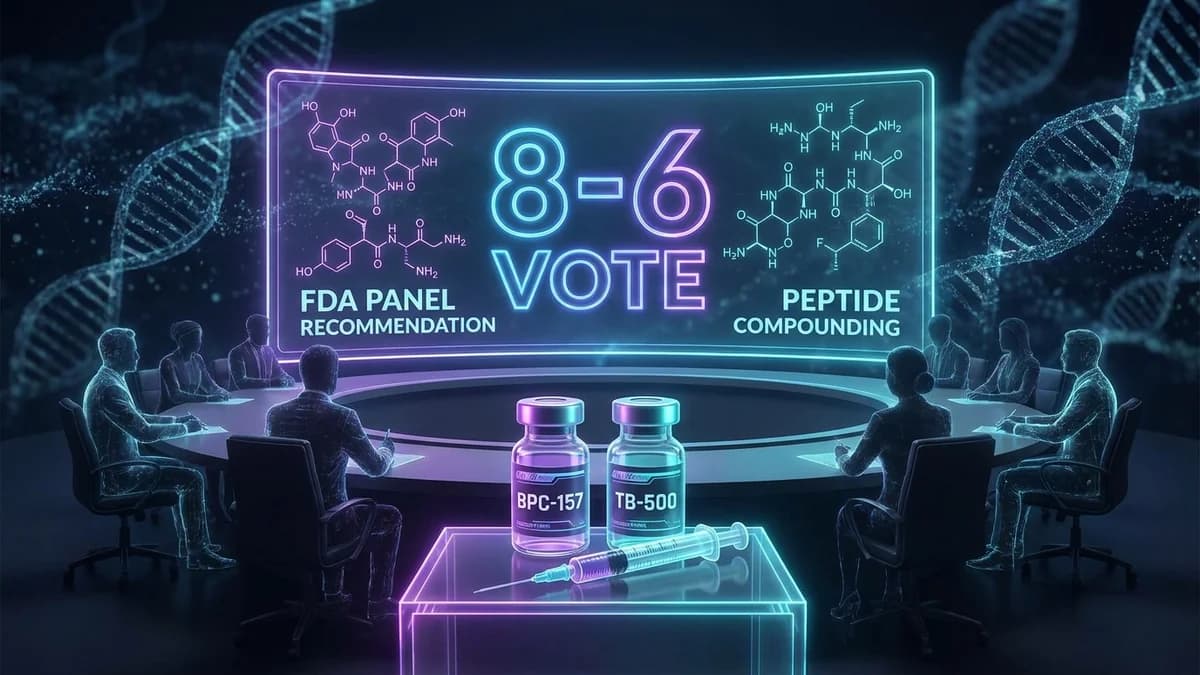
On July 23, 2026, at roughly 10:00 AM Eastern, a federal advisory panel did something that almost never happens: it publicly overruled the FDA's own scientists. Then it did it again. By the end of a two-day hearing at the agency's White Oak campus in Silver Spring, Maryland, the Pharmacy Compounding Advisory Committee had voted against the FDA staff's written recommendation six consecutive times.
The result: six popular peptides — including BPC-157 and TB-500 — received committee recommendations for placement on the 503A Bulk Drug Substances list, the regulatory mechanism that allows licensed compounding pharmacies to legally prepare a compound for patients with a prescription. Reporters in the room described an audible gasp when the first vote tally was read aloud.
Here is a plain-English breakdown of what happened, the forces behind it, what the vote actually changes, and what needs to happen before any of it reaches patients.
Key Takeaways
- Six peptides received favorable recommendations for 503A compounding eligibility: BPC-157, KPV, TB-500, MOTS-c, Epitalon, and Semax. One peptide — Emideltide (DSIP) — was rejected.
- The votes are advisory and non-binding. The FDA is not legally required to follow the committee's recommendations. Any formal change requires a separate notice-and-comment rulemaking process.
- Rulemaking typically takes 8–12 months — and has taken longer. The FDA has completed this process for only about ten substances since Congress created the list in 1997.
- Interim enforcement discretion is the expected near-term path. Legal analysts widely anticipate the FDA will signal it won't take action against pharmacies compounding the six cleared peptides while rulemaking proceeds.
- A prescription from a licensed physician is still required. These are not supplements or over-the-counter products. A doctor must evaluate you and write an order.
- Insurance will almost certainly not cover it. Compounded drugs are almost universally excluded from coverage. Expect out-of-pocket monthly costs of $80–$350 per peptide, plus an initial consultation fee of $150–$400.
- BPC-157 is not FDA-approved and is not legal over the counter, regardless of how this vote is characterized in media coverage. The committee's recommendation is one step in a longer process.
What Happened: The July 23–24, 2026 PCAC Vote
The FDA's Pharmacy Compounding Advisory Committee (PCAC) convened on July 23 and 24 to evaluate whether seven peptides should be added to the 503A Bulk Drug Substances (Category 1) list.
This list — established by Congress in 1997 under the Federal Food, Drug, and Cosmetic Act — specifies which ingredients licensed compounding pharmacies may legally source from FDA-registered manufacturers and prepare for individual patients under a valid prescription. Placement on the list is the regulatory pathway that turns a peptide from "grey-market compound" into a physician-supervised, pharmacy-dispensed medicine.
The PCAC almost never votes against the FDA staff's written recommendation. At this meeting, it did so six times in two days.
Day One Votes (July 23)
| Peptide | Proposed indication | Result |
|---|---|---|
| BPC-157 | Ulcerative colitis | 8–6, 1 abstention — Recommended ✓ |
| KPV | Wound healing, inflammatory conditions | 8–6, 1 abstention — Recommended ✓ |
| TB-500 | Tissue repair | 8–6, 1 abstention — Recommended ✓ |
| MOTS-c | Obesity, osteoporosis | 7–5, 2 abstentions — Recommended ✓ |
Day Two Votes (July 24)
| Peptide | Proposed indication | Result |
|---|---|---|
| Epitalon | Insomnia | 7–4 — Recommended ✓ |
| Semax | Migraine, cerebral ischemia | 8–5 — Recommended ✓ |
| Emideltide (DSIP) | Insomnia, opioid withdrawal | 6–7 — Not recommended ✗ |
The committee recommended both the free base and acetate formulations of each cleared peptide.
Why Did the FDA's Own Scientists Say No?
Before the hearing convened, FDA staff scientists had unanimously recommended against adding every single peptide to the list. Their objections clustered around three main concerns.
1. Thin Clinical Evidence
The overwhelming majority of supporting data for these compounds comes from animal studies — primarily rats, mice, and dogs. Well-controlled human clinical trials are sparse or nonexistent. The FDA's standard bar for approved drugs involves multiple phases of large, randomized, placebo-controlled trials with thousands of participants. None of these peptides come close to meeting that bar for their proposed indications.
2. Inconsistent Chemical Naming
For several peptides, FDA reviewers said they couldn't confirm which exact molecular version of the compound a compounding pharmacy would actually prepare — raising questions about whether dosing and safety standards could be enforced consistently. As Russell Wesdyk, associate director for Regulatory Affairs at FDA's Center for Drug Evaluation and Research, said during the hearing: "If you don't know what it is and I don't know what it is, how do I put it on the list?"
3. Approved Alternatives Already Exist
For every proposed indication — ulcerative colitis, wound healing, tissue repair, insomnia, migraine — the FDA noted that established, approved medications with decades of safety data are already available to patients.
Emideltide (DSIP) drew an additional objection: the compound stimulates endorphin release, raising a theoretical addictive potential. Even committee members who had voted "yes" all week declined to recommend it. It failed 6–7.
Why Did the Committee Vote Yes Anyway?
The eight advisers who voted in favor framed their support around a harm-reduction argument that has become central to the current moment in peptide regulation.
Their core case: these compounds are already being used by large numbers of Americans. Most are currently buying them from overseas sellers as unregulated "research chemicals," with no physician involved, no quality testing, and no certainty about what is actually in the vial. Channeling that existing demand through a licensed physician and a state-regulated compounding pharmacy — even without a full FDA evidence package — is a meaningful safety upgrade over the grey market.
"As a physician, I have to make sure that I'm keeping patients as safe as possible," panel member Dr. Haleem Mohammed said during Thursday's session. "When I look at saying no to this and pushing it to the grey market, am I doing greater harm? That's what I lose sleep at night over."
The composition of the panel also matters. In the days before the meeting, HHS added several members, including at least seven clinicians and pharmacists with financial ties to the peptide industry — clinic owners that sell these compounds, pharmacies that produce them, consulting businesses that promote them. Those members voted yes. The academic researchers on the panel largely voted no.
"I voted yes because it's time to put this decision back in the hands of the patient, the physician and the pharmacist," said committee member David Pope, chief pharmacy officer at Xifin Pharmacy Solutions, immediately after the BPC-157 vote.
The RFK Jr. Connection: How We Got to This Hearing
This vote did not happen in isolation. HHS Secretary Robert F. Kennedy Jr. has been the central political force pushing for expanded peptide access since taking office.
Kennedy has called himself a "big fan" of peptides, told podcaster Joe Rogan he has taken them personally, and has framed the 2023 FDA restrictions as unnecessary barriers that drove Americans into unregulated markets.
"The FDA has a job: Just do the science on these kinds of issues and then tell the public what they've learned," Kennedy said on the Ultimate Human podcast. "But don't tell physicians what they can and cannot prescribe."
His position produced two concrete regulatory actions in 2026 before this week's hearing:
- February 2026: Kennedy publicly announced that approximately 14 of the 19 restricted peptides would be reclassified away from the Category 2 list.
- April 23, 2026: The formal removal took effect — 12 peptides came off Category 2, easing the restriction on pharmacies preparing them.
The July PCAC meeting was the next step: establishing whether a regulated pharmacy channel would reopen behind those removals.
The Regulatory Timeline: How We Got Here
| Date | Event |
|---|---|
| 2023 | FDA places 19 peptides on Category 2 restricted compounding list, barring pharmacies from preparing them |
| Feb 27, 2026 | HHS Secretary Kennedy publicly announces intent to reclassify ~14 peptides |
| Apr 15, 2026 | FDA formally announces removal of 12 peptides from Category 2 (effective April 23) |
| Apr 23, 2026 | 12 peptides removed from Category 2 — eases pharmacy restrictions; does not authorize 503A compounding |
| Jul 23, 2026 | PCAC votes to recommend BPC-157, KPV, TB-500, and MOTS-c for 503A Bulk Drug Substances list |
| Jul 24, 2026 | PCAC votes to recommend Epitalon and Semax; rejects Emideltide |
| By Feb 2027 | Five additional peptides (LL-37, GHK-Cu, Dihexa, Melanotan II, PEG-MGF) scheduled for PCAC review |
The Three-Step Process: What Still Has to Happen
The PCAC vote is one step in a three-part process. Here is exactly where things stand:
| Step | Status as of July 25, 2026 |
|---|---|
| 1. Removal from Category 2 restricted list | ✅ Complete — April 23, 2026 |
| 2. PCAC recommendation for 503A listing | ✅ Complete — advisory only, not binding |
| 3. FDA notice-and-comment rulemaking | ⏳ Not yet started — 8–24 months |
Step three — formal FDA rulemaking — has no announced timeline. The FDA is not legally required to follow the committee's recommendation. Any formal addition of these peptides to the 503A list requires the agency to publish a proposed rule, open public comment, review that comment, and publish a final rule.
"There are three distinct legal events the market keeps treating as one: removal from Category 2, a PCAC recommendation, and actual placement on the Category 1 compoundable list following notice-and-comment rulemaking. The advisory committee's recommendation still triggers a formal rulemaking cycle that realistically runs eight to twelve months before 503A pharmacies have unambiguous legal authority to compound these substances." — Dustin Robinson, Esq., founding partner, LumaLex Law
The faster near-term path is FDA enforcement discretion: a policy statement from the agency signaling it will not take action against compounding pharmacies that prepare the six cleared peptides while formal rulemaking is underway. Legal analysts and FDA watchers expect this approach, given Secretary Kennedy's stated support. If it materializes, pharmacies could move quickly — but enforcement discretion is informal and does not carry the same legal weight as a completed rulemaking.
What This Means for Patients: Access, Cost, and What Stays the Same
Even with six favorable committee recommendations, the access picture for patients in mid-2026 is nuanced.
What Changes (If the FDA Follows Through)
- Licensed compounding pharmacies would have a legal pathway to purchase raw ingredients from FDA-registered manufacturers and prepare BPC-157, TB-500, KPV, MOTS-c, Epitalon, and Semax for patients with a valid prescription.
- The compounds would shift from a primarily grey-market channel toward a physician-supervised, pharmacy-dispensed model — similar to the path testosterone and HGH already follow in off-label prescribing.
- Telehealth companies are widely expected to ramp up marketing and prescribing once a formal pathway is confirmed.
What Stays the Same
- You still need a prescription from a licensed physician. These are not supplements. A clinician must evaluate you, determine there is a legitimate medical need, and write an order.
- Insurance will almost certainly not cover it. Compounded drugs are universally excluded from most insurance plans. These are out-of-pocket expenses.
- This is not FDA approval. 503A list placement is a compounding authorization, not a safety and efficacy finding. Compounded products still bypass the ongoing adverse-event tracking and standardized labeling that come with approved drugs.
- No adverse event reporting is required. The FDA currently lacks authority to compel compounders to report serious adverse events for these compounds — a gap multiple participants explicitly flagged during the hearing.
What Does It Cost?
Based on current market rates at licensed clinics and compounding pharmacies:
| Component | Typical range |
|---|---|
| Initial physician consultation | $150–$400 |
| Monthly compounded peptide prescription | $80–$350/month |
| Lab work (if required) | $100–$300/year |
| Estimated year-one total | $1,200–$4,500 |
What's Coming Next: Five More Peptides Under Review
Five additional peptides are scheduled to go before the PCAC by the end of February 2027:
- LL-37 — an antimicrobial peptide studied for wound healing and immune modulation
- GHK-Cu — the copper tripeptide used widely in skin care and studied for wound repair
- Dihexa — a nootropic peptide compound studied for cognitive function
- Melanotan II — a synthetic melanocortin studied for tanning and sexual function
- PEG-MGF — a pegylated form of mechano growth factor studied for muscle repair
If the July votes established a precedent, those hearings will be closely watched. The composition of the panel and the harm-reduction framing adopted by the majority suggest further favorable votes are likely — though the FDA's scientists will again have the opportunity to recommend against each.
Where to Access Peptide Therapy Safely in 2026
Many established peptide clinics already operate within a physician-supervised compounding pharmacy model — sourcing from licensed domestic manufacturers, requiring baseline labs, and providing ongoing medical oversight. This is the safest access pathway available today, even before the FDA formally acts on the committee's recommendations.
You can compare licensed clinics in our clinic directory. If you are already working with a physician and need to sort out dosing math for a reconstituted peptide, our Peptide Calculator handles reconstitution volumes and draw units.
This article is for educational and informational purposes only and is not medical or legal advice. Peptide regulations are changing rapidly in 2026; always consult a licensed clinician and verify current FDA status before making any treatment decisions.
Related Tools
Find a Peptide Therapy Clinic Near You
Browse our directory of verified peptide therapy clinics across the United States. Compare providers, read reviews, and request a consultation.
Frequently Asked Questions
Is BPC-157 now legal after the July 2026 FDA vote?
What peptides did the FDA advisory committee clear in July 2026?
Can I get BPC-157 from a compounding pharmacy now?
What is the difference between the FDA vote and actual FDA approval?
What happens next after the FDA advisory vote?
What peptides are up for review next?
Will insurance cover compounded BPC-157 or TB-500?
Looking to buy BPC-157 and TB-500 for research?
Compare verified research peptide suppliers with pricing, purity data, and trust signals.
MyPeptideMatch.com does not provide medical advice. Always consult a qualified healthcare provider before starting any peptide therapy. Regulatory status may change.