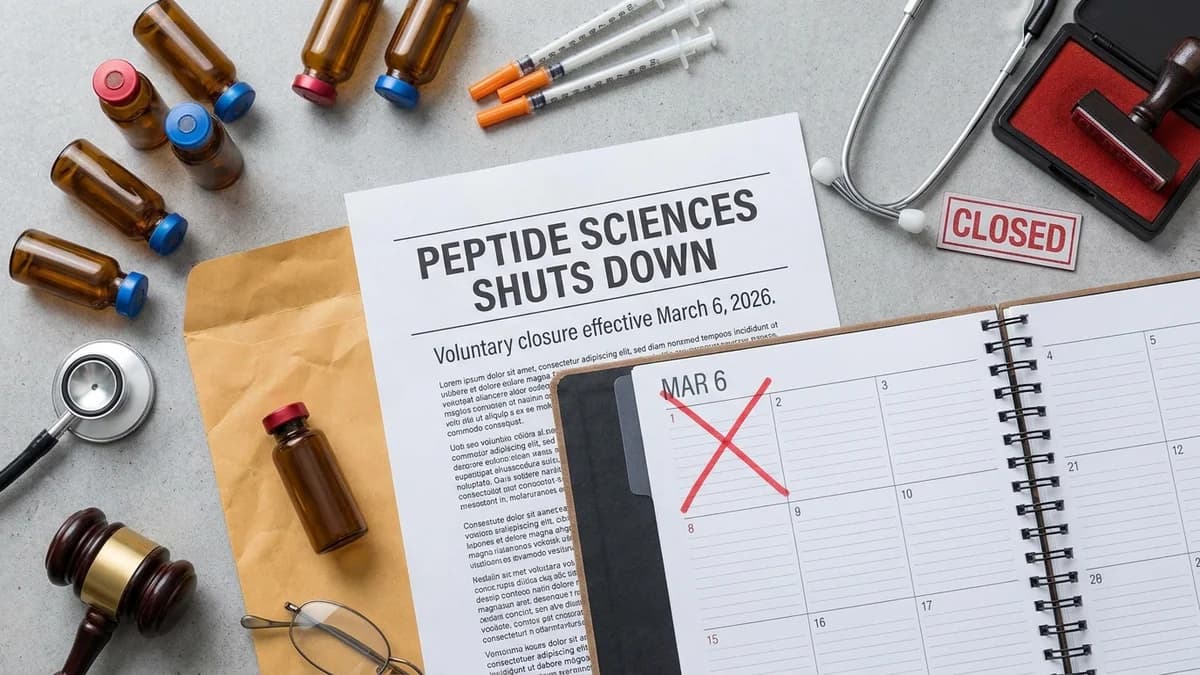
On March 6, 2026, at roughly 2:00 PM Eastern, the single largest research peptide vendor in the United States went dark. Visitors to peptidesciences.com were met with a short, red-bordered notice on an otherwise blank page: the company had "voluntarily" decided to shut down operations and discontinue the sale of all research products. There was no advance warning, no guidance for customers with pending orders, and no explanation beyond that one word.
For a company that had operated for over a decade, drew an estimated 990,000 monthly visits, and reportedly generated around $7.4 million in sales in December 2025 alone, the abruptness stunned the research community. If a vendor this established could disappear overnight, the thinking went, no grey-market supplier is safe.
Here is a complete, plain-English breakdown of what happened, the regulatory and quality forces behind the closure, and what it signals for the future of peptide access in 2026.
Key Takeaways
- Peptide Sciences voluntarily shut down on March 6, 2026, posting a brief farewell notice and going offline the same day.
- The closure was "voluntary" but not random. Industry analysts attribute it to converging pressure: escalating FDA and DOJ enforcement, independent testing that exposed quality failures, and the collapse of the high-margin GLP-1 revenue stream.
- There is no refund process and no customer support. If you had a pending order or store credit, a credit-card chargeback is your most realistic recourse.
- Any site still selling under the Peptide Sciences name is fraudulent. The company has not authorized a successor, and independent testing platforms have warned buyers directly.
- The timing is ironic: just weeks earlier, federal officials signaled that several restricted peptides may return to legal compounding, a shift that further undermines the grey-market model.
What Happened: The Peptide Sciences Shutdown
Peptide Sciences was, by web traffic and estimated revenue, the dominant name in the US "research use only" peptide market. Based in Henderson, Nevada, it sold dozens of compounds, including BPC-157, TB-500, retatrutide, semaglutide, and tirzepatide, all labeled strictly for laboratory research and not for human use.
That scale is exactly what made the shutdown so jarring. The notice that replaced its homepage read, in part:
"After careful consideration, Peptide Sciences has made the decision to voluntarily shut down operations and discontinue the sale of our research products. We are deeply grateful for your trust and support. Thank you for being part of the Peptide Sciences community."
No forwarding address. No timeline for refunds. No statement about what happens to customer data or outstanding inventory. Within hours, customer-support channels stopped responding, and peptide forums and subreddits filled with confused customers trying every available contact method.
When Did Peptide Sciences Close?
The shutdown was effective March 6, 2026. The notice appeared mid-afternoon Eastern time and was final in tone, with no indication of a temporary pause or planned return. As of this writing, the domain remains online but serves only the static farewell message. There is no public evidence the company intends to reopen, and the regulatory environment that pressured it has only intensified since.
Why Did Peptide Sciences Shut Down?
The company offered no official reason beyond "voluntary." But that word is doing a lot of work. A voluntary closure is legally far less damaging than an FDA-ordered shutdown or a criminal prosecution, and choosing to exit on your own terms is a calculated move. Three converging forces made that decision close to inevitable.
1. Escalating FDA and DOJ Enforcement
The grey-market peptide industry spent years operating in a zone where enforcement was sporadic and penalties were manageable. That changed. Peptide Sciences had already received an FDA warning letter (reported around 2023) over health-related claims about compounds like BPC-157 and TB-500, which put it squarely on the agency's radar.
From there, enforcement escalated from letters to raids and prosecutions across the sector:
- June 2025: The FDA raided the warehouse of competitor Amino Asylum, signaling the era of "ignore the warning letter" was over.
- September 2025: The FDA issued 50-plus warning letters to compounders and vendors marketing GLP-1 products.
- December 2025: Founders of Paradigm Peptides pleaded guilty in a criminal case, and Science.bio announced its closure.
When the enforcement apparatus shifts from paperwork to warehouse raids and guilty pleas, the risk calculus for a high-revenue vendor changes completely.
2. Quality-Control Failures
Peptide Sciences built its brand on the premise that you were getting rigorous, pharmaceutical-grade product. Independent testing eroded that premise. The testing platform Finnrick reported deeply uneven results across the catalog, most damagingly an "E" (Bad) rating on retatrutide across 37 samples, with flags for potential counterfeiting.
When the core value proposition, trust in purity, cracks publicly, the competitive moat that justified premium pricing erodes with it.
3. The GLP-1 Revenue Collapse
The highest-margin segment of the grey market was GLP-1 analogues, semaglutide and tirzepatide, sold during a window when drug shortages created legal cover for compounding. That window closed hard:
- April 2025: Eli Lilly sued telehealth companies over tirzepatide.
- August 2025: Novo Nordisk sued more than a dozen semaglutide distributors.
- Drug-shortage exemptions ended, removing the legal rationale that had propped up the most profitable products.
Strip away the most lucrative products, layer on litigation and raids, and add public quality failures, and the math stops working, even for a company clearing millions per month.
Timeline: The Grey-Market Crackdown (2024 to 2026)
| Date | Event |
|---|---|
| Late 2024 | FDA warning letters issued to multiple peptide vendors |
| Apr 2025 | Eli Lilly sues telehealth companies over tirzepatide |
| Jun 2025 | FDA raids Amino Asylum warehouse |
| Aug 2025 | Novo Nordisk sues semaglutide distributors |
| Sep 2025 | FDA issues 50+ warning letters to GLP-1 compounders |
| Dec 2025 | Paradigm Peptides founders plead guilty; Science.bio announces closure |
| Feb 27, 2026 | HHS Secretary signals intent to move 14 of 19 restricted peptides back to Category 1 |
| Mar 6, 2026 | Peptide Sciences shuts down voluntarily |
| Apr 15, 2026 | FDA announces removal of 12 peptides from Category 2 and schedules advisory-committee review |
Peptide Sciences was not an isolated event. It is the most visible domino in a chain that has toppled at least ten major vendors since late 2024.
What About Pending Orders and Refunds?
This is the urgent question for thousands of former customers, and the answer is not encouraging. Peptide Sciences has issued no public refund process, no order-fulfillment timeline, and no working support channel. Reports indicate pending orders went unfilled and store-credit balances effectively became worthless.
If you are affected, the practical guidance from across the community is consistent:
- Contact your bank or credit-card provider immediately to initiate a chargeback rather than waiting for a response that is unlikely to come.
- Do not enter payment information on any site claiming to be Peptide Sciences. The brand has not authorized a successor, and independent testers have explicitly warned that any site still selling under the name is fraudulent.
- Be cautious about existing inventory purchased before the shutdown, given the documented third-party testing concerns.
What This Means for the Research Peptide Industry
The closure marks the end of an era, and it accelerates trends already reshaping the market.
The "research use only" fig leaf is failing. For years, vendors used "not for human consumption" labeling as legal cover while everyone understood the real use case. Enforcement has made that posture increasingly indefensible.
Testing transparency is now table stakes. Ironically, Peptide Sciences' own testing failures raised the bar for everyone. Certificates of analysis, batch-specific COAs, independent HPLC and LC-MS verification, and batch traceability are shifting from "nice to have" to baseline expectations among the vendors trying to survive.
Consolidation is underway. With at least ten major vendors gone since late 2024, demand is concentrating among a smaller number of suppliers, and increasingly migrating toward regulated channels like telehealth clinics and licensed compounding pharmacies.
The Regulatory Silver Lining: Peptide Reclassification in 2026
The shutdown landed at a genuinely strange moment. Just over a week earlier, on February 27, 2026, HHS Secretary Robert F. Kennedy Jr. publicly signaled an intent to move roughly 14 of the 19 peptides the FDA had restricted in 2023 back toward legal compounding.
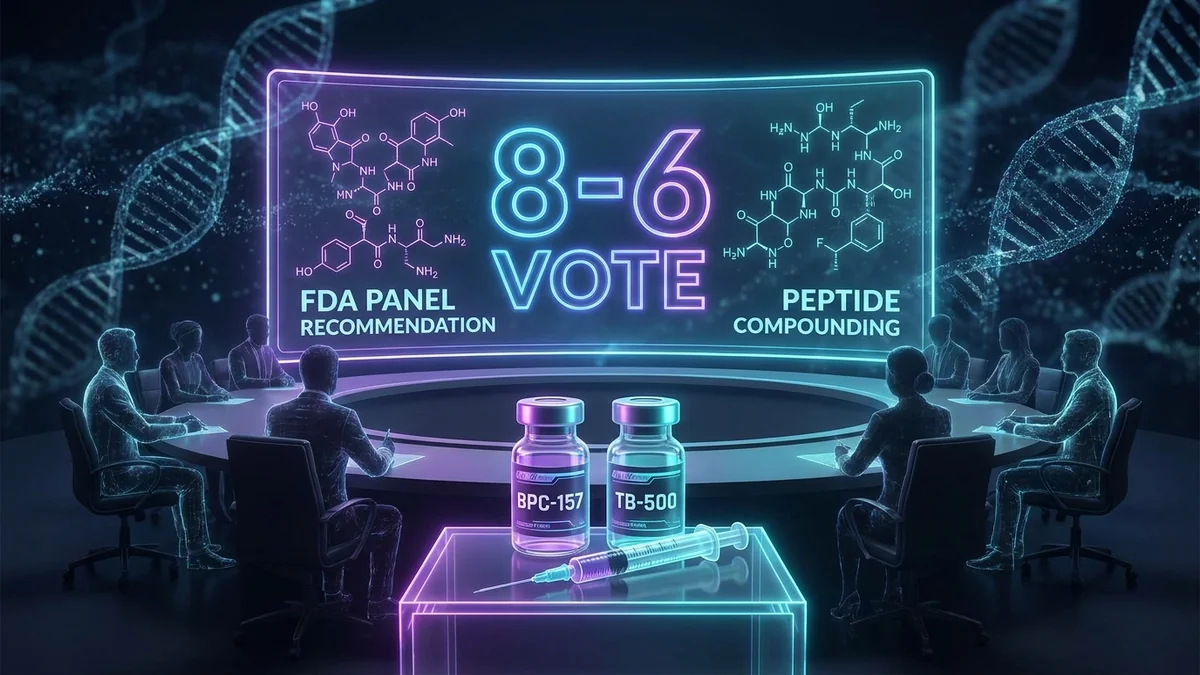
Then, on April 15, 2026, the FDA formally announced it would remove 12 peptides from Category 2 (the designation reserved for substances deemed to raise significant safety concerns) because their nominations had been withdrawn. The agency simultaneously scheduled Pharmacy Compounding Advisory Committee (PCAC) meetings for July 23 to 24, 2026, with another before the end of February 2027 to decide whether these peptides should be formally added to the 503A bulk drug substances list, which is what would actually authorize compounding.
The July review is slated to cover seven peptides, including BPC-157, TB-500 (a thymosin beta-4 fragment), KPV, MOTS-c, DSIP (Emideltide), Semax, and Epitalon, with five more, including GHK-Cu and Melanotan II, set for the 2027 session.
An important caveat: removal from Category 2 does not by itself make these peptides legal to compound. Until the FDA completes rulemaking and adds them to the 503A bulks list, their regulatory status has not formally changed. Public statements by officials are not the same as regulatory action. Still, the direction of travel is clear, and a regulated, prescription-based pathway would make the grey market largely unnecessary for many popular compounds.
Where to Access Peptides Safely in 2026
With Peptide Sciences gone and the grey market under sustained pressure, the safest path forward runs through legitimate, supervised channels:
- Telehealth clinics that provide licensed medical oversight, lab work, and prescriptions where appropriate.
- Licensed compounding pharmacies operating within the 503A framework, especially as reclassification progresses.
- FDA-approved medications for indications where an approved product exists.
If you previously relied on a grey-market vendor, this is a good moment to move toward providers with real medical accountability. You can compare licensed options in our clinic directory, and if you are sorting out dosing math for a legitimately obtained, clinician-supervised protocol, our Peptide Calculator can help you double-check reconstitution and draw volumes.
This article is for educational and informational purposes only and is not medical or legal advice. Peptide regulations are changing rapidly in 2026; always consult a licensed clinician and verify current FDA status before making decisions.
Related Tools
Find a Peptide Therapy Clinic Near You
Browse our directory of verified peptide therapy clinics across the United States. Compare providers, read reviews, and request a consultation.
Frequently Asked Questions
Is Peptide Sciences coming back?
Is any website still selling as Peptide Sciences?
What happened to my pending Peptide Sciences order or store credit?
Why did Peptide Sciences shut down?
Which peptides are being reclassified in 2026?
What are the safest alternatives to Peptide Sciences in 2026?
Looking to buy BPC-157 and TB-500 for research?
Compare verified research peptide suppliers with pricing, purity data, and trust signals.
MyPeptideMatch.com does not provide medical advice. Always consult a qualified healthcare provider before starting any peptide therapy. Regulatory status may change.