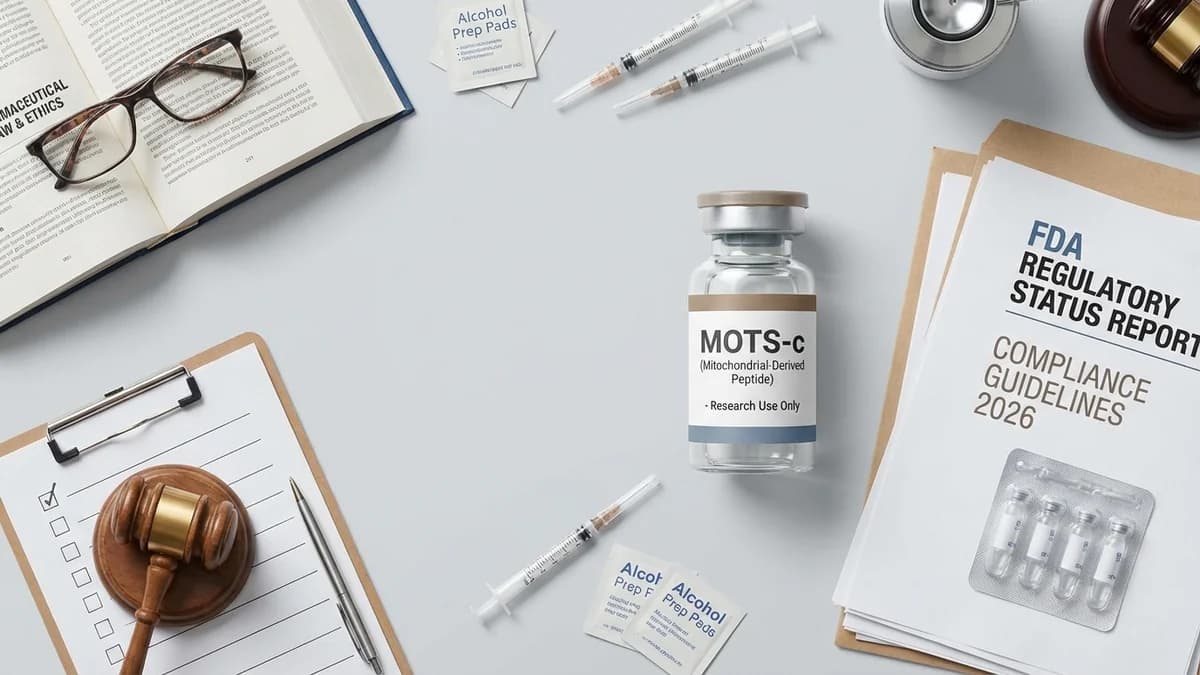
Is MOTS-c Legal in the US in 2026?
MOTS-c is not FDA-approved and is not a controlled substance. Its legal status for compounding and clinical use is actively evolving. Here is a plain-language breakdown of where things stand.
MOTS-c Status Summary (2026)
| Question | Answer |
|---|---|
| FDA approved? | No |
| Controlled substance (DEA scheduled)? | No |
| Legal to possess? | Not explicitly prohibited |
| Legal to prescribe? | Gray area — physician discretion |
| Compounding pharmacy eligible? | Restricted; limited availability |
| Clinical trials status? | Phase I/II; see below |
MOTS-c Clinical Trial Status (2026)
MOTS-c is a mitochondria-derived peptide (MDPs) that has attracted significant research interest for metabolic health and longevity. Several clinical investigations are underway or recently completed:
- Phase I safety trials have been conducted assessing MOTS-c tolerability in healthy adult volunteers
- Phase II studies examining metabolic outcomes (insulin sensitivity, body composition) are ongoing as of early 2026
- Registration studies are visible on ClinicalTrials.gov; search "MOTS-c" for current status
Important: Active clinical trials do not mean MOTS-c is FDA-approved. Investigational use is restricted to trial participants under institutional oversight.
MOTS-c FDA Approval Status (2026)
MOTS-c has no FDA approval as of 2026. It is not an approved drug, biologics license application (BLA), or new drug application (NDA) holder. This means:
- No manufacturer can legally market MOTS-c as a prescription drug
- Insurance will not cover it
- It cannot be advertised with drug efficacy claims
However, lack of approval does not mean possession is criminal. The legal framework that restricts MOTS-c is primarily regulatory (compounding rules, pharmacy laws) rather than criminal statutes.
Can You Get MOTS-c From a US Compounding Pharmacy?
With increasing difficulty. The FDA's scrutiny of peptides used in compounding has intensified since 2022. MOTS-c specifically:
- Is not on the FDA's "Category 1" list of bulk substances that may be compounded
- Has not been definitively placed on the "Category 2" prohibited list (as of early 2026)
- Occupies a nominally gray area where some 503A compounding pharmacies continue to prepare it
In practice, availability varies significantly by pharmacy. Clinics specializing in peptide therapy are the most reliable source of current availability information.
Is MOTS-c Legal to Import?
Importing MOTS-c from overseas suppliers (including research chemical vendors) for human use is not authorized under FDA regulations. The FDA can seize shipments at the border under FDCA authority. Enforcement discretion exists for small personal quantities, but there is no guarantee.
Research chemical vendors based overseas often label MOTS-c "not for human use" — this disclaimer does not create legal protection for the buyer.