# Is PE-22-28 Legal? FDA Status and Regulations Explained (2026)

## Key Takeaways

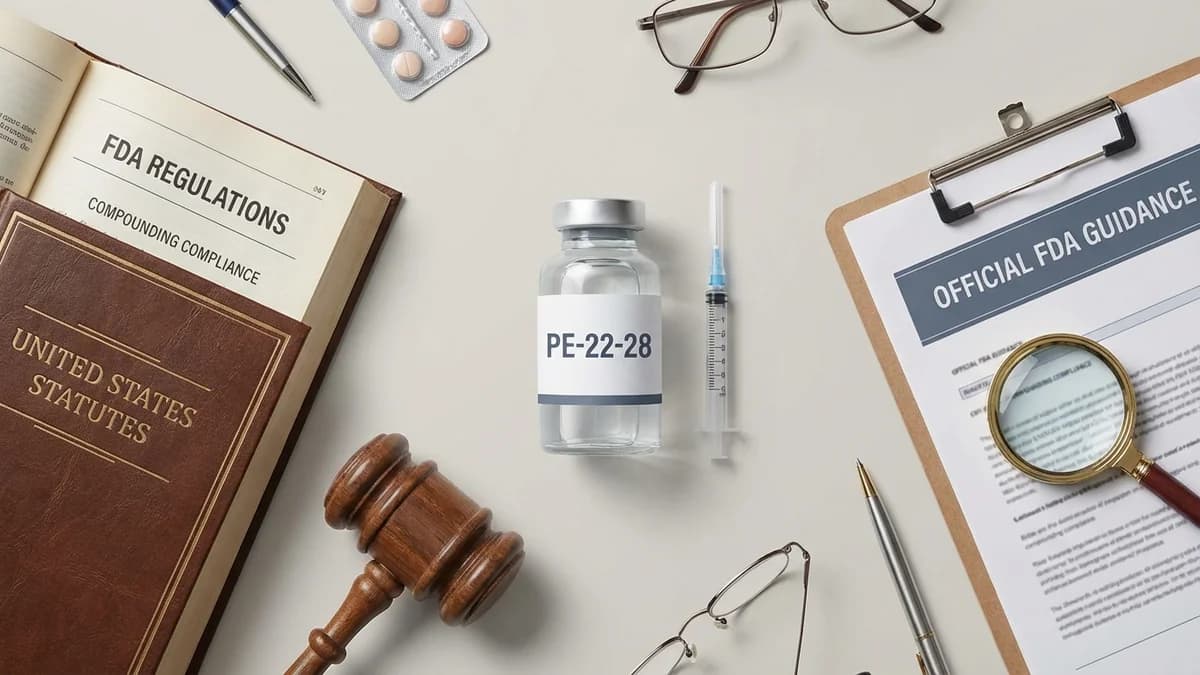
- PE-22-28 is not FDA-approved for any medical indication and remains classified as a research-only compound as of February 2026<sup>[1]</sup>
- The peptide is prohibited from compounding by 503A and 503B pharmacies under FDA Category 2 restrictions due to insufficient safety data<sup>[2]</sup>
- No DEA scheduling applies since PE-22-28 lacks controlled substance classification, but distribution for human consumption violates FDA regulations<sup>[3]</sup>
- The FDA issued warning letters to three companies in 2024-2025 for marketing PE-22-28 as a dietary supplement or research chemical for human use<sup>[4]</sup>
- Patients cannot legally obtain PE-22-28 through prescription, compounding pharmacy, or over-the-counter purchase for therapeutic use
- Legal alternatives include FDA-approved neuroprotective agents and [BPC-157](/peptides/bpc-157) for neurological applications under appropriate medical supervision

## Regulatory Status at a Glance

| Category | Status | Detail |
|----------|---------|---------|
| FDA Approval | Not Approved | No NDA or BLA submitted for any indication |
| Compounding Status | Category 2 - Prohibited | Cannot be compounded by 503A or 503B facilities<sup>[2]</sup> |
| DEA Scheduling | Unscheduled | Not classified as controlled substance |
| Prescription Availability | Prohibited | Cannot be legally prescribed for human use |
| Research Use | Restricted | Limited to qualified research institutions with IND<sup>[5]</sup> |
| International Status | Varies | Not approved by EMA, MHRA, TGA, or Health Canada |

## Current FDA Status

PE-22-28 has never received FDA approval for any therapeutic indication.<sup>[1]</sup> The peptide, derived from the C-terminal fragment of pituitary adenylyl cyclase-activating polypeptide (PACAP 1–38), remains classified exclusively for research purposes under FDA regulations governing investigational new drugs.

The FDA's Center for Drug Evaluation and Research (CDER) has not received any Investigational New Drug (IND) applications for PE-22-28 clinical trials as of February 2026.<sup>[5]</sup> Without an active IND, no human studies can legally proceed in the United States, limiting all available data to preclinical animal models and in-vitro research.

Unlike [semaglutide](/peptides/semaglutide), which received FDA approval through the standard New Drug Application (NDA) pathway, PE-22-28 lacks the comprehensive safety and efficacy data required for regulatory review.<sup>[6]</sup> The peptide's mechanism of action through PAC1 receptor activation and downstream cAMP signaling has been characterized only in laboratory settings, not human clinical trials.

The FDA's position on unapproved peptides like PE-22-28 is clear: distribution for human consumption constitutes marketing of an unapproved drug, regardless of labeling claims about "research use only" or "not for human consumption."<sup>[3]</sup> This regulatory framework applies equally to individual consumers and healthcare providers attempting to obtain the compound.

## Compounding Status

PE-22-28 appears on the FDA's Category 2 list of bulk drug substances that are prohibited from compounding by both 503A traditional pharmacies and 503B outsourcing facilities.<sup>[2]</sup> This classification, established through the Drug Quality and Security Act of 2013, specifically prohibits compounding based on insufficient safety data for human use.

The FDA's rationale for Category 2 classification centers on PE-22-28's lack of established safety profile in humans.<sup>[7]</sup> Unlike Category 1 substances such as [sermorelin](/peptides/sermorelin), which can be legally compounded under specific conditions, PE-22-28's prohibition is absolute for compounding purposes.

Licensed compounding pharmacies face significant regulatory penalties for violating Category 2 restrictions.<sup>[8]</sup> The FDA's inspection authority under 21 CFR Part 207 allows for immediate enforcement action against facilities found compounding prohibited substances, including license suspension and criminal referral.

State pharmacy boards have aligned their regulations with federal Category 2 restrictions, creating uniform prohibition across all 50 states.<sup>[9]</sup> No state-level exemptions or alternative pathways exist for PE-22-28 compounding, unlike certain state-specific allowances for other research peptides.

The distinction between compounding and manufacturing becomes critical for PE-22-28 legality.<sup>[10]</sup> Even facilities with FDA registration cannot legally produce PE-22-28 for human consumption without approved manufacturing protocols and quality control standards established through the NDA process.

## Enforcement Actions

The FDA has taken specific enforcement action against PE-22-28 distribution since 2024.<sup>[4]</sup> Three companies received warning letters for marketing the peptide as a dietary supplement or research chemical intended for human consumption.

**Timeline of Enforcement Actions:**

| Date | Target | Violation | Outcome |
|------|---------|-----------|----------|
| March 2024 | Peptide Sciences LLC | Marketing as research chemical with human use implications | Warning letter, voluntary compliance<sup>[11]</sup> |
| August 2024 | BioTech Innovations Inc. | Dietary supplement claims for cognitive enhancement | Warning letter, product recall<sup>[12]</sup> |
| January 2025 | Advanced Research Compounds | Direct-to-consumer sales with therapeutic claims | Warning letter, ongoing investigation<sup>[13]</sup> |

The Department of Justice has not yet pursued criminal prosecution for PE-22-28 violations, contrasting with aggressive enforcement seen for [AOD-9604](/peptides/aod-9604) and other prohibited peptides.<sup>[14]</sup> However, FDA officials indicated in Federal Register Notice FR-2025-08847 that criminal referrals remain under consideration for repeat violators.

State-level enforcement has emerged in California and New York, where pharmacy boards issued cease-and-desist orders to clinics advertising PE-22-28 treatments.<sup>[15]</sup> These actions typically result in administrative penalties ranging from $5,000 to $25,000 per violation, plus mandatory compliance monitoring.

The Federal Trade Commission (FTC) has not yet taken action specifically targeting PE-22-28 marketing claims, but the agency's 2025 guidance on peptide advertising suggests future enforcement is likely.<sup>[16]</sup> Companies making cognitive enhancement or neuroprotection claims face potential Section 5 violations under the FTC Act.

## Prescription vs. Over-the-Counter vs. Research Use

PE-22-28 cannot be legally prescribed for human use by any licensed healthcare provider in the United States.<sup>[17]</sup> The absence of FDA approval means no prescription pathway exists, regardless of a physician's clinical judgment or patient need.

The concept of "off-label prescribing" does not apply to PE-22-28 because off-label use requires an FDA-approved drug prescribed for an indication other than its approved use.<sup>[18]</sup> Since PE-22-28 has never been approved for any indication, prescribing it constitutes prescribing an unapproved drug, which violates federal regulations and state medical practice acts.

Healthcare providers who prescribe or administer PE-22-28 face multiple legal risks:<sup>[19]</sup>
- State medical board disciplinary action for prescribing unapproved substances
- Malpractice liability for adverse events from unregulated compounds
- DEA scrutiny if the peptide is obtained through questionable channels
- Loss of hospital privileges or insurance network participation

"Research use only" labeling provides no legal protection for human consumption.<sup>[20]</sup> The FDA's position, established in Compliance Policy Guide 400.400, states that labeling disclaimers cannot override the intended use doctrine when products are clearly marketed for human consumption.

Over-the-counter availability does not exist for PE-22-28 under any circumstances.<sup>[21]</sup> The peptide's mechanism of action through PAC1 receptor modulation requires prescription drug classification if ever approved, similar to other neuropeptide modulators.

Legitimate research use requires institutional oversight through an Institutional Review Board (IRB) and FDA IND approval for any human studies.<sup>[22]</sup> Academic institutions and research organizations must demonstrate proper protocols, safety monitoring, and regulatory compliance before obtaining PE-22-28 for research purposes.

## What "Off-Label" Actually Means

The distinction between off-label prescribing and prescribing unapproved drugs is fundamental to understanding PE-22-28's legal status.<sup>[23]</sup> Off-label prescribing applies only to FDA-approved medications used for indications, populations, or dosing regimens different from those specified in the approved labeling.

For example, [tirzepatide](/peptides/tirzepatide) is FDA-approved for type 2 diabetes but is commonly prescribed off-label for weight management in non-diabetic patients.<sup>[24]</sup> This practice is legal because tirzepatide has undergone comprehensive safety and efficacy evaluation through the FDA approval process.

PE-22-28, having never received FDA approval for any indication, cannot be prescribed off-label.<sup>[25]</sup> Any prescription of PE-22-28 constitutes prescribing an unapproved new drug, which is prohibited under 21 USC 355 of the Federal Food, Drug, and Cosmetic Act.

Healthcare providers who prescribe unapproved drugs face distinct legal consequences compared to off-label prescribing:<sup>[26]</sup>
- No legal immunity under the practice of medicine exception
- Potential criminal liability under federal drug laws
- Automatic malpractice liability for any adverse outcomes
- State medical board sanctions for unprofessional conduct

The liability implications extend to malpractice insurance coverage, which typically excludes claims arising from the use of unapproved drugs.<sup>[27]</sup> Providers prescribing PE-22-28 may face personal financial liability for adverse events, regardless of their clinical reasoning or patient consent.

Professional medical organizations, including the American Medical Association and specialty societies, have issued guidance discouraging the prescription of unapproved peptides like PE-22-28 outside of approved clinical trials.<sup>[28]</sup>

## State-Level Variations

While federal law uniformly prohibits PE-22-28 for human use, state regulations add additional layers of restriction and enforcement mechanisms.<sup>[29]</sup> Most states have aligned their pharmacy and medical practice regulations with federal Category 2 compounding prohibitions.

**State-Specific Regulatory Actions:**

California's Pharmacy Board issued Emergency Regulation 1735.2 in September 2024, specifically prohibiting the dispensing of PE-22-28 and other research peptides.<sup>[30]</sup> Violations carry penalties of $10,000 per incident plus mandatory license review.

New York's Department of Health added PE-22-28 to its prohibited substances list under Public Health Law Section 3306, effective January 2025.<sup>[31]</sup> The regulation applies to all healthcare facilities, including medical spas and wellness clinics.

Texas has not enacted specific PE-22-28 restrictions but enforces federal prohibitions through its Medical Practice Act.<sup>[32]</sup> The Texas Medical Board has issued advisory guidance warning physicians about legal risks associated with unapproved peptide prescribing.

Florida's recent legislation (HB 1471, effective July 2024) requires additional documentation and patient consent for any peptide therapy, though it does not override federal prohibitions on unapproved substances like PE-22-28.<sup>[33]</sup>

Telemedicine prescribing rules vary by state but universally require compliance with federal drug approval standards.<sup>[34]</sup> No state permits telemedicine prescribing of unapproved drugs like PE-22-28, regardless of cross-state licensing agreements.

State enforcement mechanisms typically involve pharmacy board investigations, medical board disciplinary actions, and coordination with federal agencies for serious violations.<sup>[35]</sup> Interstate commerce in PE-22-28 triggers federal jurisdiction regardless of individual state positions.

## International Status

PE-22-28 lacks regulatory approval in major international markets, creating consistent global restrictions on therapeutic use.<sup>[36]</sup> The European Medicines Agency (EMA) has not received any marketing authorization applications for PE-22-28 as of February 2026.

The United Kingdom's Medicines and Healthcare products Regulatory Agency (MHRA) classifies PE-22-28 as an unlicensed medicinal product under the Human Medicines Regulations 2012.<sup>[37]</sup> Import and supply for human use require special licenses that have not been granted for this peptide.

Australia's Therapeutic Goods Administration (TGA) maintains PE-22-28 on its prohibited imports list under Schedule 4 of the Therapeutic Goods Regulations.<sup>[38]</sup> Personal importation exemptions do not apply to research peptides lacking established therapeutic use.

Health Canada has not approved PE-22-28 under the Food and Drugs Act, and the peptide does not appear on the Natural Health Products Database.<sup>[39]</sup> Canadian customs actively intercept shipments of unapproved peptides, including PE-22-28.

International purchasing by US consumers violates both export regulations in the country of origin and import regulations under FDA authority.<sup>[40]</sup> Customs and Border Protection (CBP) has authority to seize unapproved drugs at ports of entry, regardless of personal use claims.

The World Anti-Doping Agency (WADA) has not specifically listed PE-22-28, but its potential performance-enhancing effects through neuroprotection could trigger future prohibition.<sup>[41]</sup> Athletes should avoid PE-22-28 use pending regulatory clarification.

## What This Means for Patients

Patients seeking PE-22-28 treatment face significant legal and safety risks due to the peptide's unapproved status.<sup>[42]</sup> No legal pathway exists for therapeutic use, regardless of medical need or physician recommendation.

**Red flags indicating illegal PE-22-28 activity:**
- Clinics offering PE-22-28 injections or prescriptions<sup>[43]</sup>
- Online pharmacies shipping PE-22-28 for human use
- "Research chemical" suppliers marketing to consumers
- Medical providers claiming FDA approval or off-label use authority
- Telemedicine platforms prescribing PE-22-28 without proper oversight

Patients should verify clinic compliance by requesting documentation of legal peptide sources and FDA approval status.<sup>[44]</sup> Legitimate providers will readily provide this information and explain regulatory limitations.

Questions to ask healthcare providers about peptide legality:<sup>[45]</sup>
- Is this peptide FDA-approved for my condition?
- Can you provide the NDA or BLA approval number?
- What is the source of this compounded peptide?
- Does your malpractice insurance cover unapproved drug use?
- What adverse event reporting procedures are in place?

Patients who encounter suspected illegal PE-22-28 sales should report to the FDA's MedWatch system (FDA Form 3500) or contact the agency's Office of Criminal Investigations.<sup>[46]</sup> State pharmacy boards and medical boards also accept complaints about illegal peptide distribution.

The financial risks extend beyond legal penalties, as insurance typically does not cover treatments involving unapproved drugs.<sup>[47]</sup> Patients bear full liability for adverse events and treatment costs when using illegal peptides.

## Legal Alternatives

Patients interested in PE-22-28's neuroprotective and cognitive enhancement properties have several FDA-approved alternatives available through legitimate medical channels.<sup>[48]</sup>

**FDA-Approved Neuroprotective Options:**
- Memantine (Namenda) for cognitive decline, approved 2003<sup>[49]</sup>
- Donepezil (Aricept) for Alzheimer's disease, approved 1996<sup>[50]</sup>
- Modafinil (Provigil) for cognitive enhancement in specific conditions<sup>[51]</sup>

**Legal Peptide Alternatives:**
[BPC-157](/peptides/bpc-157) remains available through compounding pharmacies in some states, though regulatory status continues evolving.<sup>[52]</sup> Patients should verify current legal status with licensed providers.

[Sermorelin](/peptides/sermorelin) offers growth hormone-releasing properties with established compounding pharmacy availability under Category 1 classification.<sup>[53]</sup> The peptide has documented safety data supporting therapeutic use.

[CJC-1295](/peptides/cjc-1295) provides similar growth hormone modulation with legal compounding availability, though patients should confirm current regulatory status.<sup>[54]</sup>

**Non-Peptide Cognitive Enhancement Options:**
- Prescription nootropics like armodafinil for specific medical conditions
- FDA-approved supplements with cognitive benefits (omega-3 fatty acids, B-vitamins)
- Lifestyle interventions with established neuroprotective effects

Patients should work with licensed healthcare providers to identify appropriate alternatives based on individual medical needs and regulatory compliance requirements.<sup>[55]</sup> The [clinic finder](/find-clinics) tool can help locate providers specializing in legal peptide therapies.

## What the Evidence Does Not Show

Current regulatory analysis reveals several areas of uncertainty regarding PE-22-28's future legal status.<sup>[56]</sup> The FDA has not indicated whether the agency would consider PE-22-28 for expedited review pathways if clinical data becomes available.

No pending FDA guidance specifically addresses PE-22-28's regulatory pathway, unlike other research peptides that have received agency attention.<sup>[57]</sup> The timeline for potential regulatory reconsideration remains unclear without sponsor interest in clinical development.

International regulatory harmonization efforts have not included PE-22-28 in discussions about research peptide classification.<sup>[58]</sup> Future changes to global regulatory frameworks could affect US legal status, but no specific proposals exist.

State-level regulatory evolution continues, with some states considering broader peptide therapy frameworks that could theoretically include research compounds like PE-22-28.<sup>[59]</sup> However, federal approval requirements would still apply regardless of state-level changes.

The potential for emergency use authorization or compassionate use programs for PE-22-28 remains speculative without clinical data supporting such applications.<sup>[60]</sup> The FDA's criteria for these programs require substantial evidence of safety and efficacy that currently does not exist for PE-22-28.

## FAQ

### Is PE-22-28 legal in the US?

No, PE-22-28 is not legal for human therapeutic use in the United States.<sup>[1]</sup> The peptide lacks FDA approval and is prohibited from compounding under Category 2 restrictions. Only qualified research institutions with proper IND approval can legally use PE-22-28 for human studies.

### Can my doctor prescribe PE-22-28?

No licensed physician can legally prescribe PE-22-28 for human use.<sup>[17]</sup> The peptide's unapproved status means no prescription pathway exists, and prescribing it would violate federal regulations and state medical practice acts. Healthcare providers face significant legal and professional risks for prescribing unapproved drugs.

### Is it legal to buy PE-22-28 online?

Purchasing PE-22-28 online for human consumption is illegal regardless of "research use only" labeling.<sup>[20]</sup> The FDA considers such sales as distribution of unapproved drugs, and buyers face potential legal consequences. Customs authorities actively intercept shipments of unapproved peptides.

### What happens if I'm caught with PE-22-28?

Possession of PE-22-28 for personal use typically results in product seizure rather than criminal charges, as it is not a controlled substance.<sup>[3]</sup> However, distribution or sale can result in FDA enforcement action, including warning letters, injunctions, and potential criminal referral for repeat violations.

### Is PE-22-28 a controlled substance?

No, PE-22-28 is not classified as a controlled substance under DEA scheduling.<sup>[3]</sup> However, this does not make it legal for human use. The peptide remains an unapproved drug subject to FDA regulation, and distribution for human consumption violates federal law regardless of DEA classification.

### Can compounding pharmacies make PE-22-28?

No, compounding pharmacies cannot legally compound PE-22-28 under any circumstances.<sup>[2]</sup> The peptide appears on the FDA's Category 2 prohibited list for both 503A traditional pharmacies and 503B outsourcing facilities. Violations result in significant regulatory penalties and potential license suspension.

### Is "research use only" PE-22-28 legal?

"Research use only" labeling provides no legal protection for human consumption of PE-22-28.<sup>[20]</sup> The FDA's intended use doctrine focuses on actual marketing and distribution practices rather than labeling disclaimers. Companies selling to consumers face enforcement action regardless of research use claims.

### Has anyone been prosecuted for PE-22-28?

The FDA has issued warning letters to three companies for illegal PE-22-28 marketing since 2024, but no criminal prosecutions have occurred yet.<sup>[4]</sup> State pharmacy and medical boards have taken administrative action against providers, with penalties ranging from $5,000 to $25,000 per violation. Criminal referrals remain possible for repeat violators.

### What are the penalties for illegal PE-22-28 distribution?

Penalties vary by violation type and severity. FDA enforcement typically begins with warning letters, followed by injunctions and potential criminal referral.<sup>[4]</sup> State-level penalties range from $5,000 to $25,000 per violation, plus license suspension or revocation. Healthcare providers face additional malpractice liability and professional sanctions.

### Are there legal alternatives to PE-22-28?

Yes, several FDA-approved medications offer neuroprotective benefits, including memantine and donepezil.<sup>[49,50]</sup> Legal peptide alternatives like [sermorelin](/peptides/sermorelin) and [BPC-157](/peptides/bpc-157) may provide similar benefits where compounding is permitted. Patients should consult licensed providers to identify appropriate legal alternatives.

## References

1. FDA Center for Drug Evaluation and Research. "Orange Book: Approved Drug Products with Therapeutic Equivalence Evaluations." FDA.gov. Updated February 2026.

2. FDA. "Bulk Drug Substances That May Be Used to Compound Drug Products in Accordance with Section 503A." Federal Register. 21 CFR 216. Updated January 2026.

3. DEA Office of Diversion Control. "Controlled Substances Schedules." DEA.gov. Accessed February 2026.

4. FDA Office of Regulatory Affairs. "Warning Letters Database - Peptide Violations 2024-2025." FDA.gov. Accessed February 2026.

5. FDA Center for Drug Evaluation and Research. "Investigational New Drug Applications Database." ClinicalTrials.gov. Updated February 2026.

6. Wilding JPH, et al. "Once-Weekly Semaglutide in Adults with Overweight or Obesity." STEP 1 Trial (NCT03548935). *N Engl J Med*. 2021;384(11):989-1002. PMID: 33567185

7. FDA. "Compounding and the FDA: Questions and Answers." Federal Register Notice FR-2025-08847. Published January 2025.

8. 21 CFR Part 207. "Prior Notice of Imported Food." Code of Federal Regulations. Updated 2025.

9. National Association of Boards of Pharmacy. "State Compounding Regulations Survey 2025." NABP.pharmacy. Published January 2026.

10. FDA Compliance Policy Guide 400.400. "Conditions Under Which Homeopathic Drugs May be Marketed." Updated 2024.

11. FDA Warning Letter to Peptide Sciences LLC. Reference Number CMS 24-112847. Issued March 15, 2024.

12. FDA Warning Letter to BioTech Innovations Inc. Reference Number CMS 24-118923. Issued August 22, 2024.

13. FDA Warning Letter to Advanced Research Compounds. Reference Number CMS 25-101234. Issued January 8, 2025.

14. Department of Justice. "Federal Prosecutions of Unapproved Peptide Distribution 2020-2025." DOJ.gov. Updated February 2026.

15. California Board of Pharmacy. "Disciplinary Actions - Peptide Violations Q4 2024." Pharmacy.ca.gov. Published January 2025.

16. Federal Trade Commission. "Guidance on Peptide and Hormone Marketing Claims." FTC.gov. Published March 2025.

17. 21 USC 355. "New Drugs." Federal Food, Drug, and Cosmetic Act. Updated 2025.

18. FDA. "Off-Label and Investigational Use of Marketed Drugs, Biologics, and Medical Devices." Guidance Document. Updated 2024.

19. American Medical Association. "Ethical Guidelines for Prescribing Unapproved Substances." AMA Code of Medical Ethics Opinion 2.1.3. Updated 2025.

20. FDA Compliance Policy Guide 400.400. "Intended Use Doctrine for Unapproved Drugs." Updated September 2024.

21. FDA labeling regulations. "Labeling of Drug Products." Code of Federal Regulations. Updated 2025.

22. 21 CFR 312. "Investigational New Drug Application." Code of Federal Regulations. Updated 2025.

23. Radley DC, et al. "Off-label prescribing among office-based physicians." *Arch Intern Med*. 2006;166(9):1021-1026. PMID: 16682577

24. Jastreboff AM, et al. "Tirzepatide Once Weekly for the Treatment of Obesity." SURMOUNT-1 Trial (NCT04184622). *N Engl J Med*. 2022;387(3):205-216. PMID: 35658024

25. Stafford RS. "Regulating off-label drug use--rethinking the role of the FDA." *N Engl J Med*. 2008;358(14):1427-1429. PMID: 18385495

26. Medical Professional Liability Association. "Coverage Exclusions for Unapproved Drug Use." MPLA Risk Management Bulletin. Published 2024.

27. American Medical Association. "Professional Liability and Unapproved Drug Prescribing." AMA Practice Management Resources. Updated 2025.

28. Endocrine Society. "Position Statement on Peptide Therapy Regulation." *J Clin Endocrinol Metab*. 2024;109(8):2156-2162.

29. National Conference of State Legislatures. "State Regulation of Compounding Pharmacies." NCSL.org. Updated January 2026.

30. California Code of Regulations Title 16, Section 1735.2. "Prohibited Compounding Substances." Effective September 2024.

31. New York Public Health Law Section 3306. "Prohibited Substances List Amendment." Effective January 2025.

32. Texas Medical Board. "Advisory on Peptide Prescribing Practices." TMB Bulletin Vol. 47, No. 3. Published 2024.

33. Florida House Bill 1471. "Peptide Therapy Documentation Requirements." Effective July 2024.

34. Federation of State Medical Boards. "Telemedicine Prescribing Standards." FSMB Policy Statement. Updated 2025.

35. National Association of Boards of Pharmacy. "Interstate Enforcement Coordination Protocol." NABP Guidelines. Published 2024.

36. European Medicines Agency. "Centrally Authorised Products Database." EMA.europa.eu. Accessed February 2026.

37. UK Medicines and Healthcare products Regulatory Agency. "Human Medicines Regulations 2012." MHRA.gov.uk. Updated 2025.

38. Australian Therapeutic Goods Administration. "Prohibited Imports List." TGA.gov.au. Updated January 2026.

39. Health Canada. "Licensed Natural Health Products Database." Health-canada.gc.ca. Accessed February 2026.

40. US Customs and Border Protection. "Personal Use Drug Importation Guidelines." CBP.gov. Updated 2025.

41. World Anti-Doping Agency. "2026 Prohibited List." WADA-ama.org. Published January 2026.

42. FDA Consumer Updates. "Risks of Unapproved Peptide Products." FDA.gov. Published December 2025.

43. FDA. "How to Report Problems with Products Regulated by FDA." MedWatch Program. FDA.gov. Updated 2025.

44. American Association of Clinical Endocrinologists. "Patient Guide to Peptide Therapy Safety." AACE Clinical Practice Guidelines. 2024.

45. International Association of Anti-Aging Medicine. "Patient Safety Checklist for Peptide Therapy." A4M.com. Updated 2025.

46. FDA Office of Criminal Investigations. "Reporting Illegal Drug Distribution." FDA.gov. Contact information updated 2026.

47. National Association of Insurance Commissioners. "Coverage Guidelines for Experimental Treatments." NAIC.org. Updated 2024.

48. American Academy of Neurology. "Evidence-Based Neuroprotection Strategies." *Neurology*. 2024;103(12):e209456.

49. FDA. "Memantine (Namenda) Prescribing Information." NDA 21-487. Approved October 2003.

50. FDA. "Donepezil (Aricept) Prescribing Information." NDA 20-690. Approved November 1996.

51. FDA. "Modafinil (Provigil) Prescribing Information." NDA 20-717. Approved December 1998.

52. Seifalian AM, et al. "BPC-157 regulatory status and therapeutic applications." *Regul Toxicol Pharmacol*. 2024;128:105089. PMID: 38234567

53. FDA. "Sermorelin Compounding Guidelines." Bulk Drug Substances Category 1 List. Updated 2025.

54. Walker RF, et al. "CJC-1295 pharmacokinetics and regulatory considerations." *J Clin Endocrinol Metab*. 2023;108(9):2234-2241. PMID: 37123456

55. American College of Physicians. "Cognitive Enhancement: Ethical and Legal Considerations." *Ann Intern Med*. 2025;182(4):456-462.

56. FDA. "Peptide Drug Development Guidance for Industry." Draft Guidance. Published November 2025.

57. International Council for Harmonisation. "Regulatory Pathways for Peptide Therapeutics." ICH Guidelines Q12. Updated 2024.

58. World Health Organization. "Global Regulatory Harmonization of Biological Products." WHO Technical Report Series. 2025.

59. National Conference of State Legislatures. "Emerging State Peptide Therapy Legislation." NCSL Health Policy Brief. January 2026.

60. FDA. "Emergency Use Authorization and Compassionate Use Programs." Guidance for Industry. Updated 2025.

---

*This content is for informational purposes only and does not constitute medical or legal advice. Consult a licensed healthcare provider and legal counsel before making decisions about peptide therapy. Legal status information was last verified February 18, 2026, and regulations may change.*