# Is TB-500 Fragment (17-23) Legal? FDA Status and Regulations Explained (2026)

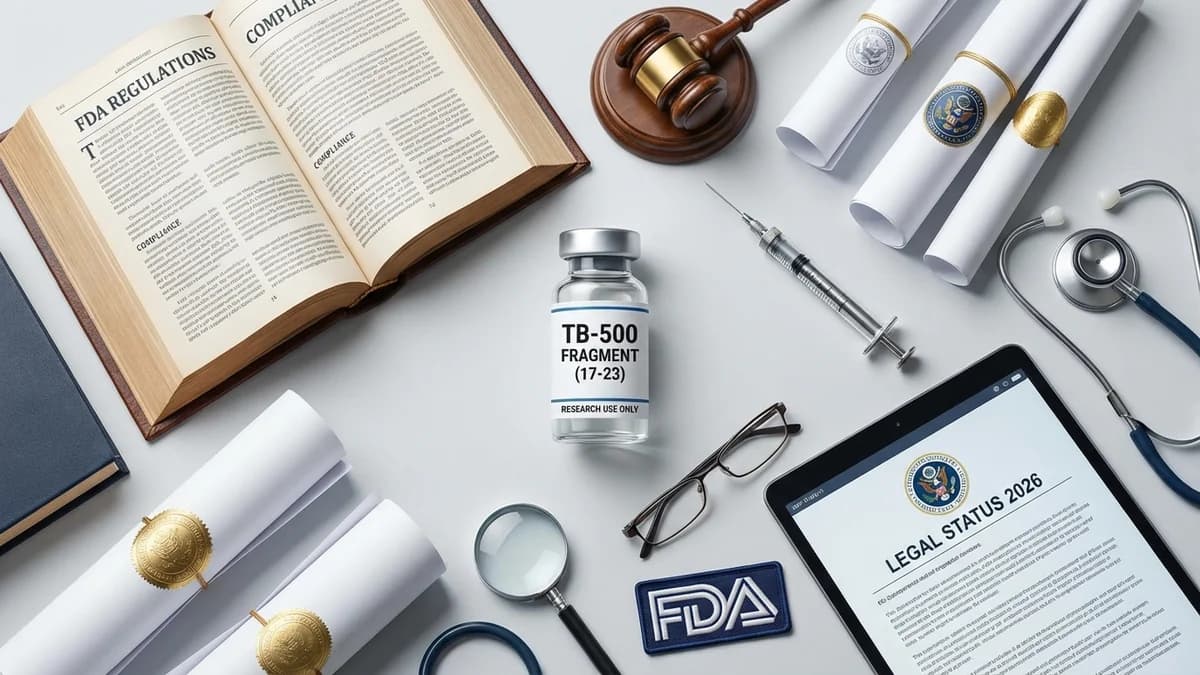
If you're researching TB-500 Fragment (17-23) legality, you're probably trying to answer a pretty specific question: can you get this peptide legally, from a real clinic, with a real prescription? The short answer is no — not in the United States, not right now. TB-500 Fragment (17-23) carries a "research use only" classification, which means it has no FDA-approved indication, no approved compounding pathway, and no legal route to a prescription for human use under current federal regulatory standards.

That's not the end of the conversation, though. The regulatory picture for research peptides is genuinely complicated, and understanding *why* this peptide sits where it does — and what the practical risks are for buyers, sellers, and prescribers — matters whether you're a patient exploring options or a provider trying to stay on the right side of the law.

---

## Key Takeaways

- **TB-500 Fragment (17-23) is not FDA-approved** for any indication and is classified as "research use only" under current federal regulatory standards.
- **Compounding pharmacies cannot legally produce** TB-500 Fragment (17-23) for human use; it does not appear on the FDA's 503A or 503B bulk drug substance lists as an approved compoundable agent.
- **"Research use only" is not a legal loophole** — purchasing or possessing this peptide under that label for personal human use exists in a legal grey zone with real enforcement risk.
- **TB-500 Fragment (17-23) is not a DEA-scheduled controlled substance**, but that doesn't make it legal to sell or use as a human therapeutic.
- **The FDA has taken enforcement action** against companies marketing unapproved peptide products, including research peptides sold for human use. Consult FDA.gov for current enforcement activity.
- **Evidence for TB-500 Fragment (17-23) in humans is essentially nonexistent** — all published data comes from preclinical (animal and cell-based) studies, which is a key reason it hasn't moved through the approval process.

---

## Regulatory Status at a Glance

| Category | Status | Detail |
|---|---|---|
| **FDA Approval** | ❌ Not Approved | No approved indication for any human use |
| **FDA Compounding (503A/503B)** | ❌ Not Listed | Not on the bulk drug substance list for compounding |
| **DEA Scheduling** | ✅ Not Scheduled | Not a controlled substance under the CSA |
| **Prescription Availability** | ❌ Not Available | Cannot be legally prescribed for human use |
| **"Research Use Only" Sale** | ⚠️ Grey Zone | Legal for in-vitro/lab research; illegal for human administration |
| **International (EU/UK/AUS/CA)** | ❌ Not Approved | No marketing authorization in major regulatory jurisdictions |

---

## Current FDA Status

TB-500 Fragment (17-23) is not FDA-approved. Full stop. The FDA has not granted this peptide an approved New Drug Application (NDA), Biologics License Application (BLA), or any other marketing authorization for human therapeutic use.<sup>[1]</sup>

The peptide is a 7-amino-acid fragment (residues 17-23) of Thymosin Beta-4, the full-length 43-amino-acid protein. Its molecular mechanism involves modulation of actin polymerization, which influences cell migration, angiogenesis, and cytoskeletal organization — processes relevant to wound repair and tissue remodeling.<sup>[2]</sup> That's genuinely interesting biology. But interesting biology and FDA approval are very different things, and TB-500 Fragment (17-23) is nowhere near the latter.

The parent molecule, Thymosin Beta-4, has been studied in human clinical trials for wound healing and cardiac repair — including a Phase II trial (NCT01311518) evaluating it in patients with pressure ulcers — but even the full-length protein has not achieved FDA approval.<sup>[3]</sup> The 17-23 fragment has not progressed to human clinical trials at all, as of March 2026. All published evidence for this specific fragment comes from preclinical studies: in-vitro cell work and animal models.

Under FDA regulations, any substance intended for use in humans as a drug must either hold an approved NDA/BLA or qualify for a specific exemption (like an Investigational New Drug application for clinical research).<sup>[1]</sup> TB-500 Fragment (17-23) qualifies for neither in a clinical or commercial context. Its current classification — research use only — reflects its status as a substance with no approved human indication and no established safety or efficacy data in humans.

---

## Compounding Status

This is where a lot of patients get confused, because compounding has been a legal pathway for other unapproved peptides. So let's be precise about how this works.

Under Section 503A of the Federal Food, Drug, and Cosmetic Act, licensed pharmacies can compound drugs for individual patients using bulk drug substances — but only if those substances appear on the FDA's approved bulk drug substance list, or meet specific criteria for patient-specific compounding.<sup>[1]</sup> Section 503B covers outsourcing facilities that can compound at larger scale for healthcare facilities. Both pathways require the active ingredient to be either an FDA-approved drug or a substance the FDA has specifically evaluated and permitted for compounding.

TB-500 Fragment (17-23) does not appear on the FDA's 503A or 503B bulk drug substance candidate lists as an approved or provisionally permitted compounding ingredient. The FDA has been actively reviewing peptides for compounding eligibility over the past several years, and several well-known peptides — including BPC-157 and TB-500 (the full-length version) — have faced significant regulatory scrutiny under this framework. TB-500 Fragment (17-23), as a distinct molecular entity from the full-length TB-500 peptide, carries its own separate regulatory status and has not been granted compounding authorization.

What this means practically: a licensed 503A compounding pharmacy cannot legally prepare TB-500 Fragment (17-23) for a patient, even with a valid prescription. A 503B outsourcing facility cannot produce it for distribution to healthcare providers. Any compounding pharmacy offering this peptide for human use is operating outside current FDA guidance.

If you're working with a clinic that claims they can get you compounded TB-500 Fragment (17-23) through a licensed pharmacy, ask them to show you the specific FDA regulatory basis for that claim. A legitimate provider will be able to point to a specific regulatory document. If they can't, that's a meaningful red flag.

For context on how compounding regulations work for peptides that *are* permitted, see our guides on [BPC-157 legality](/peptides/bpc-157), [CJC-1295 legality](/peptides/cjc-1295), and [Sermorelin legality](/peptides/sermorelin).

---

## Enforcement Actions

The FDA, FTC, and DOJ have all been active in enforcing regulations against companies that market unapproved peptides for human use — particularly research peptides sold with implied therapeutic claims.<sup>[1]</sup> This enforcement activity has accelerated since 2020, as the FDA tightened its position on peptide compounding and began issuing warning letters to online retailers, "research chemical" vendors, and clinics operating outside approved frameworks.

The FDA has taken enforcement action against companies marketing unapproved TB-500 Fragment (17-23) products. For current and specific enforcement activity, consult FDA.gov and the FDA's MedWatch program directly.

The pattern of enforcement in this space typically involves:

- **Warning letters** to online vendors selling research peptides with implied human-use claims (e.g., product descriptions referencing dosing for humans, testimonials, or condition-specific marketing)
- **Import alerts** that allow FDA to detain shipments of unapproved drug substances at the border without physical examination
- **FTC actions** targeting companies making unsubstantiated health claims about research peptides
- **DOJ prosecutions** in cases involving large-scale distribution networks or fraud

The risk isn't zero for buyers either. While individual patients are rarely the primary enforcement target, customs seizures of imported peptides are routine, and purchasing unapproved drug substances for personal use carries legal exposure under federal law.

---

## Prescription vs. Over-the-Counter vs. Research Use

Let's be direct about what each of these categories actually means for TB-500 Fragment (17-23).

**Prescription:** TB-500 Fragment (17-23) cannot be legally prescribed for human use under current FDA regulations. There's no approved indication, no approved compounding pathway, and no IND that would cover individual patient prescribing outside of a formal clinical trial. A physician who writes a prescription for this peptide for a patient to fill at a compounding pharmacy is prescribing an unapproved drug substance — which is a different legal situation than off-label prescribing of an approved drug (more on that distinction below).

**Over-the-counter:** Not applicable. TB-500 Fragment (17-23) has never been evaluated for OTC status and has no pathway to it under current regulations.

**Research use only:** This is the category where most online vendors operate, and it's widely misunderstood. "Research use only" (RUO) labeling means the product is intended for laboratory research — in-vitro cell studies, animal studies, analytical chemistry — not for human administration. The RUO label is not a legal workaround that permits human use. Under FDA regulations, a substance labeled "not for human use" that is actually being sold and used for human therapeutic purposes is still subject to FDA jurisdiction as an unapproved drug.<sup>[1]</sup> The label doesn't change the substance's regulatory status; the intended use does.

**Gray market products:** A significant volume of TB-500 Fragment (17-23) circulates through gray market channels — websites that sell it as a "research peptide" with wink-and-nod marketing that makes the human-use intent obvious. Buyers face customs seizure risk, product quality uncertainty (no GMP oversight, no sterility testing requirements), and legal exposure. Sellers face the full range of FDA enforcement tools.

**International purchasing:** Importing unapproved drug substances for personal use is technically illegal under federal law, though the FDA's personal importation policy creates some practical tolerance for small quantities of drugs that are approved abroad and used for serious conditions with no US equivalent. TB-500 Fragment (17-23) doesn't fit that framework — it's not approved anywhere, and "tissue remodeling research" doesn't qualify as a serious unmet medical need under that policy.

---

## What "Off-Label" Actually Means

This distinction matters, and it's worth getting right because a lot of peptide marketing blurs it deliberately.

Off-label prescribing is legal in the United States. A physician can prescribe an FDA-approved drug for a use, population, or dose that isn't in the approved labeling — and this is common practice, accounting for an estimated 20% of all prescriptions written in the US.<sup>[4]</sup> The key phrase there is *FDA-approved drug*. Off-label prescribing only applies to substances that have already cleared the FDA approval process for at least one indication.

TB-500 Fragment (17-23) has never been FDA-approved for anything. That means prescribing it isn't off-label use — it's prescribing an unapproved drug. These are legally distinct situations with different liability profiles.

For providers, the distinction matters enormously. Prescribing an approved drug off-label carries some liability exposure, but it's a recognized medical practice with established legal precedent. Prescribing an unapproved drug substance with no human safety data, no approved formulation, and no regulatory pathway is a different risk category entirely — and one that state medical boards, malpractice insurers, and federal regulators treat differently.

If a clinic is marketing TB-500 Fragment (17-23) as an "off-label" therapy, that's either a misunderstanding of the regulatory framework or a deliberate misrepresentation. Either way, it's worth asking harder questions before proceeding.

---

## State-Level Variations

Federal law sets the floor for drug regulation in the US, but states add their own layers — particularly through pharmacy board regulations, medical board guidance, and telemedicine rules.

**State pharmacy boards** have authority over compounding pharmacies operating within their borders. Some state boards have been more permissive than others in allowing compounding of unapproved peptides, operating on the theory that state law doesn't prohibit what federal law hasn't explicitly banned at the state level. This creates inconsistency: a compounding pharmacy in one state might produce a peptide that a pharmacy in another state would refuse. That said, FDA jurisdiction over drug substances is federal and preempts state law in most circumstances — so a state pharmacy board's permissiveness doesn't insulate a compounder from federal enforcement action.

**Medical boards** in several states have issued guidance or taken disciplinary action against physicians prescribing unapproved peptides without adequate clinical justification or informed consent documentation. Providers operating in states with active medical board oversight of peptide prescribing face additional scrutiny.

**Telemedicine rules** affect access significantly. Many peptide clinics operate primarily or exclusively via telemedicine, and the post-COVID regulatory environment for telehealth has been in flux. Some states require an in-person evaluation before prescribing certain drug categories; others permit fully remote prescribing. For unapproved substances like TB-500 Fragment (17-23), however, the telemedicine prescribing question is somewhat moot — there's no legal prescription pathway regardless of the visit format.

For more on how state regulations affect peptide therapy access, see our [clinic finder](/clinics) and state-specific guides.

---

## International Status

TB-500 Fragment (17-23) has no marketing authorization in any major regulatory jurisdiction as of March 2026.

**European Union / EMA:** The European Medicines Agency has not approved TB-500 Fragment (17-23) or granted it orphan drug designation. The full-length Thymosin Beta-4 has been investigated in EU-based trials, but the fragment has not achieved regulatory standing.

**United Kingdom / MHRA:** The Medicines and Healthcare products Regulatory Agency classifies unapproved peptide substances similarly to the FDA's framework. TB-500 Fragment (17-23) is not a licensed medicine in the UK, and its sale for human use would require a marketing authorization it doesn't have.

**Australia / TGA:** The Therapeutic Goods Administration maintains a strict framework for unapproved therapeutic goods. TB-500 Fragment (17-23) is not listed on the Australian Register of Therapeutic Goods (ARTG). Importation for personal use under Australia's personal importation scheme is limited to approved medicines not available domestically — a category this peptide doesn't meet.

**Canada / Health Canada:** Health Canada has not approved TB-500 Fragment (17-23) as a drug product. Canada's Natural Health Products regulations don't provide a pathway for unapproved peptide therapeutics either.

The practical takeaway: there's no jurisdiction where you can legally import TB-500 Fragment (17-23) from and bring it back to the US as a "legally obtained abroad" product. It's unapproved everywhere.

---

## What This Means for Patients

If you came to this article hoping to find a legal pathway to TB-500 Fragment (17-23) therapy, the honest answer is that one doesn't exist under current US regulations. Here's what that means practically:

**How to verify a clinic is operating legally:** Ask any clinic offering TB-500 Fragment (17-23) to provide the specific FDA regulatory basis for their prescribing. A legitimate clinic operating within federal guidelines will be able to cite the relevant 503A/503B compounding authorization or IND exemption. If they respond with vague references to "research use" or "off-label prescribing," those are red flags — not reassurances.

**Red flags to watch for:**
- Claims that TB-500 Fragment (17-23) is "legally compounded" without citing a specific FDA authorization
- Marketing language describing it as "off-label" for human therapeutic use
- Vendors selling it online with dosing instructions for humans
- Clinics that can't or won't explain their regulatory compliance in writing

**Questions to ask your provider:** "Is this substance on the FDA's 503A bulk drug substance list?" and "Do you have a copy of the compounding pharmacy's 503A or 503B registration?" are reasonable starting points. A provider who can't answer those questions clearly isn't the right provider for peptide therapy.

**How to report suspicious sellers:** The FDA's MedWatch program (fda.gov/safety/medwatch) accepts reports of suspected illegal drug sales. The FDA's Office of Criminal Investigations also accepts tips about unapproved drug distribution.

If you're interested in legal peptide therapy options, use our [clinic finder](/clinics) to locate providers working within established regulatory frameworks.

---

## Legal Alternatives

If you're interested in the biological targets that TB-500 Fragment (17-23) addresses — wound repair, tissue remodeling, angiogenesis, cell migration — there are legal options worth discussing with a qualified provider.

**[BPC-157](/peptides/bpc-157):** A 15-amino-acid peptide with overlapping research interests in tissue repair and wound healing. BPC-157's compounding status has also been under FDA scrutiny, so confirm current regulatory status with your provider.

**[Thymosin Beta-4 (TB-500)](/peptides/tb-500):** The full-length 43-amino-acid parent peptide has a more developed clinical research record, including human Phase II trials, though it also lacks FDA approval for any indication.

**[GHK-Cu](/peptides/ghk-cu):** A copper-binding tripeptide with research interest in wound healing and skin remodeling. Its regulatory status differs from TB-500 Fragment (17-23) and may offer a more accessible research pathway.

**FDA-approved wound care options:** For patients with specific wound healing needs, FDA-approved biologics including becaplermin (PDGF-BB, approved for diabetic neuropathic ulcers) and various growth factor-containing wound care products represent legitimate therapeutic options with established safety and efficacy data.

Discuss these alternatives with a provider who specializes in regenerative medicine and can help you identify options that are both clinically appropriate and legally accessible. Our [peptide encyclopedia](/peptides) covers the regulatory status of dozens of peptides in detail.

---

## What the Evidence Does Not Show

The legal status of TB-500 Fragment (17-23) is directly tied to its evidence base — and understanding the gaps in that evidence helps explain why regulatory approval is nowhere on the near-term horizon.

**No human clinical trial data exists** for TB-500 Fragment (17-23) specifically. The peptide's effects have been studied in cell culture models and animal studies, primarily examining its role in actin dynamics and cell migration.<sup>[2]</sup> These preclinical findings are scientifically interesting but cannot be extrapolated to human dosing, safety, or efficacy without controlled human trials.

**No IND application is publicly known** for TB-500 Fragment (17-23) as of March 2026. The FDA's IND database and ClinicalTrials.gov show no registered trials for this specific fragment. Without an IND, there's no formal mechanism for human investigation that would generate the data needed for eventual approval.

**Pending FDA decisions** on the broader category of research peptides could affect TB-500 Fragment (17-23)'s status indirectly. The FDA's ongoing review of the peptide compounding landscape — including decisions on which bulk drug substances qualify for 503A/503B compounding — may eventually address Thymosin Beta-4 derivatives more broadly. But no such decision is publicly scheduled as of this writing.

**The regulatory landscape for research peptides is actively evolving.** FDA guidance on compounding, enforcement priorities, and the boundary between "research use" and "human drug" has shifted meaningfully over the past five years and will likely continue to evolve. What's true today may not be true in 12-24 months. Checking FDA.gov and following updates from organizations like the Alliance for Pharmacy Compounding (APC) is the best way to stay current.

---

## FAQ

### Is TB-500 Fragment (17-23) legal in the US?

Not for human therapeutic use. TB-500 Fragment (17-23) is classified as "research use only" and is not FDA-approved for any indication. It cannot be legally prescribed, compounded for patients, or sold as a human drug product under current federal regulations. It is legal to purchase for legitimate laboratory research purposes — in-vitro studies, animal research conducted under appropriate oversight — but that's a narrow category with specific requirements.

### Can my doctor prescribe TB-500 Fragment (17-23)?

No. There's no legal prescription pathway for TB-500 Fragment (17-23) under current FDA regulations. It's not an approved drug, it's not on the compounding bulk drug substance list, and prescribing it for human use would mean prescribing an unapproved drug substance — which carries significant legal and liability risk for the prescribing physician. Any clinic claiming they can prescribe it through a licensed pharmacy should be asked to provide the specific regulatory basis for that claim.

### Is it legal to buy TB-500 Fragment (17-23) online?

Buying it from a US vendor for legitimate laboratory research use occupies a grey zone — technically legal for research purposes, but the "research use only" label doesn't protect you if you're actually using it on yourself. Importing it from overseas for personal human use is illegal under federal law. Customs seizure is a real and routine risk for international peptide shipments.

### What happens if I'm caught with TB-500 Fragment (17-23)?

Individual possession for personal use is rarely the primary target of federal enforcement — agencies tend to focus on manufacturers and large-scale distributors. That said, customs seizure of imported shipments is common and requires no criminal charge. If you're a provider or distributor, the enforcement exposure is substantially greater and includes warning letters, injunctions, product seizure, and in serious cases, criminal prosecution.

### Is TB-500 Fragment (17-23) a controlled substance?

No. TB-500 Fragment (17-23) is not scheduled under the Controlled Substances Act and is not on the DEA's schedule of controlled substances. Being unscheduled doesn't make it legal for human use — it's still an unapproved drug under FDA jurisdiction — but it does mean possession doesn't carry the same criminal exposure as a scheduled substance.

### Can compounding pharmacies make TB-500 Fragment (17-23)?

Not legally. TB-500 Fragment (17-23) is not on the FDA's 503A or 503B bulk drug substance lists, which means licensed compounding pharmacies have no approved pathway to produce it for patient use. A pharmacy offering this peptide for human compounding is operating outside current FDA guidance.

### Is "research use only" TB-500 Fragment (17-23) legal?

For genuine laboratory research — cell studies, animal studies conducted under IACUC oversight, analytical chemistry — yes, purchasing RUO-labeled TB-500 Fragment (17-23) is legally defensible. For personal human use, the RUO label provides no legal protection. The FDA's jurisdiction over drug substances is based on intended use, not labeling. If you're buying it to inject yourself, you're using an unapproved drug regardless of what the label says.

### Has anyone been prosecuted for TB-500 Fragment (17-23) specifically?

No confirmed, publicly documented criminal prosecutions specifically for TB-500 Fragment (17-23) are in the public record as of March 2026. Enforcement actions in the research peptide space have generally targeted broader distribution networks selling multiple unapproved peptides rather than single-substance prosecutions. The FDA has taken enforcement action against companies marketing unapproved peptide products broadly — consult FDA.gov for current enforcement activity.

---

## References

1. U.S. Food and Drug Administration. "Compounding and the FDA: Questions and Answers." FDA.gov. Accessed March 2026. Available at: https://www.fda.gov/drugs/human-drug-compounding/compounding-and-fda-questions-and-answers

2. Sosne G, Qiu P, Goldstein AL, Wheater M. "Biological activities of thymosin beta4 defined by active sites in actin and non-actin binding domains." *FASEB J*. 2010;24(7):2144-2151. PMID: 20181940

3. Goldstein AL, Hannappel E, Sosne G, Kleinman HK. "Thymosin β4: a multi-functional regenerative peptide. Basic properties and clinical applications." *Expert Opin Biol Ther*. 2012;12(1):37-51. PMID: 22107105

4. Radley DC, Finkelstein SN, Stafford RS. "Off-label prescribing among office-based physicians." *Arch Intern Med*. 2006;166(9):1021-1026. PMID: 16682577

---

*Legal status last verified: March 2026. Regulatory classifications for research peptides are subject to change. Check FDA.gov for the most current guidance.*

---

*This content is for informational purposes only and does not constitute medical advice, legal advice, or regulatory guidance. Consult a licensed healthcare provider before starting any treatment, and consult a qualified attorney for legal questions about peptide regulations. MyPeptideMatch.com does not endorse or facilitate the purchase of unapproved drug substances.*