Is Tesamorelin Legal? FDA Status and Regulations Explained (2026)
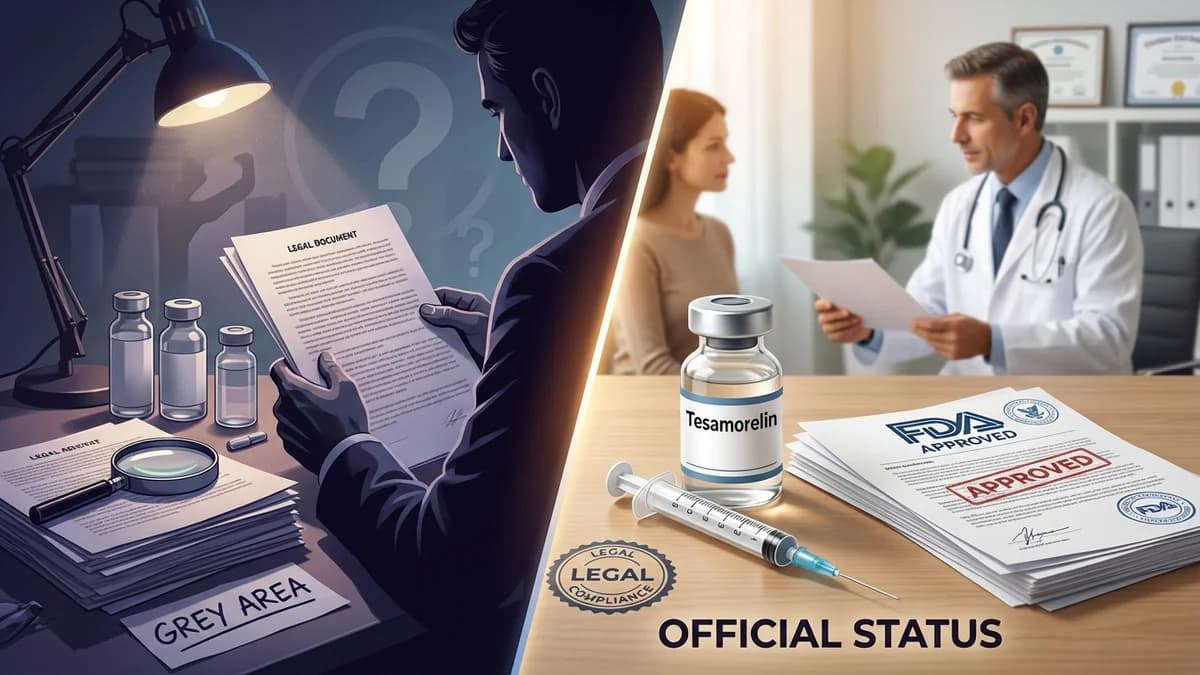
Tesamorelin legality is one of the more nuanced questions in the peptide therapy space — and the answer isn't a simple yes or no. Unlike most peptides, tesamorelin actually has FDA approval. That's the good news. The more complicated news is that its approval is narrow, its compounding status is restricted, and the gap between what it's approved for and what patients want it for creates real legal grey areas that you need to understand before you do anything.
This article walks through the complete regulatory picture: what the FDA has approved, what compounding pharmacies can and can't do, what "research use only" actually means legally, and what your realistic options are in 2026.
Key Takeaways
- Tesamorelin is FDA-approved under the brand names EGRIFTA SV and EGRIFTA WR, specifically for reducing excess abdominal fat in HIV-infected adults with lipodystrophy.[1]
- That approval is narrow. Using or prescribing tesamorelin for any other purpose — including general body composition, anti-aging, or athletic performance — is not "off-label prescribing" in the traditional sense. It's a more complicated legal situation (explained below).
- Compounding tesamorelin is restricted. FDA has placed tesamorelin on its list of bulk drug substances that raise significant concerns for compounding, which limits what 503A and 503B pharmacies can legally do with it.
- Tesamorelin is not a controlled substance. It is not scheduled by the DEA, so possession alone doesn't carry the same criminal exposure as, say, anabolic steroids.
- Buying it online from unregulated sources is illegal regardless of what the product label says — "research use only" is not a legal loophole.
- If you have HIV-associated lipodystrophy, tesamorelin is legally accessible by prescription through licensed providers and pharmacies carrying EGRIFTA SV or EGRIFTA WR.
Regulatory Status at a Glance
| Category | Status | Detail |
|---|---|---|
| FDA Approval | ✅ Approved (narrow indication) | EGRIFTA SV and EGRIFTA WR; HIV-associated lipodystrophy only[1] |
| Compounding Status | ⚠️ Restricted | FDA has identified tesamorelin as a substance of concern for compounding; 503A/503B access is significantly limited |
| DEA Scheduling | ✅ Not Scheduled | Tesamorelin is not a controlled substance under the Controlled Substances Act |
| Prescription Requirement | ✅ Prescription Required | Cannot be legally dispensed without a valid prescription from a licensed provider |
| International Status | 🌐 Varies | Not approved in the EU, UK, or Australia as of March 2026; limited availability outside the US |
| Research Use | ⚠️ Restricted | "Research use only" label does not permit human administration outside of approved clinical trials |
Current FDA Status
Tesamorelin has a real, confirmed FDA approval — something that puts it in a very different category from most peptides discussed in the clinic space. The FDA approved EGRIFTA (the original formulation) in November 2010, followed by the reformulated EGRIFTA SV (single-vial) and EGRIFTA WR (weekly release) versions.[1] The approved indication is specific: reduction of excess abdominal fat in HIV-infected adult patients with lipodystrophy.
That's it. One indication, one patient population.
The approval pathway was a standard New Drug Application (NDA) process. The clinical basis for approval rested on two randomized, double-blind, placebo-controlled Phase III trials — the LIPO-010 and LIPO-011 studies — which demonstrated statistically significant reductions in visceral adipose tissue (VAT) measured by CT scan in HIV-positive patients on antiretroviral therapy.[2] In those trials, patients receiving 2 mg subcutaneous tesamorelin daily achieved mean VAT reductions of approximately 18% versus placebo after 26 weeks.[2]
Tesamorelin works as a growth hormone releasing hormone (GHRH) analog. It binds to the GHRH receptor on pituitary somatotroph cells, stimulating endogenous growth hormone (GH) secretion in a pulsatile, physiological pattern — which is mechanistically different from exogenous GH administration.[3] Its molecular structure is a 44-amino acid peptide with a trans-3-hexenoic acid group at the N-terminus that stabilizes it against dipeptidyl peptidase IV (DPP-IV) degradation, giving it a longer effective half-life than native GHRH.[3]
So the FDA approval is real, documented, and based on solid Phase III data. What it doesn't do is make tesamorelin legal for every purpose someone might want it for.
Compounding Status
This is where tesamorelin legality gets genuinely complicated, and where most of the confusion in the clinic space originates.
Because tesamorelin has an FDA-approved commercial product (EGRIFTA SV/WR), compounding pharmacies face significant restrictions on their ability to prepare it independently. Under Section 503A of the Federal Food, Drug, and Cosmetic Act, compounding pharmacies can prepare customized medications for individual patients — but they generally cannot compound drugs that are "essentially a copy" of a commercially available FDA-approved product unless there's a documented clinical difference (such as a strength or dosage form not available commercially, or a documented allergy to an excipient in the commercial product).[4]
For 503B outsourcing facilities, which can produce larger batches for healthcare facilities without patient-specific prescriptions, the FDA has developed a list of bulk drug substances that may or may not be used in compounding. Tesamorelin's status on these lists is a critical point: the FDA has identified tesamorelin as a substance that raises significant safety and policy concerns for compounding, given that an approved commercial product exists and that the peptide's complexity creates immunogenicity risks if not manufactured under strict pharmaceutical-grade conditions.[4]
What this means practically:
- A compounding pharmacy cannot simply produce generic tesamorelin as a cheaper alternative to EGRIFTA SV for the approved indication without meeting a high bar for clinical necessity documentation.
- Compounding tesamorelin for unapproved indications — body composition in non-HIV patients, anti-aging, GH optimization — is not legally supported under current FDA guidance.
- Any compounded tesamorelin product that lacks the rigorous quality controls of the approved formulation poses real immunogenicity risks: antibodies to the peptide can develop and potentially cross-react with endogenous GHRH.[3]
If you're seeing tesamorelin offered at a compounding pharmacy for general wellness purposes, that's a red flag worth taking seriously. Check the MyPeptideMatch clinic finder to identify providers operating within documented legal frameworks.
Enforcement Actions
The FDA has taken enforcement action against companies marketing unapproved peptide products, including GHRH analogs. Consult FDA.gov and the FDA's MedWatch program for current enforcement activity specific to tesamorelin.
What the general enforcement pattern looks like in the peptide space:
- The FDA and FTC have jointly targeted companies selling peptides labeled "research use only" that are clearly intended for human use — the marketing language, dosing instructions, and customer-facing content make the intended use obvious, and regulators treat these as unapproved drug sales regardless of the label disclaimer.
- FDA warning letters to compounding pharmacies have cited "essentially a copy" violations when pharmacies compound drugs with existing approved commercial equivalents without documented clinical justification.
- DOJ has pursued criminal charges in cases involving large-scale distribution of unapproved biologics, particularly where the products were marketed with explicit therapeutic claims.
The existence of an FDA-approved commercial product (EGRIFTA SV/WR) actually makes tesamorelin a higher enforcement priority than peptides with no approved version, because the "essentially a copy" violation is easier to establish. Regulators don't have to argue about whether tesamorelin is a drug — the NDA settles that question.
Prescription vs. Over-the-Counter vs. Research Use
Prescription Access
For the approved indication — HIV-associated lipodystrophy — tesamorelin is legally accessible by prescription. Your provider writes a prescription for EGRIFTA SV or EGRIFTA WR, which is filled through a licensed pharmacy. The standard approved dose is 2 mg administered subcutaneously once daily.[1] Insurance coverage varies; the commercial product is expensive (list price historically in the thousands of dollars per month), and prior authorization requirements are common.
If you have HIV-associated lipodystrophy and your provider hasn't discussed tesamorelin, that's worth raising directly. It's an FDA-approved option with a meaningful evidence base.
"Research Use Only" — Not a Loophole
You'll find tesamorelin sold online with "research use only" or "not for human use" labels. Here's the legal reality: that language does not create a legal exemption. The FDA evaluates the totality of how a product is marketed and sold, not just the label disclaimer. If a product is sold in human-dose vials, with dosing guides, to customers who are obviously seeking it for personal use, it's being marketed as an unapproved drug — full stop.[4]
Buying "research use only" tesamorelin online and injecting it yourself is:
- Purchasing an unapproved drug without a prescription
- Potentially receiving a product of unknown purity, sterility, and concentration
- Exposing yourself to the immunogenicity risks of a non-pharmaceutical-grade peptide preparation
The legal risk to buyers is lower than to sellers, but it's not zero — particularly for quantities suggesting distribution rather than personal use.
Gray Market Products
Gray market tesamorelin — products that aren't clearly illegal but aren't operating within a legitimate pharmaceutical supply chain — typically comes from overseas manufacturers, domestic "research chemical" suppliers, or compounding pharmacies operating outside their legal scope. The quality control on these products is genuinely unknown. The FDA's pharmaceutical-grade standards for the approved EGRIFTA formulations exist for a reason: peptide purity, sterility, and proper lyophilization all matter for both safety and efficacy.
International Purchasing
Importing tesamorelin from foreign sources for personal use sits in a legally precarious position. The FDA's personal importation policy allows some discretion for patients importing small quantities of unapproved drugs for serious conditions when no domestic equivalent exists — but tesamorelin has a domestic approved equivalent, which undermines that argument significantly.[4] Customs seizures of peptide shipments have increased, and there's no guaranteed legal protection for personal importation of a drug with an existing US-approved commercial version.
What "Off-Label" Actually Means
This distinction matters enormously, and it's one that even some providers get wrong.
"Off-label prescribing" refers to a licensed physician prescribing an FDA-approved drug for an indication, population, or dosage not specified in its FDA-approved labeling. This is legal and common — approximately 20% of all prescriptions in the US are written off-label.[5]
Here's the critical point for tesamorelin: the FDA approval for EGRIFTA SV/WR is indication-specific. Prescribing the approved commercial product (EGRIFTA SV/WR) to a non-HIV patient for body composition purposes is off-label prescribing of an FDA-approved drug. That's legal for providers to do, though it comes with liability considerations and typically won't be covered by insurance.
But prescribing compounded tesamorelin — a non-approved formulation — to a non-HIV patient for an unapproved purpose is a different situation. That's prescribing an unapproved drug, which carries different legal and regulatory weight. Providers who do this are exposed to potential board discipline, malpractice liability, and DEA/FDA scrutiny.
The practical implication: if a provider wants to use tesamorelin for a non-HIV patient, the legally cleaner path is to prescribe the FDA-approved commercial product off-label, with documented informed consent and clinical justification, rather than directing a patient to a compounding pharmacy for a non-approved formulation.
For providers navigating this, the MyPeptideMatch provider resources section covers documentation best practices for off-label peptide prescribing.
State-Level Variations
Federal law sets the floor for drug regulation, but states add their own layers — and those layers matter for tesamorelin access.
State pharmacy board positions: Several state pharmacy boards have issued guidance restricting compounding of peptides that have commercially available FDA-approved equivalents. Florida, Texas, and California have all seen enforcement activity against compounding pharmacies operating outside federal compounding guidelines, including for peptides in the GHRH class.
Telemedicine prescribing rules: Many patients seek peptide therapy through telehealth platforms. For tesamorelin specifically, the off-label prescribing scenario (approved drug, unapproved indication) is generally permissible via telemedicine — but the provider must be licensed in the patient's state, must conduct a legitimate clinical evaluation, and cannot prescribe without a valid patient-provider relationship. The DEA's Ryan Haight Act requirements apply to controlled substances, not to tesamorelin specifically (since it's not scheduled), but state telemedicine rules still govern prescribing validity.
States with active enforcement: Arizona, Florida, and New York have seen the most active state-level enforcement against unlicensed peptide dispensing. If you're in one of these states and you're being offered compounded tesamorelin without a clear clinical justification, the risk profile is higher.
International Status
Tesamorelin's FDA approval is a US-specific regulatory achievement. The picture looks quite different outside the US.
| Jurisdiction | Regulatory Body | Status |
|---|---|---|
| European Union | EMA | Not approved as of March 2026 |
| United Kingdom | MHRA | Not approved as of March 2026 |
| Australia | TGA | Not approved as of March 2026 |
| Canada | Health Canada | Not approved as of March 2026 |
This matters for a few reasons. First, if you're traveling internationally with tesamorelin, you may be carrying a substance that has no legal status in your destination country. Second, overseas sources of tesamorelin are not operating under any approved regulatory framework — they're producing an unapproved drug by any country's standards. Third, the lack of international approval means there's no foreign regulatory body providing quality oversight on imported products.