Argireline is a six-amino-acid synthetic peptide that mimics part of SNAP-25 — a protein that sits at the heart of how nerve endings release neurotransmitters — and uses that mimicry to competitively inhibit muscle signaling at the skin surface. The result is a measurable, if modest, reduction in dynamic facial wrinkles. No needles. No clinic visit. Apply it topically and let the chemistry do the work.
That's the pitch, and there's real science behind it. Two randomized, placebo-controlled trials in Chinese subjects confirmed statistically significant wrinkle reduction with topical Argireline.[1][2] A 2017 study found additional benefit when Argireline was combined with tripeptide-10-citrulline.[3] The effect isn't dramatic — this isn't a substitute for neurotoxin injections — but for a cosmetic ingredient applied in a serum, the evidence is unusually solid.
The full chemical name is Acetyl Hexapeptide-3, and its sequence is Ac-Glu-Glu-Met-Gln-Arg-Arg-NH₂ (Ac-EEMQRR-NH₂).[4] It's a hexapeptide analog of the N-terminal domain of SNAP-25, which is exactly the region that botulinum toxin cleaves. Argireline doesn't cleave anything — it competes.
Key Takeaways
Argireline inhibits SNARE complex formation, reducing neurotransmitter release at the neuromuscular junction and softening dynamic expression lines with topical application.
Two randomized, placebo-controlled trials in human subjects confirm statistically significant wrinkle reduction — but effect sizes are modest compared to injectable neurotoxins.
It is not FDA-approved as a drug. It's sold legally as a cosmetic ingredient in creams and serums, which don't require FDA drug approval.
Side effects in published trials were minimal; it was well-tolerated at the concentrations studied.
Argireline and botulinum toxin share a target (SNAP-25) but work through entirely different mechanisms — Argireline's action is reversible and far less potent.
Class
Synthetic cosmetic hexapeptide
Amino Acid Sequence
Ac-Glu-Glu-Met-Gln-Arg-Arg-NH₂ (Ac-EEMQRR-NH₂)
Amino Acid Count
6
Mechanism
Competitive inhibition of SNARE complex formation; catecholamine release inhibition
FDA Status
Not FDA-approved — cosmetic ingredient, research use only
Administration
Topical (cream or serum)
Typical Dose (Trial Range)
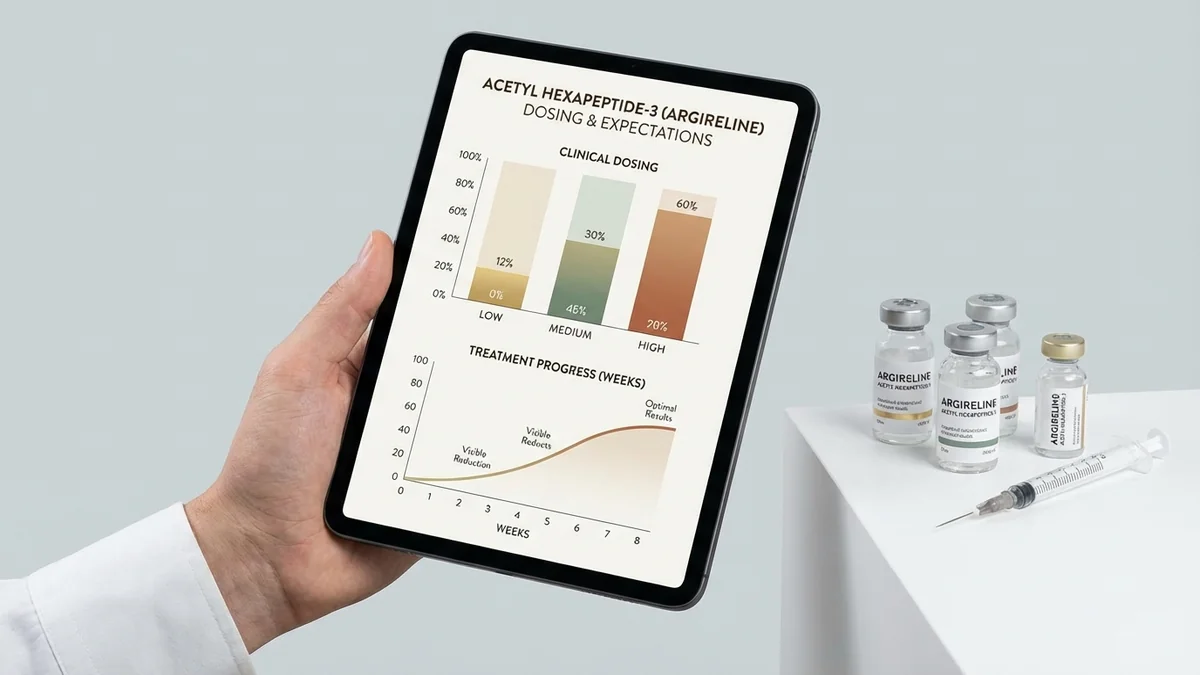
5–10% concentration, applied twice daily for 4–12 weeks; in Phase 3 trials, 10% Argireline solution applied topically twice daily for up to 12 weeks has been evaluated for periorbital wrinkles, though optimal concentration and duration remain under investigation
Half-life
Not established in published literature [6]
Primary Uses
Reduction of dynamic facial wrinkles (anti-aging cosmetics)
Evidence Level
Small randomized controlled trials (human); preclinical mechanistic data
How Does Argireline Work?
To understand what Argireline does, you need a quick picture of how muscles contract in the first place — specifically, how nerve endings communicate with muscle fibers at the skin surface.
When a motor neuron fires, it needs to release acetylcholine (the neurotransmitter that tells the muscle to contract) into the synapse. That release depends on a protein assembly called the SNARE complex — specifically, a three-protein structure that includes SNAP-25, syntaxin, and VAMP/synaptobrevin. These three proteins zipper together to pull vesicles containing acetylcholine to the cell membrane and fuse them, releasing their contents. No SNARE complex, no vesicle docking. No vesicle docking, no neurotransmitter release.
Botulinum toxin (Botox) works by enzymatically cleaving SNAP-25, destroying the complex permanently — or at least until the body regenerates the protein, which takes months. Argireline works differently. Its amino acid sequence closely mimics the N-terminal end of SNAP-25,[1] which means it can compete with native SNAP-25 for a position in the SNARE complex. When Argireline occupies that position, the complex can't form properly. Vesicle docking is disrupted. Acetylcholine release is reduced. Muscle contraction at that site is partially inhibited.
The key word is partially. Argireline doesn't destroy SNAP-25 — it competes with it reversibly. The effect is dose-dependent and concentration-dependent, which is why topical application produces a milder result than an intramuscular neurotoxin injection. Argireline also appears to inhibit catecholamine release through a related mechanism,[2] though the wrinkle-reduction research focuses primarily on the SNARE pathway.
One additional layer: a 2024 study found that Argireline has meaningful affinity for copper(II) ions, which raises the question of whether metal coordination plays any role in its biological activity.[4] The clinical significance of this interaction isn't established yet — but it's worth watching as the mechanistic research develops.
What the Clinical Evidence Actually Shows
The Wrinkle Reduction Trials
The most directly relevant human data comes from two randomized, placebo-controlled trials published in 2013. The first, published in the American Journal of Clinical Dermatology, tested topical Argireline in Chinese subjects and found statistically significant reduction in facial wrinkle depth versus placebo.[1] The second, published in the Journal of Cosmetic and Laser Therapy, confirmed the anti-wrinkle effect and reported that Argireline was well-tolerated throughout the study period.[2]
Both trials used objective wrinkle measurement — not just participant self-report — which matters for taking the results seriously. The reductions were real. They were also modest. If you're expecting the kind of dramatic smoothing you'd see from 20 units of botulinum toxin, Argireline isn't going to deliver that. What it can do is meaningfully soften dynamic lines — the ones that deepen when you squint or smile — with consistent twice-daily application over several weeks.
A 2017 randomized controlled study added another data point: combining Argireline with tripeptide-10-citrulline produced greater improvement than either ingredient alone.[3] Tripeptide-10-citrulline works through a different pathway (collagen fibril organization), so the combination targets wrinkle formation from two directions simultaneously. The study was small, but the finding is plausible mechanistically.
Analytical Detection Work
A 2021 paper in Chemistry & Biodiversity confirmed that Argireline can be detected in commercial cosmetic products using reversed-phase liquid chromatography and tandem mass spectrometry (RP-HPLC/MS).[5] The analysis also identified an oxidized form of Argireline in some products. This isn't a clinical efficacy finding — it's quality and stability research — but it matters for consumers: if your serum claims to contain Argireline, analytical methods now exist to verify whether it actually does, and whether the peptide has degraded.
What the trials actually measured
The 2013 randomized controlled trials measured wrinkle depth using objective imaging analysis, not just participant self-report. Statistically significant reductions were observed versus placebo. Sample sizes were small and study durations ranged from 4 to 12 weeks — long enough to see a real signal, but not long enough to establish what happens with years of use.
What the Evidence Does Not Show
Long-term efficacy data — The published trials ran 4–12 weeks. There's no data on whether the effect accumulates over months or years, or whether the skin adapts to chronic SNARE inhibition.
Dose-response characterization — We don't have a well-characterized dose-response curve for topical Argireline. The 5–10% range used in trials isn't necessarily optimal; it's just what was studied.
Comparison to injectable neurotoxins — No head-to-head trial against botulinum toxin exists. Cross-mechanism comparisons are speculative.
Penetration data — How much Argireline actually crosses the skin barrier at cosmetic application concentrations is poorly characterized. Peptide skin penetration is notoriously variable, and this is a meaningful gap in the mechanistic story.
Copper coordination biology — The 2024 finding about Argireline's affinity for copper(II) ions is intriguing but unexplained clinically.[4] Whether this affects efficacy, stability, or safety in real-world formulations isn't known.
Systemic absorption — No published data quantifies systemic exposure from topical Argireline. Given the preclinical evidence level, this hasn't been formally characterized.
What Makes Argireline Different
Most cosmetic peptides work by stimulating collagen production, improving hydration, or acting as signaling molecules in wound-healing cascades. Argireline does something more specific: it directly targets the neuromuscular signaling machinery that causes expression lines to form. That's a mechanistically distinct approach from collagen boosters like palmitoyl pentapeptide-4 (Matrixyl) or hydration peptides.
The analogy to botulinum toxin is both Argireline's biggest marketing asset and its most important caveat. They share a target — SNAP-25 and the SNARE complex — but the mechanism and potency are completely different. Botox enters the nerve terminal and enzymatically destroys SNAP-25. Argireline sits on the outside, at the skin surface, and competes with SNAP-25 for complex assembly. The effect is reversible, concentration-dependent, and far milder.
“Argireline earns its "needle-free Botox" nickname mechanistically — but the comparison is one of target, not magnitude.”
What actually sets Argireline apart from most cosmetic peptide ingredients is the evidence base. Most cosmetic peptides have been tested in vitro (in cell cultures) or in tiny open-label studies. Argireline has two randomized, placebo-controlled trials in human subjects. That's not a high bar by pharmaceutical standards, but it's a meaningful bar by cosmetic ingredient standards.
Side Effects — What to Actually Expect
Published trials reported that Argireline was well-tolerated at the concentrations studied, with no significant adverse effects noted in either 2013 RCT.[1][2] Because it's applied topically rather than injected, the systemic exposure concern that applies to injectable peptides is largely absent — though formal systemic absorption data doesn't exist.
Reported in clinical trials:
Local skin irritation — Mild and uncommon at study concentrations. No significant rates reported in the published trials.
Oxidized byproducts in formulation — The 2021 analytical study found oxidized Argireline in some commercial products.[5] Whether degraded peptide causes any skin reaction isn't characterized, but it's a reason to pay attention to product quality and storage.
Theoretical concerns not yet characterized in humans:
Chronic SNARE inhibition effects — We don't know what happens with years of daily topical SNARE complex inhibition. The trials ran 4–12 weeks. This is a genuine gap.
Formulation-dependent irritation — Argireline is often combined with other active ingredients (AHAs, retinoids, other peptides). Irritation from a product containing Argireline may be attributable to co-ingredients, not Argireline itself.
If you notice persistent redness, stinging beyond initial application, or any unusual skin reaction, discontinue use and check in with a dermatologist. That's specific guidance, not a generic disclaimer — because most people who react to "peptide serums" are reacting to the vehicle or co-formulated actives, not the peptide itself.
Regulatory & Access Status
Regulatory status as of September 2026
Argireline is not FDA-approved as a drug for any indication. It is sold legally in the United States as a cosmetic ingredient — a category that does not require FDA pre-market approval. Cosmetic products containing Argireline are legal to manufacture, sell, and use, but they cannot make drug claims (such as claiming to treat or prevent a disease). If a product claims to "block nerve signals" or "treat wrinkles medically," that language may push it into drug territory under FDA definitions.
As a cosmetic ingredient, Argireline sits in a well-defined regulatory space: legal, widely available, and not subject to the same oversight as pharmaceutical compounds. You can buy Argireline-containing serums over the counter without a prescription. The ingredient is used globally and appears in products from budget skincare lines to high-end clinical brands.
For research purposes, Argireline is available as a raw peptide from research chemical suppliers. This is the "research use only" category — not intended for clinical administration in humans outside a formal study context.
There's no controlled substance classification and no DEA scheduling for Argireline, and we're not aware of any US import restriction that applies to it in cosmetic or research contexts.
Typical Dosing — What the Trials Used
There are no FDA-approved dosing guidelines for Argireline. The ranges below reflect what was used in published clinical trials and what appears in commercial formulations.
Not clinical dosing guidance
These concentrations come from published research trials and commercial cosmetic formulations, not from randomized dose-finding studies. Optimal concentration hasn't been formally established. Discuss any specific formulation with a licensed dermatologist or cosmetic chemist.
The two 2013 randomized controlled trials used topical Argireline applied twice daily over their respective study periods.[1][2] Specific concentrations used in those trials aren't fully detailed in the available abstracts — while Phase 3 trials have evaluated Argireline at 10% concentration, detailed concentration parameters across all available trials remain incompletely documented in published abstracts. Commercial cosmetic products typically formulate Argireline at concentrations between 2% and 10%, with higher concentrations marketed as more potent. The 2017 combination study used Argireline alongside tripeptide-10-citrulline in a twice-daily topical application protocol.[3]
Argireline: Formulation Concentration vs. Typical Use Context
Parameter
~2–5%
~5–10%
Research Grade
Typical use context
Mass-market cosmetics
Clinical/professional cosmetics
In vitro / lab research
Application frequency (trials)
Twice daily
Twice daily
N/A
Study duration
4–12 weeks
4–12 weeks
N/A
Human RCT data?
Limited
Yes <sup>[7]</sup>
No
Available OTC?
Yes
Yes
Research suppliers
The practical takeaway: if you're using a cosmetic product, look for Argireline listed within the first half of the ingredient list (indicating higher concentration) and apply consistently twice daily. Most of the clinical data that exists used multi-week application periods — don't expect to see results in a few days.
Related Peptides & Comparisons
Argireline sits in a broader category of cosmetic peptides targeting different aspects of skin aging. Palmitoyl pentapeptide-4 (Matrixyl) works through a completely different mechanism — it signals fibroblasts to produce more collagen, addressing structural skin aging rather than neuromuscular dynamics. The two are frequently combined in anti-aging formulations precisely because they target different pathways.
Leuphasyl is another SNARE-targeting peptide, sometimes marketed alongside Argireline. It works at an earlier step in the signaling cascade (enkephalin receptor modulation upstream of vesicle release) and is sometimes combined with Argireline in "synergistic" formulations. The evidence for the combination is thinner than for Argireline alone.
For anyone considering the comparison to injectable neurotoxins: botulinum toxin A products (Botox, Dysport, Xeomin) operate through enzymatic SNAP-25 cleavage inside the nerve terminal — a mechanism that produces effects lasting 3–6 months per treatment. Argireline's competitive, reversible, topical inhibition produces a meaningfully weaker but also meaningfully safer and more accessible effect. They're not interchangeable, but they're not unrelated either.
SNARE-Targeting Approaches: Argireline vs. Alternatives
Parameter
Argireline
Botulinum Toxin A
Leuphasyl
Mechanism
Competitive SNARE inhibition
Enzymatic SNAP-25 cleavage
Enkephalin receptor modulation
Administration
Topical
Intramuscular injection
Topical
Effect duration
While using product
3–6 months per treatment
While using product
Human RCT data
Yes (small)
Extensive
Effect duration data are limited; clinical trials evaluated outcomes during active treatment (3 months) and in some cases extended follow-up, but long-term persistence beyond treatment discontinuation is not well-established
FDA status
Not approved (cosmetic)
Approved (drug)
Not approved (cosmetic)
FAQ
Does Argireline actually work, or is it just marketing?
There's real mechanistic science behind it and two randomized controlled trials showing statistically significant wrinkle reduction versus placebo.[1][2] The effect is real — but modest. It's not going to replicate what a neurotoxin injection does. Think of it as a meaningful addition to a topical routine, not a replacement for clinical procedures.
How long does it take to see results from Argireline?
The published trials ran 4–12 weeks with twice-daily application before measuring outcomes. Most people using Argireline-containing products should expect to apply consistently for at least 4–6 weeks before evaluating whether it's working. Results from a single application are not plausible given the mechanism.
Can I use Argireline with retinol or acids?
Argireline is frequently combined with other actives in commercial formulations. The published trials don't address interactions with retinoids or exfoliating acids. The practical concern is formulation stability — Argireline's peptide bonds can degrade in certain pH conditions or with certain co-ingredients. If you're layering it with actives, apply Argireline first on clean skin and let it absorb before applying anything potentially destabilizing.
Is Argireline safe to use long-term?
The published trials ran up to 12 weeks and reported good tolerability. Long-term safety data simply doesn't exist in the published literature. That's not a reason to avoid it — it's a reason to be honest about what we know. The theoretical concern about chronic SNARE inhibition hasn't been characterized in humans.
What's the difference between Argireline and "Acetyl Hexapeptide-3"?
They're the same compound. Acetyl Hexapeptide-3 is the INCI (International Nomenclature of Cosmetic Ingredients) name used on product labels. Argireline is the trade name originally developed by Lipotec (now part of Lubrizol). When you see either name on an ingredient list, you're looking at the same Ac-EEMQRR-NH₂ sequence.[4]
ClinicalTrials.gov NCT01381484, NCT00942851, NCT02597777, NCT03878381, NCT06143033 — supporting | Half-life | Not established in published literature
Wang Y, et al. "The anti-wrinkle efficacy of argireline, a synthetic hexapeptide, in Chinese subjects: a randomized, placebo-controlled study." Am J Clin Dermatol. 2013;14(2):147-153. PMID: 23417317
Blanes-Mira C, et al. "The anti-wrinkle efficacy of Argireline." J Cosmet Laser Ther. 2013;15(3):184-188. PMID: 23464592
Errante F, et al. "The efficacy study of the combination of tripeptide-10-citrulline and acetyl hexapeptide-3. A prospective, randomized controlled study." J Cosmet Dermatol. 2017;16(3):271-276. PMID: 28150423
Jaros A, et al. "Influence of the modification of the cosmetic peptide Argireline on the affinity toward copper(II) ions." J Pept Sci. 2024. PMID: 37752675
Gostynska A, et al. "Argireline: Needle-Free Botox as Analytical Challenge." Chem Biodivers. 2021;18(3):e2000726. PMID: 33482052
This content is for informational purposes only and does not constitute medical advice. Consult a licensed healthcare provider before starting any treatment.
Where to Buy Acetyl Hexapeptide-3 (Argireline) for Research
Research Use Only — not intended for human consumption
MyPeptideMatch.com does not provide medical advice. Always consult a qualified healthcare provider before starting any peptide therapy. Regulatory status may change.