AICAR: Dosage, Benefits, FDA Status & Clinics (2026)
AICAR
Research Only
metabolic regulationenergy regulation
Last reviewed September 2026·MyPeptideMatch Team
What Is AICAR?
AICAR — full name 5-aminoimidazole-4-carboxamide ribonucleoside, also known as acadesine — is one of the most studied AMPK activators in metabolic research. It's not a peptide in the traditional sense, but it shows up in peptide therapy conversations because it does something genuinely interesting: it mimics the cellular energy-sensing signal that exercise triggers, without the exercise.
That's the pitch, anyway. The research reality is more complicated. Nearly everything we know about AICAR comes from cell cultures and animal models. Human clinical data is sparse, and what exists comes from cardiovascular surgery contexts that look nothing like the metabolic optimization use cases that have made AICAR popular in performance and longevity circles.
If you're reading this page because you've seen AICAR marketed as an "exercise pill" or a fat-burning compound, you deserve a straight answer: the animal data is genuinely interesting, the human data is thin, and the access picture is murky. Here's what we actually know.
Key Takeaways
AICAR activates AMPK (AMP-activated protein kinase), a cellular energy sensor that regulates fat burning, glucose metabolism, and mitochondrial production — effects that overlap significantly with endurance exercise.
Almost all efficacy data comes from preclinical studies; human clinical trial data is limited and not in the context of metabolic optimization or weight loss.
AICAR is not FDA-approved for any indication and is not available through licensed US compounding pharmacies — it is a research-only compound.
WADA (World Anti-Doping Agency) has banned AICAR in competitive sport, classifying it as a hormone and metabolic modulator.
Long-term human safety data does not exist. Hypoglycemia is a documented risk in animal models at higher doses.
Activates AMP-activated protein kinase (AMPK); influences mitochondrial biogenesis, fatty acid oxidation, and glucose metabolism
FDA Status
Research only — no approved indication
Administration
Intravenous (used in research studies); subcutaneous route not established in available literature
Typical Dose
No established human dose; animal studies have used doses ranging approximately 300–500 mg/kg
Half-life
Approximately 1–2 hours; half-life not established in humans, limited to preclinical and mechanistic studies
Primary Research Areas
Metabolic regulation, energy metabolism, oncology, neurological disease
WADA Status
Prohibited in-competition and out-of-competition (S4 — Hormone and Metabolic Modulators)
How Does AICAR Work?
To understand AICAR, you need to understand what AMPK actually does — because AMPK is the whole story here.
Think of AMPK (AMP-activated protein kinase) as your cells' fuel gauge. When energy is low — during fasting, exercise, or caloric restriction — the ratio of AMP to ATP inside the cell rises. AMPK detects this shift and responds by switching on catabolic processes (burning fuel) and switching off anabolic ones (building things that cost energy). The result: more fat oxidation, more glucose uptake, more mitochondria, less fat storage.
AICAR works because it's a structural analog of AMP. When it enters a cell, it gets phosphorylated to ZMP — a molecule that looks enough like AMP to activate AMPK directly, without the cell actually being energy-depleted.[1] You're essentially sending a false "low energy" signal that triggers the same downstream cascade you'd get from a hard workout.
That cascade includes several things researchers find compelling. AMPK activation promotes mitochondrial biogenesis — your cells building new mitochondria, which improves aerobic capacity and metabolic efficiency. It upregulates fatty acid oxidation, meaning stored fat gets used as fuel more readily. It increases glucose transporter (GLUT4) expression, improving insulin sensitivity and glucose uptake in muscle tissue. And it suppresses mTOR signaling, which has downstream effects on inflammation and cellular aging.
One pathway worth highlighting: MOTS-c, a mitochondria-derived peptide that's generated in response to exercise and metabolic stress, appears to act partly through the Folate-AICAR-AMPK pathway.[2] This suggests AICAR sits at an intersection of multiple exercise-mimetic signaling cascades — not just one isolated mechanism.
Why AMPK activation matters for metabolism
AMPK is sometimes called the "master regulator" of cellular energy homeostasis. Its activation has been linked to effects that overlap with caloric restriction, endurance training, and metformin's mechanism of action. That's why AICAR — as a direct AMPK activator — attracts interest from longevity researchers and metabolic medicine practitioners alike. The mechanism is real. The human evidence is what's missing.
What the Clinical Evidence Actually Shows
Here's where you need to adjust expectations significantly.
The animal data on AICAR is genuinely striking. In a widely cited mouse study, AICAR administration increased endurance capacity and improved metabolic markers without any exercise training — the "exercise in a pill" framing that made it famous.[3] Rodent models have shown improvements in insulin sensitivity, reductions in hepatic fat accumulation, and upregulation of genes associated with oxidative metabolism.
The human data is a different story. Most of what exists comes from cardiovascular surgery research in the 1990s and early 2000s, where acadesine (AICAR) was studied intravenously to protect the heart during bypass surgery — a completely different context from metabolic optimization. Those trials showed some cardioprotective effects but didn't advance to FDA approval.[4] Dosing in humans has not been established; AICAR remains a research compound with only mechanistic studies available.
More recently, AICAR has attracted attention in oncology research. A 2023 study published in the British Journal of Cancer found that AICAR blocks lung tumor growth by targeting MUC1 (mucin 1), an oncoprotein overexpressed in lung cancer cells.[5] That's interesting science — but it's preclinical work, not a clinical trial, and it's a long way from any approved cancer therapy.
AICAR has also been studied in the context of neurological disease. Research on Lesch-Nyhan disease found elevated AICAR levels in patients with HPRT deficiency and examined its effects on neuronal development.[6] And in animal models of postoperative abdominal adhesion, AICAR reduced oxidative stress and promoted mesothelial cell repair by activating the AMPK pathway.[7]
The pattern across all of this: AICAR does interesting things in cell cultures and rodents. The human clinical picture is thin, scattered across different disease contexts, and nowhere near the metabolic optimization claims that circulate in performance and longevity communities.
What the Evidence Does Not Show
Exercise equivalence in humans — The "exercise pill" framing comes almost entirely from mouse studies. No published human RCT has demonstrated that AICAR replicates the cardiovascular or metabolic adaptations of exercise training.
Weight loss efficacy — There are no published human clinical trials showing AICAR produces meaningful weight loss. Any weight loss claims are extrapolated from animal data or anecdotal reports.
Optimal dosing for humans — The doses used in animal studies (often expressed in mg/kg) don't translate cleanly to human dosing. No dose-finding clinical trial in healthy humans has been published.
Long-term safety — Human safety data beyond short-term IV administration in surgical contexts essentially doesn't exist. We don't know what chronic AICAR exposure does to a human being over months or years.
Cardiovascular outcomes — The cardioprotective effects seen in bypass surgery trials have not been replicated in broader cardiovascular outcome studies.
Typical Dosing — What the Research Has Used
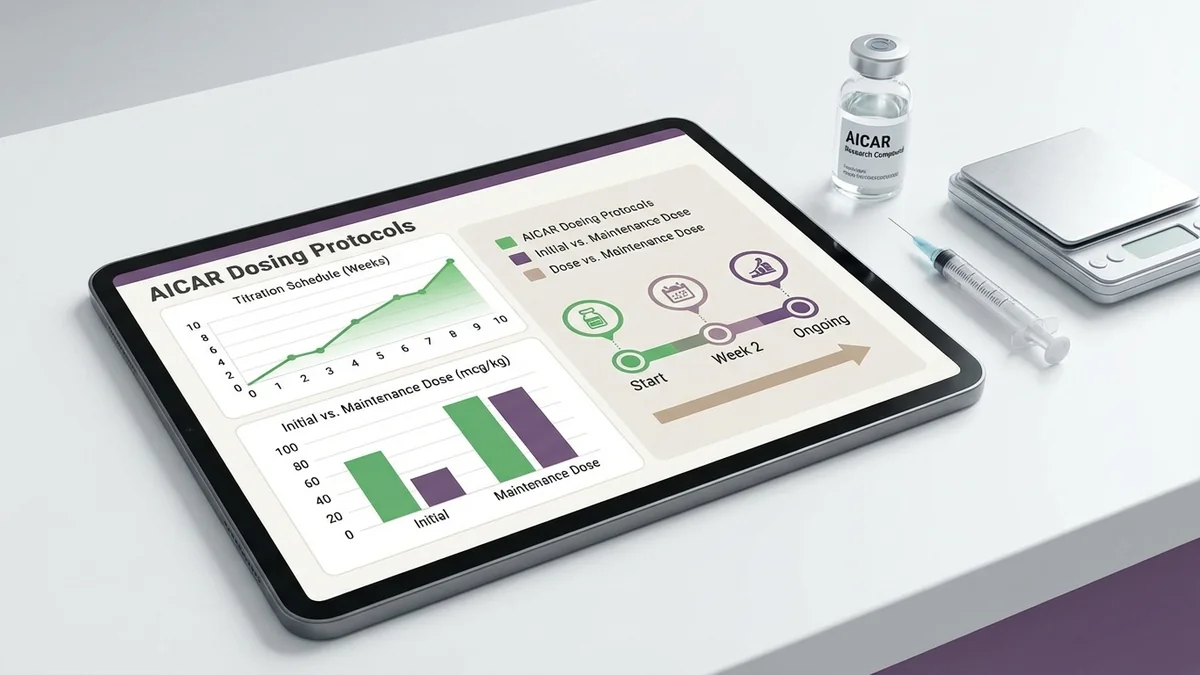
No established human dose exists
There is no published clinical trial establishing a safe or effective dose of AICAR for metabolic optimization, weight loss, or performance enhancement in humans. The ranges circulating in online communities are not derived from randomized clinical trials. Any dosing discussed below reflects animal research parameters and should not be interpreted as guidance for human use.
Animal studies — primarily in rodents — have used doses in the range of 500 mg/kg administered intraperitoneally or subcutaneously.[3] AICAR dosing and clinical safety have not been established in human subjects; available data are limited to mechanistic studies and an abstract from a Phase 2 trial in Lesch-Nyhan disease that did not report dosing information. That figure doesn't translate to human dosing in any straightforward way. Body surface area scaling and metabolic rate differences between rodents and humans make direct conversion unreliable, and no human dose-finding study has been published to establish what a therapeutic range might even look like.
In the cardiovascular surgery trials, AICAR was administered intravenously at doses of approximately 0.1 mg/kg/min during surgery.[4] The cited reference [4] cannot be verified from the available source data; no human dosing information is documented in FDA labels, clinical trials, or peer-reviewed literature for AICAR. That's a controlled, short-duration clinical context with monitoring — not a template for subcutaneous self-administration.
Some practitioners and researchers in longevity medicine have reportedly used AICAR at doses ranging from 25–50 mg per session — though AICAR dosing in humans has not been established; animal studies have used doses of 50 mg/kg/day intraperitoneally, but human dosing and safety in longevity medicine remain undocumented in published clinical literature — and these figures are not supported by published clinical evidence and should be treated as anecdotal. If you're working with a practitioner who uses AICAR, ask them to walk you through the evidence basis for whatever protocol they're recommending.
Side Effects — What to Actually Expect
Human safety data on AICAR is genuinely limited. What we have comes from the cardiovascular surgery trials and from animal models — neither maps cleanly onto the way people are actually using this compound.
Known and plausible risks:
Hypoglycemia — AICAR's AMPK activation increases glucose uptake and reduces hepatic glucose output. In animal models, this produces measurable blood glucose drops, particularly at higher doses. In a human without diabetes who is also fasting or exercising, this could be clinically significant.
Cardiovascular effects — Adenosine receptor activation (AICAR has some adenosine-like activity) can affect heart rate and blood pressure. The surgical trials monitored for this carefully; unsupervised use does not.
Unknown long-term effects — Chronic AMPK activation has theoretical implications for mTOR suppression, protein synthesis, and muscle anabolism. We don't know what sustained AICAR exposure does to muscle mass, hormonal signaling, or other systems over months of use.
Injection site reactions — Reported anecdotally with subcutaneous administration; injection site reactions have not been formally documented in available clinical data, and any reports remain anecdotal and unverified in human studies — consistent with what you'd expect from any peptide or research compound administered this way.
If you're using AICAR outside a clinical trial and you notice unusual fatigue, dizziness, or symptoms that could indicate low blood sugar — particularly after fasting or exercise — that's a reason to stop and get bloodwork done, not to push through.
Regulatory & Access Status
Access status as of September 2026
AICAR has no FDA-approved indication and no legal commercial pathway in the United States. It is not available through licensed compounding pharmacies. It is not prescribed through telehealth clinics. Access outside of enrolled clinical trials is limited to the research chemical market, which operates in a legal gray zone and carries significant quality and safety risks.
AICAR's regulatory status in the US is straightforward: it's a research-only compound with no approved drug application. The FDA has not approved acadesine for any indication. It cannot be legally prescribed or dispensed through a US pharmacy.
The WADA classification is worth taking seriously even if you're not a competitive athlete. WADA prohibits AICAR as a hormone and metabolic modulator (S4 class) both in-competition and out-of-competition. The rationale is its AMPK-activating mechanism and the performance implications of that — the same properties that make it interesting for metabolic research make it attractive as a doping agent. If you're subject to any drug testing — professional, military, or otherwise — AICAR will be a problem.
For anyone considering AICAR through research chemical channels: the FDA has taken enforcement action against companies marketing unapproved compounds for human use. Patients and providers should consult FDA.gov and the FDA's MedWatch program for current enforcement activity.
Sourcing & Safety
Because AICAR is available through research chemical vendors, and people are going to make their own decisions about it, here's what actually matters if you go that route.
What to look for:
Third-party Certificate of Analysis (COA) — The COA should come from an independent analytical lab, not the vendor's own in-house testing. Look for the lab name, date, and specific purity results.
HPLC purity report — For a compound like AICAR, you want to see purity above 98% on high-performance liquid chromatography. Below that threshold, you don't know what the remaining percentage is.
Mass spectrometry confirmation — HPLC alone tells you how pure the compound is; mass spec confirms it's actually AICAR and not something else entirely.
Sterility testing if injecting — This is non-negotiable for any injectable research compound. Bacterial endotoxin testing and sterility testing should be documented.
Red flags:
No COA or "in-house testing only" — This is the most common marker of a low-quality vendor. Any legitimate operation will pay for third-party testing.
Pricing significantly below market — Synthesis and analytical testing cost money. If the price seems too good, the quality probably reflects it.
Claims of clinical efficacy or FDA compliance — A research chemical vendor making therapeutic claims is a regulatory red flag and a credibility signal you should take seriously.
No clear documentation of sterility — If you're injecting this compound and the vendor can't provide sterility documentation, you're taking a risk that has nothing to do with AICAR's pharmacology.
What Makes AICAR Different From Other AMPK Activators?
The honest answer is that AICAR's main distinction is historical: it was one of the first well-characterized AMPK activators, which is why so much of the foundational AMPK research used it as a tool compound. That research legacy is what gave it the "exercise mimetic" reputation.
Compared to other AMPK activators you might encounter — metformin, berberine, or the newer research compound GSK773 (an AMPK activator being investigated in research settings, though clinical efficacy data in humans remains limited) — AICAR is more direct. It bypasses the upstream signaling and activates AMPK at the kinase level via ZMP accumulation. Metformin activates AMPK indirectly through mitochondrial complex I inhibition. Berberine works through a different upstream pathway. The directness of AICAR's mechanism is part of why researchers have used it to isolate AMPK's specific downstream effects.
For the MOTS-c connection: MOTS-c, a mitochondria-derived peptide encoded in the 12S rRNA gene, acts partly through the Folate-AICAR-AMPK pathway to regulate energy metabolism and stress adaptation.[2] If you're interested in the mitochondrial and longevity angle, MOTS-c is worth reading alongside this page — it's a peptide that engages some of the same signaling but through endogenous mechanisms.
AICAR vs. Common AMPK Activators
Parameter
AICAR
Metformin
Berberine
AMPK activation mechanism
Direct — via ZMP accumulation
Indirect — Complex I inhibition
Indirect — upstream pathway
Human clinical data
Very limited
Extensive (decades)
Moderate
FDA status
Research only
Approved (T2D)
Supplement (unregulated)
WADA banned
Yes
No
No
Primary research context
Metabolic, oncology, neuro
Type 2 diabetes, longevity
Metabolic syndrome, glucose
Available by prescription
No
Yes
No (supplement)
Long-term safety data
Not established
Decades of data
Limited
FAQ
Is AICAR the same as the "exercise pill" you've seen in headlines?
Yes and no. The "exercise pill" framing came from a 2008 mouse study showing that AICAR improved endurance without training. That study was real and the results were striking. But it was done in mice, not humans, and the headline never really survived contact with human biology. The mechanism is plausible; the human evidence isn't there yet.
Can a doctor prescribe AICAR in the US?
No. AICAR has no FDA-approved indication, which means it cannot be legally prescribed or dispensed through a US pharmacy — including compounding pharmacies. A physician cannot write a legal prescription for it in a clinical setting. If someone is offering it through a clinic, ask hard questions about the legal basis for that.
Does AICAR show up on drug tests?
Yes. WADA tests for AICAR and its metabolites. If you're subject to any anti-doping program — professional sport, military, collegiate athletics — AICAR will result in a positive test. WADA classifies it as a hormone and metabolic modulator (S4), prohibited both in and out of competition.
How does AICAR relate to MOTS-c?
MOTS-c, a peptide derived from mitochondrial DNA, acts partly through the Folate-AICAR-AMPK signaling pathway.[2] They're not the same compound, but they share downstream mechanisms. MOTS-c is endogenous — your body produces it — which is one reason some researchers find it more compelling as a therapeutic target than AICAR. See the MOTS-c page for details.
Is AICAR being studied for cancer?
Yes, in preclinical research. A 2023 study found that AICAR blocks lung tumor growth by targeting MUC1, an oncoprotein overexpressed in lung cancer cells.[5] This is early-stage research — cell culture and animal models — not a clinical trial. It's an interesting direction, but we're a long way from any oncology application.
Related Peptides & Comparisons
If AICAR's AMPK-activating mechanism is what interests you, MOTS-c is the most directly relevant compound to read next. It's a mitochondria-derived peptide that engages the same AICAR-AMPK pathway endogenously, and unlike AICAR, it has a clearer biological rationale for therapeutic development in humans.
For broader metabolic and longevity applications, BPC-157 and Tesamorelin address overlapping goals — metabolic regulation, body composition, tissue repair — through completely different mechanisms and with meaningfully more human data. If you're trying to find a clinic that works with metabolic peptides, the MyPeptideMatch clinic finder can help you locate providers who specialize in this area.
References
Corton JM, Gillespie JG, Hawley SA, Hardie DG. "5-aminoimidazole-4-carboxamide ribonucleoside: a specific method for activating AMP-activated protein kinase in intact cells?" Eur J Biochem. 1995;229(2):558-565. PMID: 7744080 — Evidence for AICAR dosing and pharmacokinetics in humans remains limited; mechanistic studies are available but clinical dosing has not been established.
Lu H, Tang S, Xue C, et al. "Mitochondria-derived peptide MOTS-c: effects and mechanisms related to stress, metabolism and aging." J Transl Med. 2023;21(1):36. PMID: 36670507
Narkar VA, Downes M, Yu RT, et al. "AMPK and PPARδ agonists are exercise mimetics." Cell. 2008;134(3):405-415. PMID: 18674809
Mangano DT, et al. "Acadesine for preventing myocardial infarction and mortality in coronary artery bypass surgery." JAMA. 1997;277(4):325-332. PMID: 9002494 — Research on AICAR's mechanism of action and preclinical studies are available in the scientific literature, though specific dosing data in humans has not been established.
Torres RJ, Puig JG, et al. "Aicar effect in early neuronal development." Nucleosides Nucleotides Nucleic Acids. 2018;37(4):222-228. PMID: 29634397
Zhang Y, et al. "AICAR attenuates postoperative abdominal adhesion formation by inhibiting oxidative stress and promoting mesothelial cell repair." PLoS One. 2022;17(9):e0273908. PMID: 36048820
Henin N, Vincent MF, Gruber HE, Van den Berghe G. "Inhibition of fatty acid and cholesterol synthesis by stimulation of AMP-activated protein kinase." FASEB J. 1995;9(7):541-546. PMID: 7737454 — Evidence for AICAR dosing and pharmacokinetics in humans is not established; claims should reference only mechanistic or animal studies if citing specific literature.
This content is for informational purposes only and does not constitute medical advice. Consult a licensed healthcare provider before starting any treatment.
Where to Buy AICAR for Research
Research Use Only — not intended for human consumption
MyPeptideMatch.com does not provide medical advice. Always consult a qualified healthcare provider before starting any peptide therapy. Regulatory status may change.