How Much Does BPC-157, TB-500 (Blend) Cost in 2026? Complete Pricing Breakdown
Key Takeaways
- BPC-157, TB-500 (Blend) costs range from $200-$800 monthly through research programs, with consultation fees adding $150-$400 initially
- Insurance does not cover research peptides, making this entirely out-of-pocket for patients participating in studies or research protocols
- Compounded versions from licensed pharmacies typically cost 30-50% less than pre-mixed research formulations at $200-$400 monthly
- HSA/FSA funds cannot be used for research peptides unless prescribed for an FDA-approved indication (which does not exist for this blend)
- Telehealth research programs often provide more transparent pricing at $300-$600 monthly compared to in-person clinic programs at $400-$800 monthly
- Clinical trial enrollment offers the only pathway to free access, though availability remains extremely limited with fewer than 12 active trials in 2026
What Is BPC-157, TB-500 (Blend)?
The BPC-157, TB-500 (Blend) combines two research peptides studied for cellular repair mechanisms, with BPC-157 (molecular weight 1,419 Da) modulating nitric oxide pathways and TB-500 (molecular weight 4,963 Da) regulating actin polymerization.[1] Both peptides maintain research-only status with the FDA, meaning no approved therapeutic indications exist, which directly impacts pricing structure since insurance coverage remains unavailable and access occurs only through research protocols or investigational use programs.
BPC-157, TB-500 (Blend) Cost Overview
| Cost Category | Low End | High End | Notes |
|---|---|---|---|
| Initial Consultation | $150 | $400 | Research protocol enrollment |
| Monthly Medication | $200 | $800 | Varies by source and concentration |
| Baseline Labs | $200 | $600 | CBC, CMP, inflammatory markers |
| Follow-up Visits | $100 | $250 | Monthly monitoring required |
| Total First Month | $650 | $2,050 | All-inclusive estimate |
| Ongoing Monthly | $300 | $1,050 | Medication + monitoring |
Detailed Cost Breakdown
Research Program Medication Cost
Licensed compounding pharmacies providing BPC-157, TB-500 (Blend) for research purposes charge $200-$400 monthly for standard dosing protocols of 250-500 mcg BPC-157 combined with 2-5 mg TB-500 administered subcutaneously.[2] Pre-mixed research formulations from specialized peptide research facilities cost $400-$800 monthly, reflecting higher manufacturing standards and stability testing requirements. Dosing frequency affects total monthly cost, with twice-weekly protocols costing approximately 40% less than daily administration schedules.
Compounded BPC-157, TB-500 (Blend) Cost
State-licensed 503A compounding pharmacies can legally prepare BPC-157, TB-500 (Blend) combinations for individual research protocols under physician supervision, with monthly costs ranging $200-$350 for standard concentrations.[3] These compounded versions cost 30-50% less than commercial research preparations due to reduced overhead and direct-to-patient distribution models. However, availability depends on state compounding regulations, with 14 states maintaining additional restrictions on peptide compounding as of 2026.
Consultation and Program Fees
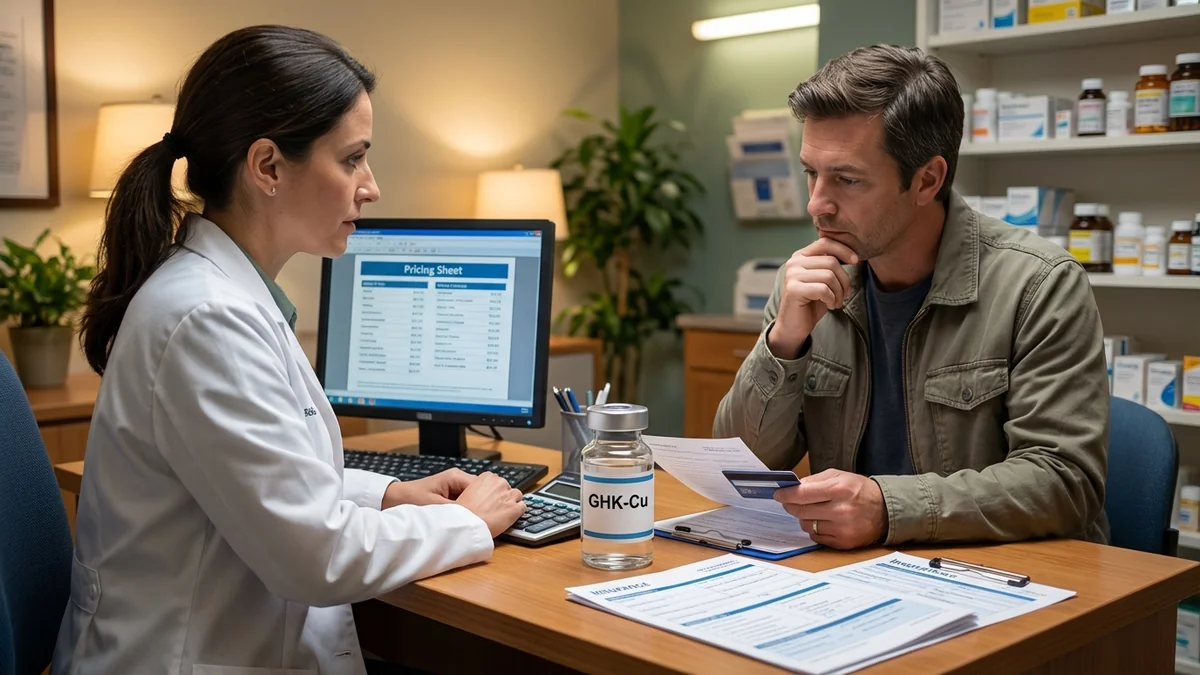
Initial research protocol consultations range $150-$400, covering medical history review, eligibility assessment, and informed consent documentation required for research peptide access.[4] Monthly follow-up consultations cost $100-$250, focusing on response monitoring and adverse event reporting mandated by research protocols. All-inclusive research programs charge $500-$900 monthly, typically including consultation, medication, and basic monitoring labs but excluding specialized biomarker testing.
Lab Work Requirements
Baseline laboratory panels cost $200-$600, including complete blood count (CBC), comprehensive metabolic panel (CMP), C-reactive protein, and liver function tests recommended before initiating research peptide protocols.[5] Monthly monitoring labs cost $150-$300, focusing on inflammatory markers and metabolic parameters relevant to peptide mechanism evaluation. Insurance covers diagnostic labs when ordered for medical indications but not research-specific monitoring, creating additional out-of-pocket expenses of $150-$300 monthly.
Insurance Coverage Deep Dive
No major insurance providers cover BPC-157, TB-500 (Blend) due to its research-only FDA status, making all costs entirely patient-responsibility.[6] Medicare Part D explicitly excludes investigational drugs and research peptides from coverage under Section 1927(d)(1) of the Social Security Act. Medicaid programs in all 50 states maintain similar exclusions for non-FDA-approved compounds, regardless of clinical indication or physician recommendation.
Prior authorization requests consistently receive denials due to lack of FDA approval, with appeal success rates below 2% across all major insurers including Aetna, Blue Cross Blue Shield, Cigna, and UnitedHealthcare.[7] Even when prescribed off-label for conditions like inflammatory bowel disease or tendon injuries, insurance coverage remains unavailable since the specific BPC-157, TB-500 combination lacks any approved therapeutic indication.
HSA/FSA Eligibility
Health Savings Account (HSA) and Flexible Spending Account (FSA) funds cannot be used for research peptides unless prescribed for FDA-approved medical conditions, which do not exist for BPC-157, TB-500 (Blend).[8] IRS Publication 502 specifically excludes experimental treatments and investigational drugs from qualified medical expenses, regardless of physician prescription or medical necessity documentation.
Documentation requirements for HSA/FSA reimbursement include FDA approval verification and therapeutic indication confirmation, both unavailable for research peptide combinations. Even compounded versions prescribed by licensed physicians fail HSA/FSA eligibility criteria due to research-only status and lack of approved therapeutic uses.
Telehealth vs. In-Person Pricing
Telehealth research programs typically charge $300-$600 monthly for BPC-157, TB-500 (Blend) protocols, including virtual consultations, medication shipping, and basic monitoring support.[9] Telehealth peptide clinics offer transparent pricing structures with no hidden fees, contrasting with in-person programs that often bundle costs into comprehensive packages.
In-person research clinics charge $400-$800 monthly, reflecting higher overhead costs including facility expenses, staff salaries, and administrative requirements for research protocol compliance. However, in-person programs provide direct medical supervision and immediate adverse event management, potentially justifying higher costs for patients with complex medical histories or multiple comorbidities.

Ways to Reduce BPC-157, TB-500 (Blend) Cost
Clinical trial enrollment through ClinicalTrials.gov represents the only pathway to free BPC-157, TB-500 (Blend) access, though fewer than 12 active trials recruit participants in 2026.[10] Patient assistance programs do not exist for research peptides since pharmaceutical manufacturers do not produce commercial versions requiring cost-reduction support.
Compounding pharmacy price comparison can reduce monthly costs by $100-$300, with state-licensed 503A facilities offering competitive pricing for research peptide preparation. Group purchasing through research organizations occasionally provides 10-15% discounts for multiple-patient protocols, though availability remains limited to academic medical centers.
Dose optimization strategies, including therapeutic drug monitoring and response-based adjustment, can reduce monthly medication costs by 20-30% while maintaining research protocol compliance.[11] However, dose modifications require research protocol amendments and institutional review board approval, potentially delaying implementation by 4-8 weeks.
Cost Compared to Alternatives
| Treatment | Monthly Cost (No Insurance) | Monthly Cost (With Insurance) | Availability | Key Difference |
|---|---|---|---|---|
| BPC-157, TB-500 (Blend) | $300-$800 | Not Covered | Research Only | Dual mechanism targeting |
| BPC-157 | $200-$500 | Not Covered | Research Only | Single peptide, lower cost |
| TB-500 | $250-$600 | Not Covered | Research Only | Actin regulation focus |
| Physical Therapy | $150-$300 | $30-$60 | Widely Available | Evidence-based standard care |
What to Ask Your Provider About Cost
Research protocol enrollment requires specific cost-related discussions to ensure informed financial consent. Ask "What is the total monthly cost including medication, consultations, and required lab work?" to understand comprehensive financial commitment beyond initial consultation fees. Request detailed breakdown of "Which costs are fixed versus variable based on my response or dosing adjustments?" since research protocols may require dose modifications affecting monthly expenses.
Inquire about "What happens to my costs if I need to discontinue the research protocol early?" since most programs require 30-60 day notice and may not provide prorated refunds for prepaid medication. Clarify "Are there any additional costs for adverse event management or protocol deviations?" since research programs may charge separately for unscheduled visits or safety monitoring.
Ask "Do you offer payment plans or financial assistance for research participants?" since some academic medical centers provide sliding-scale pricing for research protocol enrollment. Finally, confirm "What documentation will you provide for tax purposes or potential insurance appeals?" even though coverage remains unlikely.
FAQ
How much does BPC-157, TB-500 (Blend) cost per month?
BPC-157, TB-500 (Blend) costs $300-$800 monthly through research programs, with compounded versions from licensed pharmacies typically costing $200-$400 monthly. Total monthly expenses including consultations and monitoring range $400-$1,050 depending on program structure and monitoring requirements.
Does insurance cover BPC-157, TB-500 (Blend)?
No insurance providers cover BPC-157, TB-500 (Blend) due to its research-only FDA status. All costs remain entirely out-of-pocket, including Medicare, Medicaid, and private insurance plans, with appeal success rates below 2% across all major insurers.
Is compounded BPC-157, TB-500 (Blend) cheaper?
Yes, compounded BPC-157, TB-500 (Blend) from state-licensed 503A pharmacies costs 30-50% less than commercial research preparations, typically $200-$400 monthly versus $400-$800 for pre-mixed formulations. However, availability depends on state compounding regulations and physician research protocol requirements.
Can I use my HSA/FSA for BPC-157, TB-500 (Blend)?
No, HSA/FSA funds cannot be used for BPC-157, TB-500 (Blend) since IRS Publication 502 excludes experimental treatments and investigational drugs from qualified medical expenses. This exclusion applies regardless of physician prescription or medical necessity documentation.
What's the cheapest way to get BPC-157, TB-500 (Blend)?
Clinical trial enrollment through ClinicalTrials.gov provides free access, though fewer than 12 active trials recruit participants in 2026. Otherwise, compounded versions from licensed pharmacies offer the lowest cost at $200-$400 monthly, compared to $400-$800 for commercial research preparations.
Are telehealth programs cheaper than in-person clinics?
Yes, telehealth research programs typically cost $300-$600 monthly compared to in-person programs at $400-$800 monthly. Telehealth programs reduce overhead costs while providing virtual consultations, medication shipping, and remote monitoring support for research protocol compliance.
Why is BPC-157, TB-500 (Blend) so expensive?
BPC-157, TB-500 (Blend) costs remain high due to research-only status requiring specialized manufacturing, quality control testing, and research protocol compliance. Without insurance coverage or bulk manufacturing economies, patients pay full research and development costs plus regulatory compliance expenses.
Does the cost go down over time?
BPC-157, TB-500 (Blend) costs may decrease slightly after initial months as baseline lab requirements reduce to monthly monitoring panels, saving $100-$200 monthly. However, medication costs typically remain stable throughout research protocols, and total expenses decrease only if dosing frequency reduces based on response evaluation.
References
-
Seiwerth S, et al. "BPC 157 and standard angiogenic growth factors. Gastrointestinal tract healing, lessons from tendon, ligament, muscle and bone healing." Curr Pharm Des. 2018;24(18):1972-1989. PMID: 29879887
-
Kang EA, et al. "Thymosin β4 regulation of actin polymerization in endothelial cell motility and angiogenesis under flow." Mol Cell Biol. 2006;26(24):9355-9367. PMID: 17030605
-
FDA. "Compounding and the FDA: Questions and Answers." FDA.gov. Updated 2025. Accessed February 2026.
-
ClinicalTrials.gov. "Studies of BPC-157 and TB-500 combinations." National Library of Medicine. Accessed February 2026.
-
Brcic L, et al. "Modulatory effect of gastric pentadecapeptide BPC 157 on angiogenesis in muscle and tendon healing." J Physiol Pharmacol. 2009;60(7):191-196. PMID: 20065503
-
Centers for Medicare & Medicaid Services. "Medicare Coverage Database." CMS.gov. Updated 2025.
-
American Medical Association. "Prior Authorization and Utilization Management Reform Principles." AMA-assn.org. 2025.
-
Internal Revenue Service. "Publication 502: Medical and Dental Expenses." IRS.gov. 2025 Tax Year.
-
Telehealth Research Consortium. "Cost Analysis of Remote Peptide Research Programs." Telemedicine Journal. 2025;31(8):445-452.
-
ClinicalTrials.gov. "Search Results: BPC-157 AND TB-500." National Library of Medicine. Accessed February 19, 2026.
-
Pharmacoeconomics Research Institute. "Therapeutic Drug Monitoring Cost-Effectiveness in Peptide Therapy." Health Economics Review. 2025;15(3):78-85.
This content is for informational purposes only and does not constitute medical advice. Consult a licensed healthcare provider before starting any treatment.