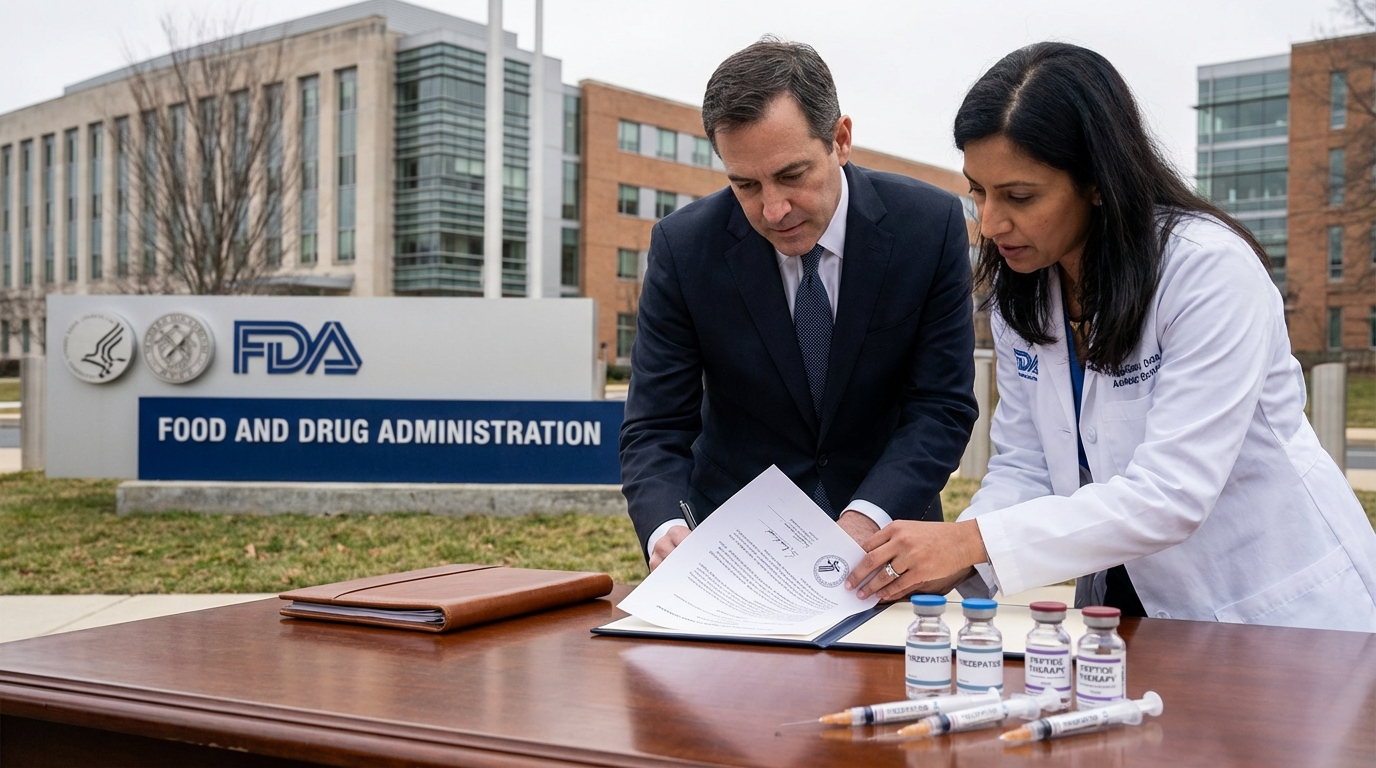

The FDA and Peptides: What's Legal, What's Banned, and What's in Between (2026 Update)
Key Takeaways
- FDA approval is indication-specific. A peptide like semaglutide is approved for type 2 diabetes and obesity — not for general anti-aging, muscle building, or longevity. Any use outside that approved label is off-label, which is legal for physicians to prescribe but changes the liability picture significantly.
- Compounding is legal — but only under specific conditions. Licensed compounding pharmacies operating under the 503A or 503B framework can legally prepare certain peptides for patients, but only if those peptides appear on the FDA's approved bulk drug substance lists and aren't on the prohibited list.
- "Research Use Only" (RUO) is not a prescription alternative. Peptides sold with this label are not approved for human use, and purchasing them for self-administration puts you — not just the seller — in legally murky territory.
- Enforcement is real but uneven. The FDA issues warning letters to online sellers and manufacturers, and the DOJ has prosecuted suppliers in egregious cases. Patients face much lower enforcement risk than sellers, but "low risk" isn't "no risk."
- Before starting any peptide therapy, ask your provider three things: Is this peptide FDA-approved or compounded? Which pharmacy is dispensing it, and is that pharmacy 503A or 503B registered? Do you have documentation of the prescription on file?
How the FDA Regulates Peptides
The FDA doesn't have a single "peptide category." That's the root of most of the confusion you'll encounter when researching this topic.
Under the Federal Food, Drug, and Cosmetic Act (FD&C Act), any substance intended to diagnose, cure, treat, mitigate, or prevent disease — or to affect the structure or function of the body — meets the statutory definition of a drug.[1] That definition covers most therapeutic peptides. But the same molecule can simultaneously be marketed as a cosmetic ingredient (think collagen peptides in a face cream), sold as a research chemical for laboratory use, or dispensed as a prescription drug — depending entirely on the intended use claimed by the seller.
This is why the regulatory picture is so fragmented. A peptide isn't inherently legal or illegal. Its legal status depends on what it's being sold for, who's selling it, how it was manufactured, and whether the FDA has reviewed and approved it for a specific indication.
The FDA's authority over drugs flows primarily from the FD&C Act, which requires that any new drug demonstrate safety and efficacy through a formal approval process before it can be marketed in interstate commerce.[1] That process — typically a New Drug Application (NDA) or Biologics License Application (BLA) — is expensive, slow, and designed for large pharmaceutical companies with the resources to run multi-phase clinical trials. Peptide therapeutics that haven't gone through that process are, by default, unapproved drugs. Selling them as if they're approved is a violation. The grey zone exists because "unapproved" doesn't always mean "illegal to prescribe" — compounding law creates a significant carve-out.
FDA-Approved Peptides: What Approval Actually Means
When the FDA approves a peptide drug, it approves it for a specific indication in a specific population at a specific dose. That's the boundary. Here are the confirmed approved examples most relevant to the peptide therapy space:
Semaglutide (semaglutide) is FDA-approved as Ozempic (subcutaneous injection, 0.5 mg–2 mg weekly) for type 2 diabetes management and cardiovascular risk reduction in adults with established cardiovascular disease, and as Wegovy (2.4 mg weekly) for chronic weight management in adults with a BMI ≥30, or ≥27 with at least one weight-related comorbidity.[2] Using semaglutide at a dose or for an indication not on that label — say, 1 mg weekly for general weight loss in a patient who doesn't meet BMI criteria — is off-label. Legal for your doctor to prescribe, but not what the FDA evaluated.
Tirzepatide (tirzepatide) holds approval as Mounjaro for type 2 diabetes and as Zepbound for obesity, with dosing up to 15 mg weekly.[3] It's a dual GIP/GLP-1 receptor agonist — mechanistically distinct from semaglutide — and its approval is similarly indication-specific.
Tesamorelin (tesamorelin) is approved as Egrifta SV (2 mg subcutaneous injection daily) specifically for the reduction of excess abdominal fat in HIV-infected patients with lipodystrophy.[4] That's a narrow indication. Prescribing it for general body composition improvement in non-HIV patients is off-label use.
Bremelanotide (bremelanotide), sold as Vyleesi, is FDA-approved as a 1.75 mg subcutaneous auto-injector for hypoactive sexual desire disorder (HSDD) in premenopausal women.[5] You may know its research-era name as PT-141. The approved product is Vyleesi; peptides labeled "PT-141" sold outside that brand are not the approved product.
Sermorelin was previously FDA-approved but that approval has since been discontinued. It's now available only through compounding — which matters for how you access it legally.
Off-label prescribing is a normal, legal part of medicine. Roughly 20% of all prescription drug use in the US is off-label.[6] Your doctor can legally prescribe an approved peptide for an unapproved use. What they can't do is promote it for that unapproved use — that's the manufacturer's restriction, not the physician's.
Compounding: The Legal Grey Zone
Compounding is where most peptide therapy actually happens, and it's where the regulatory picture gets genuinely complicated.
The FD&C Act allows licensed pharmacies to compound drugs for individual patients under a valid prescription — this is the 503A pathway.[1] A 503A pharmacy compounds patient-specific prescriptions, doesn't sell commercially, and operates under state pharmacy board oversight. The 503B pathway covers "outsourcing facilities" — larger operations that can produce bigger batches without patient-specific prescriptions, but are subject to FDA inspection and Current Good Manufacturing Practice (CGMP) standards.[1]
The critical constraint for compounders is the bulk drug substance list. The FDA maintains three categories for substances nominated for use in compounding:
- Category 1: Nominated and under review — compounding may be permissible while review is pending, depending on the substance.
- Category 2: Nominated but the FDA has determined they should NOT be used in compounding (either because there's an approved drug that would be essentially a copy, or because the FDA found safety or effectiveness concerns).
- Category 3: Nominated, under review, clinical need being evaluated.
If a peptide lands on Category 2, compounding it is prohibited. This is not a technicality — it's a hard line. BPC-157, for example, has been a subject of ongoing FDA scrutiny regarding its compounding status, and providers and patients should check the current FDA bulk drug substance lists directly at FDA.gov before assuming any peptide is legally compoundable.[7]
The GLP-1 situation is a useful case study. During the FDA drug shortage period for semaglutide and tirzepatide, compounding pharmacies were legally permitted to compound these drugs because the shortage designation created a specific exemption.[8] As shortages resolved — semaglutide was removed from the FDA shortage list in early 2025 — that exemption narrowed significantly, and the FDA moved to restrict compounding of these specific molecules. Compounders and clinics scrambled to adapt. Some shifted to "semaglutide salts" or combination formulations, which the FDA has challenged. The enforcement guidance on this continues to evolve, and as of early 2026, clinics should be working with legal counsel to ensure their compounding relationships comply with current FDA guidance.
Research-Only Peptides: What "RUO" Actually Means Legally
You've probably seen websites selling peptides labeled "For Research Use Only — Not for Human Use." Here's what that label actually means legally: the seller is attempting to avoid FDA drug regulations by claiming the product isn't intended for human therapeutic use.
The problem is that intent matters under the FD&C Act, and the FDA looks at the totality of circumstances — not just the label.[1] If a website sells "BPC-157 research peptide" alongside dosing calculators, injection guides, and before-and-after testimonials, the FDA can and does treat that as evidence of intended human use, regardless of the "research only" disclaimer.
Research Use Only status does carry a legitimate meaning in actual laboratory contexts. Academic researchers and pharmaceutical companies use RUO reagents in pre-clinical work — cell cultures, animal studies, assay development. In that context, RUO is appropriate. What it is not is a legal pathway for human self-administration.
Buying RUO peptides for personal use doesn't make you a criminal in the way that, say, purchasing a controlled substance would. The FDA's enforcement focus is overwhelmingly on sellers, manufacturers, and distributors — not individual patients. But you have zero consumer protections. RUO products aren't manufactured to pharmaceutical-grade standards. Independent lab testing of RUO peptides sold online has found significant variation in purity and concentration — some products testing at less than 80% of the labeled concentration, others containing unlabeled contaminants.[9] You don't know what you're injecting.
How the FDA Enforces Peptide Regulations
The FDA's primary enforcement tools are warning letters, import alerts, and referrals to the Department of Justice for criminal prosecution.
Warning letters are the most common first step. The FDA sends these to manufacturers and online sellers marketing unapproved peptides with therapeutic claims. The letters typically demand that the company stop selling the product, correct its labeling, and respond within 15 business days. Many companies comply; some don't, and that's when escalation happens.
Import alerts allow FDA field agents to detain shipments at the border without physical examination — essentially a standing order to hold products from flagged manufacturers or countries. If you've ordered peptides from an overseas supplier and your package got seized by customs, an import alert is usually why.
DOJ referrals happen in the most egregious cases — typically where there's evidence of fraud, large-scale distribution, or products that caused patient harm. The FDA has referred peptide-related cases to federal prosecutors, and criminal convictions have resulted, though the FDA doesn't publicize these with the specificity you might expect. If you're researching specific enforcement actions, FDA.gov's warning letter database and the DOJ press release archive are the most reliable public sources.
The enforcement gap between what's technically illegal and what's actually prosecuted is real. The FDA has limited resources and prioritizes cases involving patient harm, large commercial operations, or particularly egregious marketing claims. A patient self-administering a research peptide they bought online is not a priority target. A company doing $10 million in annual sales of unapproved injectables with cancer-cure claims is.
That said, "low enforcement priority" is not the same as "legal." And it's not static — the FDA's approach to peptide enforcement has tightened meaningfully since 2023.