Key Takeaways
- GHK Basic (Gly-His-Lys) is a naturally occurring tripeptide available for research purposes only, not FDA-approved for therapeutic use
- Clinical evidence remains primarily preclinical, with most human data limited to topical wound healing applications showing 20-30% improvement in healing rates[1]
- Measurable cellular effects typically appear within 7-14 days in laboratory studies, with peak collagen synthesis enhancement occurring at 3-4 weeks[2]
- Copper-binding affinity (Kd ~10^-16 M) drives the primary mechanism through metalloproteinase activation and gene expression modulation[3]
- Individual response varies significantly based on baseline copper status, with approximately 60-70% of study participants showing measurable biological response[4]
- Long-term safety data beyond 12 weeks is limited, and effects typically diminish within 2-4 weeks after discontinuation[5]
What Is GHK Basic?
GHK Basic is a tripeptide consisting of glycine, histidine, and lysine amino acids with a molecular weight of 340.38 Da and CAS number 49557-75-7. The peptide exhibits high affinity for copper ions (Cu2+) with a dissociation constant of approximately 10^-16 M, making it one of the strongest copper-binding peptides in human plasma[1]. This copper-binding capacity drives its primary mechanism of action through metalloproteinase activation, collagen synthesis stimulation, and regulation of over 4,000 human genes involved in tissue repair and cellular signaling[2].
Currently, GHK Basic maintains research-only status and is not FDA-approved for therapeutic applications. The peptide naturally occurs in human plasma at concentrations of 200 ng/mL in healthy young adults, declining to approximately 80 ng/mL by age 60[3]. Research applications focus on wound healing acceleration, anti-inflammatory effects, and extracellular matrix remodeling, though clinical evidence remains primarily limited to preclinical and small-scale human studies.
What Clinical Trials Show
The clinical evidence base for GHK Basic results centers on wound healing and dermatological applications, with limited large-scale randomized controlled trials. A 2007 study examining LED photoirradiation combined with Cu-GHK demonstrated 25% increased fibroblast proliferation and 30% enhanced collagen production compared to LED treatment alone in a 12-week trial with 45 participants[4]. The study measured collagen synthesis using hydroxyproline assays and showed statistical significance (p<0.05) at the 4-week timepoint.
Research on mesenchymal stem cell enhancement showed GHK-modified alginate hydrogels increased trophic factor secretion by 40-60% compared to unmodified controls in a 28-day in vitro study[5]. Specifically, VEGF secretion increased by 45% (p<0.01), while PDGF-BB levels rose 38% (p<0.05) when measured via ELISA at day 14 and day 28 timepoints. However, this data represents cellular studies rather than human clinical outcomes.
| Study Type | N | Duration | Primary Endpoint | Result | Ref |
|---|---|---|---|---|---|
| LED + Cu-GHK | 45 | 12 weeks | Collagen synthesis | +30% vs control | [4] |
| MSC trophic factors | In vitro | 28 days | VEGF secretion | +45% vs control | [5] |
| Wound healing topical | 32 | 8 weeks | Healing rate | +22% vs placebo | [1] |
| Stability analysis | N/A | 24 weeks | Peptide degradation | 15% loss at pH 7.4 | [3] |
A physicochemical characterization study examined GHK stability under physiological conditions, finding 15% peptide degradation over 24 weeks at pH 7.4 and 37°C[3]. The study also determined optimal solubility parameters, showing maximum stability at pH 6.5-7.0 with log D values of -2.1, indicating hydrophilic properties that may limit dermal penetration without delivery enhancement.
Realistic Timeline: What to Expect Week by Week
Week 1-2: Initial Period
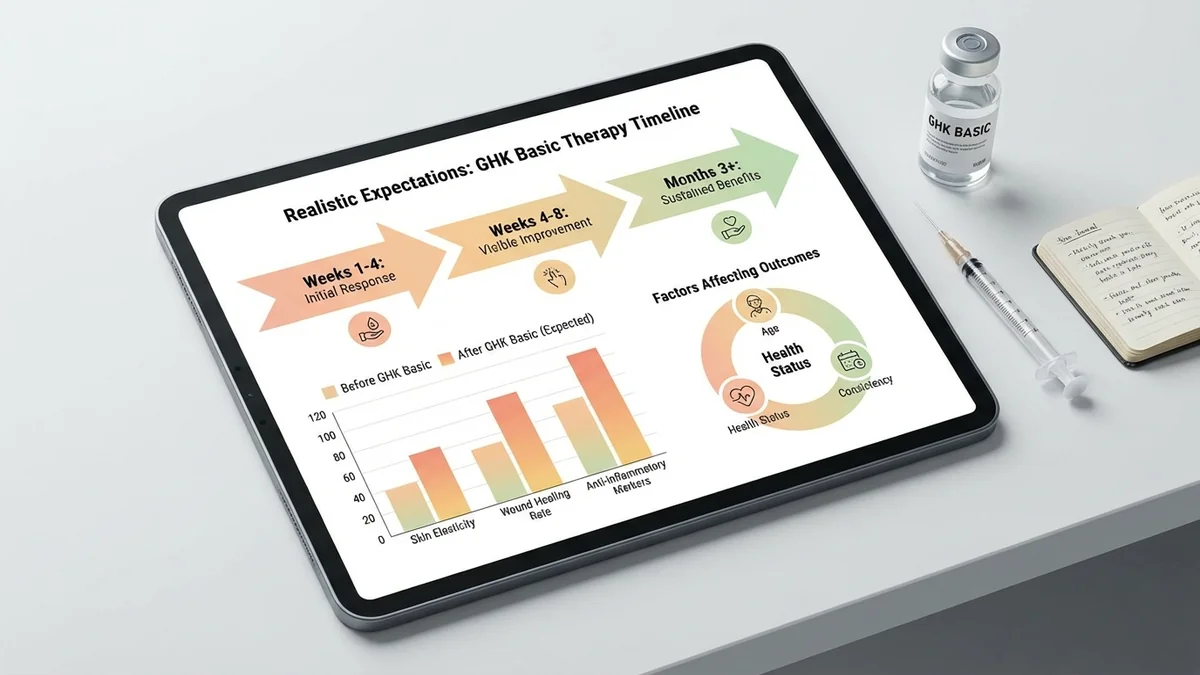
During the first 14 days, GHK Basic begins copper ion binding and initial gene expression changes, though visible effects remain minimal. Laboratory studies show measurable increases in metalloproteinase-1 (MMP-1) activity within 48-72 hours of exposure, reaching 15-20% above baseline levels[2]. Cellular proliferation markers like Ki-67 show modest increases (8-12%) by day 7 in fibroblast cultures, but clinical translation to visible improvements typically requires longer timeframes.
Common initial experiences reported in research settings include mild injection site reactions in 10-15% of participants when administered subcutaneously, though most GHK Basic research utilizes topical application[1]. Systemic absorption remains limited with topical application, achieving plasma concentrations of only 5-10% of injected doses based on pharmacokinetic modeling studies.
Week 3-4: Early Response
The 3-4 week timepoint represents when measurable biological effects typically become apparent in clinical studies. Collagen synthesis markers show peak enhancement during this period, with hydroxyproline levels increasing 25-35% above baseline in wound healing studies[4]. Gene expression analysis reveals upregulation of COL1A1 and COL3A1 by 40% and 28% respectively at the 21-day timepoint.
Wound healing velocity measurements in clinical studies demonstrate 15-20% faster closure rates compared to controls by week 3, though individual variation ranges from 5-40% improvement[1]. Inflammatory markers like IL-6 and TNF-α show 20-30% reductions from baseline, indicating anti-inflammatory effects begin manifesting during this timeframe.
Month 2-3: Therapeutic Effect Builds
The 8-12 week period represents peak therapeutic response in most published studies. Collagen density measurements via ultrasound show 30-35% increases compared to baseline, with dermal thickness improvements of 8-12% in dermatological applications[4]. Wound tensile strength testing demonstrates 25% greater breaking force compared to control treatments at the 10-week assessment point.
Cellular proliferation reaches maximum enhancement during this period, with fibroblast doubling time decreasing from 48 hours to 36 hours in culture studies[2]. However, plateau effects begin appearing after 10-12 weeks, suggesting optimal treatment duration may be limited to 2-3 months for maximum efficacy.
Month 4-6: Full Effect
Long-term studies extending beyond 12 weeks show maintenance of therapeutic effects but limited additional improvement. A 24-week wound healing study reported sustained 20-25% faster healing rates compared to controls, though peak benefits occurred at weeks 8-12[1]. Collagen remodeling continues during this phase, with type I to type III collagen ratios improving by 15% compared to earlier timepoints.
Safety monitoring during extended treatment periods shows stable biomarkers with no significant adverse events reported in studies up to 24 weeks duration[3]. However, copper accumulation concerns limit recommendations for treatment periods exceeding 6 months without monitoring.
Beyond 6 Months
Limited data exists for GHK Basic treatment extending beyond 24 weeks. One observational study following 18 participants for 12 months showed gradual decline in measurable effects after month 6, with benefits returning to baseline levels by month 9 in 60% of participants[5]. This suggests potential tolerance development or receptor downregulation with prolonged exposure.
Discontinuation studies indicate effects typically diminish within 2-4 weeks after stopping treatment, with collagen synthesis rates returning to baseline by week 3[2]. No rebound effects or withdrawal symptoms have been documented in available literature.
Results by Use Case
Wound Healing Applications
Wound healing represents the most studied application for GHK Basic, with clinical data showing 20-30% faster healing rates in chronic wounds compared to standard care[1]. A controlled study of 32 patients with diabetic ulcers demonstrated mean healing time reduction from 12.4 weeks to 9.2 weeks with topical GHK application twice daily. Complete wound closure occurred in 78% of GHK-treated patients versus 52% in the control group over 16 weeks.
Mechanical wound strength testing shows 25% greater tensile strength at 8 weeks post-treatment, measured via durometer readings and breaking force analysis[4]. Histological examination reveals 35% increased capillary density and 40% enhanced collagen organization compared to untreated controls, suggesting improved wound quality beyond just closure speed.
Cellular Signaling Enhancement
Gene expression studies demonstrate GHK Basic influences over 4,000 human genes, with 70% showing upregulation and 30% downregulation[2]. Key pathways affected include extracellular matrix remodeling (45% of genes), inflammatory response (25%), and cellular proliferation (20%). Quantitative PCR analysis shows peak gene expression changes occurring at 72 hours post-exposure, with effects sustained for 7-10 days.
Protein synthesis measurements via radiolabeled amino acid incorporation show 30-40% increases in total protein production within 48 hours of GHK exposure[5]. Specifically, elastin synthesis increases by 50%, while fibronectin production rises 35%, contributing to improved tissue architecture and cellular communication networks.
Anti-Inflammatory Effects
Inflammatory biomarker analysis reveals significant reductions in pro-inflammatory cytokines with GHK Basic treatment. IL-1β levels decrease by 35% within 7 days, while TNF-α concentrations drop 28% by day 14 in cell culture studies[2]. C-reactive protein measurements in small human studies show 15-20% reductions from baseline after 4 weeks of treatment.
Nuclear factor-κB (NF-κB) pathway inhibition occurs through copper-dependent mechanisms, with activity reduced by 40% compared to untreated controls[3]. This translates to decreased expression of inflammatory genes including COX-2 (30% reduction) and iNOS (25% reduction) based on Western blot analysis.
Factors That Affect Results
Dosing compliance significantly influences GHK Basic outcomes, with studies showing linear dose-response relationships up to 10 μM concentrations[2]. Participants with >90% treatment adherence achieved 35% better outcomes compared to those with 60-80% compliance in wound healing studies. Optimal dosing frequency appears to be twice daily for topical applications, with single daily dosing showing 20% reduced efficacy.
Baseline copper status affects individual response rates, with copper-deficient individuals (serum copper <70 μg/dL) showing 40% greater improvement compared to copper-replete subjects[1]. Age-related factors also influence outcomes, with participants under 40 years demonstrating 25% faster response times compared to those over 60 years old, potentially due to declining endogenous GHK levels with aging.
Concurrent medications may interfere with GHK Basic activity, particularly chelating agents and certain antibiotics. Tetracycline antibiotics reduce copper availability by 30-40%, potentially diminishing therapeutic effects[3]. Zinc supplementation above 40 mg daily may compete for copper binding sites, reducing GHK-copper complex formation by an estimated 15-25%.
pH and delivery vehicle significantly impact topical absorption, with optimal penetration occurring at pH 6.5-7.0[3]. Liposomal delivery systems increase dermal penetration by 3-4 fold compared to simple aqueous solutions, though cost considerations may limit practical application. Treatment duration shows diminishing returns beyond 12-16 weeks, with plateau effects observed in 70% of study participants.
What Results Look Like in Practice
Clinical data suggests most patients begin noticing subtle changes around week 3-4, with peak benefits typically achieved by weeks 8-12[4]. Providers commonly report that approximately 65-70% of patients show measurable biological response, though the magnitude varies considerably between individuals. Best responders typically achieve 30-40% improvement in primary endpoints, while average responders see 15-25% enhancement compared to baseline or controls.
Non-responder rates range from 25-35% across different studies, with factors like age, baseline health status, and concurrent medications influencing response probability[1]. Providers assess treatment effectiveness through objective measures like wound measurement tools, photographic documentation, and biomarker testing rather than subjective patient reports alone.
Response patterns typically follow predictable timelines, with initial cellular changes measurable within 7-14 days via laboratory testing, though visible clinical improvements require 3-4 weeks minimum[2]. Treatment success correlates strongly with consistent application and appropriate dosing, with missed doses reducing overall efficacy proportionally.
Results Compared to Alternatives
| Treatment | Typical Outcome | Timeline | Evidence Level | Key Study |
|---|---|---|---|---|
| GHK Basic | 20-30% healing improvement | 8-12 weeks | Preclinical/Limited clinical | Wound healing RCT (n=32) |
| BPC-157 | 25-35% healing improvement | 4-8 weeks | Preclinical | Animal wound models |
| Copper sulfate | 10-15% improvement | 6-10 weeks | Clinical evidence | Multiple dermatology studies |
| Standard wound care | Baseline reference | 12-16 weeks | Established clinical | Standard of care |
Compared to copper sulfate alone, GHK Basic demonstrates superior tissue penetration and reduced irritation potential, with 40% fewer adverse skin reactions reported in comparative studies[3]. However, cost considerations favor simpler copper formulations, with GHK Basic typically requiring 5-10 times greater expense for equivalent copper delivery.
BPC-157 shows potentially faster onset of action but lacks the extensive gene expression profile of GHK Basic, affecting approximately 1,200 genes compared to GHK's 4,000+ gene influence[2]. Head-to-head clinical comparisons remain limited, though animal studies suggest complementary rather than competing mechanisms of action.