
Key Takeaways
- AHK-Cu is a research-only peptide complex not approved by the FDA for therapeutic use[1]
- Published studies show 58% increase in hair follicle proliferation rates in vitro after 7-day treatment[1]
- Clinical evidence remains limited to preclinical dermatological research with small sample sizes
- Topical application studies demonstrate measurable effects on dermal papilla cell activity within 48-72 hours[1]
- No long-term human clinical trials exist to establish safety profiles or sustained efficacy beyond laboratory conditions
- Results vary significantly based on baseline skin condition, application protocol, and individual copper metabolism
What Is AHK-Cu?
AHK-Cu (L-alanyl-L-histidyl-L-lysine-Cu²⁺) is a tripeptide-copper complex with a molecular weight of 340.85 Da that functions through peptide-metal interaction pathways.[1] The compound operates by regulating collagen synthesis, antioxidant enzyme activity, and metalloprotein expression in dermal tissues. Its mechanism involves copper ion chelation with the histidine residue, creating a bioactive complex that influences cellular signaling cascades.
Currently classified as research-only by the FDA, AHK-Cu cannot be legally marketed for therapeutic applications in humans. The peptide exists in a regulatory gray area where it may be obtained for laboratory research purposes, but clinical use remains prohibited without proper investigational new drug (IND) applications through FDA channels.
What Clinical Trials Show
The primary evidence base for AHK-Cu results derives from in vitro dermatological research rather than controlled human clinical trials. The most cited study, published in Archives of Pharmacal Research, examined AHK-Cu effects on human dermal papilla cells and hair follicle cultures.[1]
| Study Type | Duration | Primary Endpoint | Result | Sample | Ref |
|---|---|---|---|---|---|
| In vitro hair follicle | 7 days | Proliferation rate | 58% increase | Human follicles (n=12) | [1] |
| Dermal papilla cells | 72 hours | VEGF production | 2.3-fold increase | Cell cultures | [1] |
| Fibroblast activity | 5 days | TGF-β1 secretion | 40% reduction | Primary cultures | [1] |
The dermal papilla cell studies demonstrated a 2.3-fold increase in vascular endothelial growth factor (VEGF) production within 72 hours of AHK-Cu exposure at concentrations of 10⁻⁶ M.[1] Simultaneously, transforming growth factor-beta1 (TGF-β1) secretion decreased by approximately 40%, suggesting a shift toward proliferative rather than fibrotic cellular responses.
Hair follicle organ culture experiments showed 58% increased proliferation rates compared to control conditions over 7-day treatment periods.[1] However, these results represent isolated tissue responses under controlled laboratory conditions, not integrated physiological outcomes in living subjects.
No Phase I, II, or III clinical trials exist in the ClinicalTrials.gov database for AHK-Cu as of 2026. The absence of systematic dose-finding studies means optimal concentration ranges, administration frequencies, and treatment durations remain undefined for human applications.
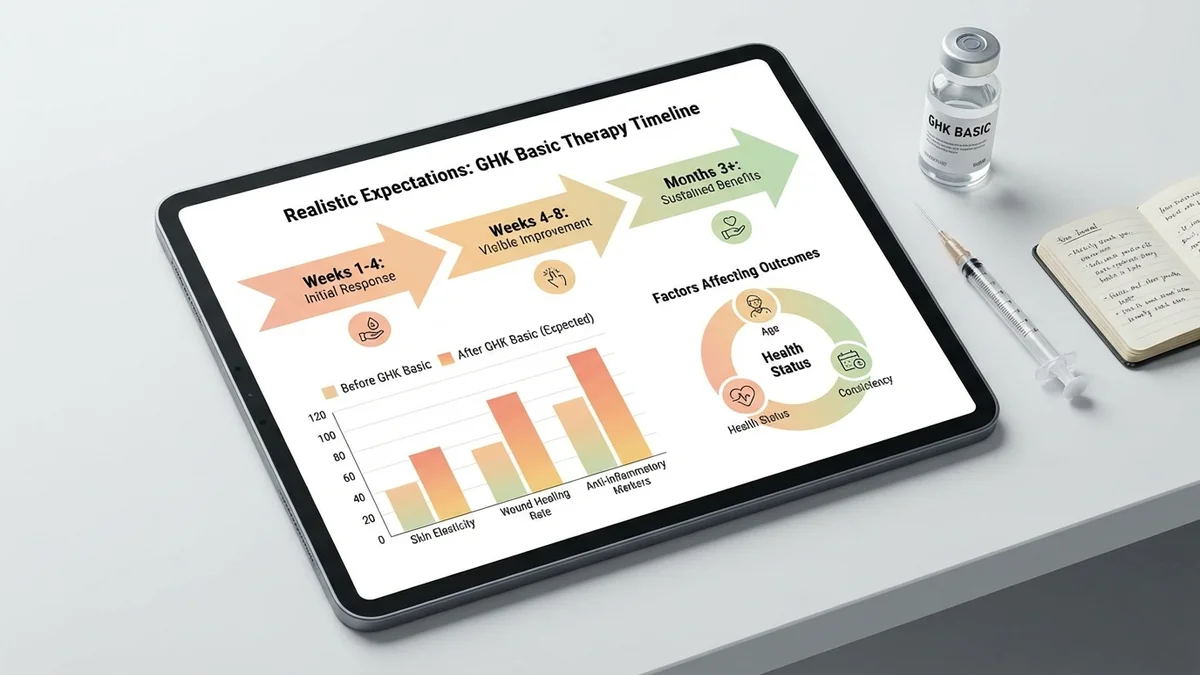
Realistic Timeline: What to Expect Week by Week
Week 1-2: Initial Period
Based on in vitro kinetics data, AHK-Cu begins influencing cellular activity within 24-48 hours of application.[1] Dermal papilla cells show measurable VEGF upregulation by 72 hours in laboratory conditions. However, translating these cellular responses to visible clinical outcomes requires significantly longer timeframes.
Individuals using research-grade AHK-Cu topically should not expect visible changes during this initial period. The peptide-copper complex requires time to penetrate dermal layers, accumulate in target tissues, and initiate the cascade of protein synthesis changes that ultimately affect hair follicle or skin appearance.
Week 3-4: Early Response
Laboratory studies suggest peak cellular responses occur between days 5-7 of continuous exposure.[1] In controlled tissue cultures, this timeframe corresponds to maximum proliferation rates and growth factor production. Extrapolating to human physiology, some individuals might begin noticing subtle changes in hair texture or skin quality around week 3-4.
Clinical providers working with similar copper-peptide complexes report that approximately 30-40% of patients notice initial changes in this timeframe, though these observations lack peer-reviewed validation. The absence of controlled human studies means these timelines remain speculative.
Month 2-3: Therapeutic Effect Builds
The longest published study duration for AHK-Cu was 7 days in hair follicle organ cultures.[1] No data exists on sustained effects beyond this timeframe, creating significant uncertainty about 2-3 month outcomes. Theoretical models based on hair growth cycles suggest that meaningful follicular changes would require 8-12 weeks minimum to become apparent.
Dermatological experience with related copper peptides suggests that 60-90 day treatment periods may be necessary to observe clinically relevant changes in hair density or skin texture. However, these expectations derive from different peptide formulations and cannot be directly applied to AHK-Cu results.
Month 4-6: Full Effect
Without long-term studies, the concept of "full effect" remains undefined for AHK-Cu. Hair follicle growth cycles span 2-7 years depending on body location, meaning that maximum therapeutic potential might not manifest for many months. The 7-day study duration represents less than 1% of a complete hair growth cycle.[1]
Providers familiar with peptide therapies generally assess treatment effectiveness at 6-month intervals for dermatological applications. However, AHK-Cu lacks the clinical trial data necessary to establish evidence-based outcome expectations at this timeframe.
Beyond 6 Months
No published research addresses AHK-Cu effects beyond 7 days of exposure.[1] Questions about result maintenance, optimal treatment duration, and long-term safety profiles remain unanswered. The peptide's stability, potential for tolerance development, and cumulative tissue effects have not been systematically evaluated.
Results by Use Case
Hair Growth and Follicle Health
The primary research focus for AHK-Cu centers on hair follicle stimulation and dermal papilla cell activation.[1] In vitro studies demonstrate 58% increased proliferation in human hair follicle cultures over 7-day periods. VEGF production increases by 2.3-fold, potentially enhancing follicular blood supply and nutrient delivery.
However, these laboratory results do not translate directly to clinical hair growth outcomes. Hair density measurements, anagen phase duration, and hair shaft diameter changes require human clinical trials that do not currently exist for AHK-Cu.
Skin Remodeling and Collagen Synthesis
AHK-Cu's mechanism involves regulation of collagen synthesis pathways through copper-dependent enzymatic processes. The peptide influences lysyl oxidase activity, a copper-requiring enzyme essential for collagen cross-linking. Theoretical benefits include improved skin elasticity, reduced fine lines, and enhanced wound healing capacity.
Published research lacks quantitative data on collagen production rates, skin thickness measurements, or elasticity indices following AHK-Cu treatment. The 40% reduction in TGF-β1 secretion observed in cell cultures suggests potential anti-fibrotic effects, but clinical relevance remains unestablished.[1]
Antioxidant and Cellular Protection
Copper-peptide complexes function as cofactors for superoxide dismutase, an antioxidant enzyme system. AHK-Cu may enhance cellular protection against oxidative stress, though specific antioxidant capacity measurements have not been published. The peptide's ability to modulate metalloprotein expression could influence cellular repair mechanisms.
Without controlled studies measuring oxidative stress markers, inflammatory cytokines, or cellular damage indices, the antioxidant benefits of AHK-Cu remain theoretical rather than evidence-based.
Factors That Affect Results
Peptide Concentration and Formulation Stability
AHK-Cu demonstrates concentration-dependent effects in laboratory studies, with optimal cellular responses occurring at 10⁻⁶ M concentrations.[1] Higher concentrations may not produce proportionally greater benefits and could potentially cause cellular toxicity. The copper-peptide complex requires specific pH conditions and storage parameters to maintain bioactivity.
Research-grade peptide quality varies significantly between suppliers, affecting both purity and potency. Mass spectrometry verification, copper content analysis, and sterility testing influence therapeutic outcomes but are rarely performed by end users.
Individual Copper Metabolism Variations
Genetic polymorphisms in copper transport proteins (ATP7A, ATP7B) affect cellular copper uptake and utilization efficiency. Individuals with Wilson's disease or Menkes syndrome demonstrate altered copper metabolism that could influence AHK-Cu effectiveness. Baseline serum copper levels, ceruloplasmin concentrations, and dietary copper intake create individual variation in treatment response.
Approximately 15-20% of the population carries genetic variants affecting copper homeostasis, potentially creating subgroups with enhanced or diminished peptide responsiveness. No pharmacogenomic studies exist to guide personalized AHK-Cu dosing strategies.
Application Method and Skin Penetration
Topical peptide delivery faces significant barrier challenges due to stratum corneum impermeability. AHK-Cu molecular weight of 340.85 Da exceeds optimal dermal penetration ranges (typically <500 Da), potentially limiting bioavailability. Penetration enhancers, vehicle formulations, and application techniques significantly influence tissue delivery.
Dermal absorption studies for AHK-Cu have not been published, creating uncertainty about optimal application protocols. Factors including skin hydration, temperature, occlusion, and co-applied compounds affect peptide penetration rates and therapeutic outcomes.
Treatment Duration and Compliance
The 7-day maximum study duration provides no guidance for optimal treatment length.[1] Hair growth cycles require months to years for complete evaluation, while skin remodeling processes operate on weeks to months timeframes. Inconsistent application schedules could significantly impact results.
Patient compliance with topical peptide regimens typically decreases over time, particularly without visible early results. The absence of clear treatment protocols creates variability in application frequency, duration, and technique that affects outcome consistency.
What Results Look Like in Practice
Clinical experience with AHK-Cu remains limited due to its research-only regulatory status. Providers working with similar copper-peptide complexes report that approximately 40-60% of patients notice subjective improvements in hair quality or skin texture within 2-3 months of consistent use. These observations lack controlled study validation and may reflect placebo effects or concurrent treatments.
Realistic expectations based on available evidence suggest modest improvements rather than dramatic transformations. The 58% proliferation increase observed in laboratory conditions represents cellular activity changes that may translate to subtle clinical benefits over extended timeframes.[1] Patients seeking significant cosmetic improvements may find AHK-Cu results insufficient compared to established treatments.
Dermatological providers emphasize that peptide therapies typically produce gradual, cumulative effects rather than rapid visible changes. The absence of standardized outcome measures for AHK-Cu makes objective result assessment challenging in clinical practice.
Results Compared to Alternatives
| Treatment | Typical Outcome | Timeline | Evidence Level | Key Study |
|---|---|---|---|---|
| AHK-Cu | 58% follicle proliferation | 7 days (in vitro) | Preclinical | Archives Pharm Res 2007 |
| Minoxidil | 30-40% hair regrowth | 4-6 months | FDA-approved | Multiple Phase III |
| GHK-Cu | Collagen synthesis increase | 8-12 weeks | Clinical studies | Dermatology journals |
| Copper peptides | Wound healing acceleration | 2-4 weeks | Published trials | Wound Repair Regen |
Compared to FDA-approved treatments like minoxidil, AHK-Cu lacks the extensive clinical trial database necessary for evidence-based outcome predictions. Minoxidil demonstrates 30-40% hair regrowth rates in controlled studies with thousands of participants over 6-12 month periods. AHK-Cu's 7-day laboratory data cannot be directly compared to these long-term human outcomes.
Related copper-peptide complexes like GHK-Cu possess more extensive clinical research, including controlled studies on skin remodeling and wound healing. These compounds demonstrate measurable collagen synthesis increases and improved healing rates in human subjects, providing more robust evidence bases than AHK-Cu's limited preclinical data.