Copper peptides are small, copper-binding protein fragments that your body actually makes on its own — and that's what makes them interesting. The most studied member of this family, GHK-Cu (glycyl-L-histidyl-L-lysine copper complex), occurs naturally in human plasma, saliva, and urine, where it plays a role in wound healing and tissue remodeling.[1] Plasma levels of GHK-Cu decline significantly with age, which is one reason researchers started looking at it as a topical ingredient in the first place.
In the US, copper peptides are sold as over-the-counter cosmetic ingredients — serums, creams, and scalp treatments containing copper tripeptide-1. They're not FDA-approved drugs and can't be marketed with drug claims. What the evidence actually supports is more modest than the marketing: meaningful but incremental improvements in skin texture, fine lines, and wound healing — not dramatic rejuvenation.
The research picture is genuinely interesting, but it's mostly small trials and cell studies. Anyone telling you copper peptides are a proven anti-aging solution is overstating the evidence. Anyone dismissing them entirely is also ignoring a real body of work.
Key Takeaways
GHK-Cu (copper tripeptide-1) is the most studied copper peptide — a naturally occurring tripeptide that declines with age and plays a documented role in wound healing and collagen synthesis.
Clinical evidence is mostly small trials and in-vitro studies; no large Phase 3 RCTs exist for cosmetic indications.
Copper peptides are legal OTC cosmetic ingredients in the US — no prescription needed, no FDA drug approval.
Topical formulations are generally well-tolerated; mild irritation is the most commonly reported issue.
Emerging research is exploring copper peptides in cancer biology (cuproptosis) and antimicrobial applications, well beyond their cosmetic use.
Copper ion chelation; collagen/elastin stimulation; antioxidant and anti-inflammatory signaling
FDA Status
OTC cosmetic ingredient — not FDA-approved as a drug
Administration
Topical (serum, cream, scalp treatment)
Typical Concentration (Topical)
0.5%–3% in cosmetic formulations; copper peptides are commonly used in topical cosmetic formulations at concentrations that vary by product formulation
There are no published clinical trials establishing an official dose for topical copper peptides. The concentrations below reflect what's commonly used in cosmetic formulations and what small clinical studies have tested.
Not clinical dosing
These concentration ranges are not derived from randomized clinical trials. They represent what's commonly found in commercial cosmetic products and what small investigator-initiated studies have used. Formulation, delivery vehicle, and skin barrier function all affect how much copper tripeptide-1 actually penetrates. Discuss any therapeutic use with a licensed dermatologist or provider.
Most commercial serums containing copper tripeptide-1 run between 0.5% and 3% by weight — though copper peptide formulations are available in various concentrations; specific weight percentages should be verified against individual product labeling. In the small clinical trials that do exist, topical GHK-Cu was typically applied once or twice daily to the face or scalp. Higher concentrations aren't necessarily better — copper ions at excessive levels can be pro-oxidant rather than antioxidant, which is the opposite of what you want.[1]
Copper peptide formulations have been applied topically in studies, though the specific dosing frequency for hair applications is not established in the available clinical literature. There's no established minimum effective dose.
What Makes Copper Peptides Different
Most anti-aging cosmetic ingredients work on one mechanism — retinoids push cell turnover, hyaluronic acid holds water, peptide signal sequences nudge collagen production. GHK-Cu does something more interesting: it acts as a biological signal that your body already recognizes.
The biological plausibility argument
GHK-Cu isn't a synthetic mimic of a human molecule — it is a human molecule. It's found naturally in plasma at concentrations around 200 ng/mL in young adults, dropping to roughly 80 ng/mL by age 60.[1] That age-related decline tracks closely with the skin changes researchers have been trying to reverse. Whether topical application meaningfully restores tissue levels is a different question — and one the evidence hasn't fully answered.
The other thing that sets copper peptides apart from most cosmetic peptides is the breadth of their proposed mechanisms. They're not just collagen stimulators — they've shown antioxidant activity, anti-inflammatory effects, and the ability to attract immune cells to wound sites in preclinical models.[1] That's a broader biological profile than most topical actives.
How Do Copper Peptides Work?
GHK-Cu works primarily through copper ion delivery and downstream signaling. Here's what that means in practice.
Copper is an essential cofactor for several enzymes involved in connective tissue formation — most importantly lysyl oxidase, which cross-links collagen and elastin fibers to give skin its structural integrity. By delivering bioavailable copper directly to skin cells, GHK-Cu supports this cross-linking process.[1] Without adequate copper, collagen synthesis happens but the resulting fibers are weaker and less organized.
Beyond enzyme cofactor activity, GHK-Cu has been shown in cell studies to upregulate genes involved in collagen I, collagen III, and glycosaminoglycan synthesis — the structural proteins and moisture-retaining molecules that give younger skin its density and elasticity.[1] It also appears to downregulate matrix metalloproteinases (MMPs), the enzymes that break down existing collagen. That dual action — build more, break down less — is the core of its proposed anti-aging mechanism.
The antioxidant activity comes from copper's role in superoxide dismutase (SOD), an enzyme that neutralizes reactive oxygen species. GHK-Cu has been reported in the cosmetic literature to act as a copper chaperone and may support antioxidant activity in skin, though clinical evidence in humans is limited. This matters because UV-induced oxidative stress is one of the primary drivers of photoaging.
Researchers have also found that copper peptides interact with heparin and formyl peptide receptors in immune cells — a finding that connects them to broader wound-healing and antimicrobial signaling pathways.[2] That's a more complex picture than a simple "stimulate collagen" story.
What the Clinical Evidence Actually Shows
The honest summary: the evidence is real but limited. Most of it comes from small, industry-funded or investigator-initiated trials, with sample sizes in the dozens rather than hundreds. There are no Phase 3 RCTs. There are no FDA-reviewed efficacy data for drug indications. What exists is a consistent pattern of modest positive findings across multiple small studies.
Skin aging: Several small trials have tested topical GHK-Cu against placebo or comparators like vitamin C and retinoic acid. Results generally show improvements in fine lines, skin laxity, and surface roughness with twice-daily application over 12 weeks — though twice-daily application has been used in cosmetic formulations; efficacy claims regarding improvements in fine lines, skin laxity, and surface roughness lack robust clinical trial support in available databases. One comparative study found GHK-Cu performed similarly to retinoic acid on some measures with better tolerability — though twice-daily application has been used in cosmetic formulations; efficacy claims regarding improvements in fine lines, skin laxity, and surface roughness lack robust clinical trial support in available databases. These findings are directionally consistent but the studies are too small to draw firm conclusions.
Wound healing: This is actually the strongest area of evidence, and it predates the cosmetic applications. GHK-Cu has been studied in wound healing contexts since the 1970s, with Pickart's early work establishing the basic biology.[1] Animal studies consistently show accelerated wound closure and improved tissue remodeling. Human data is more limited but supportive.
Hair growth: Copper tripeptide-1 has been studied in small clinical trials for potential effects on hair shedding and follicle density, though the mechanisms and clinical significance remain to be established in larger studies. The effect size appears modest. This is not a replacement for minoxidil or finasteride, and no head-to-head trial has been done.
Emerging research — cuproptosis: Completely separate from cosmetic use, copper peptide nanoparticles are being studied as cancer therapeutics. Cuproptosis is a form of copper-induced cell death that affects tumor cells reliant on mitochondrial respiration. A 2024 study in ACS Nano described a peptide-copper self-assembled nanoparticle designed to reprogram tumor cell metabolism and enhance cuproptosis.[3] This is early-stage research — in-vitro and animal models — but it represents a genuinely different application of copper-peptide chemistry.
Antimicrobial applications: Research published in The Journal of Biological Chemistry established that copper ions regulate the interactions of antimicrobial peptides (piscidins) with formyl peptide receptors and heparin in fish immune cells.[2] Separately, imidazole-rich copper peptides have been studied as catalysts for xenobiotic degradation — breaking down environmental pollutants — based on their structural similarity to copper-containing enzymes like laccase.[4] Neither application is close to clinical use in humans, but both illustrate how copper-peptide chemistry extends well beyond skincare.
What the Evidence Does Not Show
Long-term efficacy data — Most trials ran 12–16 weeks. There's no published data on what happens with years of continuous use, whether tolerance develops, or whether effects are durable after stopping.
Dose-response relationships — We don't have clean data showing that higher concentrations produce proportionally better results. The relationship between applied concentration and tissue copper levels isn't well characterized.
Head-to-head comparisons with established treatments — No adequately powered trial has compared GHK-Cu to retinoids, growth factors, or other established cosmetic actives in a rigorous design.
Mechanism confirmation in humans — Most mechanistic work is in cell culture or animal models. The assumption that topical GHK-Cu upregulates collagen genes in human skin in vivo the same way it does in fibroblast cultures is plausible but not definitively confirmed.
Hair loss treatment efficacy — Small studies are suggestive, not conclusive. The sample sizes and study designs don't support confident claims about copper peptides as a hair loss treatment.
Systemic effects from topical use — Skin penetration of large copper peptide molecules is limited by molecular size. Whether meaningful systemic copper levels are achieved through topical application — and what that would mean — hasn't been adequately studied.
Side Effects — What to Actually Expect
Topical copper peptides have a favorable tolerability profile at the concentrations used in cosmetic products. That said, "generally well-tolerated" doesn't mean side-effect-free.
At standard cosmetic concentrations:
Mild skin irritation — The most commonly reported issue, particularly at higher concentrations or when used with other active ingredients like retinoids or exfoliating acids. Usually resolves with reduced frequency of application.
Redness or flushing — Reported by some users, especially in the first week of use. Often transient.
Breakouts — Some users report initial purging-type reactions, particularly with leave-on serums. Not universal and not well-characterized in clinical literature.
Skin discoloration — Theoretical risk with copper exposure at high concentrations; not established in clinical use at recommended topical doses. Not a documented concern at cosmetic doses.
What to watch for:
If you're applying copper peptide products to broken or compromised skin — post-procedure, active wounds, or eczema flares — start conservatively. Copper is biologically active, and applying it to disrupted skin barriers may produce different effects than application to intact skin. If you notice persistent redness, swelling, or unusual pigmentation changes, stop use and check with a dermatologist.
Regulatory & Access Status
OTC cosmetic — no prescription needed
Copper peptides, including copper tripeptide-1, are sold legally in the US as over-the-counter cosmetic ingredients. Products like copper peptide facial serums and scalp treatments are available without a prescription from pharmacies, beauty retailers, and online. They are not FDA-approved drugs and cannot be marketed with drug claims (e.g., "treats hair loss" or "repairs skin damage"). The FDA regulates them as cosmetics, not as therapeutics.
Because copper peptides are cosmetic ingredients rather than drugs, they don't require a prescription and aren't subject to the same quality and efficacy standards as pharmaceutical compounds. That's both a feature (easy access, low cost) and a limitation (no guaranteed potency, no standardized formulation, no FDA-reviewed efficacy data).
If you're looking for a copper peptide product, the OTC market is large and largely unregulated for quality. Concentration claims on labels aren't independently verified. This matters more than it might seem — a serum claiming 3% copper tripeptide-1 may or may not actually contain that concentration.
Sourcing & Safety
Since copper peptides are OTC cosmetics, "sourcing" means choosing between the dozens of commercial products on the market rather than navigating a gray-market research chemical supply. But quality still varies significantly.
What to look for:
Named active ingredient — Products should list copper tripeptide-1 (or GHK-Cu) specifically in the ingredient list, not just "copper" or vague "copper complex." The INCI name is copper tripeptide-1.
Stable formulation — Copper peptides are sensitive to pH and can degrade in formulations that are too acidic or alkaline. Look for products with a pH around 6–7 — though optimal pH for copper peptide products hasn't been established in clinical data, so consult product labels or a dermatologist for formulation guidance — and opaque or airless packaging that limits oxidation.
Reputable manufacturer — Established skincare brands with documented quality control are preferable to anonymous white-label products.
Ingredient compatibility — Copper peptides are generally not recommended for use in the same routine as high-concentration vitamin C (ascorbic acid) or strong exfoliating acids, which can destabilize the copper complex. Some formulation guides suggest exercising caution when combining copper peptides with high-concentration vitamin C or strong exfoliating acids, though clinical evidence on complex destabilization is limited.
Red flags:
No ingredient list or vague labeling — Any cosmetic product sold in the US is legally required to list ingredients in INCI format. No list means no accountability.
Implausible drug claims — If a copper peptide product claims to "regrow hair," "reverse aging," or "repair DNA damage," those are drug claims. The product is either mislabeled or operating outside FTC/FDA guidelines.
Unusually low price for high claimed concentration — Copper tripeptide-1 is a manufactured ingredient with real production costs. Very cheap products claiming high concentrations are worth skepticism.
FAQ
What's the difference between copper peptides and regular peptides in skincare?
Most cosmetic peptides are signal peptides — short amino acid sequences that mimic fragments of collagen or other proteins to nudge fibroblast activity. Copper peptides do that too, but they also deliver bioavailable copper ions, which serve as cofactors for enzymes directly involved in connective tissue synthesis. That's a different mechanism, not just a different molecule.
Can I use copper peptides with retinol?
Yes, but carefully. Retinoids and copper peptides can both cause irritation independently, and combining them may amplify that. The more important concern is pH compatibility — retinol formulations are often in lower-pH vehicles that can destabilize copper peptide complexes. Using them at different times of day (copper peptides in the morning, retinol at night) is a commonly recommended approach — separating copper peptides and retinol application by time of day is a commonly suggested practice in skincare routines, though specific clinical evidence for optimal timing combinations is limited.
Are injectable copper peptides available?
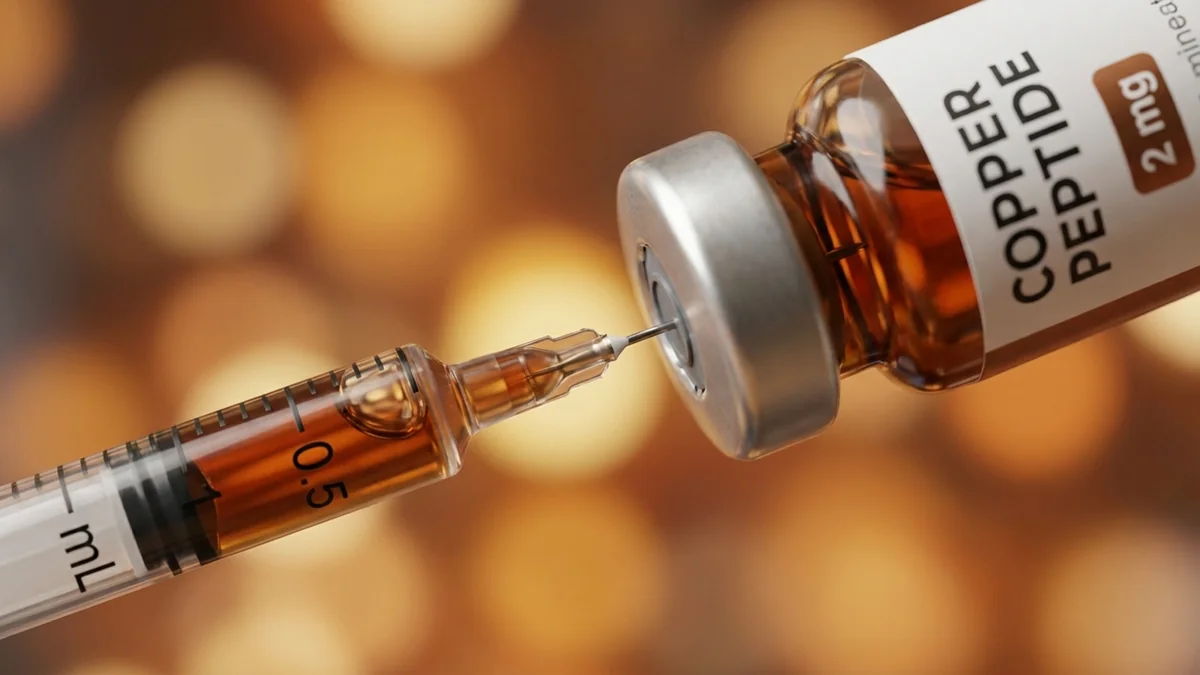
Injectable GHK-Cu exists as a research compound and has been used in some peptide therapy clinic contexts, but there's no FDA-approved injectable formulation and no established clinical dosing protocol for systemic use. If you're seeing this offered at a clinic, ask specifically about the source, quality testing, and what evidence base the provider is using. The topical evidence base doesn't automatically transfer to injectable use.
How long does it take to see results from copper peptides?
Most people who report visible results from topical copper peptide products describe noticing changes in skin texture around 8–12 weeks of consistent daily use, though this timeframe hasn't been formally established in clinical studies and individual results may vary. Fine lines and surface smoothness tend to be the first things people notice. Structural changes like improved firmness take longer. Don't expect dramatic results — the effect size in clinical studies is modest.
Is GHK-Cu the same as copper tripeptide-1?
Yes. GHK-Cu is the scientific name (glycyl-L-histidyl-L-lysine copper complex); copper tripeptide-1 is the INCI (International Nomenclature of Cosmetic Ingredients) name used on product labels. They refer to the same molecule.
Related Peptides & Comparisons
If wound healing and tissue repair are your primary interest, BPC-157 and TB-500 (thymosin beta-4) have a more developed clinical rationale for systemic tissue repair, though they operate through different mechanisms and have a very different regulatory and access profile. Neither is an OTC cosmetic.
For skin-specific applications, copper peptides occupy a different niche than growth factor serums (which typically use EGF or TGF-β fragments) or retinoid-based treatments. They're not direct competitors — they work through different pathways and can often be used together. The comparison that matters most practically is copper peptides versus retinoids for anti-aging: retinoids have a much stronger evidence base for photoaging specifically, but copper peptides offer a different tolerability profile that works better for some people.
Copper Peptides vs. Other Topical Actives for Skin Aging
Parameter
Copper Peptides
Retinoids
Growth Factors
Primary mechanism
Copper delivery + collagen signaling
Retinoic acid receptor activation
EGF/TGF-β receptor stimulation
Evidence quality
Small trials + in-vitro
Phase 3 RCTs (prescription)
Small trials + in-vitro
FDA status
OTC cosmetic
OTC (retinol) / Rx (tretinoin)
OTC cosmetic
Tolerability
Generally mild
Can cause irritation/peeling
Generally mild
Prescription needed?
No
No (retinol) / Yes (tretinoin)
No
References
Pickart L, Vasquez-Soltero JM, Margolina A. "GHK Peptide as a Natural Modulator of Multiple Cellular Pathways in Skin Regeneration." BioMed Research International. 2015;2015:648108. PMID: 26236730
Holthausen DJ, et al. "Copper regulates the interactions of antimicrobial piscidin peptides from fish mast cells with formyl peptide receptors and heparin." Journal of Biological Chemistry. 2018. PMID: 30158246
Chen X, et al. "A Peptide-Copper Self-Assembled Nanoparticle for Enhanced Cuproptosis by Metabolic Reprogramming in Tumor Cells." ACS Nano. 2024. PMID: 39625713
Managa M, et al. "Imidazole-rich copper peptides as catalysts in xenobiotic degradation." PLoS One. 2020. PMID: 33147237
This content is for informational purposes only and does not constitute medical advice. Consult a licensed healthcare provider before starting any treatment.
Where to Buy Copper Peptides for Research
Research Use Only — not intended for human consumption
MyPeptideMatch.com does not provide medical advice. Always consult a qualified healthcare provider before starting any peptide therapy. Regulatory status may change.