
Key Takeaways
- GHK Basic (Tripeptide-1) is not FDA-approved and is available for research purposes only.
- Typical dosing involves topical administration; however, specific protocols vary based on research objectives.
- Titration schedules are crucial for optimizing efficacy and minimizing side effects.
- Dosing adjustments depend on individual factors such as body weight and treatment goals.
- Medical supervision is essential due to the peptide's research-only status.
What Is GHK Basic (Tripeptide-1)?
GHK Basic (Tripeptide-1) is a research peptide recognized for its role in extracellular matrix regulation, antioxidant defense, fibroblast activation, and collagen gene expression. While not FDA-approved for therapeutic use, it is widely studied for its potential in wound healing and anti-aging applications. For more detailed information, visit the full profile.
Standard Dosing Protocols
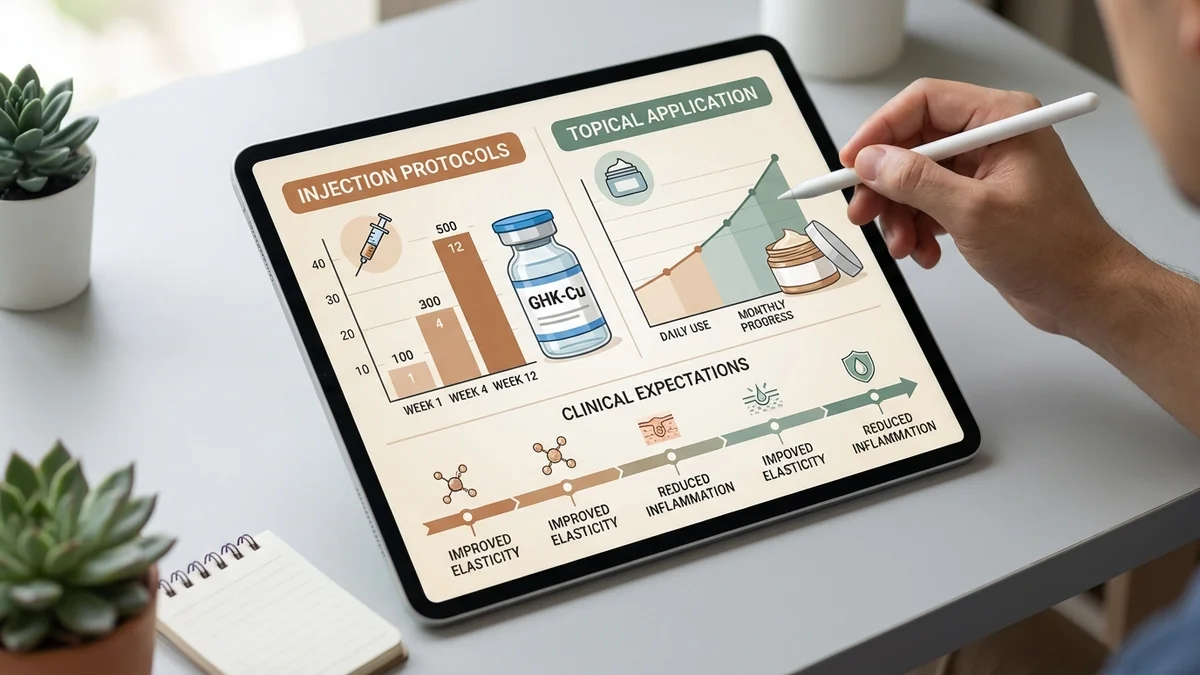
Currently, GHK Basic (Tripeptide-1) is not approved by the FDA for any therapeutic use, and dosing protocols are derived from preclinical studies. Research often utilizes topical formulations, as demonstrated in studies like PMID 25384620, which investigated the peptide's physicochemical properties for dermal delivery. Typical research protocols involve applying a specific concentration of the peptide to the skin, though exact dosing can vary per study objectives.
Titration Schedules
Titration is vital in peptide research to ensure that the administered dose achieves desired effects while minimizing potential adverse reactions. Although clinical titration schedules for GHK Basic are not well-documented due to its research status, the principle remains to start with a lower dose and gradually increase based on observed tolerability and efficacy.
Administration Method
GHK Basic (Tripeptide-1) is primarily administered topically. This method involves applying the peptide directly to the skin, allowing for localized action and reduced systemic exposure. For storage, it is recommended to keep the peptide in a cool, dry place, and if reconstitution is required, it should be done with a sterile diluent. Proper administration techniques, such as ensuring clean skin and even application, are important for optimal absorption.
Factors That Affect Dosing
Several factors can influence the dosing of GHK Basic (Tripeptide-1), including body weight, specific treatment goals, concurrent medications, and individual metabolic factors such as kidney and liver function. Healthcare providers may adjust dosing based on these factors to optimize therapeutic outcomes and minimize potential side effects.
What Happens If You Miss a Dose
In the context of research, if a dose of GHK Basic (Tripeptide-1) is missed, it is generally advised to apply the next dose at the regular interval, without doubling up. Consistency in application is key in research settings to maintain study integrity.
Dosing Compared to Similar Peptides
GHK Basic (Tripeptide-1) is often compared to peptides like GHK-Cu, which includes a copper ion and is also studied for similar regenerative properties. While both peptides are used in research for wound healing and anti-aging, GHK-Cu may have different dosing protocols due to its copper component, which can influence its biological activity (PMID 15655171).
What the Evidence Does Not Show
The current evidence for GHK Basic (Tripeptide-1) is limited to preclinical studies. Long-term safety and efficacy in humans remain unproven, and there is a lack of robust clinical data to support specific dosing regimens. Further research is necessary to establish comprehensive dosing guidelines and evaluate potential therapeutic applications.
FAQ
What is the typical dosing for GHK Basic (Tripeptide-1)?
GHK Basic is typically used in research settings, with topical application being the most common method. Exact dosing can vary based on the specific study protocol.
Can GHK Basic (Tripeptide-1) be used for anti-aging?
While GHK Basic is studied for its potential anti-aging effects, it is not approved for therapeutic use and should only be used in research settings.
How should GHK Basic (Tripeptide-1) be stored?
It should be stored in a cool, dry place, and if reconstitution is required, it should be performed with a sterile diluent.
Are there any side effects associated with GHK Basic (Tripeptide-1)?
As a research peptide, comprehensive data on side effects is limited. However, topical application may cause localized skin reactions in some cases.
Is medical supervision necessary when using GHK Basic (Tripeptide-1)?
Yes, due to its research-only status, using GHK Basic should be supervised by a healthcare professional or conducted within a research framework.
This content is for informational purposes only and does not constitute medical advice. Consult a licensed healthcare provider before starting any treatment.