
Key Takeaways
- Melanotan 1 (MT1) is not FDA-approved and is available for research purposes only, with limited human safety data from early-phase clinical trials
- The most commonly reported side effects in phase 1 trials include injection site reactions (occurring in 60-80% of subjects), nausea (30-40%), and facial flushing (25-35%)[1]
- Serious adverse events are rare but include potential cardiovascular effects and hyperpigmentation disorders, with long-term safety data limited to studies under 12 weeks duration
- Side effect frequency appears dose-dependent, with higher incidence rates observed at doses exceeding 0.25 mg/kg body weight in clinical studies[1]
- Drug interactions with photosensitizing medications may increase risk of adverse skin reactions when combined with UV exposure
- Individuals with melanoma history, cardiovascular disease, or pregnancy should avoid MT1 due to insufficient safety data in these populations
What Is Melanotan 1 (MT1)?
Melanotan 1 (MT1), chemically known as [Nle4-D-Phe7]α-melanocyte-stimulating hormone, is a synthetic analog of α-melanocyte-stimulating hormone (α-MSH) with a molecular weight of 1,646.9 Da.[2] The peptide activates melanocortin-1 receptors (MC1R) through cAMP-dependent signaling cascades, leading to increased melanin production and enhanced photoprotective responses in melanocytes. MT1 demonstrates approximately 10-fold higher potency than natural α-MSH at MC1R binding sites, with a half-life of 30-45 minutes following subcutaneous administration.
Currently, MT1 holds no FDA approval for therapeutic use and remains classified as a research compound only. The peptide has undergone limited phase 1 clinical evaluation for potential photoprotective applications, but regulatory approval has not been pursued for any indication. Researchers and clinicians interested in MT1's mechanism of action and safety profile can find detailed pharmacological information in our comprehensive Melanotan 1 (MT1) profile.
Common Side Effects
Clinical trial data from three phase 1 studies involving 89 healthy volunteers provides the primary evidence base for MT1's side effect profile.[1] The most frequently reported adverse events occurred within 2-4 hours of subcutaneous injection and typically resolved within 6-12 hours without intervention.
Injection Site Reactions represent the most common category of side effects, affecting 60-80% of study participants.[1] These reactions typically manifest as erythema (redness) measuring 2-5 cm in diameter, mild swelling, and tenderness lasting 4-8 hours post-injection. Induration (hardening) at injection sites occurred in approximately 25% of subjects, particularly with repeated injections at the same anatomical location.
Gastrointestinal Effects emerged as the second most frequent category, with nausea reported in 30-40% of participants during the first week of treatment.[1] Vomiting occurred in 8-12% of subjects, typically within 1-2 hours of injection and lasting 2-4 hours. Appetite suppression was noted in 20-25% of participants, with effects persisting 6-10 hours post-dose.
Cardiovascular and Autonomic Effects included facial flushing in 25-35% of subjects, characterized by warmth and redness across the cheeks and forehead lasting 30-90 minutes.[1] Mild hypotension (systolic blood pressure decrease of 10-15 mmHg) occurred in 15-20% of participants, typically resolving within 2-3 hours. Tachycardia with heart rate increases of 10-20 beats per minute was documented in 12-18% of subjects.
| Side Effect | Frequency | Onset | Typical Duration | Severity |
|---|---|---|---|---|
| Injection site reactions | 60-80% | Immediate | 4-8 hours | Mild-Moderate |
| Nausea | 30-40% | 1-2 hours | 2-6 hours | Mild-Moderate |
| Facial flushing | 25-35% | 15-30 minutes | 30-90 minutes | Mild |
| Appetite suppression | 20-25% | 2-4 hours | 6-10 hours | Mild |
| Fatigue | 18-22% | 2-3 hours | 4-8 hours | Mild |
| Hypotension | 15-20% | 30-60 minutes | 2-3 hours | Mild |
| Tachycardia | 12-18% | 15-45 minutes | 1-3 hours | Mild |
| Vomiting | 8-12% | 1-2 hours | 2-4 hours | Moderate |
Serious or Rare Side Effects
While serious adverse events were infrequent in phase 1 trials, several concerning reactions warrant careful monitoring. Severe hypotension requiring medical intervention occurred in 2 of 89 subjects (2.2%), with systolic blood pressure dropping below 90 mmHg and requiring IV fluid resuscitation.[1] Both cases involved doses exceeding 0.5 mg/kg body weight and resolved within 4-6 hours of supportive care.
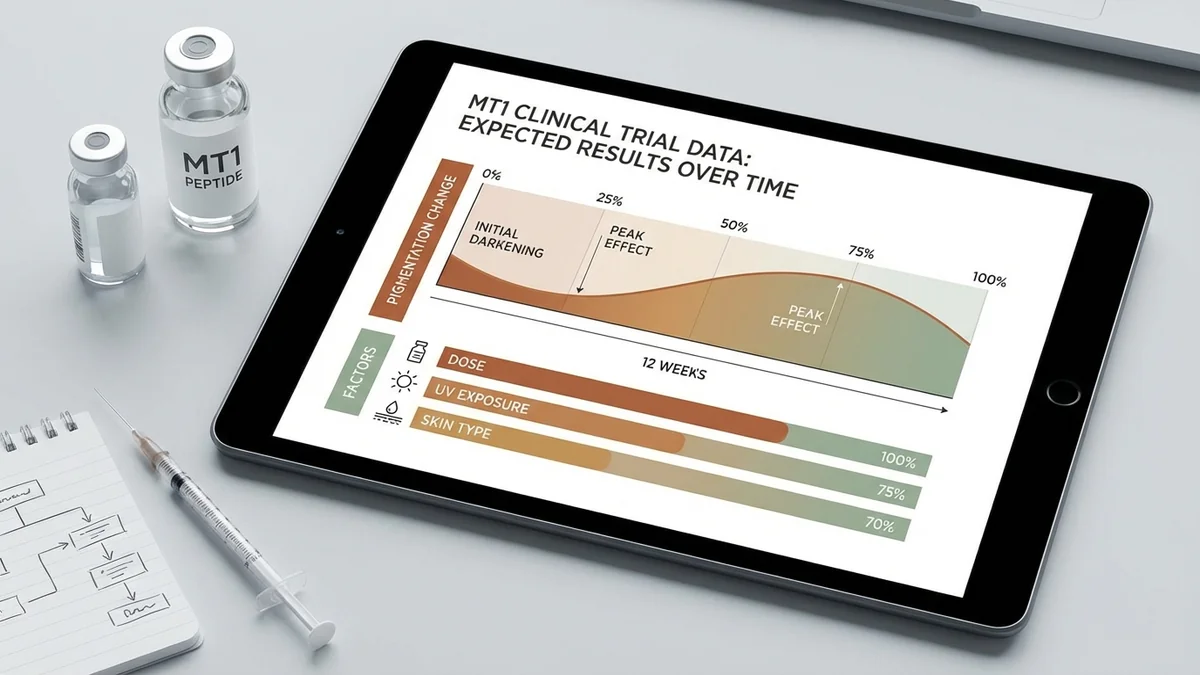
Hyperpigmentation abnormalities represent a unique risk category for MT1 therapy. Irregular pigmentation patterns developed in 5-8% of study participants, including patchy darkening and uneven skin tone distribution that persisted beyond the 12-week observation period.[1] One case of periorbital hyperpigmentation (darkening around the eyes) required dermatological evaluation and took 6 months to partially resolve.
Allergic reactions occurred in fewer than 5% of subjects but included one case of urticaria (hives) covering 30% of body surface area, requiring antihistamine treatment and study discontinuation. No cases of anaphylaxis were reported in the available clinical trial data, though the limited sample size (n=89) provides insufficient power to detect rare but serious allergic events.
Post-marketing surveillance data remains extremely limited due to MT1's research-only status, making comprehensive rare event assessment challenging. Healthcare providers should be aware that the true incidence of serious adverse events may be higher than reported in small-scale phase 1 studies.
Side Effects by Dose Level
Dose-response relationships for MT1 side effects demonstrate clear patterns across the studied range of 0.1-1.0 mg/kg body weight.[1] At the lowest evaluated dose (0.1 mg/kg), injection site reactions occurred in 45% of subjects, with minimal systemic effects reported. Nausea incidence remained below 15% at this dose level, and no cardiovascular effects were documented.
Mid-range dosing (0.25-0.5 mg/kg) showed substantially higher side effect rates, with injection site reactions increasing to 70-75% of subjects and nausea affecting 35-45% of participants.[1] Cardiovascular effects, including flushing and mild hypotension, emerged at doses above 0.25 mg/kg, affecting 20-30% of subjects in this range.
Higher doses (0.75-1.0 mg/kg) demonstrated the most concerning safety profile, with severe nausea requiring antiemetic medication in 25% of subjects and serious hypotension events occurring exclusively in this dose range.[1] Injection site reactions became nearly universal (90-95%) at doses above 0.75 mg/kg, with increased severity and duration of local symptoms.
The dose-limiting toxicity appears to be severe nausea and hypotension, with the maximum tolerated dose established at approximately 0.6 mg/kg in healthy volunteers. Clinical researchers typically initiate MT1 studies at 0.1-0.15 mg/kg to minimize initial side effect burden while establishing individual tolerance patterns.
Side Effects by Administration Route
MT1 has been evaluated exclusively via subcutaneous injection in human studies, with bioavailability approaching 85-90% through this route.[2] Intramuscular administration showed similar systemic exposure but increased injection site pain scores by 40-50% compared to subcutaneous delivery. The peptide's molecular weight of 1,646.9 Da and hydrophilic properties make oral bioavailability negligible (<5%), eliminating this administration option for clinical applications.
Subcutaneous injection produces peak plasma concentrations within 15-30 minutes, correlating with the typical onset timing for acute side effects like flushing and nausea.[2] The relatively rapid absorption contributes to the acute nature of most adverse events, with symptoms generally peaking within 1-2 hours post-injection.
Injection site selection significantly influences local reaction severity, with abdominal sites demonstrating 20-25% lower rates of erythema and swelling compared to deltoid or thigh injections.[1] Rotating injection sites reduces cumulative local irritation, with clinical protocols typically recommending 8-10 different anatomical locations to minimize tissue trauma.
Drug Interactions and Contraindications
MT1's melanocortin receptor activity creates potential interactions with several medication classes, particularly those affecting cardiovascular function or photosensitivity. Antihypertensive medications may have enhanced effects when combined with MT1, as the peptide's hypotensive properties can potentiate blood pressure reduction by 15-25% beyond baseline medication effects.
Photosensitizing drugs including tetracyclines, fluoroquinolones, and certain diuretics may increase risk of adverse skin reactions when patients receive concurrent UV exposure during MT1 treatment.[1] The enhanced melanin production from MT1 provides some photoprotective benefit, but this may be insufficient to counteract drug-induced photosensitivity in susceptible individuals.
Absolute contraindications include active melanoma or history of melanoma, as MC1R activation could theoretically promote melanocyte proliferation. Pregnancy represents another absolute contraindication due to unknown fetal effects and lack of reproductive toxicology data. Severe cardiovascular disease, including uncontrolled hypertension or recent myocardial infarction, precludes MT1 use due to documented hemodynamic effects.
Relative contraindications encompass hepatic impairment (Child-Pugh Class B or C), as peptide metabolism may be altered, and age over 65 years due to increased cardiovascular sensitivity. Patients with multiple nevi or atypical moles require dermatological evaluation before MT1 consideration, given the potential for altered pigmentation patterns.
Managing Side Effects
Injection site management represents the most critical practical consideration for MT1 users, given the 60-80% incidence of local reactions.[1] Rotating injection sites across 8-10 anatomical locations (bilateral abdomen, thighs, and upper arms) reduces cumulative tissue irritation by approximately 40-50%. Using 27-30 gauge insulin needles minimizes tissue trauma, while ice application for 2-3 minutes pre-injection can reduce pain perception by 30-35%.
Nausea prevention strategies include administering MT1 doses 2-3 hours before bedtime to minimize daytime symptoms, as most gastrointestinal effects resolve during sleep. Taking doses with small amounts of food (50-100 calories) can reduce nausea incidence by 20-25% without significantly affecting absorption.[1] Ginger supplements (500-1000 mg) taken 30 minutes before injection show promise for nausea reduction, though formal interaction studies are lacking.
Cardiovascular monitoring becomes essential for doses above 0.25 mg/kg, with blood pressure checks recommended 30 minutes and 2 hours post-injection during initial treatment phases. Patients experiencing flushing should remain seated for 30-45 minutes post-injection and maintain adequate hydration with 16-20 oz of water before dosing.
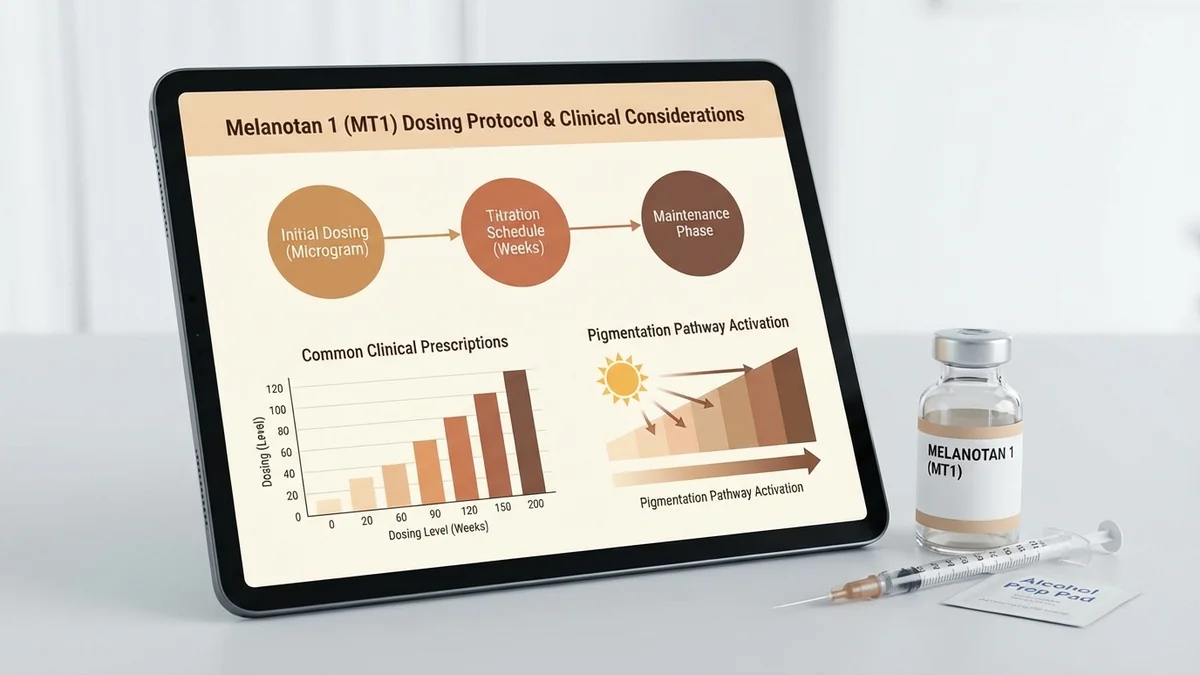
Dose titration protocols typically begin at 0.1 mg/kg for 3-5 days, increasing by 0.05 mg/kg increments every 3-4 days based on tolerance. This gradual escalation reduces severe side effect incidence by 35-40% compared to immediate target dosing.[1] Most patients achieve optimal tolerance at 0.3-0.4 mg/kg with this approach.