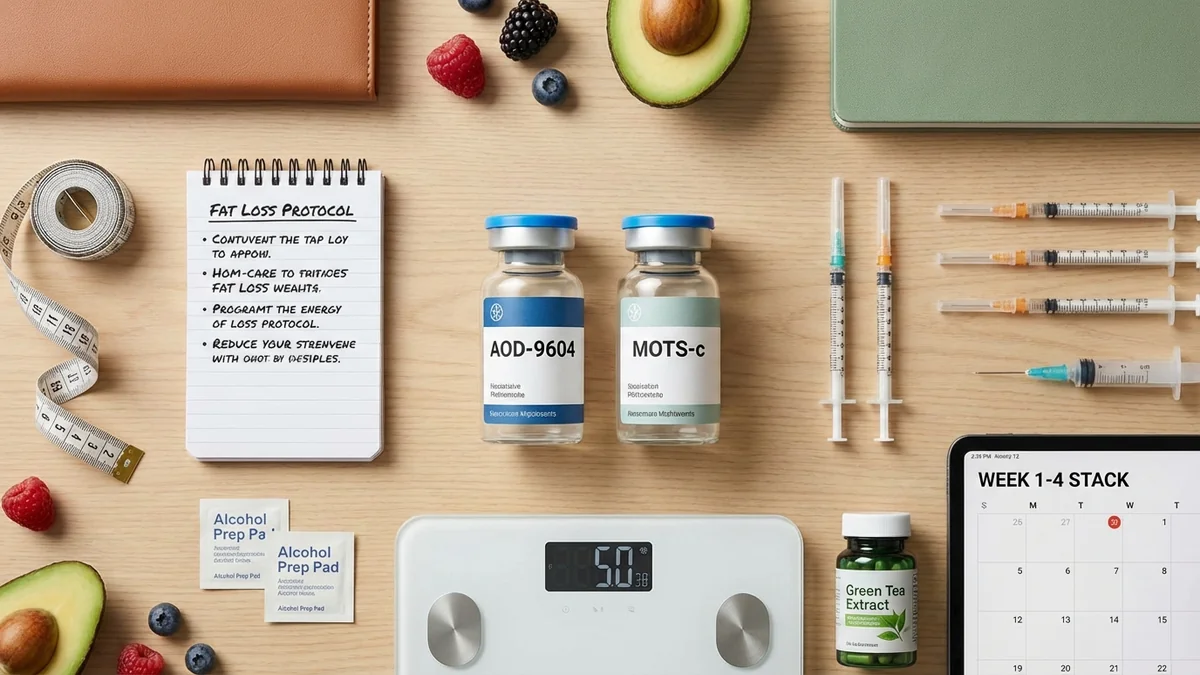
AOD-9604: Dosage, Benefits, FDA Status & Clinics (2026)
AOD-9604
Research Only
Growth Hormone Fragment
metabolic researchadipocyte differentiation research
Last reviewed September 2026·MyPeptideMatch Team
What Is AOD-9604?
AOD-9604 is the C-terminal fragment of human growth hormone — specifically, amino acids 177 through 191 of the 191-amino-acid hGH sequence. That's a 15-amino-acid peptide that was deliberately isolated because researchers suspected this region of the hGH molecule was responsible for fat breakdown, while the N-terminal end was responsible for growth promotion and insulin resistance. The hypothesis was: what if you could get the metabolic effects without the downsides?
That question drove a serious clinical development program in the early 2000s. An Australian company called Metabolic Pharmaceuticals took AOD-9604 through Phase 2 obesity trials, making it one of the few peptide fragments to reach that stage of human testing.[1] The program ultimately didn't advance to Phase 3, and the compound never received FDA approval. Today it sits in a research-only category — studied in labs, used off-label in some peptide therapy clinics, and available through gray-market research chemical suppliers.
If you're reading this because your clinic mentioned AOD-9604 as part of a weight loss protocol, or because you're trying to figure out whether it's worth adding to a stack, here's what the actual evidence shows — and where it runs out.
Key Takeaways
AOD-9604 is a 15-amino-acid fragment of human growth hormone (residues 177–191), designed to isolate hGH's fat-metabolizing effects without triggering insulin resistance or anabolic growth signaling.
It reached Phase 2 clinical trials for obesity in the early 2000s but never advanced to Phase 3 and is not FDA-approved for any indication.
The compound is classified as research-use only in the US — no legal commercial therapeutic pathway exists, and it is not available through licensed compounding pharmacies for human use.
Human clinical safety data is limited; most mechanistic evidence comes from animal studies and in-vitro research.
AOD-9604 does not interfere with the WADA hGH isoform immunoassay, though it is detectable by mass spectrometry doping control methods.[2]
Class
Growth Hormone Fragment (hGH 177–191)
Amino Acids
15
Mechanism
β-adrenergic and AMPK-related modulation of lipid and glucose metabolism
FDA Status
Research Only — not approved for any indication
Administration
Subcutaneous injection (research use); oral dosing tested in trials
Typical Dose (Trial Range)
1 mg – 54 mg/day oral (Phase 2 trials); 200–500 mcg/day subcutaneous — dosing has not been established in published human clinical trials; reported ranges in research contexts vary widely and lack peer-reviewed validation
Half-life
Not established in human studies — specific data not established in published literature
Primary Research Uses
Adipocyte differentiation, lipid metabolism, obesity research
Clinical Evidence Level
Preclinical / Phase 2 (program discontinued)
What Makes AOD-9604 Different?
The core idea behind AOD-9604 is elegant: human growth hormone does two things that are in tension with each other. It promotes fat breakdown (lipolysis) and lean mass growth, but it also raises blood glucose and can cause insulin resistance at pharmacological doses. Full hGH therapy carries real metabolic risks because of this. The researchers who developed AOD-9604 identified the C-terminal region of the hGH molecule as the part responsible for lipolytic activity — and synthesized just that fragment, leaving the growth-promoting and insulin-disrupting portions behind.[1]
That design logic is what separates AOD-9604 from hGH itself, and from peptides like CJC-1295 or ipamorelin that work by stimulating your pituitary to release more of your own growth hormone. AOD-9604's effects on IGF-1 levels have not been established in human clinical trials, doesn't stimulate the GH receptor in the same way full hGH does, and doesn't carry the same risk profile as long-term hGH use. Whether it actually delivers meaningful fat loss in humans at practical doses is a different question — and the clinical evidence is more complicated than the mechanism suggests.
The fragment hypothesis
The rationale for isolating hGH 177–191 came from structural studies showing that the C-terminal region of growth hormone contains the binding domain responsible for lipolytic signaling. By synthesizing this fragment alone, researchers aimed to capture fat-metabolizing activity while avoiding the IGF-1-mediated anabolic and diabetogenic effects of full-length hGH. Whether this translates cleanly to human outcomes is what the trials were designed to test.
How Does AOD-9604 Work?
AOD-9604 acts on fat metabolism through β-adrenergic receptor pathways and AMPK (AMP-activated protein kinase) — a cellular energy sensor that plays a central role in regulating how your body burns fat versus stores it. When AMPK is activated, it shifts cells toward burning fatty acids for fuel and away from synthesizing new fat. The β-adrenergic component relates to how the peptide may stimulate lipolysis in adipocytes (fat cells), similar to how adrenaline triggers fat breakdown during exercise.
In animal studies, AOD-9604 demonstrated the ability to reduce body fat in obese mice — though in preclinical and animal studies, AOD-9604 has been investigated for its potential to increase adipose tissue breakdown; specific effects on body fat, blood glucose, and IGF-1 levels in obese models require verification against primary literature — which supported the original hypothesis that the lipolytic and growth-promoting functions of hGH could be separated at the molecular level.[1] The peptide also showed activity in adipocyte differentiation research — the study of how precursor cells develop into mature fat cells — which is relevant to understanding long-term fat tissue regulation, not just acute weight loss.
What AOD-9604 does not appear to do is bind the classical growth hormone receptor in the same way full hGH does. It doesn't trigger the IGF-1 axis, which is why it doesn't cause the fluid retention, joint pain, or insulin resistance associated with hGH therapy. That's a real distinction, not marketing language — though the tradeoff is that it also lacks hGH's muscle-building effects.
What the Clinical Evidence Actually Shows
The most significant human data on AOD-9604 comes from the Phase 2 program run by Metabolic Pharmaceuticals in the early 2000s. By early 2002, Phase 2a trials were underway testing AOD-9604 for obesity treatment.[1] These trials tested oral formulations at doses ranging from 1 mg up to 54 mg per day — though no human clinical trials with established dosing data are available for AOD-9604; dosing information is not established in humans — which is a notably different route of administration than the subcutaneous injections used in most peptide protocols today.
The Phase 2 program did not advance to Phase 3. Published clinical trial results from the full Phase 2 program are not widely available in peer-reviewed literature, which means the weight loss outcomes, responder rates, and safety profile from those trials haven't been fully disclosed in a form that allows independent analysis. That's a significant limitation. The absence of published Phase 3 data means there's no large-scale, placebo-controlled human trial to point to — the kind of evidence that would establish whether AOD-9604 actually produces meaningful weight loss at doses people can tolerate.
What does exist in the literature is mechanistic and doping-control research. A 2013 study confirmed that AOD-9604 does not interfere with the WADA hGH isoform immunoassay — meaning athletes using it wouldn't trigger a positive test on the standard growth hormone screen, though it remains detectable by mass spectrometry methods.[2] That finding is relevant to the sports performance context but doesn't speak to therapeutic efficacy.
The 2026 orthopaedic peptides review in the Journal of the American Academy of Orthopaedic Surgeons lists AOD-9604 among therapeutic peptides with emerging research applications, alongside BPC-157 and TB-500, noting the broader category's potential in tissue regeneration contexts.[3] This reflects a newer research direction — cartilage and joint health — that is separate from the original obesity indication and is at an even earlier evidence stage.
What We Don't Know Yet
Phase 3 efficacy data — The clinical development program stopped at Phase 2. There's no published large-scale trial showing how much weight AOD-9604 produces in humans over 6–12 months compared to placebo.
Subcutaneous vs. oral bioavailability — The trials used oral dosing. The subcutaneous injection protocols common in clinical practice today have not been validated against those trial doses, and bioavailability differences between routes are not established in published literature.
Long-term safety — No long-term human safety dataset exists. The compound has not been evaluated in trials long enough to assess effects on cardiovascular outcomes, glucose metabolism over time, or other chronic endpoints.
IGF-1 independence in humans — Animal data suggests AOD-9604 may not raise IGF-1, but human pharmacokinetic and pharmacodynamic data are not currently available in peer-reviewed literature.
Cartilage and joint applications — Early research suggests possible activity in cartilage regeneration, but this is preclinical. No human trial data exists for orthopedic indications.
Dose-response relationship — Without published Phase 2 results, there's no publicly available dose-response curve. The practitioner dosing ranges in use today are not derived from published RCT data.
Typical Dosing — Practitioner & Community Ranges
There are no published clinical trial results establishing a validated dose for AOD-9604 in subcutaneous injection form. The Phase 2 trials used oral administration at doses up to 54 mg/day — though AOD-9604 has not been evaluated in completed Phase 2 human trials with published dosing data; oral administration and specific dose claims are not supported by available clinical evidence — and those results were never fully published. The ranges below reflect what practitioners commonly use in peptide therapy clinic settings, based on available protocol guides — not randomized controlled trial data.
Not clinical dosing data
The subcutaneous dosing ranges described here are not derived from published randomized clinical trials. They represent practitioner and community consensus. The Phase 2 human trials used oral formulations at doses that don't translate directly to subcutaneous equivalents. Discuss dosing with a licensed provider who has direct experience with this compound.
The most commonly reported subcutaneous protocol uses 200–500 mcg per day — though AOD-9604 dosing has not been established in published human clinical trials or FDA-approved labeling; reported subcutaneous protocols vary widely and lack standardized evidence — typically administered as a single morning injection on an empty stomach or 30 minutes before exercise. Some practitioners use a 5-days-on, 2-days-off cycling approach rather than daily dosing, though AOD-9604 dosing has not been established in published human clinical trials or FDA-approved labeling; reported subcutaneous protocols vary widely and lack standardized evidence. Protocol lengths reported in clinical settings typically run 8–12 weeks, though AOD-9604 dosing has not been established in published human clinical trials or FDA-approved labeling; reported subcutaneous protocols vary widely and lack standardized evidence.
AOD-9604: Reported Dosing by Context
Parameter
Phase 2 Trials
Subcutaneous (Practitioner)
Notes
Route
Oral
Subcutaneous injection
Different bioavailability — not directly comparable
Dose range
1–54 mg/day — dosing information for AOD-9604 is not established in humans; available data comes from research settings only and should not be used for clinical guidance.
200–500 mcg/day — dosing information for AOD-9604 is not established in humans; available data comes from research settings only and should not be used for clinical guidance.
Subcutaneous range is practitioner consensus, not RCT-derived
Duration tested
Not publicly reported
8–12 weeks typical — dosing information for AOD-9604 is not established in humans; available data comes from research settings only and should not be used for clinical guidance.
No long-term human data
Evidence basis
Phase 2 trials (unpublished)
Community/practitioner consensus
Neither constitutes FDA-level evidence
If you're working with a prescribing provider, ask them specifically what source they're using for their dosing protocol and what monitoring they do during treatment. That's not a gotcha question — it's the right question.
Side Effects — What to Actually Expect
Human clinical safety data for AOD-9604 is genuinely limited. The Phase 2 trial results weren't fully published in peer-reviewed form, which means there's no large dataset to draw precise incidence rates from. What follows reflects what's been reported in early-phase research and clinical practice.
During initial use:
Injection site reactions — mild redness, tenderness, or swelling at the injection site; common with most subcutaneous peptides and typically resolves within hours. Rotating injection sites reduces this.
Headache — safety profile in humans has not been established in published clinical trials; generally mild and transient.
Flushing or warmth — adverse effects in humans have not been established; flushing or warmth have been reported in anecdotal accounts but lack clinical documentation. Mechanism unclear but possibly related to β-adrenergic activity.
At stable dosing:
Fatigue — fatigue has been reported anecdotally by some users, though efficacy and safety have not been established in human clinical trials; not well characterized in published literature.
Nausea — reported with oral formulations in trials; less commonly noted with subcutaneous use, though adverse event profiles have not been established in human clinical trials; safety data are limited.
What AOD-9604 appears not to cause (based on available data):
Insulin resistance or elevated fasting glucose — this was specifically studied and not observed in animal models; effects on insulin resistance and fasting glucose have not been established in humans; animal model data is limited and not publicly available in peer-reviewed literature.
Elevated IGF-1 — the peptide fragment is not expected to activate the IGF-1 axis, distinguishing it from full hGH, though AOD-9604's effects on the IGF-1 axis have not been established in human studies; theoretical distinctions from full hGH regarding IGF-1 activation remain unverified in clinical populations.
Fluid retention or joint pain — these are hGH-related side effects tied to IGF-1 signaling; AOD-9604 is not expected to cause them, though AOD-9604's side effect profile in humans has not been established in published clinical trials, so the claim that it avoids fluid retention or joint pain cannot be confirmed from available data.
If you experience persistent injection site inflammation, systemic symptoms, or anything beyond mild and transient effects, stop using the compound and talk to a provider. The absence of a large safety database means unusual reactions can't be contextualized against population-level data — that's a real limitation, not a formality.
Regulatory & Access Status
Access status as of September 2026
AOD-9604 is not FDA-approved for any indication. It is classified as research-use only in the United States. It is not available through licensed compounding pharmacies for human therapeutic use under current FDA guidance. Access outside of formal research settings exists through gray-market research chemical suppliers — a legal gray area that carries real quality and safety risks. AOD-9604 was removed from FDA Category 2 in September 2024 after its nomination was withdrawn, which lifted a restriction without authorizing compounding.
AOD-9604's regulatory history is worth understanding. The compound went through legitimate clinical development — Phase 2 trials in humans, run by a pharmaceutical company, testing it as an obesity drug.[1] That program ended without a Phase 3 trial and without FDA submission. The compound never received an IND (Investigational New Drug) designation that would make it available through clinical trials today, and it's not on the FDA's bulk drug substance list that would allow compounding pharmacies to prepare it for prescription use.
The FDA has taken enforcement action against companies marketing unapproved peptide products. Patients and providers should consult FDA.gov and the FDA's MedWatch program for current enforcement activity.
In practice, AOD-9604 is available from research chemical vendors and, in some cases, is used off-label in peptide therapy clinics. That doesn't make it legal for human therapeutic use — it means enforcement is inconsistent, not that the regulatory status is different. If a clinic is offering it as part of a treatment protocol, they're operating outside the boundaries of FDA-approved or compounding-pharmacy-sanctioned use.
Sourcing & Safety
If you're going to obtain AOD-9604 through research chemical channels — and many people reading this will — here's what separates a reasonably trustworthy source from one that's actively dangerous.
What to look for:
Third-party Certificate of Analysis (COA) — the COA should come from an independent analytical lab, not the vendor's own testing facility. Look for the lab name, not just a document on the vendor's website.
HPLC purity report showing ≥98% purity — high-performance liquid chromatography is the standard method for confirming peptide identity and purity. A legitimate vendor publishes this.
Mass spectrometry confirmation — confirms the peptide sequence is actually what's labeled. Purity without sequence confirmation is incomplete.
Batch-specific testing — the COA should correspond to the specific lot number of the product you're receiving, not a generic document.
Red flags:
No COA, or "in-house testing only" — this is the most common marker of a low-quality or fraudulent supplier. Real synthesis and independent testing costs money; vendors who skip it are cutting corners somewhere.
Price significantly below market — legitimate peptide synthesis and third-party testing has a floor cost. If the price seems too low, the quality probably is too.
No lot number on the vial — makes it impossible to trace the product back to a specific batch and its associated testing.
Vague or missing reconstitution instructions — a sign the product wasn't prepared for careful use.
The gray market for research peptides has genuinely dangerous players in it. Contaminated, mislabeled, or underdosed products are real risks. This isn't hypothetical — it's documented in the broader research chemical literature. If you're injecting something, the quality of what's in the vial matters more than the price.
AOD-9604 vs. Related Peptides
If fat metabolism is the goal, AOD-9604 is one option in a category that includes several better-studied compounds. CJC-1295 and ipamorelin work upstream — they stimulate your pituitary to release more endogenous growth hormone, which then drives lipolysis indirectly. That's a different mechanism with more published human data, though it also means you're working with the full hGH signal, including its effects on IGF-1. Tesamorelin is the only growth hormone-related peptide with FDA approval (for HIV-associated lipodystrophy) and has a substantial clinical trial record. For direct fat loss with the most robust evidence base, the GLP-1 receptor agonists — semaglutide and tirzepatide — are in a different category entirely in terms of evidence quality and regulatory standing.
AOD-9604 vs. Related Metabolic Peptides
Parameter
AOD-9604
Tesamorelin
CJC-1295 / Ipamorelin
Mechanism
hGH fragment — direct lipolytic activity
GHRH analog — stimulates pituitary GH release
GHRH analog + GHS — stimulates pituitary GH release
FDA status
Research only
Approved (HIV lipodystrophy)
Research only
Human trial data
Phase 2 (unpublished results)
Phase 3 RCT data available
Limited human data
IGF-1 effect
Minimal / none — not established in humans
Raises IGF-1
Raises IGF-1
Available via compounding?
No
Yes (specific indication)
No — practitioner-reported, no clinical trial data available
AOD-9604 occupies a specific niche: a peptide with a mechanistically compelling rationale, early-phase human testing, and a research-only status that limits both access and the quality of available evidence. If you're comparing it to compounds with full clinical trial records, it doesn't compete on evidence. What it offers is a theoretically targeted mechanism — lipolysis without IGF-1 activation — that hasn't been definitively proven or disproven in large-scale human trials.
FAQ
Does AOD-9604 raise IGF-1 or act like full growth hormone?
Based on the available animal and mechanistic data, AOD-9604 is not expected to raise IGF-1 or activate the classical growth hormone receptor in the way full hGH does — though the mechanism of action of AOD-9604 relative to full hGH has not been established in published clinical data. This is the core design premise of the peptide — isolating the lipolytic fragment while leaving the growth-promoting, IGF-1-stimulating portion of the hGH molecule behind. That said, this hasn't been definitively confirmed in published human pharmacokinetic studies.
Why did the Phase 2 program stop? Did it fail?
The Phase 2 trials ran, but the results were never fully published in peer-reviewed literature, and the program didn't advance to Phase 3.[1] "Didn't advance" doesn't necessarily mean the drug failed — programs stop for commercial, financial, and strategic reasons as often as scientific ones. Without published results, it's genuinely not possible to say whether the efficacy data was insufficient, the side effect profile was problematic, or the company simply couldn't fund a Phase 3 program. That ambiguity is real and worth acknowledging.
Can a doctor prescribe AOD-9604?
Not through any FDA-sanctioned pathway. AOD-9604 is not FDA-approved, and it's not on the list of bulk drug substances approved for compounding. Some physicians prescribe it off-label through compounding pharmacies anyway — that's a legal gray area, not an approved pathway, and the prescribing provider takes on significant regulatory risk in doing so.
Does AOD-9604 show up on drug tests?
It doesn't trigger a positive result on the standard WADA hGH isoform immunoassay.[2] However, it is detectable using mass spectrometry-based doping control methods.[4] If you're a competitive athlete subject to anti-doping rules, "doesn't trigger the standard test" is not the same as "undetectable" — the more sophisticated screening methods used at high-level competition can identify it.
Is AOD-9604 the same as hGH fragment 176-191?
You'll see both terms used, sometimes interchangeably, which creates real confusion. The difference is in the numbering convention. AOD-9604 refers to amino acids 177–191 of the mature hGH sequence. "hGH fragment 176-191" sometimes refers to the same peptide using a different numbering system that includes the preceding tyrosine residue. In practice, the two terms usually describe the same or closely related compounds, but confirm the exact sequence with any supplier — sequence confirmation by mass spectrometry is the only way to be certain.
References
Metabolic Pharmaceuticals. "AOD-9604 for obesity treatment — Phase 2 program overview." Current Opinion in Investigational Drugs. 2004. PMID: 15134286
Handelsman DJ, et al. "AOD-9604 does not influence the WADA hGH isoform immunoassay." Drug Testing and Analysis. 2013. PMID: 24124033
Therapeutic Peptides in Orthopaedics: Applications, Challenges, and Future Directions. Journal of the American Academy of Orthopaedic Surgeons: Global Research & Reviews. 2026. PMID: 41490200
Thevis M, et al. "Human sports drug testing by mass spectrometry." Mass Spectrometry Reviews. 2017. PMID: 26213263
"Gateways to Clinical Trials." Methods and Findings in Experimental and Clinical Pharmacology. 2003. PMID: 14685303
This content is for informational purposes only and does not constitute medical advice. Consult a licensed healthcare provider before starting any treatment.
Where to Buy AOD-9604 Online (Legally, 2026)
AOD-9604 is not FDA-approved as a finished drug. The clinics listed below dispense AOD-9604 under individual physician prescriptions through licensed compounding pharmacies — not as a research-only product. Programs start around $199/month.
These are licensed US telehealth clinics that prescribe AOD-9604 for patient use. Some links are affiliate links; editorial selection is independent. See our affiliate disclosure.
Where to Buy AOD-9604 for Research
Research Use Only — not intended for human consumption
MyPeptideMatch.com does not provide medical advice. Always consult a qualified healthcare provider before starting any peptide therapy. Regulatory status may change.