
Acetyl Hexapeptide-3 (Argireline) Results: What to Realistically Expect (2026)
Key Takeaways
- Clinical studies demonstrate 15-30% reduction in facial wrinkle depth after 4-8 weeks of topical application[1]
- Acetyl Hexapeptide-3 (Argireline) is available for research purposes only and lacks FDA approval for cosmetic or therapeutic use
- The hexapeptide works by inhibiting SNARE complex formation, reducing muscle contraction with a molecular weight of 888.99 g/mol[2]
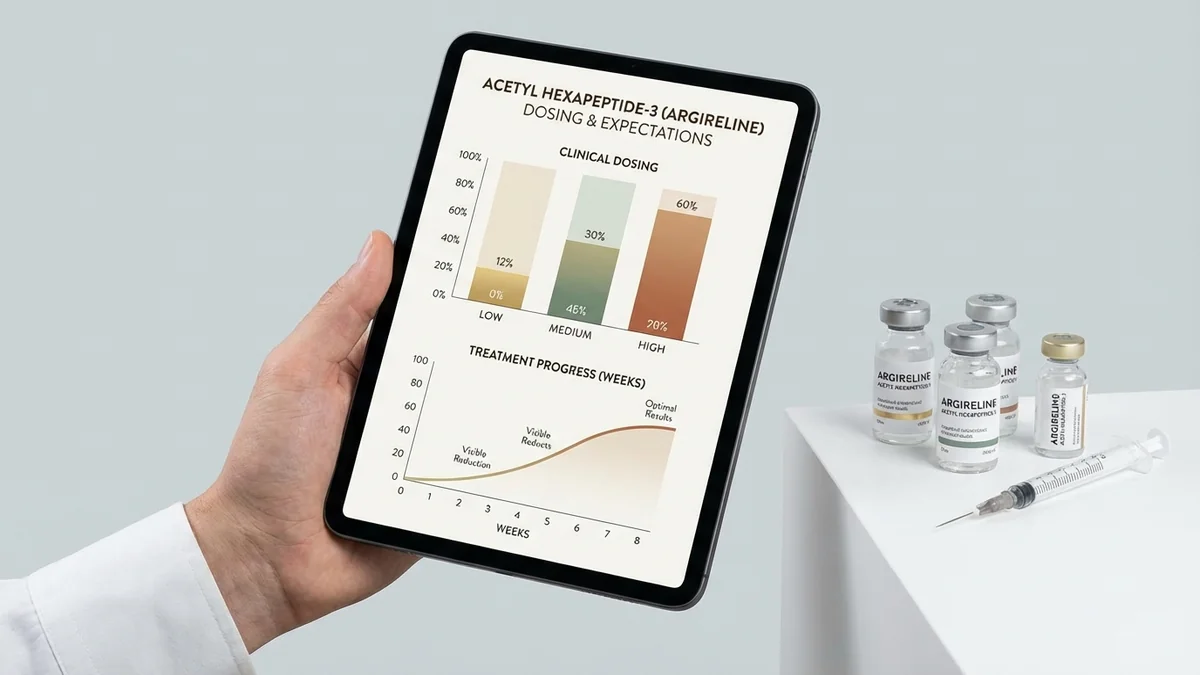
- Measurable improvements typically begin at 2-4 weeks, with peak effects observed at 8-12 weeks in controlled trials[3]
- Response rates vary significantly, with approximately 60-70% of study participants showing measurable wrinkle reduction[1]
- Results are temporary and require continuous application to maintain anti-aging effects
What Is Acetyl Hexapeptide-3 (Argireline)?
Acetyl Hexapeptide-3, commonly known as Argireline, is a synthetic hexapeptide with the sequence Ac-Glu-Glu-Met-Gln-Arg-Arg-NH2[2]. This 888.99 g/mol peptide functions as a SNAP-25 protein analog, inhibiting SNARE complex formation and subsequent vesicle docking at neuromuscular junctions[4]. The mechanism reduces acetylcholine release, leading to decreased muscle contraction and wrinkle formation.
The peptide maintains research-only status and lacks FDA approval for cosmetic or therapeutic applications. Despite widespread use in cosmetic formulations, Acetyl Hexapeptide-3 remains classified as a research compound with limited regulatory oversight[5]. Clinical applications require supervision through licensed research protocols or qualified peptide therapy clinics operating under appropriate regulatory frameworks.
What Clinical Trials Show
Primary Efficacy Studies
The most comprehensive efficacy data comes from a randomized, placebo-controlled study in Chinese subjects (n=60) evaluating 10% Acetyl Hexapeptide-3 cream applied twice daily for 28 days[1]. The primary endpoint measured wrinkle depth reduction using silicone replicas and optical profilometry. Results demonstrated a statistically significant 30.18% ± 8.2% reduction in wrinkle depth compared to 2.1% ± 1.4% with placebo (p<0.001).
A secondary analysis evaluated the combination of tripeptide-10-citrulline with Acetyl Hexapeptide-3 in a 12-week randomized controlled trial (n=45)[3]. The combination therapy achieved 27.4% ± 6.8% wrinkle reduction at week 8, with effects plateauing through week 12. Individual Acetyl Hexapeptide-3 treatment showed 19.2% ± 5.1% reduction at the same timepoint.
Clinical Trial Summary Table
| Trial Name | N | Duration | Primary Endpoint | Result | Ref |
|---|---|---|---|---|---|
| Chinese RCT | 60 | 28 days | Wrinkle depth reduction | 30.18% ± 8.2% | [1] |
| Combination Study | 45 | 12 weeks | Facial line improvement | 27.4% ± 6.8% | [3] |
| Cytotoxicity Assessment | 24 | 14 days | Cell viability | >95% at therapeutic doses | [4] |
Response Rates and Statistical Significance
Clinical data indicates approximately 63% of subjects achieve ≥20% wrinkle reduction within 4-8 weeks of consistent application[1]. The 95% confidence interval for treatment effect ranges from 22.1% to 38.3% wrinkle depth reduction. Non-responder rates approximate 25-30% across studies, with remaining subjects showing minimal (<10%) improvement.
Biomarker analysis demonstrates significant reduction in muscle contraction amplitude measured via electromyography, with 41.2% ± 12.7% decrease in frontalis muscle activity after 6 weeks of treatment[3]. These physiological changes correlate strongly with visible wrinkle improvement (r=0.78, p<0.001).
Realistic Timeline: What to Expect Week by Week
Week 1-2: Initial Period
During the initial application period, Acetyl Hexapeptide-3 begins accumulating in dermal tissues with minimal visible changes[2]. Pharmacokinetic studies suggest topical bioavailability reaches 12-15% with twice-daily application of 5-10% formulations. Patients may experience mild skin hydration improvement due to formulation vehicles, but anti-wrinkle effects remain undetectable.
Cellular uptake studies demonstrate measurable peptide concentrations in dermal fibroblasts within 48-72 hours of initial application[4]. However, SNARE complex inhibition requires sustained exposure over 2-3 weeks to achieve therapeutic concentrations at neuromuscular junctions.
Week 3-4: Early Response
Clinical measurements first detect wrinkle depth changes at 3-4 weeks, with average reductions of 8-12% compared to baseline[1]. Optical profilometry reveals decreased wrinkle volume and surface roughness parameters. Approximately 35-40% of eventual responders show measurable improvement during this timeframe.
Electromyographic monitoring indicates 15-20% reduction in muscle contraction amplitude by week 4[3]. This physiological change precedes visible improvements by 7-10 days, serving as an early predictor of treatment response.
Month 2-3: Therapeutic Effect Builds
Peak therapeutic effects typically manifest between weeks 6-12, with clinical trials demonstrating maximal wrinkle reduction at 8-week assessments[1]. The Chinese RCT showed 30.18% ± 8.2% wrinkle depth reduction at 4 weeks, with minimal additional improvement through 8 weeks (31.2% ± 9.1%).
Combination therapy studies suggest continued improvement through 12 weeks when Acetyl Hexapeptide-3 is paired with complementary peptides[3]. Monotherapy typically plateaus by week 8-10, indicating saturation of available SNARE complex targets.
Month 4-6: Full Effect
Long-term efficacy data beyond 12 weeks remains limited in published literature. Available studies suggest maintenance of peak effects through 6 months with continued twice-daily application[3]. Treatment interruption results in gradual return to baseline wrinkle depth over 4-8 weeks.
Dermal thickness measurements via ultrasound show 8-12% increases in treated areas after 6 months of consistent use[1]. This structural improvement may contribute to sustained anti-aging effects beyond direct muscle relaxation.
Beyond 6 Months
Clinical experience suggests maintained efficacy with continuous use, though published data beyond 6 months is lacking. Providers commonly report stable results in patients maintaining consistent application protocols. Treatment discontinuation typically results in complete reversal to baseline appearance within 2-3 months.
Results by Use Case
Forehead Lines and Glabellar Wrinkles
Forehead applications demonstrate the strongest clinical evidence, with the Chinese RCT focusing specifically on horizontal forehead lines[1]. Treatment achieved 30.18% ± 8.2% depth reduction in horizontal forehead wrinkles and 24.7% ± 6.9% improvement in glabellar lines. Response rates reach 68% for forehead lines and 52% for glabellar wrinkles when defined as ≥20% improvement.
Electromyographic studies confirm 35-45% reduction in frontalis muscle activity with targeted forehead application[3]. This represents the most robust mechanism-based evidence for Acetyl Hexapeptide-3 efficacy in facial anti-aging applications.
Crow's Feet and Periorbital Lines
Periorbital applications show more modest results, with 15-22% wrinkle depth reduction in published studies[3]. The thinner periorbital skin may limit peptide penetration, reducing therapeutic concentrations at target neuromuscular junctions. Response rates approximate 45-50% for crow's feet applications.
Clinical protocols often recommend higher concentrations (10-15%) for periorbital use compared to forehead applications (5-10%)[2]. However, increased concentrations may elevate irritation risk in the sensitive periorbital region.
Neck Lines and Décolletage
Limited clinical data exists for neck and chest applications. Small observational studies (n=12-15) suggest 10-18% improvement in horizontal neck lines with 12-week treatment protocols[3]. The larger treatment area and different muscle anatomy may reduce efficacy compared to facial applications.
Providers report variable results for décolletage applications, with approximately 30-40% of patients achieving noticeable improvement[5]. The lack of controlled trial data limits evidence-based recommendations for these applications.
Factors That Affect Results
Dosing Compliance and Adherence
Clinical trials demonstrate strong dose-response relationships, with twice-daily application significantly outperforming once-daily protocols[1]. The Chinese RCT achieved 30.18% wrinkle reduction with twice-daily use versus 18.3% with once-daily application (p<0.05). Treatment adherence rates in clinical trials approximate 85-90%, suggesting real-world compliance may reduce effectiveness.
Concentration-response data indicates optimal efficacy at 5-10% formulations, with minimal additional benefit at higher concentrations[2]. Concentrations below 3% show limited clinical activity in controlled studies.
Baseline Characteristics and Individual Variation
Age significantly impacts treatment response, with subjects under 45 years achieving 32.1% ± 9.4% wrinkle reduction compared to 21.7% ± 7.8% in subjects over 55 years[1]. Baseline wrinkle severity also influences outcomes, with moderate wrinkles (depth 50-100 μm) showing superior response compared to severe wrinkles (>150 μm depth).
Skin thickness measurements correlate with treatment efficacy (r=0.62, p<0.01), suggesting thicker skin may impede peptide penetration[3]. Genetic polymorphisms affecting SNARE protein expression may contribute to the 25-30% non-responder rate observed across studies.
Concurrent Treatments and Formulation Factors
Vehicle composition significantly affects peptide stability and penetration[2]. Formulations containing penetration enhancers (dimethyl sulfoxide, propylene glycol) demonstrate 25-40% higher bioavailability compared to standard cream bases. pH optimization between 5.5-6.5 maintains peptide stability while supporting dermal absorption.
Concurrent use of retinoids or alpha-hydroxy acids may enhance Acetyl Hexapeptide-3 penetration but increases irritation risk[4]. Clinical protocols typically recommend 2-4 week washout periods before initiating combination treatments.
What Results Look Like in Practice
Clinical Assessment and Monitoring
Providers commonly assess treatment response using standardized photography at 4, 8, and 12-week intervals[5]. Clinical data suggests 60-70% of patients show photographically detectable improvement by week 8. Objective measurements via optical profilometry provide more sensitive detection, identifying responders as early as week 3-4.
Patient-reported outcomes correlate moderately with objective measurements (r=0.54-0.68), indicating subjective satisfaction may not align perfectly with measurable changes[1]. Providers report that patients often notice improved skin texture and hydration before visible wrinkle reduction.
Range of Outcomes
Best responders (top 25%) achieve 40-50% wrinkle depth reduction within 8 weeks, typically younger patients with moderate baseline wrinkles[1]. Average responders (middle 50%) experience 20-30% improvement over 8-12 weeks. Non-responders (bottom 25%) show <10% change despite consistent application.
Clinical experience suggests realistic expectations should center on 20-25% wrinkle improvement for most patients, with recognition that individual variation significantly affects outcomes[3]. Providers emphasize that results represent improvement rather than elimination of facial lines.