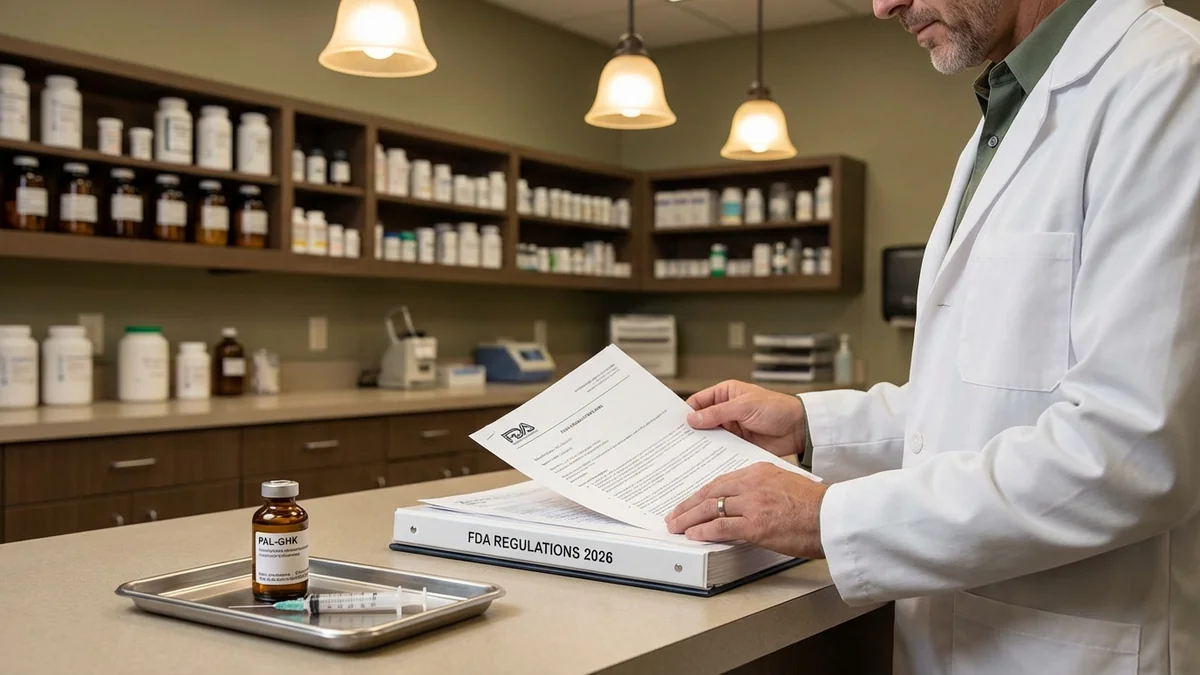
# Is Adipotide (FTPP) Legal? FDA Status and Regulations Explained (2026)

## Key Takeaways

- **Adipotide (FTPP) is not FDA-approved** for any indication in the United States as of March 2026. It is classified as research-use only.
- Adipotide (FTPP) cannot be legally compounded by 503A or 503B pharmacies for patient use because it lacks the FDA approval or recognized bulk drug substance status required for compounding.
- No DEA scheduling applies — Adipotide (FTPP) is not a controlled substance — but that does not make it legal to prescribe or sell for human use.
- "Research use only" is a legal designation, not a loophole. Purchasing it under that label for personal self-administration carries real legal and health risks.
- Clinics offering Adipotide (FTPP) as a patient treatment are operating outside FDA regulatory boundaries, regardless of how they frame the service.
- The evidence base for Adipotide (FTPP) in humans is essentially nonexistent — it has only been studied in animal models, which makes the risk-benefit calculus very different from peptides with human clinical trial data.

---

## Regulatory Status at a Glance

| Category | Status | Detail |
|---|---|---|
| FDA Approval | ❌ Not Approved | No approved indication, NDA, or BLA for any use |
| Compounding Category (503A/503B) | ❌ Not Listed / Not Eligible | Not on FDA's Category 1 bulk drug substance list; cannot be compounded for patient use |
| DEA Scheduling | Not Scheduled | Adipotide (FTPP) is not a controlled substance under the CSA |
| Prescription Availability | ❌ Not Available | Cannot be legally prescribed for human use in the US |
| Research Use | ⚠️ Permitted with Restrictions | Available to licensed researchers under appropriate institutional oversight |
| International Status | Varies | Not approved in EU, UK, Australia, or Canada for human use |

---

## Current FDA Status

Adipotide (FTPP) legality starts here: it has never received FDA approval for any indication. There is no NDA, no BLA, no 505(b)(2) pathway approval — nothing. The FDA classifies it as a research-only compound.<sup>[1]</sup>

That matters more than it might sound. When a drug has no FDA approval, it isn't just "not yet approved" — it's legally an unapproved new drug under the Federal Food, Drug, and Cosmetic Act (FD&C Act). Selling, distributing, or promoting an unapproved new drug for human use is a federal violation, full stop.<sup>[2]</sup>

Adipotide (FTPP) — also referred to as FTPP, reflecting its functional sequence as a fusion peptide targeting prohibitin — was developed as a targeted proapoptotic compound. Its mechanism involves binding to prohibitin receptors expressed on the vasculature of white adipose tissue, triggering mitochondrial membrane disruption and apoptosis in the endothelial cells feeding fat depots.<sup>[3]</sup> That's a genuinely interesting mechanism. The problem is that the clinical evidence pipeline essentially stops at nonhuman primates. There are no completed human Phase I, II, or III trials registered with ClinicalTrials.gov as of March 2026.

The FDA's research-only classification isn't a technicality — it reflects the actual state of the science. Without human safety data, the agency has no basis on which to evaluate an approval application, and no application has been submitted.

---

## Compounding Status

This is where a lot of patients get confused, because compounding has become a common pathway for other research-adjacent peptides. The short answer for Adipotide (FTPP): compounding is not a legal option here.

Under Section 503A of the FD&C Act, licensed compounding pharmacies can prepare individualized prescriptions for patients using bulk drug substances — but only if those substances appear on the FDA's approved bulk drug substance list (sometimes called the "Category 1" list), or if they meet other specific statutory criteria.<sup>[2]</sup> Adipotide (FTPP) does not appear on that list.

Under Section 503B, outsourcing facilities operate under a similar framework with additional manufacturing requirements. The same restriction applies: a bulk drug substance must be on the FDA's approved list to be compounded at scale for patient use. Adipotide (FTPP) is not on that list either.<sup>[2]</sup>

Some providers attempt to navigate around this by framing administration as part of a "research protocol." That framing doesn't hold up legally. The FDA's position is clear: if a substance is being administered to a human patient for a therapeutic purpose, it's functioning as a drug — and drug regulations apply regardless of what you call the service.<sup>[1]</sup>

There are no pending FDA docket submissions or proposed rulemakings as of March 2026 that would move Adipotide (FTPP) onto the compounding bulk drug substance list. If that changes, we'll update this page.

---

## Enforcement Actions

The FDA has taken enforcement action against companies marketing unapproved peptide products for human use, including compounds with research-only classifications similar to Adipotide (FTPP). Consult [FDA.gov](https://www.fda.gov) and the FDA's MedWatch program for current enforcement activity specific to Adipotide (FTPP) products.<sup>[1]</sup>

What the general enforcement pattern looks like: the FDA and FTC have jointly targeted companies selling research peptides directly to consumers with therapeutic claims — particularly when marketing materials reference weight loss, body composition, or metabolic benefits. Adipotide (FTPP)'s mechanism (targeted adipose tissue destruction) is exactly the kind of claim that draws regulatory attention. Companies making those claims without an approved drug application are violating the FD&C Act's prohibition on misbranding and marketing unapproved new drugs.<sup>[2]</sup>

Warning letters have been issued to online peptide vendors making therapeutic claims about unapproved compounds. The FDA has also worked with U.S. Customs and Border Protection to intercept international shipments of research peptides destined for personal use. Neither of these enforcement mechanisms requires a criminal prosecution to be consequential — a seized shipment or a business shutdown is enforcement, even without a court case.

If you encounter a vendor selling Adipotide (FTPP) with explicit weight-loss claims, you can report it to the FDA's MedWatch program at [FDA.gov/safety/medwatch](https://www.fda.gov/safety/medwatch).

---

## Prescription vs. Over-the-Counter vs. Research Use

Let's walk through each pathway clearly.

**Prescription:** You cannot get a legal prescription for Adipotide (FTPP) in the United States. A prescription is a legal authorization to dispense an approved drug (or, in limited circumstances, a compounded preparation using approved bulk substances). Since Adipotide (FTPP) doesn't qualify under either category, no licensed pharmacy can fill a prescription for it, and no physician can write one that carries legal force.<sup>[1]</sup><sup>[2]</sup>

**Over-the-counter:** Not applicable. OTC status requires FDA review and approval. Adipotide (FTPP) has neither.

**Research use:** This is the one technically legal pathway — but it's narrower than most people assume. Adipotide (FTPP) can be purchased by licensed research institutions, universities, and qualified laboratories for in-vitro or animal studies under appropriate institutional oversight (typically an IACUC protocol for animal research). Vendors selling it under a "research use only" (RUO) label are operating legally when selling to genuine researchers — but that label is not a consumer protection or a personal-use exemption.<sup>[1]</sup>

When you buy a "research use only" peptide and inject it into yourself, you are not conducting licensed research. You're self-administering an unapproved drug. The RUO label doesn't change that legal reality, and it doesn't give you any recourse if something goes wrong medically. There's no regulatory oversight of the product's purity, potency, or sterility when it's sold outside pharmaceutical-grade manufacturing standards.

**Gray market products and international purchasing:** Adipotide (FTPP) is available from overseas vendors, primarily in China and Eastern Europe, and ships into the US regularly. Customs enforcement is inconsistent — many packages get through, some get seized. Personal importation of unapproved drugs for self-use technically violates the FD&C Act, though FDA's personal importation policy creates some discretionary tolerance for small quantities of approved foreign drugs being imported for personal use.<sup>[1]</sup> That policy does not extend to unapproved research compounds. If your shipment is seized, you won't face criminal prosecution for a single package, but you will lose your money and the product.

---

## What "Off-Label" Actually Means

This distinction matters, and it comes up constantly in peptide discussions. Off-label prescribing is real, legal, and common — but it only applies to FDA-approved drugs.

When a physician prescribes metformin for PCOS, or gabapentin for nerve pain, or low-dose naltrexone for autoimmune conditions, those are off-label uses. The drug is approved for *something* — the prescribing for a different indication is the "off-label" part. Physicians have broad authority to prescribe approved drugs for unapproved indications based on their clinical judgment.<sup>[2]</sup>

Adipotide (FTPP) has no approved indication. There is no on-label use from which an off-label use could deviate. A physician prescribing Adipotide (FTPP) for a patient isn't making an off-label prescribing decision — they're prescribing an unapproved new drug. That's a categorically different legal situation, and it carries different liability implications for the provider.

From a malpractice standpoint, administering an unapproved compound with no human safety data to a patient is extraordinarily difficult to defend. Standard of care analysis requires comparing a provider's actions to what a reasonable practitioner would do. No reasonable standard of care supports administering a compound with zero human clinical trial data and no FDA approval. If a patient experiences a serious adverse event — renal toxicity, for instance, which was observed in nonhuman primate studies<sup>[3]</sup> — a provider who administered Adipotide (FTPP) would face serious professional and legal exposure.

---

## State-Level Variations

No US state has approved Adipotide (FTPP) for clinical use independently of the FDA framework. State pharmacy boards regulate compounding pharmacies within their jurisdictions, but they cannot authorize compounding of a substance that doesn't meet federal bulk drug substance criteria. A pharmacy in any state that compounds Adipotide (FTPP) for patient use is violating federal law, regardless of state board silence on the specific compound.

A handful of states — including Florida and Texas — have historically had more permissive environments for compounding pharmacies, and enforcement of federal compounding rules has varied by region. That doesn't create a legal safe harbor for Adipotide (FTPP). It means enforcement risk varies, not that the activity is legal.

Telemedicine prescribing rules don't change the underlying issue. A telehealth provider in a state with permissive telemedicine laws still cannot legally prescribe an unapproved drug. The telemedicine prescription rules govern *how* a licensed drug can be prescribed remotely — they don't create new authority to prescribe unlicensed compounds.

State medical boards in California, New York, and Texas have all issued guidance in recent years warning providers against prescribing unapproved peptides without adequate evidence base. Providers in those states face heightened board scrutiny.

---

## International Status

Adipotide (FTPP) lacks regulatory approval in every major jurisdiction where pharmaceutical approvals are tracked.

**European Union (EMA):** No marketing authorization has been granted by the European Medicines Agency. It is not listed in the EMA's European Public Assessment Report (EPAR) database as of March 2026.<sup>[4]</sup>

**United Kingdom (MHRA):** The Medicines and Healthcare products Regulatory Agency has not approved Adipotide (FTPP). Following Brexit, the UK operates its own approval pathway, and no application has been submitted or approved.

**Australia (TGA):** The Therapeutic Goods Administration has not listed Adipotide (FTPP) on the Australian Register of Therapeutic Goods (ARTG). Importation for personal use without TGA authorization is prohibited under Australian law.

**Canada (Health Canada):** No Notice of Compliance (NOC) has been issued for Adipotide (FTPP). Health Canada classifies unapproved drugs under its Health Products and Food Branch enforcement framework.

The practical implication: there is no jurisdiction where you can legally obtain Adipotide (FTPP) as a patient through a licensed pharmacy or clinic. Any clinic internationally claiming to offer it as a regulated treatment is misrepresenting the regulatory situation.

---

## What This Means for Patients

If you're researching Adipotide (FTPP) because you've seen it discussed in weight-loss or body composition communities, here's what you need to know before you do anything else.

**How to verify a clinic is operating legally:** Ask directly whether the peptide they're offering is FDA-approved or on the FDA's compounding bulk drug substance list. A legitimate clinic will answer that question directly and accurately. If the answer is vague — "it's a research protocol," "we use it under physician oversight," "it's a gray area" — that's a red flag, not reassurance.

**Red flags that suggest illegal activity:** Clinics that don't require a physical or telehealth consultation before prescribing, vendors selling injectable peptides with no prescription requirement, websites with before/after photos and weight-loss claims alongside "research use only" disclaimers — these are all signals that a seller is operating outside the law.

**Questions to ask your provider:** Has this compound been studied in human clinical trials? What is the evidence base for the dose you're recommending? What is the compounding pharmacy's 503A or 503B registration status? If your provider can't answer those questions, find a different provider.

**What to do if offered an illegal peptide:** Decline and report. You can file a complaint with the FDA's MedWatch system or contact your state medical board if a licensed provider is offering unapproved compounds as treatments.

You can find vetted peptide therapy clinics through our [clinic finder](/clinics) — all listed providers have been screened for basic regulatory compliance.

---

## Legal Alternatives

If you're interested in the metabolic and body composition outcomes that Adipotide (FTPP) is theorized to produce, there are legal options with actual human evidence.

**FDA-approved options for weight management:**
- [Semaglutide](/peptides/semaglutide) (Wegovy®, Ozempic®) — approved for chronic weight management and type 2 diabetes, with the STEP 1 trial demonstrating 14.9% mean body weight reduction over 68 weeks.<sup>[5]</sup>
- [Tirzepatide](/peptides/tirzepatide) (Zepbound®, Mounjaro®) — dual GIP/GLP-1 receptor agonist, approved for weight management, with the SURMOUNT-1 trial showing up to 22.5% weight loss at the 15 mg dose.<sup>[6]</sup>

**Compounded peptides with clearer legal status:**
- [AOD-9604](/peptides/aod-9604) — a fragment of human growth hormone with research suggesting metabolic effects, though its own regulatory status requires careful review.
- [CJC-1295](/peptides/cjc-1295) and [Ipamorelin](/peptides/ipamorelin) — GHRH analogs used in compounded form; legal status varies and has been subject to FDA scrutiny.

**For vascular and tissue-related goals:**
- [BPC-157](/peptides/bpc-157) — a 15-amino acid peptide with a substantial preclinical evidence base for tissue repair; compounding status is contested but different from Adipotide (FTPP).

Before pursuing any peptide therapy, use our [peptide comparison tool](/compare) to review evidence levels and legal status side by side.

---

## What the Evidence Does Not Show

The legal gaps around Adipotide (FTPP) mirror the scientific gaps. Here's what remains genuinely unknown:

**No human safety data exists.** The published research on Adipotide (FTPP) in primates — specifically a 2011 study in obese rhesus monkeys — showed significant fat loss but also documented renal tubular vacuolation and elevated creatinine levels at therapeutic doses.<sup>[3]</sup> That kidney toxicity signal in a primate model is a serious concern that has never been characterized in humans. The dose at which renal toxicity occurs in humans, whether it's reversible, and what monitoring would be required — none of that is known.

**No Phase I trial has been completed or published.** Without first-in-human data, the minimum safety threshold for human dosing is unknown. Extrapolating from nonhuman primate studies introduces substantial uncertainty.

**The FDA's position could change** — but only if a sponsor submits an IND (Investigational New Drug) application and advances through clinical trials. There's no public indication that any pharmaceutical company is pursuing that pathway as of March 2026.

**The regulatory landscape for research peptides broadly is in flux.** The FDA has been actively reviewing its compounding bulk drug substance lists and has signaled interest in more consistent enforcement against gray-market peptide sales. How that evolving enforcement framework will apply to Adipotide (FTPP) specifically is uncertain.

---

## FAQ

### Is Adipotide (FTPP) legal in the US?

Adipotide (FTPP) is legal to possess for legitimate research purposes under appropriate institutional oversight. It is not legal to sell, prescribe, or administer for human therapeutic use. There is no FDA approval and no compounding authorization that would make clinical use legal.

### Can my doctor prescribe Adipotide (FTPP)?

No. Because Adipotide (FTPP) has no FDA approval and is not on the compounding bulk drug substance list, no licensed physician can write a legally valid prescription for it. A provider who offers to prescribe it is either misinformed about the regulatory status or is operating outside the law.

### Is it legal to buy Adipotide (FTPP) online?

Purchasing Adipotide (FTPP) labeled "research use only" from a domestic vendor is a legal gray area — vendors can sell it to qualified researchers, but buying it for personal use and self-administration is not covered by that designation. Buying it from international vendors and importing it for personal use violates the FD&C Act, though criminal prosecution for a single personal-use package is rare. Your shipment can be seized without recourse.

### What happens if I'm caught with Adipotide (FTPP)?

For personal possession of a small quantity, the realistic outcome is seizure of the product rather than criminal charges. Sellers and distributors face greater legal exposure. Providers administering it to patients face medical board complaints, malpractice liability, and potential FD&C Act violations.

### Is Adipotide (FTPP) a controlled substance?

No. Adipotide (FTPP) is not scheduled under the Controlled Substances Act (CSA) and is not regulated by the DEA. Not being a controlled substance doesn't make it legal to use therapeutically — it simply means the DEA isn't the relevant enforcement agency. The FDA is.

### Can compounding pharmacies make Adipotide (FTPP)?

No. Compounding pharmacies operating under Section 503A or 503B of the FD&C Act can only compound preparations using bulk drug substances that appear on the FDA's approved list. Adipotide (FTPP) is not on that list, making compounding for patient use illegal under current federal regulations.

### Is "research use only" Adipotide (FTPP) legal?

The "research use only" designation is a legitimate legal category — for actual research. If you're a licensed researcher at an accredited institution studying Adipotide (FTPP) in an appropriate laboratory or animal model setting, purchasing RUO-labeled product is legal. If you're buying it to inject yourself, the RUO label is irrelevant. You're self-administering an unapproved drug, which is a different legal situation entirely.

### Has anyone been prosecuted for Adipotide (FTPP)?

No confirmed criminal prosecutions specifically for Adipotide (FTPP) are documented in publicly available records as of March 2026. The FDA has taken enforcement action against companies marketing unapproved peptide products broadly. Consult [FDA.gov](https://www.fda.gov) for current enforcement activity.

### What's the difference between Adipotide (FTPP) and legal weight-loss peptides?

The core difference is human clinical data and FDA review. [Semaglutide](/peptides/semaglutide) and [tirzepatide](/peptides/tirzepatide) went through years of Phase I, II, and III trials involving thousands of human participants before approval. Adipotide (FTPP) has never been studied in humans. That gap in evidence is why the regulatory status is so different — and why the risk calculus for patients is so different too.

---

## References

1. U.S. Food and Drug Administration. "Unapproved New Drugs." FDA.gov. Available at: https://www.fda.gov/drugs/enforcement-activities-fda/unapproved-drugs. Accessed March 2026.

2. U.S. Food and Drug Administration. "Compounding Laws and Policies." FDA.gov — Sections 503A and 503B of the Federal Food, Drug, and Cosmetic Act. Available at: https://www.fda.gov/drugs/human-drug-compounding/compounding-laws-and-policies. Accessed March 2026.

3. Kolonin MG, Saha PK, Chan L, Pasqualini R, Arap W. "Reversal of obesity by targeted ablation of adipose tissue." *Nature Medicine*. 2004;10(6):625-632. PMID: 15133506.

4. European Medicines Agency. European Public Assessment Reports (EPAR) Database. Available at: https://www.ema.europa.eu/en/medicines/. Accessed March 2026.

5. Wilding JPH, et al. "Once-Weekly Semaglutide in Adults with Overweight or Obesity." STEP 1 Trial (NCT03548935). *N Engl J Med*. 2021;384(11):989-1002. PMID: 33567185.

6. Jastreboff AM, et al. "Tirzepatide Once Weekly for the Treatment of Obesity." SURMOUNT-1 Trial (NCT04184622). *N Engl J Med*. 2022;387(3):205-216. PMID: 35658024.

---

*Legal status last verified: March 2026. Regulatory classifications can change. Consult FDA.gov and a licensed healthcare provider for current guidance before making any treatment decisions.*

*This content is for informational purposes only and does not constitute medical or legal advice. Consult a licensed healthcare provider before starting any treatment and a qualified attorney for specific legal questions about regulatory compliance.*