# Is KPV (Ac-KPV-NH2) Legal? FDA Status and Regulations Explained (2026)

## Key Takeaways

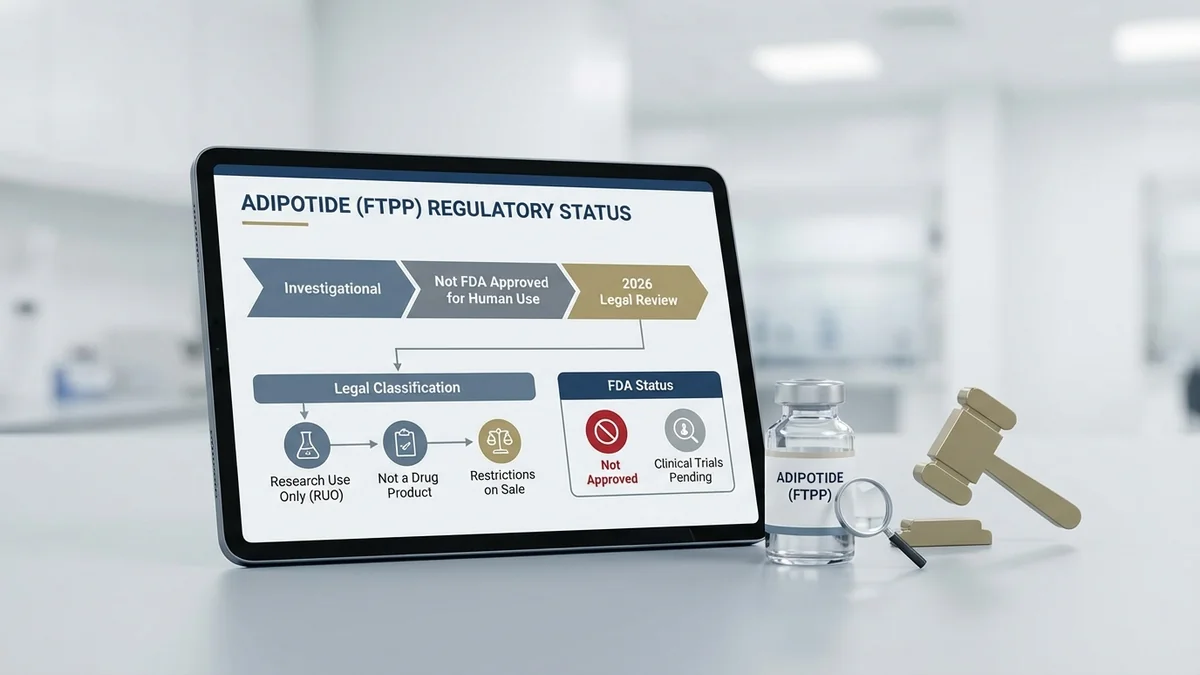
- **KPV (Ac-KPV-NH2) is not FDA-approved** for any indication. Its current regulatory classification in the United States is "research only," meaning it has no legal pathway for clinical prescribing under standard practice.
- **Compounding pharmacies cannot legally dispense KPV** for patient use under current FDA compounding regulations, because it lacks the approvals required to be placed on the bulk drug substances list for 503A or 503B compounding.
- **"Research use only" is not a loophole.** Purchasing or administering KPV under that label for human therapeutic use violates FDA regulations, regardless of how the product is marketed.
- **KPV is not a DEA-scheduled controlled substance**, but that doesn't make it freely legal — unapproved drugs have their own regulatory constraints entirely separate from the Controlled Substances Act.
- **International purchasing carries real legal risk.** Importing unapproved drug substances into the US for personal use is subject to FDA enforcement, and packages can be seized at customs.
- **If you're looking for a clinically supervised anti-inflammatory or gut-integrity peptide protocol, your provider needs to work within legal frameworks.** Ask specifically whether the compound they're recommending has an established compounding pathway or FDA approval. KPV currently has neither.

---

## Regulatory Status at a Glance

| Category | Status | Detail |
|---|---|---|
| **FDA Approval** | ❌ Not Approved | No approved indication, NDA, or BLA for any use |
| **Compounding Category (503A/503B)** | ❌ Not Listed | Not on FDA's bulk drug substances list for compounding |
| **DEA Scheduling** | ✅ Not Scheduled | Not a controlled substance under the Controlled Substances Act |
| **Prescription Availability** | ❌ Not Available by Rx | No legal prescribing pathway exists under current FDA rules |
| **Research Use (Institutional)** | ✅ Permitted with oversight | Lawful for in-vitro, animal, or IRB-approved human studies |
| **Over-the-Counter Sale** | ❌ Illegal for human use | Cannot be sold as a supplement or OTC drug product |
| **International Status** | ⚠️ Varies | Generally unapproved; research-grade access only in most jurisdictions |

---

## Current FDA Status

Let's be direct: KPV (Ac-KPV-NH2) is **not FDA-approved for any indication**.<sup>[1]</sup> There's no NDA number to cite, no BLA, no approved brand name. The FDA classifies it as research-only, which puts it in a distinct regulatory category from both approved drugs and even many other unapproved peptides that have at least made it into the compounding framework.

KPV is a synthetic tripeptide — lysine-proline-valine — derived from the C-terminal sequence of alpha-melanocyte-stimulating hormone (α-MSH).<sup>[2]</sup> It's a three-amino-acid fragment with a molecular weight of approximately 340 Da in its acetylated, amidated form (Ac-KPV-NH2). Researchers have studied it primarily for its ability to modulate inflammatory signaling through melanocortin receptor activation and NF-κB pathway inhibition.<sup>[3]</sup> That's genuinely interesting science. But interesting science and FDA approval are two very different things, and right now KPV has only the former.

The FDA's drug approval process requires clinical trial data — Phase I, II, and III — demonstrating safety and efficacy in humans for a defined indication. KPV has not completed that pathway. The existing evidence base is preclinical: cell culture studies and animal models, primarily in rodents, examining inflammatory bowel models and epithelial barrier function.<sup>[3]</sup> There are no completed Phase III trials, no IND (Investigational New Drug) application publicly listed for KPV in the FDA's database, and no pending NDA.

What this means practically: a physician who administers or prescribes KPV to a patient is not prescribing an approved drug. They're not even prescribing an off-label drug in the traditional sense (more on that distinction below). They're recommending an unapproved drug substance with no established legal clinical pathway — and that carries meaningful liability.

---

## Compounding Status

Compounding is where a lot of peptide legality questions get complicated, and KPV is a good example of why the rules matter.

Under the Drug Quality and Security Act (DQSA) of 2013, compounding pharmacies operate under two frameworks: 503A (traditional compounding pharmacies filling individual patient prescriptions) and 503B (outsourcing facilities producing larger batches).<sup>[4]</sup> Both frameworks require that any bulk drug substance used in compounding either be: (a) a component of an FDA-approved drug, (b) on the FDA's official bulk drug substances list (the "503A list" or "503B list"), or (c) subject to an active clinical investigation under an IND.

KPV (Ac-KPV-NH2) is **not on the FDA's 503A or 503B bulk drug substances list**.<sup>[1]</sup> It has not been nominated and evaluated for inclusion in a way that resulted in listing. That means a licensed 503A compounding pharmacy cannot legally compound KPV for patient use, and a 503B outsourcing facility cannot manufacture it for clinical distribution.

This is a harder wall than many patients realize. Even if a compounding pharmacy wanted to make KPV — and some have marketed peptides in grey areas — doing so without the substance being on the approved bulk drug list puts the pharmacy out of compliance with federal compounding regulations. The FDA has increased scrutiny of compounding pharmacies dispensing unapproved peptide substances, and the consequences for pharmacies can include warning letters, injunctions, and loss of licensure.

If you've been told by a clinic that they can get you compounded KPV through a "special pharmacy," that claim deserves close scrutiny. Ask for the specific FDA regulatory basis. If they can't point to a bulk drug substance listing or an active IND, the compound is not being dispensed through a legally compliant compounding pathway.

For context on how compounding frameworks apply to other peptides, see our guides on [BPC-157 legality](/peptides/bpc-157), [TB-500 legal status](/peptides/tb-500), and [PT-141 (Bremelanotide) prescribing](/peptides/pt-141).

---

## Enforcement Actions

The FDA has taken enforcement action against companies marketing unapproved peptide products, including compounds with research-only classifications similar to KPV. Patients and providers should consult [FDA.gov](https://www.fda.gov) and the FDA's MedWatch program for current enforcement activity related to KPV (Ac-KPV-NH2).<sup>[1]</sup>

In general terms, FDA enforcement against unapproved peptide products has followed a consistent pattern:

- **Warning letters** issued to online retailers and "research chemical" vendors selling unapproved peptides with implied therapeutic claims, even when labeled "not for human use."
- **Import alerts** that allow FDA field agents to detain shipments of unapproved drug substances at US ports of entry without physical examination.
- **Injunctions and consent decrees** against compounding pharmacies found to be producing unapproved bulk substances outside the legal compounding framework.
- **FTC coordination** on deceptive marketing claims, particularly where vendors make health or disease treatment claims for research-only compounds.

The FDA's enforcement posture on unapproved peptides has intensified since 2023, with the agency specifically targeting the grey market ecosystem around injectable research peptides. The fact that KPV hasn't generated the same volume of public enforcement activity as higher-profile peptides like BPC-157 or semaglutide analogues doesn't mean it's in a safe zone — it likely reflects its smaller market footprint rather than any regulatory tolerance.

---

## Prescription vs. Over-the-Counter vs. Research Use

### Prescription

There is no legal prescription pathway for KPV (Ac-KPV-NH2) in the United States under current FDA regulations.<sup>[1]</sup> A physician cannot write a valid prescription for an unapproved drug substance that has no compounding pathway and no approved formulation. If a clinic offers to prescribe you KPV, they're either misinformed about the regulatory framework or operating outside it.

### Over-the-Counter

KPV cannot be sold as an OTC drug product. It's not a dietary supplement ingredient with GRAS (Generally Recognized as Safe) status, and it has no OTC drug monograph. Selling it as a supplement or OTC therapeutic for any human use would violate FDA regulations on unapproved new drugs.<sup>[1]</sup>

### Research Use Only

This is the label you'll see most often on KPV products sold online. "Research use only" (RUO) is a real regulatory category — but it's specifically for products used in laboratory research, animal studies, or institutional research settings with appropriate oversight. It is **not** a consumer-facing category, and it's not a legal workaround for human use.

Purchasing a vial of KPV labeled "research use only" and injecting it yourself — or having a provider administer it — doesn't change its legal status. The FDA looks at actual intended use, not labeling. A company selling "research peptides" while knowing (or having reason to know) that customers intend human use is potentially liable for distributing an unapproved new drug. And the buyer isn't in a legally clean position either.

### International Purchasing

Ordering KPV from overseas vendors and importing it into the US is subject to FDA import authority. The FDA can detain personal importation shipments under its import alert system, and customs enforcement has become more active around injectable research peptides specifically. Even if a foreign vendor ships legally in their home country, that doesn't create a legal import pathway into the US. Packages can be seized, and repeated attempts to import unapproved drug substances can attract regulatory attention.

For more on how import rules apply to peptides broadly, see our [peptide import and customs guide](/resources/peptide-import-guide).

---

## What "Off-Label" Actually Means

This distinction matters, and it's one that gets blurred constantly in the peptide space.

"Off-label prescribing" refers to a physician prescribing an **FDA-approved drug** for an indication, patient population, or dosage not listed in its approved labeling. It's legal, common, and well-established — roughly 20% of all prescriptions in the US are written off-label.<sup>[5]</sup> When a doctor prescribes gabapentin for pain or metformin for PCOS, those are off-label uses of approved drugs.

KPV (Ac-KPV-NH2) has **never been approved for any indication**. That means there is no "off-label" use of KPV. Prescribing it wouldn't be off-label prescribing — it would be prescribing an unapproved new drug, which is a fundamentally different regulatory and legal situation.

This distinction has real consequences for providers. Off-label prescribing of an approved drug carries relatively modest liability risk when there's a reasonable evidence base. Prescribing an unapproved drug substance with only preclinical evidence, no established safety profile in humans, and no FDA-recognized clinical pathway is a different liability calculation entirely. Medical boards in several states have issued guidance specifically flagging this distinction in the context of peptide therapy.

Providers who are genuinely interested in KPV's mechanisms — particularly its effects on melanocortin receptors and NF-κB signaling — should be directing patients toward [clinical trials](/resources/peptide-clinical-trials) or IRB-approved research protocols, not clinical administration outside any regulatory framework.

---

## State-Level Variations

Federal law sets the floor here, but state-level regulation adds additional layers that vary meaningfully.

**State pharmacy boards** have independent authority to regulate compounding pharmacies and can impose stricter standards than federal minimums. Several state boards — including those in Florida, California, and Texas — have issued guidance or taken enforcement action specifically addressing compounding pharmacies that dispense unapproved peptide substances. A pharmacy operating in one of these states faces compounded risk: federal non-compliance plus state board action.

**Medical licensing boards** in multiple states have opened investigations into physicians prescribing unapproved peptide substances without adequate clinical justification. While KPV's lower profile means it hasn't generated the same state-level scrutiny as semaglutide analogues or BPC-157, the regulatory framework that applies to those peptides applies equally to KPV.

**Telemedicine prescribing** adds another layer. Several states have tightened telemedicine prescribing rules post-pandemic, requiring an in-person examination before prescribing certain drug categories. Since KPV has no legal prescribing pathway at the federal level, state telemedicine rules are somewhat moot — but they matter for adjacent peptides that do have compounding pathways.

If you're working with a telehealth clinic that's offering KPV as part of a protocol, the state in which both you and the provider are located affects which regulatory bodies have jurisdiction. See our [state-by-state peptide prescribing guide](/resources/state-peptide-regulations) for details on your specific state.

---

## International Status

KPV (Ac-KPV-NH2) does not have regulatory approval in any major jurisdiction, to the best of current available information as of March 2026. Here's a brief jurisdiction-by-jurisdiction breakdown:

**European Union / EMA:** KPV has no EMA marketing authorization. It's not listed in the EMA's European Public Assessment Reports (EPARs). Research-grade use within institutional settings is permissible under member-state research regulations, but clinical use would require marketing authorization that doesn't exist.

**United Kingdom / MHRA:** The MHRA has not approved KPV for any indication. Post-Brexit, the UK operates its own approval pathway, and KPV has not entered it. The MHRA has issued general guidance on unapproved medicines and specials manufacturing that would apply to any attempt to compound or supply KPV.

**Australia / TGA:** The Therapeutic Goods Administration has not approved KPV. Australia's compounding framework (under the Therapeutic Goods Act) requires that compounded preparations use approved active ingredients or those specifically permitted under the TGA's compounding provisions — KPV meets neither criterion.

**Canada / Health Canada:** Health Canada has not approved KPV. Canada's Special Access Program (SAP) theoretically allows access to unapproved drugs in specific circumstances, but SAP access requires a serious or life-threatening condition and no reasonable alternative — criteria that would be difficult to satisfy for KPV given the absence of clinical trial data.

The consistent theme across jurisdictions: KPV is a research compound with no approved clinical pathway anywhere in the world, as of the date of this article.

---

## What This Means for Patients

If you've been reading about KPV's potential effects on gut inflammation, epithelial barrier function, or immune modulation and you're wondering whether you can access it clinically — here's the honest answer: **not through a legal channel in the US right now.**

That doesn't mean the science isn't interesting. The preclinical data on KPV's effects via melanocortin receptor activation and NF-κB pathway modulation is genuinely compelling.<sup>[3]</sup> But compelling preclinical data and a legal clinical pathway are different things, and conflating them is how patients end up with unverified compounds from grey-market vendors.

**How to verify a clinic is operating legally:**
- Ask specifically which peptides they're prescribing and whether each one has an FDA-approved compounding pathway (i.e., is it on the 503A or 503B bulk drug substances list).
- Request the name of the compounding pharmacy they use and verify it's registered with the FDA as a 503B outsourcing facility if they're doing bulk dispensing.
- Check the FDA's database of registered outsourcing facilities at [FDA.gov](https://www.fda.gov/drugs/human-drug-compounding/registered-outsourcing-facilities).

**Red flags that suggest illegal activity:**
- A clinic offering KPV as a standard protocol without acknowledging its research-only status.
- "Compounded KPV" without being able to name the specific FDA regulatory basis.
- Vials labeled "research use only" being administered in a clinical setting.
- Overseas sourcing presented as equivalent to domestic compounding.

**If you're offered KPV:** Ask your provider to walk you through the regulatory basis for prescribing it. A provider operating in good faith should be able to explain clearly why they believe they're within legal bounds — or should acknowledge the regulatory ambiguity honestly.

**To report suspicious sellers:** The FDA's MedWatch program (1-800-FDA-1088) and the FDA's online Safety Reporting Portal accept reports of suspect medical products, including unapproved drug substances being marketed for human use.

---

## Legal Alternatives

If you're interested in KPV because of its potential anti-inflammatory or gut-integrity applications, there are peptides and compounds with clearer legal pathways worth discussing with a qualified provider.

**For gut integrity and mucosal support:**
- [BPC-157](/peptides/bpc-157) has a more established (though still evolving) compounding history and has been the subject of more extensive preclinical and early clinical investigation. Its compounding status has been contested by the FDA, so verify current status with your provider.
- [Larazotide acetate](/peptides/larazotide-acetate) has completed Phase II clinical trials for celiac disease and tight junction modulation, giving it a more developed clinical evidence base than KPV.<sup>[6]</sup>

**For inflammatory modulation:**
- [Thymosin alpha-1 (Thymalfasin)](/peptides/thymosin-alpha-1) is approved in multiple countries (though not the US) for immune modulation and has a more substantial human clinical trial record.
- [Low-dose naltrexone (LDN)](/resources/low-dose-naltrexone) is an FDA-approved drug used off-label for inflammatory and autoimmune conditions, giving it a legitimate off-label prescribing pathway that KPV lacks.

**FDA-approved options:** For inflammatory bowel conditions specifically, there are multiple FDA-approved biologics and small molecules. A gastroenterologist can walk you through approved options that have completed the full regulatory pathway.

Use our [peptide finder](/find-a-peptide) to explore compounds by condition area, evidence level, and current legal status.

---

## What the Evidence Does Not Show

### Regulatory Uncertainty

The FDA's approach to research-only peptides is not static. Several peptides that were in regulatory limbo have moved — in both directions — as the FDA has updated its bulk drug substances lists and issued new guidance on compounding. KPV could theoretically be nominated for evaluation under the 503A or 503B framework, but as of March 2026, no such nomination has resulted in a listing.

### Pending Clinical Data

There are no publicly registered Phase II or Phase III clinical trials for KPV (Ac-KPV-NH2) in the ClinicalTrials.gov database as of this writing. Without clinical trial data, the regulatory pathway to approval remains distant. The preclinical evidence — primarily rodent models of colitis and in-vitro studies of NF-κB inhibition — does not establish human safety or efficacy.<sup>[3]</sup>

### What "Research Only" May or May Not Become

Research-only status isn't permanent by definition, but it requires active clinical development to change. Without a sponsor investing in IND-enabling studies and clinical trials, KPV's regulatory status is unlikely to shift on any near-term horizon. Patients waiting for a legal clinical pathway for KPV specifically should have realistic expectations about that timeline.

### The Grey Market's Durability

The availability of KPV through grey-market vendors doesn't reflect regulatory tolerance — it reflects enforcement resource allocation. The FDA prioritizes enforcement based on risk profile, market size, and available resources. KPV's current low enforcement profile could change if market activity increases or adverse events are reported.

---

## FAQ

### Is KPV (Ac-KPV-NH2) legal in the US?

KPV is legal to possess for legitimate research purposes within an institutional or laboratory setting. It is **not legal** to sell, prescribe, or administer as a therapeutic agent for human use. There's no FDA-approved indication, no compounding pathway, and no OTC category that makes it available for clinical use. If someone is selling it to you for human therapeutic use, they're operating outside FDA regulations.

### Can my doctor prescribe KPV (Ac-KPV-NH2)?

No — not through any currently legal pathway. KPV isn't FDA-approved, isn't on the compounding bulk drug substances list, and doesn't have an active IND that would allow physician-supervised investigational use outside a clinical trial. A physician prescribing KPV would be doing so without a recognized legal basis, which creates regulatory and malpractice exposure for them and means you'd be receiving an unverified compound with no regulatory oversight of its manufacturing quality.

### Is it legal to buy KPV (Ac-KPV-NH2) online?

Purchasing KPV labeled "research use only" from a domestic vendor occupies a grey area — the vendor may be technically selling it for laboratory research, but if you're buying it for personal therapeutic use, the intended use matters legally. Buying from overseas vendors and importing it into the US creates additional exposure under FDA import authority. The practical risk of buying a single vial for personal use is generally low in terms of criminal prosecution, but the compound you receive has no quality verification, and the regulatory risk to vendors is real.

### What happens if I'm caught with KPV (Ac-KPV-NH2)?

Individual possession of small quantities of an unapproved drug substance (as opposed to a scheduled controlled substance) is rarely the target of criminal prosecution. The FDA's enforcement focus is on manufacturers, distributors, and marketers of unapproved drugs — not individual consumers. That said, "low enforcement priority" is not the same as "legal," and importing quantities that suggest distribution rather than personal use could attract different scrutiny.

### Is KPV (Ac-KPV-NH2) a controlled substance?

No. KPV is not scheduled under the Controlled Substances Act and is not regulated by the DEA. Its legal constraints come from FDA drug approval and compounding regulations, not from scheduling. This is a meaningful distinction — the penalties and enforcement mechanisms for unapproved drugs differ from those for controlled substances.

### Can compounding pharmacies make KPV (Ac-KPV-NH2)?

Not legally under current FDA rules. KPV is not on the FDA's 503A or 503B bulk drug substances lists, which means licensed compounding pharmacies cannot use it as a bulk ingredient for patient preparations. A pharmacy compounding KPV would be out of compliance with federal compounding regulations.

### Is "research use only" KPV (Ac-KPV-NH2) legal?

"Research use only" labeling is legitimate for products used in institutional research — cell culture work, animal studies, or IRB-approved human trials. It is **not** a legal category for consumer purchase and self-administration. A vendor selling "RUO" KPV while knowing customers intend to use it therapeutically is potentially distributing an unapproved new drug. The label doesn't change the FDA's analysis of intended use.

### Has anyone been prosecuted for KPV (Ac-KPV-NH2)?

There are no publicly confirmed criminal prosecutions specifically for KPV (Ac-KPV-NH2) as of March 2026. The FDA has taken enforcement action against companies marketing unapproved peptide products broadly — consult [FDA.gov](https://www.fda.gov) for current enforcement activity. The absence of a publicized prosecution for KPV specifically doesn't indicate regulatory tolerance; it more likely reflects the compound's smaller market footprint compared to higher-profile peptides.

### Could KPV (Ac-KPV-NH2) become legally available in the future?

Potentially, but it would require active clinical development. The pathway would involve an IND application, completion of Phase I/II/III trials demonstrating safety and efficacy for a specific indication, and FDA review. Alternatively, a successful nomination to the bulk drug substances list could create a compounding pathway without full approval — but that process also requires safety and clinical data. Neither pathway is imminent as of current available information.

---

## References

1. U.S. Food & Drug Administration. "Bulk Drug Substances Used in Compounding Under Section 503A of the Federal Food, Drug, and Cosmetic Act." FDA.gov. Accessed March 2026. https://www.fda.gov/drugs/human-drug-compounding/bulk-drug-substances-used-compounding-under-section-503a-federal-food-drug-and-cosmetic-act

2. Catania A, et al. "Alpha-melanocyte-stimulating hormone in the control of inflammation." *Journal of Leukocyte Biology*. 1999;65(3):291-296. PMID: 10080529

3. Dalmasso G, et al. "The Peptide KPV Inhibits NF-κB Activation and Inflammatory Response in Intestinal Epithelial Cells." *Inflammatory Bowel Diseases*. 2010;16(9):1516-1525. PMID: 20848512

4. U.S. Congress. Drug Quality and Security Act (DQSA), Pub. L. No. 113-54, 127 Stat. 587 (2013). https://www.congress.gov/bill/113th-congress/house-bill/3204

5. Radley DC, Finkelstein SN, Stafford RS. "Off-label prescribing among office-based physicians." *Archives of Internal Medicine*. 2006;166(9):1021-1026. PMID: 16682577

6. Kelly CP, et al. "Larazotide acetate in patients with coeliac disease undergoing a gluten challenge: a randomised placebo-controlled study." *Alimentary Pharmacology & Therapeutics*. 2013;37(2):252-262. PMID: 23163616

---

*Legal status last verified: March 2026. Regulatory classifications can change. Consult [FDA.gov](https://www.fda.gov) and a licensed healthcare provider for the most current information before making any clinical decisions.*

---

**Medical Disclaimer:** This content is for informational purposes only and does not constitute medical advice, legal advice, or a clinical recommendation. KPV (Ac-KPV-NH2) is not FDA-approved for any indication. Do not use this article as the basis for starting, stopping, or modifying any treatment. Consult a licensed healthcare provider who is knowledgeable about peptide therapy regulations before pursuing any peptide protocol. If you have questions about the legal status of a specific compound, consult both a licensed physician and, where relevant, a healthcare attorney familiar with FDA compounding regulations.