
Is Syn-Coll (Palmitoyl Tripeptide-5) Legal? FDA Status and Regulations Explained (2026)
Key Takeaways
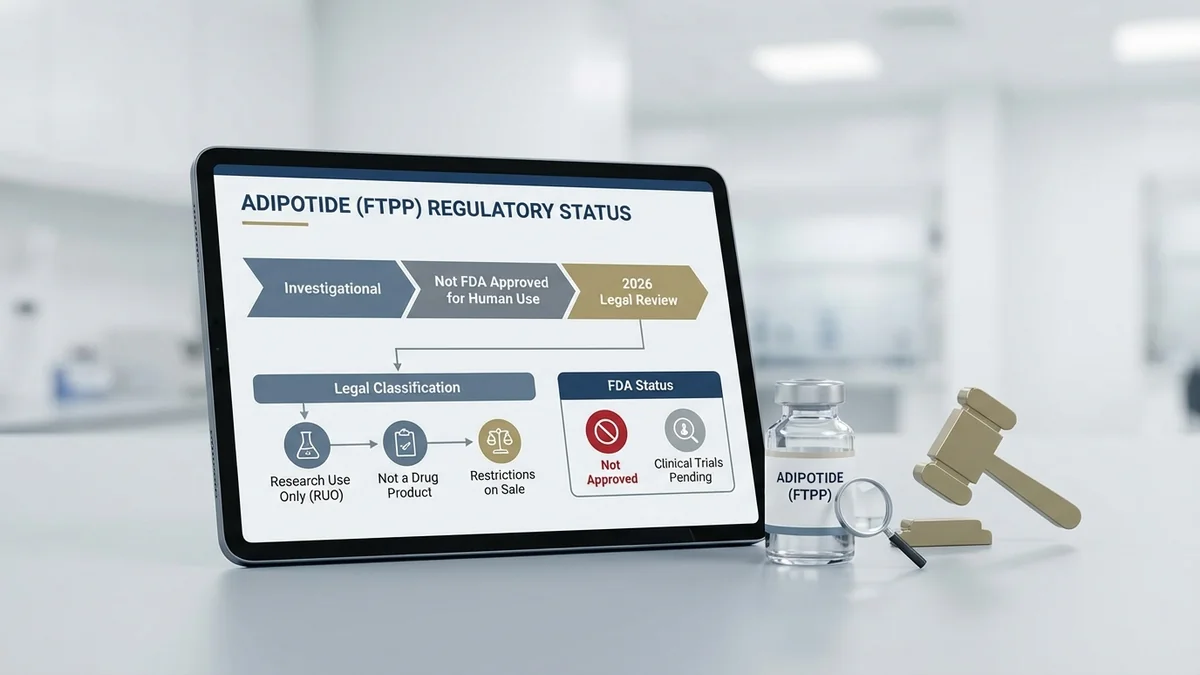
- Syn-Coll (Palmitoyl Tripeptide-5) is not FDA-approved for any clinical indication. Its legal status in the US is "research use only."
- Because it carries no FDA approval, a physician cannot legally prescribe it in the way they prescribe an FDA-approved or compounded drug — prescribing it is not "off-label use," it's prescribing an unapproved drug substance.
- Syn-Coll is primarily sold as a cosmetic ingredient and research reagent. Consumer-facing products containing it as a cosmetic ingredient occupy a different regulatory lane than injectable peptide drugs — but that lane has its own rules and limits.
- Buying Syn-Coll online from gray market or overseas sources carries real legal and safety risks: no quality control, no verified purity, and potential customs seizure.
- The FDA has broad authority to take enforcement action against companies marketing unapproved drug products, including peptides. If you're considering Syn-Coll, understanding exactly which regulatory category your intended use falls into is non-negotiable.
- The clinical evidence base for Syn-Coll in humans is thin — preclinical and in vitro data exist, but no Phase II or Phase III human trials have been completed as of March 2026.
Regulatory Status at a Glance
| Category | Status | Detail |
|---|---|---|
| FDA Approval | ❌ Not Approved | No NDA, BLA, or approved indication for any route of administration |
| FDA Compounding (503A/503B) | ❌ Not Listed | Not on the FDA's bulk drug substances list for compounding |
| DEA Scheduling | ✅ Not Scheduled | Not a controlled substance under the Controlled Substances Act |
| Prescription Requirement | N/A | No legal prescription pathway exists for clinical use in the US |
| Cosmetic Ingredient Use | ✅ Permitted (with limits) | Can be used in topical cosmetic formulations under FDA cosmetics regulations |
| Research Use | ✅ Permitted | Legal for in vitro and laboratory research by qualified researchers |
| International (EU) | ⚠️ Cosmetic Ingredient | Listed for use in cosmetics; not approved as a drug by the EMA |
| International (UK/AU/CA) | ⚠️ Varies | Regulated as cosmetic ingredient; no drug approval in any major market |
Current FDA Status
Let's be direct: Syn-Coll (Palmitoyl Tripeptide-5) has no FDA approval for any clinical indication, in any dosage form, for any route of administration.[1] There is no New Drug Application (NDA), no Biologics License Application (BLA), and no Investigational New Drug (IND) application in the public record that would indicate an active clinical development pathway toward approval.
The FDA's own classification system is relevant here. When the FDA evaluates whether a substance can be used clinically — especially by compounding pharmacies — it places bulk drug substances into one of three categories under its 503A and 503B compounding frameworks. Category 1 substances have been nominated and are under review for potential compounding use. Category 2 substances have been evaluated and the FDA has determined they should not be compounded. Category 3 substances are nominated but not yet reviewed. Syn-Coll (Palmitoyl Tripeptide-5) does not appear on any of these lists as of March 2026, which means it hasn't entered the formal FDA bulk drug substance evaluation process at all.[2]
What does "research use only" actually mean from the FDA's perspective? It means the substance can be manufactured, sold, and used in the context of legitimate laboratory and in vitro research — not for human administration outside of an IND-approved clinical trial framework. The "research use only" designation is not a backdoor to clinical use. It's a statement of regulatory scope.
Syn-Coll is a synthetic lipopeptide — specifically, palmitoyl tripeptide-5, a palmitoylated sequence of three amino acids designed to mimic a portion of thrombospondin-1 and influence transforming growth factor-beta (TGF-β) signaling pathways.[3] Its mechanism involves stimulating fibroblast activity through Smad-dependent downstream signaling to upregulate collagen synthesis. That's a biologically meaningful mechanism. But biological plausibility and FDA approval are two entirely different things, and right now, only the former exists for Syn-Coll.
Compounding Status
Compounding pharmacies — both 503A (patient-specific) and 503B (outsourcing facilities) — operate under FDA oversight and may only compound drug products using bulk drug substances that appear on the FDA's approved lists, are components of FDA-approved drugs, or are the subject of an active IND.[2]
Syn-Coll (Palmitoyl Tripeptide-5) does not meet any of these criteria. It's not on the 503A or 503B bulk drug substance lists. It's not a component of any FDA-approved drug product. And there's no publicly available IND covering it.
What this means practically: no licensed US compounding pharmacy can legally compound Syn-Coll for patient use, regardless of whether the intended route is topical, injectable, or anything else. A pharmacy that offers compounded Syn-Coll as a drug product — with a dosing regimen and clinical indication — is operating outside FDA regulations.
The one important nuance here is the distinction between a drug and a cosmetic. Under the Federal Food, Drug, and Cosmetic Act (FD&C Act), a product is classified as a drug if it's intended to affect the structure or function of the body or to treat, mitigate, or prevent a condition.[4] A cosmetic is intended to cleanse, beautify, or alter appearance without affecting body structure or function. Palmitoyl Tripeptide-5 is widely used as a cosmetic ingredient — you'll find it in anti-aging serums and moisturizers from dozens of brands — and in that context, it's regulated under cosmetics rules, not drug rules.
But the moment a product is marketed with claims like "stimulates collagen synthesis," "reduces wrinkles by remodeling dermal matrix," or any language suggesting a physiological effect, it crosses into drug territory under FDA's interpretation.[4] Cosmetic companies using Palmitoyl Tripeptide-5 walk this line carefully. Companies that step over it are exposed to FDA enforcement.
Enforcement Actions
The FDA has broad authority under the FD&C Act to take enforcement action against companies that market unapproved drug products — including peptides — through warning letters, import alerts, seizures, and injunctions.[4] The agency has exercised this authority against peptide sellers across multiple product categories over the past several years.
No confirmed enforcement actions specifically naming Syn-Coll (Palmitoyl Tripeptide-5) are present in our verified source data as of March 2026. If the FDA has issued warning letters or taken enforcement action against companies marketing unapproved Syn-Coll products, those actions would be documented at FDA.gov. Consult the FDA's Warning Letters database and the FDA's MedWatch program for current enforcement activity related to this compound.
What's relevant for context: the FDA has consistently targeted peptide products that are marketed as cosmetics but make drug-like claims, as well as research peptide vendors that sell to consumers rather than qualified researchers. Both patterns apply to the broader market in which Syn-Coll products are sold. The FTC has also taken action against cosmetic companies making unsubstantiated anti-aging claims, which is a separate but overlapping enforcement risk for Syn-Coll product sellers.[5]
Prescription vs. Over-the-Counter vs. Research Use
Here's how the legal pathways actually break down for Syn-Coll:
Prescription: There is no legal prescription pathway for Syn-Coll in the US. A physician cannot write a valid prescription for an unapproved drug substance that isn't available through a licensed compounding pharmacy. Some providers may attempt to prescribe it anyway, but that doesn't make it legal — it creates liability for the provider and doesn't guarantee you'll receive a product that's been tested for purity, sterility, or accurate dosing.
Over-the-counter cosmetic: This is the legitimate consumer pathway. Topical products containing Palmitoyl Tripeptide-5 as a cosmetic ingredient — serums, creams, lotions — are legal to sell and purchase in the US, provided the product doesn't make drug claims and meets FDA cosmetics labeling requirements.[4] These products don't require a prescription and are widely available.
Research use: Syn-Coll is legal for in vitro and laboratory research by qualified researchers at academic institutions, pharmaceutical companies, and licensed research facilities. Vendors selling to this market are supposed to verify the buyer's research credentials and include "not for human use" labeling. Buying a "research use only" product and self-administering it is not a legal use of that product — the research-use designation doesn't create a consumer exemption.
Gray market and online purchasing: This is where things get murky and risky. Numerous online vendors sell Syn-Coll and similar peptides in formats that blur the line between cosmetic ingredients, research reagents, and injectable drug products. Purchasing from these sources means you have no assurance of product purity, no verified peptide concentration, no sterility testing, and no recourse if the product causes harm. Customs seizure of imports is also a real possibility, particularly for anything packaged in a way that suggests injectable use.
International purchasing: Syn-Coll is not approved as a drug in any major international market. Importing unapproved drug products into the US for personal use is technically illegal under FDA regulations, though enforcement against individual importers is inconsistent. The FDA's personal importation policy provides some discretion for individuals importing small quantities of unapproved drugs for serious conditions with no US alternative — but cosmetic peptides don't qualify for that discretion.[1]
What "Off-Label" Actually Means
This distinction matters, so let's be precise about it. Off-label prescribing is legal in the US and extremely common — physicians prescribe FDA-approved drugs for indications, dosages, or patient populations not listed on the approved label roughly 20% of the time in some specialties.[6] That's legitimate medical practice.
But off-label prescribing only applies to drugs that are already FDA-approved for at least one indication. Syn-Coll (Palmitoyl Tripeptide-5) has never been FDA-approved for anything. A physician who prescribes it isn't prescribing off-label — they're prescribing an unapproved drug substance, which is a different legal situation entirely.
Prescribing an unapproved drug outside of an IND-approved clinical trial framework exposes a physician to:
- Potential FDA regulatory action for introducing an unapproved new drug into interstate commerce
- State medical board discipline for practicing outside accepted standards of care
- Malpractice liability if a patient is harmed, since there's no FDA-approved labeling to establish a standard of care
For patients, receiving an unapproved drug means you have limited recourse through standard drug injury channels, since those frameworks assume the drug went through FDA review. That's not a reason to panic if you've used a Syn-Coll cosmetic product — topical cosmetics operate under different rules. But it's a real concern for anyone considering injectable or clinical-use formulations.
State-Level Variations
State-level regulation adds another layer to the picture. State pharmacy boards regulate compounding pharmacies within their jurisdictions, and some states have taken more aggressive positions on unapproved peptide compounding than others. California, New York, and Florida have all seen pharmacy board activity related to unapproved peptide products in recent years, though specific guidance varies by state.
State medical boards also set standards for what constitutes acceptable prescribing practice. A physician in any state who prescribes an unapproved drug substance outside of a clinical trial context risks board action if a complaint is filed, regardless of whether federal enforcement has occurred.
Telemedicine adds a further complication. Several online telehealth platforms have marketed peptide therapies to patients across state lines, sometimes for compounds with questionable legal status. If a telemedicine provider offers you Syn-Coll as a drug treatment, the legal exposure is theirs — but you should know that the product you receive won't have the regulatory backing that a legitimate prescription drug has.
For state-specific guidance on compounding regulations, the National Association of Boards of Pharmacy (NABP) maintains a database of state pharmacy board positions that's worth consulting if you're in a state with active regulatory activity.
International Status
Syn-Coll (Palmitoyl Tripeptide-5) is not approved as a drug product by any major international regulatory authority as of March 2026.
European Union (EMA): No EMA approval exists for Palmitoyl Tripeptide-5 as a drug. It appears in the EU's CosIng database as a cosmetic ingredient, where it's permitted for use in topical cosmetic products under EU Cosmetics Regulation No. 1223/2009.[7] The same drug-versus-cosmetic distinction applies in the EU — products making drug-like claims would require EMA authorization.
United Kingdom (MHRA): Post-Brexit, the UK regulates cosmetics under the UK Cosmetics Regulation (retained EU law). Palmitoyl Tripeptide-5 is permitted as a cosmetic ingredient. No MHRA drug approval exists.
Australia (TGA): The Therapeutic Goods Administration regulates peptides as either listed or registered therapeutic goods, depending on their intended use and evidence base. Syn-Coll is not listed in the Australian Register of Therapeutic Goods (ARTG) as of March 2026. Topical cosmetic use may be permissible under Australian cosmetics regulations, but clinical use would require TGA registration.
Canada (Health Canada): Health Canada has not approved Palmitoyl Tripeptide-5 as a drug product. It may be used in cosmetic formulations under the Cosmetic Regulations under the Food and Drugs Act, provided it meets safety requirements and no drug claims are made.
The consistent pattern internationally: Syn-Coll is tolerated as a cosmetic ingredient, prohibited as an unapproved drug, and not approved for any clinical indication anywhere in the world.