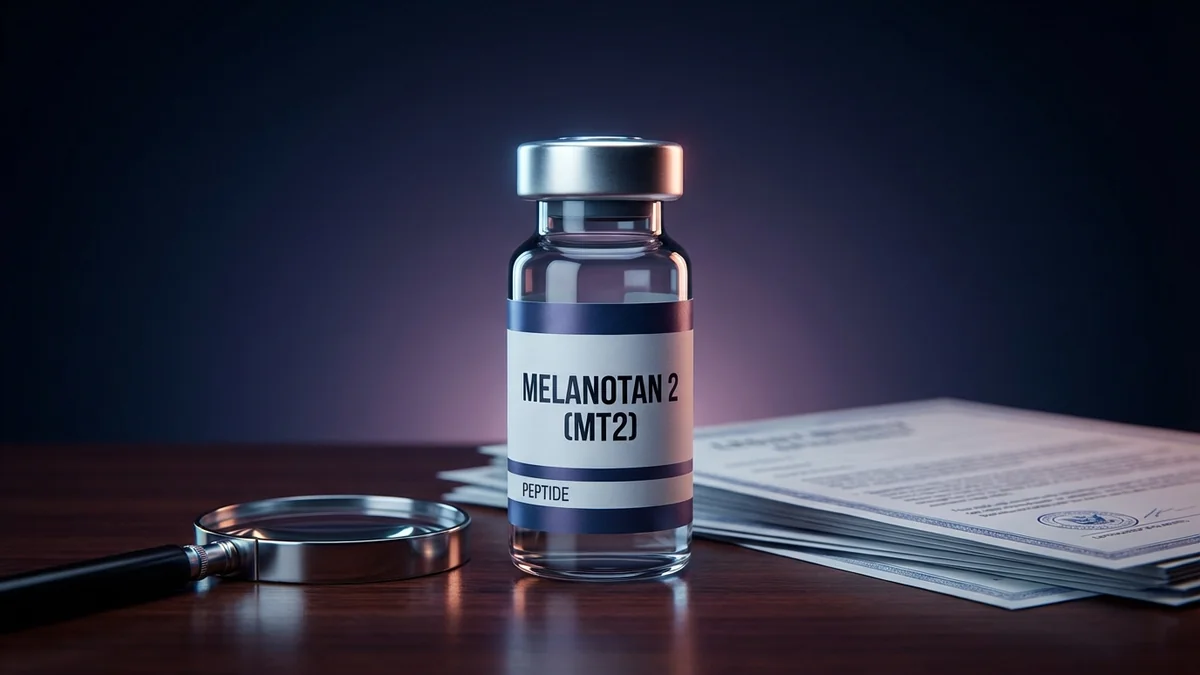
# Is Melanotan II Legal? FDA Status and Regulations Explained (2026)

If you're researching Melanotan II legality, you've probably already noticed that it's sold openly on dozens of websites labeled "for research use only," yet you can't get it from a pharmacy with a prescription. That contradiction is real, and it's not an accident. Melanotan II occupies a genuinely complicated legal space — one where the rules are clear on paper but widely ignored in practice, and where the gap between what's technically legal and what people are actually doing is enormous.

Here's the short version: Melanotan II has no FDA approval for any indication. It cannot be legally compounded by licensed US pharmacies for patient use. Buying it online from gray-market or overseas vendors puts you in legally murky territory. And any clinic or provider offering it as a prescription treatment is operating outside FDA-sanctioned boundaries. The rest of this article explains exactly why, what the enforcement picture looks like, and what your actual options are if you're interested in the outcomes Melanotan II is marketed for.

---

## Key Takeaways

- **Melanotan II is not FDA-approved** for any indication — not tanning, not sexual dysfunction, not appetite suppression. There is no NDA, BLA, or approved indication on record.
- **Compounding pharmacies cannot legally make it for patient use.** The FDA has classified it as a substance that may not be compounded under the 503A/503B framework due to safety and public health concerns.
- **"Research use only" is not a legal loophole.** Purchasing a substance labeled RUO for personal use or clinical administration doesn't change its regulatory status.
- **The FDA has taken enforcement action** against companies marketing unapproved Melanotan II products in the United States.
- **International status varies**, but the UK, EU, and Australia have all taken regulatory action to restrict or ban Melanotan II products.
- **Legal alternatives exist** for the conditions Melanotan II is marketed to treat — some FDA-approved, some available through legitimate compounding channels.

---

## Regulatory Status at a Glance

| Category | Status | Detail |
|---|---|---|
| **FDA Approval** | Not approved | No approved NDA, BLA, or indication for any use |
| **Compounding (503A/503B)** | Not permitted | Not on the FDA's bulk drug substances list for compounding; may not be compounded for patient use |
| **DEA Scheduling** | Not scheduled | Not a controlled substance under the CSA, but unapproved drug rules still apply |
| **Prescription Availability** | Not available | No legal pathway for US prescription; any Rx offering is extra-legal |
| **OTC / Research Use** | Gray market | Sold as "research chemical" but personal/clinical use remains legally problematic |
| **EU/EMA** | Not approved | Banned or restricted in multiple EU member states |
| **UK (MHRA)** | Restricted | Classified as a prescription-only medicine; unlicensed products are illegal |
| **Australia (TGA)** | Prohibited | Listed as a prohibited import; multiple enforcement actions |
| **Canada (Health Canada)** | Not approved | No DIN; sale and importation of unapproved drugs is prohibited |

---

## Current FDA Status

Melanotan II — also known by the CAS number 121062-08-6, with a molecular weight of approximately 1024.2 g/mol — is a cyclic heptapeptide analog of alpha-melanocyte-stimulating hormone (α-MSH).<sup>[1]</sup> It binds to melanocortin receptors MC1R, MC3R, MC4R, and MC5R, which is why it produces effects on skin pigmentation, sexual arousal, and appetite.<sup>[1]</sup>

Despite two decades of research interest, Melanotan II has never received FDA approval for any indication. There is no approved New Drug Application (NDA), no Biologics License Application (BLA), and no approved indication — not for erythropoietic protoporphyria, not for sexual dysfunction, not for tanning, and not for any other condition. This matters because it means the entire legal framework that governs how drugs are prescribed, dispensed, and marketed simply does not apply to Melanotan II in the way it would for an approved compound.

Under the Federal Food, Drug, and Cosmetic Act (FD&C Act), a drug that lacks FDA approval cannot be legally marketed or sold in interstate commerce for human use.<sup>[2]</sup> Melanotan II falls squarely into this category. The FDA classifies it as an unapproved new drug — not a supplement, not a cosmetic, not a research chemical that exists outside the regulatory framework. It's a drug, it's unapproved, and marketing it for human use violates federal law.

It's worth distinguishing Melanotan II from a related compound: [bremelanotide (PT-141)](/peptides/pt-141), which shares a similar melanocortin mechanism. Bremelanotide received FDA approval in June 2019 (NDA 210557) under the brand name Vyleesi for hypoactive sexual desire disorder (HSDD) in premenopausal women.<sup>[3]</sup> That approval does not extend to Melanotan II — they are structurally distinct compounds with different receptor binding profiles and different safety data packages.

---

## Compounding Status

This is where patients often get confused, because legitimate compounding is how many unapproved peptides like [BPC-157](/peptides/bpc-157), [TB-500](/peptides/tb-500), and [CJC-1295](/peptides/cjc-1295) are currently accessed through US clinics. The logic goes: if a licensed 503A or 503B pharmacy can compound a peptide, a physician can prescribe it. So can they do that with Melanotan II?

No. And here's why.

Under Section 503A of the FD&C Act, compounding pharmacies can prepare individualized drug preparations for specific patients — but only using bulk drug substances that appear on the FDA's approved list, or substances that are components of FDA-approved drugs, or substances that meet specific criteria established through the FDA's bulk drug substances evaluation process.<sup>[2]</sup> The FDA has not placed Melanotan II on any positive list permitting compounding. There is no pathway under 503A through which a licensed pharmacy can legally compound Melanotan II for patient use.

The 503B outsourcing facility framework is even more restrictive. These facilities can produce larger-scale compounded preparations, but only from substances on the FDA's 503B bulk drug substances list — and Melanotan II is not on it.<sup>[2]</sup>

The FDA's concerns about Melanotan II compounding aren't just procedural. The agency has raised substantive safety issues with melanocortin agonists lacking clinical approval, including risks of nausea, spontaneous erections, increased blood pressure, and — critically — the theoretical risk of stimulating melanocyte activity in a way that could affect existing nevi (moles) or interact with melanoma risk.<sup>[1]</sup> These are not minor concerns. The MC1R agonism that drives tanning is the same pathway implicated in melanocyte proliferation, and without an approved clinical trial program demonstrating long-term safety, the FDA has no basis to authorize compounding.

If you're currently getting Melanotan II from a compounding pharmacy in the US, that pharmacy is operating outside FDA-sanctioned bounds. That's a meaningful legal and safety distinction.

---

## Enforcement Actions

The FDA has taken enforcement action against companies marketing unapproved Melanotan II products in the United States. The agency's primary mechanisms include warning letters, import alerts, and seizure actions targeting vendors selling Melanotan II for human use — particularly those marketing it online as a tanning agent or sexual enhancer.<sup>[2]</sup>

Australia's Therapeutic Goods Administration (TGA) has been particularly aggressive. The TGA has issued multiple public warnings about Melanotan II products and has seized shipments at the border, citing serious adverse events including changes in existing moles, nausea, vomiting, and cardiovascular effects.<sup>[4]</sup> The UK's Medicines and Healthcare products Regulatory Agency (MHRA) has similarly taken action against vendors and classified unlicensed Melanotan II as an illegal medicine.<sup>[4]</sup>

In the US specifically: the FDA has issued import alerts covering unapproved melanocortin peptide products, and US Customs and Border Protection has authority to seize shipments of unapproved drugs entering the country. If you're ordering Melanotan II from an overseas vendor, your package can be detained and seized without any criminal charge against you — but repeat importation or commercial quantities can trigger more serious scrutiny.

The FTC has also taken interest in misleading health claims made by online sellers of Melanotan II, particularly those marketing nasal spray formulations as cosmetic tanning products while making implied drug claims.<sup>[2]</sup>

If you want current enforcement activity, consult FDA.gov's warning letters database and the FDA's import alert system directly. The regulatory picture can change quickly, and the most current enforcement data is always at FDA.gov.

---

## Prescription vs. Over-the-Counter vs. Research Use

Let's be direct about each of these categories.

**Prescription:** There is no legal prescription pathway for Melanotan II in the US. A physician cannot write a valid prescription for an unapproved drug that cannot be legally compounded. If a clinic is offering Melanotan II "by prescription," that prescription has no legal foundation under FDA regulations. The provider may be well-intentioned, but they're operating outside the regulatory framework — and that creates real liability for them and real risk for you.

**Over-the-counter:** Melanotan II is not available OTC. Nasal spray formulations are sometimes marketed as cosmetics, but the FDA has been clear that a product making tanning or sexual enhancement claims is a drug, regardless of how it's labeled or sold.

**Research use only (RUO):** This is the category most vendors use, and it deserves a clear explanation. "Research use only" is a legitimate designation — but only for in-vitro laboratory research or animal studies conducted by credentialed researchers in institutional settings, not for human administration. When a vendor sells you Melanotan II labeled RUO, they're technically selling a research chemical. The moment you inject it into yourself, you've used a research chemical as a drug — which means you've self-administered an unapproved new drug. The RUO label doesn't protect you, and it certainly doesn't protect a clinic that administers it to patients. It's not a loophole. It's a label that shifts legal liability toward the buyer while allowing the vendor to claim they're not selling a drug for human use.

**International purchasing:** Ordering Melanotan II from overseas vendors and importing it into the US is illegal under the FD&C Act, regardless of whether the substance is legal in the country of origin. US Customs and Border Protection can seize such shipments. Personal-use exemptions that apply to FDA-approved drugs do not extend to unapproved drugs.

---

## What "Off-Label" Actually Means

You'll sometimes hear Melanotan II described as something a doctor could prescribe "off-label." This reflects a misunderstanding of what off-label prescribing actually is, and it's worth correcting clearly.

Off-label prescribing is the practice of a physician prescribing an **FDA-approved drug** for an indication, patient population, or dosage not listed in its approved labeling. It's legal, common, and often evidence-based. Roughly 20% of all US prescriptions are written off-label.<sup>[2]</sup> Examples include [sermorelin](/peptides/sermorelin) prescribed for adult growth hormone deficiency in contexts beyond its narrow label, or low-dose naltrexone prescribed for autoimmune conditions.

Melanotan II cannot be prescribed off-label because it has never been approved for **any** label. Prescribing an unapproved drug is not off-label prescribing — it's prescribing an unapproved new drug, which is a different legal category with different consequences. A physician who prescribes Melanotan II to a patient is potentially exposing themselves to FDA regulatory action, state medical board discipline, and malpractice liability if an adverse event occurs. Medical malpractice insurers typically do not cover adverse events from unapproved drugs administered outside any recognized standard of care.

This distinction matters to you as a patient because it affects your recourse if something goes wrong. If you're harmed by an FDA-approved drug prescribed off-label, there are established legal pathways. If you're harmed by an unapproved drug administered by a provider operating outside the regulatory framework, your situation is considerably more complicated.

---

## State-Level Variations

Federal law sets the floor here, but state-level regulations add another layer of complexity.

State pharmacy boards regulate compounding within their jurisdictions, and some have issued specific guidance on peptide compounding. Several states — including California, Florida, and Texas — have active pharmacy board oversight programs that audit compounding facilities for compliance with both state and federal law. A compounding pharmacy operating in violation of FDA bulk drug substance rules is also likely violating state pharmacy board regulations, which can result in license suspension or revocation.

State medical boards regulate physician prescribing. A physician who prescribes Melanotan II to patients could face board investigation for practicing outside accepted standards of care, particularly if an adverse event is reported. The standard of care for tanning or sexual dysfunction does not include unapproved melanocortin peptide injections.

Telemedicine prescribing adds another dimension. Several states have enacted rules requiring an in-person examination before prescribing controlled or high-risk substances. While Melanotan II isn't a controlled substance, telemedicine platforms offering peptide prescriptions are under increasing scrutiny from state boards, and some have received cease-and-desist orders for prescribing practices involving unapproved compounds.

If you're working with a telehealth clinic that's offering Melanotan II, check whether that clinic is licensed in your state and whether the prescribing physician holds an active, unrestricted state medical license. You can verify this through your state's medical board website.

---

## International Status

The US isn't alone in restricting Melanotan II. Here's a quick overview of how other major regulatory bodies have addressed it:

**EU/EMA:** The European Medicines Agency has not approved Melanotan II for any indication. Individual EU member states have taken varying approaches, but several — including Germany, Denmark, and the Netherlands — have explicitly classified it as an unauthorized medicinal product, making its sale illegal without marketing authorization.<sup>[4]</sup>

**UK (MHRA):** The MHRA classifies Melanotan II as a prescription-only medicine (POM) under UK law. Because no licensed product exists, any Melanotan II product sold in the UK is by definition an unlicensed medicine, and selling it is illegal. The MHRA has issued public warnings and taken action against online vendors.<sup>[4]</sup>

**Australia (TGA):** Australia has been among the most aggressive regulators. The TGA has listed Melanotan II as a Schedule 4 prescription medicine while simultaneously placing it on the prohibited imports list, effectively banning its importation. The TGA has documented multiple adverse event reports associated with Melanotan II use in Australia, including melanoma diagnosis in users with pre-existing nevi.<sup>[4]</sup>

**Canada (Health Canada):** Melanotan II has no Drug Identification Number (DIN) in Canada. Under the Food and Drugs Act, selling or importing drugs without a DIN is prohibited. Health Canada has issued advisories warning consumers about Melanotan II products sold online.

The takeaway: there is no major regulatory jurisdiction where Melanotan II is a fully approved, legally available drug. Some countries have less enforcement than others, but "less enforcement" is not the same as "legal."

---

## What This Means for Patients

If you've been considering Melanotan II, here's how to think about this practically.

**How to verify a clinic is operating legally:** Ask any clinic offering peptide therapy to tell you specifically which peptides they prescribe, from which compounding pharmacy, and whether that pharmacy is 503A or 503B registered. You can verify 503B outsourcing facility registration at FDA.gov. If a clinic is offering Melanotan II as a prescription treatment, that's a red flag — not because the staff are necessarily bad actors, but because they're either uninformed about the regulatory framework or choosing to ignore it.

**Red flags for illegal activity:** Vendors selling Melanotan II in pre-loaded syringes, nasal sprays, or "tanning kits" with implied human use claims; clinics offering Melanotan II injections alongside legitimate peptide therapies without distinguishing their legal status; websites that claim Melanotan II is "FDA-approved" or "legal by prescription" — none of these are accurate.

**Questions to ask your provider:** "Is this compound FDA-approved, or is it available through a licensed compounding pharmacy?" and "Which compounding pharmacy do you use, and can I verify their 503A or 503B registration?" are both reasonable questions. A legitimate provider will answer both directly.

**How to report suspicious sellers:** The FDA's MedWatch program (1-800-FDA-1088 or fda.gov/safety/medwatch) accepts reports of adverse events and illegal marketing. You can also report suspected illegal drug sales to the FDA's Office of Criminal Investigations.

---

## Legal Alternatives

If you're interested in what Melanotan II is marketed to do, there are legal options worth knowing about.

**For sexual dysfunction:** [Bremelanotide (PT-141)](/peptides/pt-141) is FDA-approved (NDA 210557, brand name Vyleesi) for HSDD in premenopausal women and is available through licensed compounding pharmacies for off-label use in men.<sup>[3]</sup> It works through the same MC4R pathway as Melanotan II but has an established safety profile and a legal prescription pathway.

**For skin pigmentation conditions:** Afamelanotide (brand name Scenesse) received FDA approval in October 2019 for erythropoietic protoporphyria (EPP) — a rare condition where sun exposure causes severe pain.<sup>[3]</sup> It's a melanocortin agonist like Melanotan II, but with a narrow, specific indication and a full clinical trial safety package. It is not approved for cosmetic tanning.

**For appetite suppression:** Several FDA-approved and legally compoundable options exist. [Semaglutide](/peptides/semaglutide) (Ozempic, Wegovy) and [tirzepatide](/peptides/tirzepatide) (Mounjaro, Zepbound) are approved for weight management and have robust clinical data.<sup>[3]</sup>

**For general peptide therapy:** If you're exploring peptide-based treatments through a legitimate clinic, our [clinic finder](/clinics) can help you identify providers working within the FDA-sanctioned compounding framework with compounds like [ipamorelin](/peptides/ipamorelin), [CJC-1295](/peptides/cjc-1295), and [sermorelin](/peptides/sermorelin).

---

## What the Evidence Does Not Show

The legal picture around Melanotan II could change — though not quickly, and probably not in the direction most users hope.

**No IND application is currently active:** For Melanotan II to eventually gain FDA approval, a sponsor would need to file an Investigational New Drug (IND) application, complete Phase I, II, and III trials, and submit an NDA. No such program appears to be active in the US as of early 2026. ClinicalTrials.gov does not list any active or recruiting trials for Melanotan II in the US.

**The safety data gap is real:** The melanoma risk question — whether chronic MC1R stimulation in individuals with pre-existing nevi increases melanoma risk — has not been resolved by clinical trial data. Until it is, the FDA has no basis to approve Melanotan II, and that regulatory gap is unlikely to close without a funded clinical development program.

**Regulatory enforcement intensity may increase:** The FDA's increased scrutiny of the broader peptide compounding market, including its 2023-2024 actions placing several peptides on the Category 2 (do-not-compound) list, suggests a regulatory environment that is tightening rather than loosening for unapproved peptides.

**State-level action may accelerate:** Several states are actively reviewing their pharmacy board rules around peptide compounding. State-level restrictions could create additional barriers to accessing even legally compoundable peptides, and any such changes would further narrow the already-nonexistent legal pathway for Melanotan II.

---

## FAQ

### Is Melanotan II legal in the US?

Not for human use. Melanotan II is an unapproved new drug under the FD&C Act. It cannot be legally sold, marketed, or administered for human use in the United States. Possessing it for personal use exists in a gray zone — it's not a scheduled controlled substance, so simple possession is unlikely to result in criminal charges — but purchasing it, importing it, or administering it to others carries meaningful legal risk.

### Can my doctor prescribe Melanotan II?

No. There is no legal prescription pathway for Melanotan II in the US. A valid prescription requires either an FDA-approved drug or a legally compoundable substance. Melanotan II is neither. A physician who writes a prescription for it is operating outside the FDA regulatory framework, which creates liability for them and uncertainty for you.

### Is it legal to buy Melanotan II online?

Purchasing Melanotan II from US-based vendors means the vendor is likely violating the FD&C Act by selling an unapproved drug for human use. Purchasing from overseas vendors and importing it into the US is illegal under federal law, and shipments can be seized by US Customs and Border Protection.

### What happens if I'm caught with Melanotan II?

Because Melanotan II is not a DEA-scheduled controlled substance, simple personal possession is unlikely to result in criminal prosecution. However, commercial importation, distribution, or sale of unapproved drugs can result in federal charges under the FD&C Act. Clinics or providers administering it to patients face the highest legal exposure.

### Is Melanotan II a controlled substance?

No. As of March 2026, Melanotan II is not scheduled under the Controlled Substances Act and is not listed in DEA Schedules I through V. This does not make it legal — it means a different regulatory framework (the FD&C Act's unapproved drug provisions) governs it rather than DEA scheduling.

### Can compounding pharmacies make Melanotan II?

No. Melanotan II is not on the FDA's approved bulk drug substances list for 503A or 503B compounding. Licensed US compounding pharmacies cannot legally prepare Melanotan II for patient use. If a pharmacy is offering it, they are operating outside FDA-sanctioned compounding rules.

### Is "research use only" Melanotan II legal?

The RUO designation is legitimate for in-vitro laboratory or animal research conducted by credentialed researchers in institutional settings. Using RUO-labeled Melanotan II for personal injection or patient administration is not a legal use of that designation — it's self-administering an unapproved drug, regardless of the label on the vial.

### Has anyone been prosecuted for Melanotan II?

The FDA has taken enforcement action against companies marketing unapproved Melanotan II products, and US Customs has seized shipments at the border. For current and specific enforcement actions, consult FDA.gov and the FDA's warning letters database directly. Australia's TGA and the UK's MHRA have both taken documented enforcement actions against Melanotan II vendors in their jurisdictions.

### What's the difference between Melanotan II and PT-141?

[PT-141 (bremelanotide)](/peptides/pt-141) is a metabolite of Melanotan II with a modified structure that reduces some of the cardiovascular side effects. Critically, bremelanotide received FDA approval in 2019 (NDA 210557) for HSDD in premenopausal women — which means it has a legal prescription pathway that Melanotan II does not. If sexual dysfunction is your primary interest, PT-141 is the legally accessible option.

### Where can I find legitimate peptide therapy clinics?

Our [clinic finder](/clinics) lists verified providers working within the FDA-sanctioned compounding framework. Look for clinics that are transparent about which compounding pharmacies they use, can verify 503A or 503B registration, and don't offer compounds that lack a legal compounding pathway.

---

## References

1. Dorr RT, et al. "Evaluation of melanotan-II, a superpotent cyclic melanotropic peptide in a pilot phase-I clinical study." *Life Sciences*. 1996;58(20):1777-1784. PMID: 8637402

2. U.S. Food and Drug Administration. *Federal Food, Drug, and Cosmetic Act (FD&C Act)*. Sections 503A and 503B: Compounding of Drug Products. FDA.gov. Accessed March 2026. Available at: https://www.fda.gov/drugs/human-drug-compounding/compounding-laws-and-policies

3. U.S. Food and Drug Administration. *FDA Approves First Treatment for Hypoactive Sexual Desire Disorder in Premenopausal Women* (Vyleesi/bremelanotide, NDA 210557). FDA News Release. June 21, 2019. Available at: https://www.fda.gov/news-events/press-announcements/fda-approves-first-treatment-hypoactive-sexual-desire-disorder-premenopausal-women

4. Therapeutic Goods Administration (TGA), Australian Government. *Melanotan — consumer warning*. TGA.gov.au. Accessed March 2026. Available at: https://www.tga.gov.au/resources/consumer-information/melanotan

---

*Legal status verified as of March 2026. Regulatory classifications, enforcement activity, and compounding rules are subject to change. Consult FDA.gov, your state pharmacy board, and a licensed healthcare attorney for the most current guidance.*

*This content is for informational purposes only and does not constitute medical or legal advice. Consult a licensed healthcare provider before starting any treatment, and consult a qualified attorney for guidance on regulatory compliance.*