
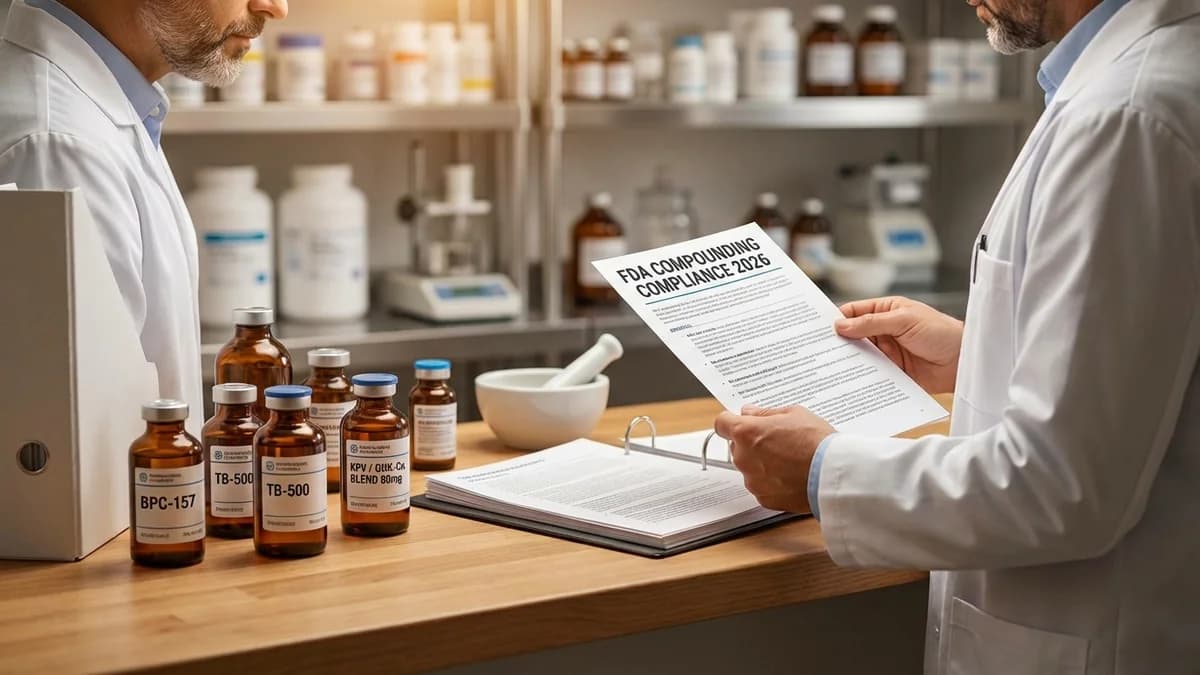
Is BPC-157, TB-500, KPV, GHK-Cu 80mg (Klow Blend) Legal? FDA Status and Regulations Explained (2026)
If you're researching the Klow Blend — a combination product containing BPC-157, TB-500, KPV, and GHK-Cu at a combined dose of 80mg — the most important thing to understand upfront is this: none of the four peptides in this blend are FDA-approved for any clinical indication. That single fact shapes every other legal question about BPC-157, TB-500, KPV, GHK-Cu 80mg (Klow Blend) legality in the United States.
That doesn't mean these peptides are illegal to possess in every context, or that no legitimate research is happening with them. But it does mean the legal pathway is narrow, the regulatory environment is actively shifting, and the gray market products sold online as "research chemicals" carry real legal risk — for sellers and, in some cases, for buyers.
This article breaks down exactly where each component stands with the FDA, what compounding pharmacies can and can't do, what enforcement looks like in practice, and what your options are if you're a patient or provider trying to operate within the law.
Key Takeaways
- None of the four peptides in the Klow Blend — BPC-157, TB-500 (Thymosin Beta-4 fragment), KPV, or GHK-Cu — hold FDA approval for any human indication as of March 2026.[1]
- The FDA classifies all four components as research-only substances, meaning their legal use in the US is restricted to properly supervised research settings under appropriate oversight.
- BPC-157 and TB-500 are explicitly listed on the FDA's Category 2 bulk drug substances list, meaning licensed compounding pharmacies (503A and 503B) are prohibited from compounding them for patient use.[2]
- The "research use only" label on peptide vendor websites is not a legal loophole — it's a regulatory disclaimer that doesn't shield buyers or sellers from FDA enforcement when products are marketed for human use.
- The FDA has taken enforcement action against companies marketing unapproved peptide products, including those containing BPC-157 and TB-500. Consult FDA.gov for current enforcement activity.
- If you're a patient seeking legal access to peptide therapy, your safest path is working with a licensed clinic that uses FDA-compliant compounded peptides — and verifying that the specific peptides prescribed are not on the Category 2 prohibited list. Use our peptide clinic finder to locate vetted providers.
Regulatory Status at a Glance
| Category | Status | Detail |
|---|---|---|
| FDA Approval | ❌ Not Approved | No approved NDA, BLA, or IND for any component as a finished drug product for humans |
| FDA Compounding Status — BPC-157 | 🚫 Category 2 (Prohibited) | FDA has determined BPC-157 presents sufficient safety concerns to prohibit compounding under 503A/503B |
| FDA Compounding Status — TB-500 | 🚫 Category 2 (Prohibited) | TB-500 (Thymosin Beta-4 fragment) prohibited from compounding under 503A/503B |
| FDA Compounding Status — KPV | ⚠️ Under Review / Uncertain | KPV (Lys-Pro-Val) regulatory compounding status requires verification with your pharmacy and prescriber |
| FDA Compounding Status — GHK-Cu | ⚠️ Under Review / Uncertain | GHK-Cu compounding status varies by formulation; topical use differs from injectable |
| DEA Scheduling | Not Scheduled | None of the four peptides are DEA-controlled substances as of March 2026 |
| Prescription Requirement | Not applicable (unapproved) | Cannot be legally prescribed for human use in the conventional sense |
| Research Use | Permitted with oversight | Use in legitimate research settings with appropriate institutional oversight |
| International Status | Varies significantly | Prohibited or unregulated in most major jurisdictions; see International Status section |
Current FDA Status
Let's be direct: the FDA has not approved BPC-157, TB-500, KPV, or GHK-Cu for any human indication. Not for wound healing, not for inflammation, not for gut repair, not for anything. The FDA's classification for all four components is research only.[1]
BPC-157
BPC-157 (Body Protection Compound-157) is a synthetic pentadecapeptide consisting of 15 amino acids, derived from a sequence found in human gastric juice protein.[3] It has a molecular weight of approximately 1,419.5 Da and a CAS number of 137525-51-0. Despite a substantial body of animal research — including studies on tendon healing, gastric ulcer repair, and neurological protection — no Phase III clinical trial has been completed, and no IND (Investigational New Drug) application has advanced to support an NDA filing as of March 2026.[1]
The FDA placed BPC-157 on its Category 2 bulk drug substances list, which means the agency has evaluated it and determined that compounding it presents safety concerns that outweigh the potential clinical benefit in the absence of approved status.[2] This is the most restrictive compounding category short of a controlled substance designation.
TB-500 (Thymosin Beta-4 Fragment)
TB-500 is a synthetic fragment of Thymosin Beta-4 (Tβ4), a 43-amino acid protein that plays a role in actin polymerization and tissue remodeling.[4] The specific fragment used in TB-500 is the actin-binding domain sequence Ac-SDKP (N-acetyl-seryl-aspartyl-lysyl-proline), though commercial TB-500 preparations vary. Like BPC-157, TB-500 appears on the FDA's Category 2 prohibited compounding list.[2] No human clinical trials have been completed for TB-500 as a standalone therapeutic as of March 2026.
KPV
KPV (Lys-Pro-Val) is a tripeptide derived from the C-terminal sequence of alpha-melanocyte-stimulating hormone (α-MSH).[5] Its primary mechanism involves modulation of NF-κB signaling and downstream cytokine production, with preclinical research exploring applications in inflammatory bowel disease models. KPV has a molecular weight of approximately 341.4 Da. Its FDA compounding status is less clearly defined than BPC-157 or TB-500 — it does not appear on the same Category 2 prohibited list as of March 2026, but its absence from the prohibited list does not constitute FDA approval or endorsement for compounding. Any pharmacy considering compounding KPV should conduct a thorough legal review with their regulatory counsel.
GHK-Cu
GHK-Cu (copper peptide GHK-Cu, CAS 89030-95-5) is a naturally occurring tripeptide-copper complex with a molecular weight of approximately 340.4 Da.[6] It has a longer history in cosmetic and topical formulations than the other three peptides in this blend. Injectable GHK-Cu, however, occupies a different regulatory category than topical use. The compounding status for injectable GHK-Cu formulations is uncertain and varies by jurisdiction. Topical GHK-Cu in cosmetic concentrations generally falls outside FDA drug regulation, but any injectable preparation intended for systemic effect requires scrutiny under the same unapproved drug framework that applies to BPC-157 and TB-500.
The Klow Blend as a Combined Product
The 80mg Klow Blend combines all four peptides into a single formulation. No combined product containing BPC-157 + TB-500 + KPV + GHK-Cu has been submitted for FDA review as a drug product. Because at least two of its components (BPC-157 and TB-500) are explicitly prohibited from compounding, no licensed 503A or 503B pharmacy can legally produce this specific blend for patient use in the United States.[2]
Compounding Status
The US compounding framework operates under two tracks: 503A pharmacies (traditional patient-specific compounding) and 503B outsourcing facilities (larger-scale production for healthcare facilities). Both tracks are governed by FDA oversight under the Drug Quality and Security Act (DQSA) of 2013.
For a compounding pharmacy to legally prepare a bulk drug substance — a peptide not itself an approved drug — that substance must appear on the FDA's 503A Bulks List (substances that can be compounded under specific conditions) or be under active evaluation. Substances the FDA has determined present safety concerns without sufficient evidence of clinical need are placed on the Category 2 list, which functions as an explicit prohibition.[2]
BPC-157 and TB-500 are both on the Category 2 list. The FDA's reasoning for BPC-157 specifically cites insufficient clinical data to establish safety and effectiveness, as well as concerns about the potential for serious adverse effects that cannot be adequately characterized without completed human trials. TB-500's Category 2 status reflects similar concerns about immunogenicity risk and the absence of human pharmacokinetic data.[2]
What this means practically: if a compounding pharmacy is offering you a formulation containing BPC-157 or TB-500 for human use, they are operating outside FDA regulations. That's not a technicality — it's a compliance violation that puts both the pharmacy and the prescribing provider at legal risk. It also puts you at risk, because products compounded outside the legal framework aren't subject to the quality controls that legitimate compounding pharmacies must follow.
KPV and GHK-Cu occupy a grayer zone. Neither appears on the Category 2 prohibited list as of March 2026, but neither is on the affirmatively approved 503A Bulks List either. Pharmacies compounding these substances are doing so in a regulatory gray area and should be able to provide documentation of their legal basis for doing so. Ask directly: "Is this substance on the FDA's 503A Bulks List, and can you provide that documentation?"
For patients interested in legally compounded peptide therapy, our peptide therapy guide covers which peptides are currently available through compliant compounding pharmacies.
Enforcement Actions
The FDA has taken enforcement action against companies marketing unapproved peptide products, including those containing BPC-157 and TB-500. The agency's enforcement approach has included warning letters to manufacturers and distributors, import alerts targeting overseas shipments, and coordination with the FTC on deceptive marketing claims. Consult FDA.gov and the FDA's MedWatch program for current enforcement activity and the most up-to-date list of warning letters issued to peptide vendors.
The pattern of enforcement in this space follows a consistent logic: the FDA prioritizes companies that explicitly market unapproved peptides for human use, make specific health claims, or sell products that present an immediate safety risk. Vendors who label products "research use only" while clearly targeting human consumers are not shielded by that label — the FDA evaluates the totality of marketing context, not just the disclaimer text.
Providers and clinics that prescribe or administer Category 2 prohibited peptides face potential action from state medical boards, in addition to FDA oversight. The DEA is not typically the primary enforcement agency for these peptides (none are scheduled controlled substances), but DEA involvement can occur when peptide distribution intersects with other controlled substance violations.
Prescription vs. Over-the-Counter vs. Research Use
Can a Doctor Prescribe the Klow Blend?
No — not in the conventional sense. Prescription authority applies to FDA-approved drugs and, under specific conditions, to compounded drugs prepared from legally permissible bulk substances. Because BPC-157 and TB-500 are on the Category 2 prohibited compounding list, no licensed pharmacy can fill a prescription for a product containing them. A physician writing such a prescription has no legal pharmacy to send it to.[2]
"Research Use Only" — What It Actually Means
When you see "research use only" on a peptide vendor's website, understand what that phrase does and doesn't do. It signals that the product is not FDA-approved for human use. What it does NOT do is create a legal exemption for human administration. The FDA's position is clear: selling a substance "for research purposes" while knowing or having reason to know it will be used in humans constitutes marketing an unapproved drug — a violation of the Federal Food, Drug, and Cosmetic Act regardless of the label.[1]
The "research use only" designation is legally meaningful only when the substance is actually being used in a legitimate research context: an IRB-approved study, an animal research protocol, or in-vitro laboratory work. If you're buying a peptide online, injecting it at home, and telling yourself it's "for research," that framing doesn't change your legal exposure.
Gray Market Products: Buyer Risk
For individual buyers, personal possession of unapproved peptides for self-administration exists in a complicated space. These peptides are not DEA-scheduled substances, which means simple possession doesn't carry the same criminal penalties as controlled substance possession. However, importing unapproved drugs — which is what buying peptides from overseas vendors constitutes — violates FDA import regulations. Customs and Border Protection can and does seize such shipments. The practical risk for individual buyers is primarily seizure of the shipment rather than criminal prosecution, but that risk calculus can change depending on quantity and context.
For sellers, the risk is considerably higher. Distributing unapproved drugs for human use is a federal violation, and enforcement has been active in this space.
What "Off-Label" Actually Means
This distinction matters enormously, and it's one that gets blurred constantly in peptide therapy marketing.
Off-label prescribing refers to a physician prescribing an FDA-approved drug for an indication, patient population, or dosage not specified in its approved labeling. This is legal, common, and well-established in US medical practice. Roughly 20% of all prescriptions written in the US are off-label.[7]
That framework does not apply to BPC-157, TB-500, KPV, or GHK-Cu. None of these peptides are FDA-approved for any indication. You cannot prescribe them "off-label" because there is no "label" — no approved indication from which to deviate. Administering them to a patient isn't off-label prescribing; it's administering an unapproved drug, which carries different legal and liability implications entirely.
For providers, this distinction has real malpractice consequences. A physician who prescribes an off-label FDA-approved drug has substantial legal cover if the decision was clinically reasonable and documented. A physician who administers an unapproved drug that causes harm has significantly less protection. Standard malpractice insurance may not cover adverse events from unapproved drug administration, and state medical boards treat these situations differently from routine off-label use.
If you're a provider considering any peptide therapy, our provider compliance guide covers the documentation and consent frameworks that responsible clinics use.
State-Level Variations
Federal FDA regulations set the floor, but state pharmacy boards and medical boards add additional layers that vary significantly.
Several state pharmacy boards have issued specific guidance on peptide compounding, particularly following the FDA's Category 2 designations for BPC-157 and TB-500. States including Florida, Texas, and California have active pharmacy board oversight programs that have flagged compounding pharmacies operating outside FDA bulk substance guidelines. Florida's Department of Health has been particularly active in reviewing compounding pharmacy compliance with federal bulk substance restrictions.
Telemedicine prescribing rules also affect access. Many peptide therapy clinics operate via telemedicine, and the legal standards for prescribing via telemedicine — including requirements for physical examination, state licensing of the prescribing provider, and restrictions on what can be prescribed without an in-person visit — vary by state. The DEA's telemedicine prescribing rules (primarily relevant for controlled substances) don't directly apply here, but state medical board telehealth standards do.
If you're seeking peptide therapy and want to understand which clinics in your state are operating within state-specific regulatory frameworks, our clinic finder filters by state and compliance status.
International Status
The Klow Blend components face similar or more restrictive regulatory environments in most major jurisdictions.
European Union: The European Medicines Agency (EMA) has not approved BPC-157, TB-500, KPV, or GHK-Cu for any indication. These peptides are not authorized medicinal products in the EU. Their distribution for human use would constitute marketing an unauthorized medicinal product under EU pharmaceutical law.
United Kingdom: The MHRA (Medicines and Healthcare products Regulatory Agency) has not approved any of the four components. The MHRA has taken enforcement action against peptide vendors operating in the UK market, and importation of unapproved medicinal products for personal use is subject to customs enforcement.
Australia: The Therapeutic Goods Administration (TGA) classifies unapproved peptides under its Therapeutic Goods Act framework. BPC-157 specifically has been the subject of TGA regulatory attention. Importation without appropriate authorization is prohibited, and the TGA has issued public warnings about unapproved peptide products.
Canada: Health Canada has not approved any of the four peptides. They fall under the Food and Drugs Act as unapproved drugs, and their importation for personal use is technically prohibited, though enforcement at the individual level varies.
The consistent thread across all major regulatory jurisdictions: none of these peptides are approved, and all jurisdictions treat their distribution for human use as a regulatory violation.