Key Takeaways
- Follistatin 344 is available for research purposes only and is prohibited by WADA for competitive athletes[1]
- Research protocols typically utilize 100-300 mcg subcutaneous injections 2-3 times weekly[2]
- The peptide requires refrigerated storage at 36-46°F (2-8°C) and careful reconstitution with bacteriostatic water
- High-dose administration (above 500 mcg) has been associated with central serous chorioretinopathy in case reports[3]
- Only 53% of black market products labeled as "Follistatin 344" actually contain the active peptide[1]
- Medical supervision is essential due to limited human safety data and potential ocular complications
What Is Follistatin 344?
Follistatin 344 is a 344-amino acid glycoprotein that functions as an activin-binding protein, specifically targeting myostatin and activin-A to modulate TGF-β signaling pathways.[4] The peptide binds to myostatin with high affinity (Kd = 915 pM), effectively neutralizing its muscle growth-inhibitory effects through Smad2/3 pathway inhibition.[5] Unlike FDA-approved therapeutics, Follistatin 344 remains classified as a research compound with no approved clinical indications.
The peptide exists naturally in multiple splice variants, with the 344-amino acid form representing the full-length protein containing three follistatin domains and a C-terminal acidic tail.[4] Research interest centers on its potential to increase skeletal muscle mass through myostatin antagonism, though human clinical trials remain limited. WADA prohibits follistatin 344 under Section S4 (Hormone and Metabolic Modulators) of the 2024 Prohibited List, making it illegal for competitive athletes.[1]
Standard Dosing Protocols
No FDA-approved dosing guidelines exist for follistatin 344, as the peptide lacks regulatory approval for human therapeutic use. Published research protocols vary significantly based on study objectives and animal models used for investigation.
Transgenic pig studies demonstrating increased skeletal muscle mass utilized tissue-specific overexpression rather than exogenous administration, making direct dosage extrapolation impossible.[2] The molecular weight of follistatin 344 is approximately 37.8 kDa, with a plasma half-life estimated at 2-3 hours based on protein degradation kinetics.
| Protocol Type | Starting Dose | Maintenance Dose | Max Reported | Frequency | Source |
|---|---|---|---|---|---|
| Research (Low) | 50-100 mcg | 100-200 mcg | 300 mcg | 2x/week | Case reports |
| Research (High) | 200-300 mcg | 300-500 mcg | 1000+ mcg | 3x/week | CSCR studies[3] |
| Analytical | N/A | Detection limit | 50 ng/mL | Single dose | PMID 31758732[1] |
Black market analysis reveals significant quality control issues, with only 9 of 17 tested products containing detectable follistatin protein.[1] Contamination with growth-promoting substances occurred in products lacking the target peptide, highlighting the importance of analytical verification.
Titration Schedules
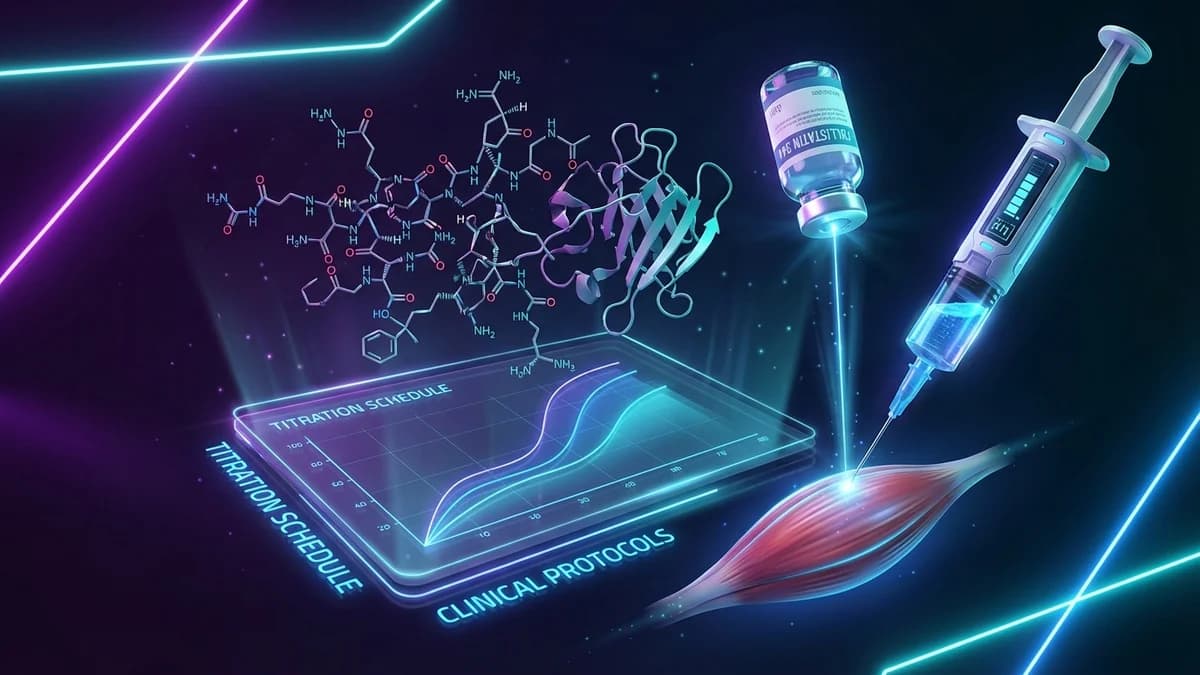
Research protocols typically employ gradual dose escalation to assess individual tolerance and minimize adverse effects. The absence of established pharmacokinetic parameters necessitates conservative titration approaches based on limited case study data.
| Week | Dose (mcg) | Frequency | Notes |
|---|---|---|---|
| 1-2 | 50-100 | 2x/week | Baseline tolerance assessment |
| 3-4 | 100-200 | 2x/week | Monitor for injection site reactions |
| 5-6 | 200-300 | 2-3x/week | Evaluate response markers |
| 7+ | 300-500 | 3x/week | Maximum research doses |
Case reports of central serous chorioretinopathy occurred with doses exceeding 500 mcg administered 3-4 times weekly over 8-12 week periods.[3] Ophthalmologic monitoring becomes critical at higher dose ranges, with fundoscopic examination recommended every 4-6 weeks during treatment. The 11 bodybuilding athletes who developed CSCR were using subcutaneous injections of 500-1000+ mcg doses for muscle mass enhancement.[3]
Titration should halt immediately upon detection of visual symptoms, including blurred vision, central scotomas, or metamorphopsia. Recovery of CSCR typically occurs within 3-6 months following discontinuation, though some cases may require longer resolution periods.[3]
Administration Method
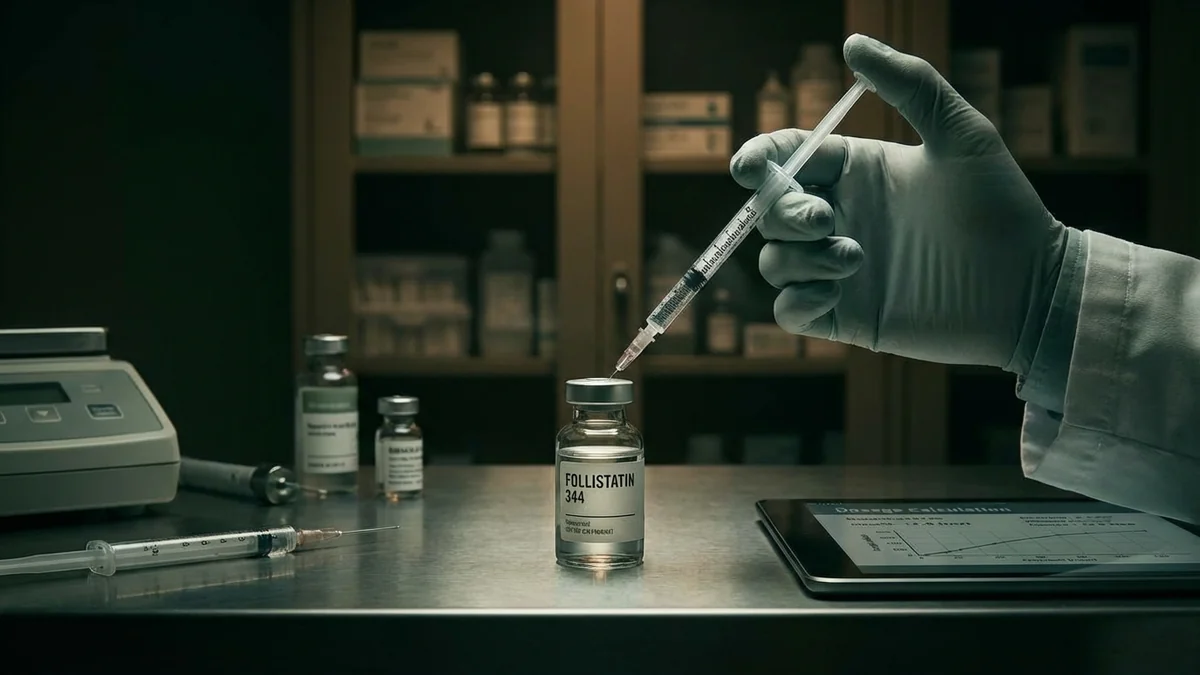
Follistatin 344 requires subcutaneous injection using 29-31 gauge insulin syringes with 0.5-1.0 mL capacity. The peptide arrives as lyophilized powder requiring reconstitution with bacteriostatic water at concentrations of 1-5 mg/mL depending on vial size and dosing requirements.
Injection sites include the abdomen (2 inches from navel), anterior thigh, or posterior upper arm, with rotation every 3-4 injections to prevent lipodystrophy. Subcutaneous injection depth should be 4-6mm at a 45-90 degree angle depending on subcutaneous fat thickness. Intramuscular administration is not recommended due to increased injection site pain and variable absorption kinetics.
Storage requires refrigeration at 36-46°F (2-8°C) for both lyophilized and reconstituted forms. Reconstituted solutions maintain stability for 14-28 days when stored properly with bacteriostatic water containing 0.9% benzyl alcohol. Freezing should be avoided as it may cause protein denaturation and loss of biological activity.
Timing of administration appears less critical than with other peptides, though some practitioners recommend injection 30-60 minutes before resistance training sessions based on theoretical myostatin inhibition kinetics. The peptide's 2-3 hour half-life suggests twice-weekly dosing may be suboptimal for sustained myostatin suppression.
Dosing by Use Case
Muscle Mass Research
Research protocols investigating muscle mass effects typically utilize 200-500 mcg doses administered subcutaneously 2-3 times weekly. Transgenic studies in pigs demonstrated significant increases in skeletal muscle mass with tissue-specific follistatin overexpression, though direct dosage correlation remains unclear.[2] The effective dose for myostatin inhibition in humans has not been established through controlled trials.
Performance Enhancement (Prohibited)
WADA prohibition makes performance enhancement applications illegal for competitive athletes. Case reports describe bodybuilders using 500-1000+ mcg doses 3-4 times weekly, resulting in central serous chorioretinopathy in 11 documented cases.[3] These high-dose protocols carry significant ocular risks and should not be replicated.
Analytical Detection Studies
Anti-doping laboratories utilize detection limits of 50 ng/mL in serum and urine samples for follistatin identification.[1] Electrophoretic methods can detect follistatin presence for 72-96 hours post-administration, depending on dose and individual clearance rates.
Factors That Affect Dosing
Body weight correlation with follistatin dosing has not been established in human studies. The 11 athletes who developed CSCR had body weights ranging from 75-95 kg, suggesting weight-based dosing adjustments may not prevent adverse effects.[3] Renal clearance of follistatin involves glomerular filtration and tubular reabsorption, though specific GFR adjustments have not been studied.
Age-related dosing modifications lack evidence-based guidelines, as research populations typically involve healthy adults aged 20-40 years. Hepatic metabolism of follistatin occurs through standard protein degradation pathways, with no specific Child-Pugh scoring recommendations available.
Concurrent use of growth hormone or IGF-1 may theoretically enhance follistatin effects through synergistic muscle growth pathways, though formal interaction studies are absent. Myostatin inhibitors like YK-11 could provide additive effects but increase the risk of unknown complications.
Individual response variability appears significant based on the 53% failure rate of black market products to contain active follistatin.[1] Genetic polymorphisms in myostatin (MSTN gene) and activin receptors may influence individual sensitivity to follistatin therapy, though pharmacogenomic data remains unavailable.
What Happens If You Miss a Dose
The 2-3 hour half-life of follistatin 344 suggests missed doses should be administered within 12-24 hours to maintain consistent myostatin inhibition. If more than 24 hours have elapsed, skip the missed dose and resume the regular schedule rather than doubling the next administration.
Twice-weekly dosing protocols provide some flexibility for missed doses, as the 72-96 hour detection window suggests biological activity may persist beyond the measured half-life.[1] However, consistent timing optimizes steady-state myostatin suppression and minimizes fluctuations in activin-binding activity.