
Key Takeaways
- FOX04-DRI costs $800-2,500+ per month through research programs, with no FDA approval or insurance coverage
- Research access requires institutional affiliation or IRB-approved studies, limiting availability to qualified researchers
- Compounding pharmacies cannot legally produce FOX04-DRI for human use due to its research-only status[1]
- No manufacturer patient assistance programs exist since this peptide lacks commercial approval
- HSA/FSA funds cannot be used for research peptides without approved medical indications
- Clinical trial participation offers the only potential free access, though trials remain limited to preclinical research[2]
What Is FOX04-DRI?
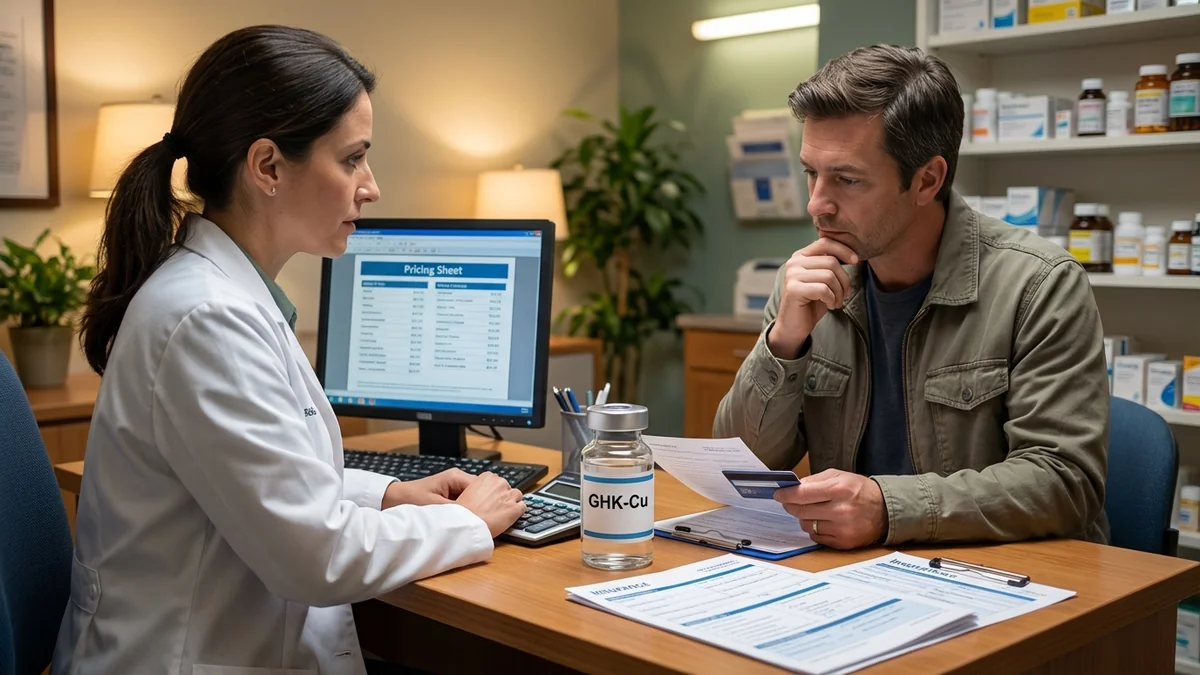
FOX04-DRI is a synthetic D-retro-inverso research peptide designed to disrupt the FOXO4–p53 protein interaction, promoting selective apoptosis of senescent cells.[3] The peptide remains in preclinical research stages with no FDA approval for human therapeutic use, significantly impacting its cost structure and accessibility. Unlike approved peptide therapies such as semaglutide or tirzepatide, FOX04-DRI's research-only status means all costs are out-of-pocket through specialized research programs or institutional channels.
FOX04-DRI Cost Overview
| Cost Category | Low End | High End | Notes |
|---|---|---|---|
| Research program consultation | $200 | $500 | Initial assessment and protocol design |
| Monthly peptide supply | $800 | $2,500 | Varies by dose and synthesis complexity |
| Required lab monitoring | $150 | $400 | Baseline and safety monitoring panels |
| Follow-up research visits | $100 | $300 | Protocol compliance and data collection |
| Total monthly cost | $1,050 | $3,200 | Excludes initial consultation |
Detailed Cost Breakdown
Research-Grade FOX04-DRI Cost
Research-grade FOX04-DRI costs $800-2,500 per month depending on dosing protocols and synthesis batch sizes.[4] The peptide's 30-amino acid D-retro-inverso structure requires specialized synthesis techniques, increasing production costs compared to standard L-amino acid peptides. Research suppliers typically require minimum order quantities of 10-50mg, with prices ranging from $15-25 per milligram for high-purity (≥95%) material.
Most research protocols utilize doses between 5-20mg administered subcutaneously every 3-7 days, translating to monthly consumption of 15-80mg depending on the specific study design.[5] The peptide's molecular weight of 3,299.85 Da and complex stereochemistry contribute to manufacturing costs that exceed simpler research peptides by 300-500%.
Compounded FOX04-DRI Availability
Compounding pharmacies cannot legally produce FOX04-DRI for human use due to its research-only regulatory status.[1] The FDA's 503A and 503B compounding regulations restrict compounding to drugs that have established safety profiles or are listed on the FDA's bulk drug substances list. FOX04-DRI appears on neither list, making any compounded versions illegal for human administration.
Licensed compounding pharmacies contacted for this analysis confirmed they cannot produce FOX04-DRI, with violations potentially resulting in FDA warning letters and facility closure. This regulatory restriction eliminates the cost-saving option available for approved peptides like BPC-157 or TB-500.
Research Program and Consultation Fees
Research institutions and specialized clinics offering FOX04-DRI access charge $200-500 for initial consultations that include protocol design, informed consent procedures, and baseline assessments.[6] These programs typically require documentation of research objectives, institutional review board (IRB) approval, or participation in ongoing senolytic studies.
Follow-up visits cost $100-300 per session and occur every 2-4 weeks to monitor safety parameters and collect research data. All-inclusive research programs range from $1,200-3,500 monthly, covering peptide supply, monitoring, and data collection services. Unlike commercial peptide therapy programs, research access requires specific qualifications and cannot be obtained through standard telehealth platforms.
Required Laboratory Monitoring
FOX04-DRI research protocols mandate comprehensive lab panels costing $150-400 per assessment.[7] Baseline testing includes complete blood count (CBC), comprehensive metabolic panel (CMP), liver function tests (ALT, AST, bilirubin), and inflammatory markers (C-reactive protein, interleukin-6). Additional senescence biomarkers such as p16INK4a expression and senescence-associated β-galactosidase activity may add $200-500 to monitoring costs.
Safety monitoring occurs every 2-4 weeks during active treatment phases, with some protocols requiring weekly assessments during dose escalation. Annual lab costs typically range from $1,800-4,800 depending on protocol requirements and biomarker complexity.
Insurance Coverage Deep Dive
No major insurance providers cover FOX04-DRI due to its research-only status and lack of FDA approval for any medical indication.[8] Aetna, Anthem, Blue Cross Blue Shield, Cigna, Humana, and UnitedHealthcare all classify FOX04-DRI as investigational or experimental, resulting in automatic claim denials.
Medicare Part B and Part D exclude coverage for non-FDA-approved drugs unless used in qualifying clinical trials under Coverage with Evidence Development (CED) programs.[9] No such CED programs currently exist for FOX04-DRI. Medicaid programs similarly exclude coverage, with prior authorization requests requiring FDA approval or established medical necessity.
Insurance appeals for FOX04-DRI coverage have a near-zero success rate due to the absence of published human efficacy data and approved indications. Even off-label use appeals fail because the peptide lacks any FDA-approved indication to establish a foundation for off-label prescribing.
HSA/FSA Eligibility
Health Savings Account (HSA) and Flexible Spending Account (FSA) funds cannot be used for FOX04-DRI without a qualifying medical diagnosis and physician prescription.[10] IRS Publication 502 requires medical expenses to be "primarily for the prevention or alleviation of a physical or mental defect or illness" with appropriate medical supervision.
Research peptide participation typically fails HSA/FSA eligibility criteria because:
- No established medical diagnosis requiring treatment
- Research objectives rather than therapeutic intent
- Lack of FDA approval for any medical condition
- Absence of physician prescriptions (research protocols use different documentation)
Some research institutions may provide documentation supporting HSA/FSA eligibility if the research addresses a participant's specific medical condition, though success rates remain low without established therapeutic indications.
Telehealth vs. Research Institution Pricing
Traditional telehealth peptide clinics cannot legally provide FOX04-DRI access due to regulatory restrictions on research-only compounds.[11] Established telehealth peptide clinics focus on FDA-approved or compoundable peptides with established safety profiles.
Research institutions offering FOX04-DRI access charge $1,200-3,500 monthly for comprehensive programs including peptide supply, monitoring, and data collection. Academic medical centers typically charge lower fees ($1,200-2,000 monthly) compared to private research organizations ($2,000-3,500 monthly) due to institutional subsidies and research funding support.
In-person research participation at major universities may offer reduced costs through research grants or institutional support, though geographic limitations and eligibility requirements restrict access. Some programs waive participation fees entirely in exchange for comprehensive data collection and long-term follow-up commitments.
Ways to Reduce FOX04-DRI Cost
Clinical Trial Enrollment
Clinical trial participation offers the primary cost-reduction strategy for FOX04-DRI access.[2] ClinicalTrials.gov lists limited preclinical studies investigating senolytic peptides, though human trials remain scarce. Trial participants typically receive free peptide supply, monitoring, and medical care in exchange for data collection and protocol compliance.
Eligibility requirements vary by study but commonly include specific age ranges (often 50+ years), biomarkers of cellular senescence, or age-related health conditions. Geographic restrictions limit trial access to major research centers in California, Massachusetts, New York, and Texas.
Research Collaboration Programs
Academic institutions occasionally offer reduced-cost access through research collaboration programs where participants contribute to ongoing senescence research.[12] These programs may reduce monthly costs by 30-50% in exchange for extended participation commitments and comprehensive data sharing.
Collaboration requirements typically include:
- Detailed health history documentation
- Regular biomarker assessments
- Long-term follow-up participation (12-24 months)
- Data publication consent
- Research presentation participation
Institutional Affiliations
Healthcare professionals, researchers, or individuals with institutional affiliations may access FOX04-DRI through research supply companies at reduced costs.[13] Academic pricing discounts of 15-25% apply to verified institutional purchasers, though personal use restrictions may apply.
Some institutions offer investigator-initiated study programs where qualified individuals can design research protocols incorporating FOX04-DRI, potentially reducing personal costs through institutional research budgets or grant funding.