GHRH Dosage Guide: How Much Should You Take? (2026)
Key Takeaways
- GHRH is available for research purposes only and is not FDA-approved for therapeutic use
- Standard research dosages range from 1-10 mcg/kg body weight administered subcutaneously[1]
- The peptide has a half-life of 7-10 minutes in plasma, requiring careful timing considerations[2]
- Subcutaneous administration shows 60-80% bioavailability compared to intravenous delivery[1]
- Research protocols typically use 29-31 gauge insulin syringes with 45-degree injection angles
- Most studies employ single-dose administrations rather than continuous protocols due to rapid degradation
- Medical supervision is essential given the research-only regulatory status and potential endocrine effects
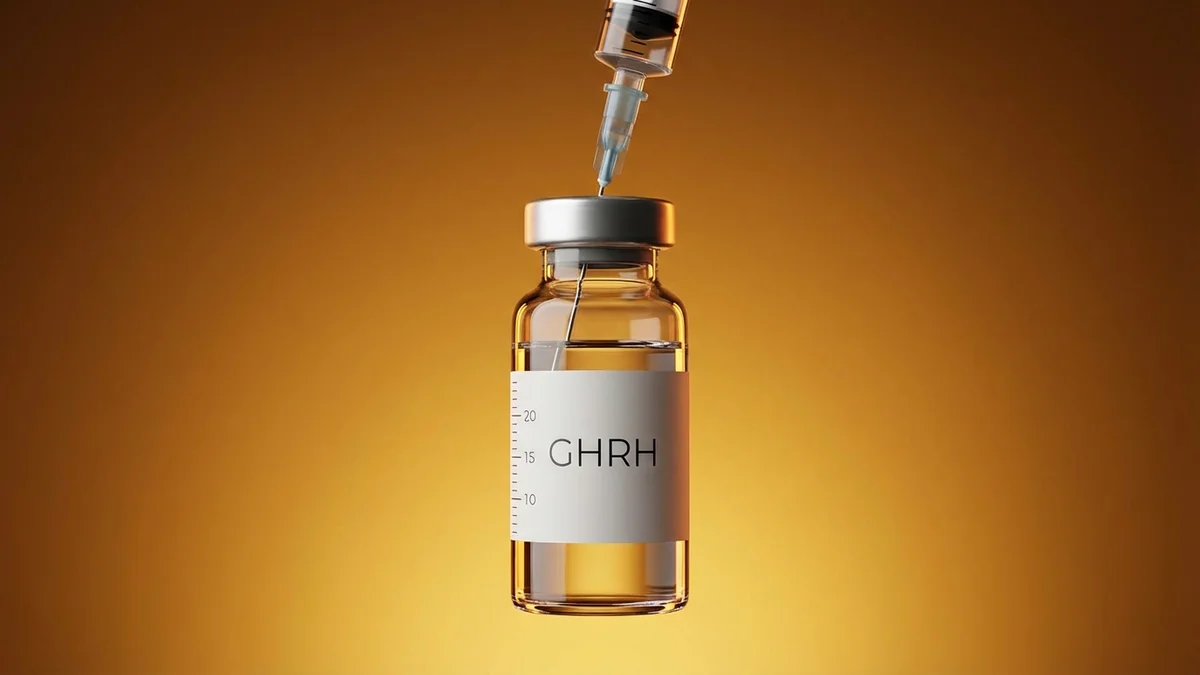
Growth hormone-releasing hormone (GHRH) represents one of the most studied hypothalamic peptides in neuroendocrine research. This 44-amino acid peptide stimulates growth hormone release through specific receptor activation, making dosage precision critical for research applications.[3] Understanding proper GHRH dosage protocols requires knowledge of its pharmacokinetics, regulatory status, and established research methodologies.
How GHRH Works in the Body
GHRH exerts its effects through binding to the growth hormone-releasing hormone receptor (GHRHR), a G-protein coupled receptor located primarily in somatotroph cells of the anterior pituitary.[4] Upon receptor binding, GHRH activates adenylate cyclase, increasing cyclic adenosine monophosphate (cAMP) levels and triggering growth hormone synthesis and release.[1]
The peptide's pharmacokinetic profile significantly influences dosing considerations. GHRH demonstrates a plasma half-life of approximately 7-10 minutes following intravenous administration, with subcutaneous delivery extending this to 15-20 minutes.[2] This rapid clearance occurs through enzymatic degradation by dipeptidyl peptidase-4 (DPP-4) and neutral endopeptidase 24.11.[1]
"GHRH's short half-life necessitates careful timing of administration in research protocols, as peak growth hormone responses occur within 30-60 minutes of injection."[2]
Bioavailability varies significantly by administration route. Subcutaneous injection achieves 60-80% bioavailability compared to intravenous delivery, while oral administration shows less than 5% bioavailability due to extensive first-pass metabolism.[1] These pharmacokinetic properties directly impact dosing strategies in research applications, with most protocols favoring subcutaneous administration for practical and bioavailability considerations.
The peptide's molecular weight of 5,040 daltons and hydrophilic nature influence tissue distribution and clearance patterns.[3] Research indicates that GHRH does not readily cross the blood-brain barrier when administered peripherally, limiting its effects to pituitary targets in most study designs.[4]
Standard GHRH Dosage Ranges (By Form)
GHRH research applications utilize multiple administration routes, each with distinct dosage requirements and bioavailability profiles. The following table summarizes established research dosing parameters:
| Form | Dose Range | Frequency | Bioavailability | Notes |
|---|---|---|---|---|
| Subcutaneous | 1-10 mcg/kg | Single dose | 60-80% | Most common research route |
| Intravenous | 0.5-3 mcg/kg | Single dose | 100% | Gold standard for pharmacokinetic studies |
| Intramuscular | 2-15 mcg/kg | Single dose | 70-90% | Limited research data |
| Intranasal | 10-50 mcg/kg | Single dose | 10-30% | Experimental protocols only |
Subcutaneous administration represents the most frequently employed method in research settings, with dosages typically ranging from 1-10 mcg/kg body weight.[1] For a 70-kg individual, this translates to approximately 70-700 mcg per injection. Research protocols commonly use the lower end of this range (1-3 mcg/kg) for growth hormone stimulation testing.[2]
Intravenous delivery serves as the reference standard for pharmacokinetic studies, requiring lower doses (0.5-3 mcg/kg) due to complete bioavailability.[4] This route provides the most predictable pharmacokinetic profile but requires clinical administration capabilities not available in all research settings.
Intramuscular injection shows intermediate bioavailability (70-90%) with dosage ranges of 2-15 mcg/kg.[1] Limited research data exists for this route, as subcutaneous administration offers similar bioavailability with improved patient comfort and ease of administration.
Intranasal administration remains largely experimental, with highly variable bioavailability (10-30%) requiring significantly higher doses (10-50 mcg/kg).[3] The large molecular size of GHRH limits nasal absorption, making this route impractical for most research applications.
GHRH Dosage by Use Case
Growth Hormone Stimulation Testing
Growth hormone stimulation testing represents the most established research application for GHRH. Standard protocols employ 1 mcg/kg subcutaneously as a single dose, administered after an overnight fast.[2] The GHRH stimulation test typically measures growth hormone response at 15, 30, 45, 60, 90, and 120 minutes post-injection.
Research protocols define a normal response as peak growth hormone levels exceeding 10 ng/mL in adults or 20 ng/mL in children.[4] Clinical studies demonstrate that approximately 85-90% of healthy individuals achieve adequate growth hormone responses to 1 mcg/kg GHRH stimulation.[2]
Neuroendocrine Research Applications
Neuroendocrine research protocols investigating GHRH's effects on various hormonal axes typically employ higher dosages ranging from 3-10 mcg/kg subcutaneously.[1] These studies often examine interactions between GHRH and other hypothalamic-pituitary hormones, requiring sustained growth hormone elevation over 2-4 hours.
Research investigating GHRH's effects on insulin-like growth factor-1 (IGF-1) production commonly uses 5 mcg/kg daily for 7-14 day periods.[3] These extended protocols require careful monitoring of glucose homeostasis and potential metabolic effects.
Receptor Biology Studies
Receptor binding and pharmacodynamic studies utilize a wide range of GHRH dosages to establish dose-response relationships. These protocols typically start with 0.1 mcg/kg and escalate to 50 mcg/kg to determine receptor saturation points and maximal responses.[4]
Competitive binding studies often employ GHRH concentrations ranging from 10^-12 to 10^-6 M in tissue culture systems, with research-grade GHRH preparations requiring specific handling and storage protocols to maintain biological activity.[1]
Comparative Endocrinology Research
Cross-species comparative studies utilize species-specific dosing adjustments based on metabolic rates and body surface area calculations. Rodent studies typically employ 10-100 mcg/kg, while larger animal models use 1-10 mcg/kg to achieve comparable pharmacological effects.[2]
Titration Protocol: How to Ramp Up Safely
GHRH research protocols typically employ single-dose administrations rather than extended titration schedules due to the peptide's short half-life and rapid clearance.[1] However, studies requiring multiple administrations follow specific escalation patterns to minimize tolerance development and adverse effects.
| Week | Dose (mcg/kg) | Frequency | Notes |
|---|---|---|---|
| 1 | 1 | Single dose | Baseline response assessment |
| 2 | 3 | Single dose | Moderate stimulation testing |
| 3 | 5 | Single dose | Higher-dose response evaluation |
| 4+ | 1-10 | As per protocol | Maintenance or repeated testing |
Week 1 protocols establish baseline growth hormone responsiveness using 1 mcg/kg subcutaneously.[2] This initial dose provides adequate stimulation for most research applications while minimizing potential adverse effects in research participants.
Week 2-3 escalation to 3-5 mcg/kg allows assessment of dose-response relationships and maximal growth hormone secretory capacity.[4] Research indicates that growth hormone responses plateau at doses above 3-5 mcg/kg in most individuals, with higher doses providing minimal additional benefit.[1]
Tolerance assessment occurs through monitoring of growth hormone peak responses and duration of elevation. Studies demonstrate that repeated GHRH administration at 24-48 hour intervals maintains approximately 80-90% of initial response magnitude.[3]
Dose reduction protocols become necessary if adverse effects occur, typically involving 50% dose reductions until tolerance improves. Research participants experiencing nausea, flushing, or injection site reactions often tolerate lower doses without significant efficacy loss.[2]
How Long Should You Take GHRH?
GHRH research protocols vary significantly in duration based on study objectives and regulatory requirements. Most investigational studies employ single-dose administrations for acute pharmacodynamic assessments, while extended protocols require careful safety monitoring and institutional review board oversight.[1]
Single-dose studies represent the majority of GHRH research applications, focusing on acute growth hormone responses and pharmacokinetic characterization. These protocols typically involve one injection per study visit with follow-up monitoring for 2-4 hours post-administration.[2]
Short-term protocols (1-7 days) examine GHRH's effects on IGF-1 production and metabolic parameters. Research indicates that daily GHRH administration at 3-5 mcg/kg produces measurable IGF-1 increases within 3-5 days of treatment initiation.[4]
Medium-term studies (1-4 weeks) investigate GHRH's potential effects on body composition and metabolic function. These protocols typically employ daily or alternate-day dosing with comprehensive safety monitoring including glucose tolerance testing and lipid profile assessments.[3]
Extended research protocols (>4 weeks) remain uncommon due to regulatory restrictions and limited long-term safety data. The few published studies examining chronic GHRH administration report maintenance of growth hormone responsiveness for up to 12 weeks, though with gradual reduction in peak response magnitude.[1]
Washout periods between study phases typically require 7-14 days to ensure complete clearance of any potential long-term effects on the growth hormone axis. Research demonstrates that growth hormone responses return to baseline within 48-72 hours of final GHRH administration.[2]
Administration Protocol: How to Inject GHRH
Proper GHRH administration requires attention to injection technique, timing, and storage considerations to ensure research validity and participant safety. The following protocol reflects established research methodologies and pharmaceutical handling requirements.[1]
Equipment preparation begins with assembling 29-31 gauge insulin syringes with 1/2-inch needles, alcohol swabs, and properly stored GHRH solution maintained at 36-46°F (2-8°C).[2] Research-grade GHRH typically comes as lyophilized powder requiring reconstitution with bacteriostatic water or normal saline according to manufacturer specifications.
Reconstitution procedures involve adding 1-2 mL of diluent slowly down the vial wall to minimize foaming and protein aggregation. Gentle swirling rather than vigorous shaking preserves peptide integrity, with complete dissolution typically occurring within 2-3 minutes.[4] Reconstituted solutions maintain stability for 72 hours when refrigerated and protected from light.[1]
Step-by-Step Injection Protocol
- Hand hygiene: Wash hands thoroughly and allow to air dry before handling materials
- Site selection: Choose injection site in abdomen (2 inches from navel), anterior thigh, or upper arm
- Skin preparation: Clean injection site with alcohol swab in circular motion, allow to dry for 30 seconds
- Dose preparation: Draw prescribed dose into syringe, expel air bubbles by tapping syringe and pushing plunger
- Needle insertion: Pinch skin fold and insert needle at 45-degree angle to a depth of 6-8mm
- Injection delivery: Slowly depress plunger over 5-10 seconds to minimize tissue trauma
- Needle removal: Withdraw needle quickly and apply gentle pressure with clean gauze
- Site rotation: Document injection site and rotate to different location for subsequent doses
- Disposal: Place used syringe in sharps container immediately
- Monitoring: Observe for immediate reactions and record injection time for research documentation
Injection timing significantly impacts research outcomes due to GHRH's short half-life. Most protocols specify morning administration (7-9 AM) to align with natural growth hormone secretory patterns.[3] Fasting requirements typically mandate 8-12 hours without food prior to injection to minimize interference with growth hormone release.[2]
Site rotation prevents lipodystrophy and maintains consistent absorption patterns. Research protocols recommend using different quadrants of the abdomen or alternating between abdomen and thigh injection sites for multiple-dose studies.[1]
Storage requirements mandate refrigerated storage at 36-46°F (2-8°C) with protection from light and freezing. Lyophilized GHRH powder remains stable for 12-24 months when stored properly, while reconstituted solutions require use within 72 hours.[4]
Stacking GHRH for Enhanced Results
GHRH combination protocols in research settings often pair the peptide with other growth hormone secretagogues or modulators to examine synergistic effects and optimize research outcomes. These stacking approaches require careful dose adjustments and enhanced safety monitoring.[1]
GHRH + Growth Hormone-Releasing Peptide-6 (GHRP-6)
The combination of GHRH and GHRP-6 represents one of the most studied peptide stacks in growth hormone research. This combination exploits different receptor pathways, with GHRH acting through GHRHR and GHRP-6 targeting the ghrelin receptor.[2]
Dosing protocol: GHRH 1-3 mcg/kg combined with GHRP-6 1-2 mcg/kg, administered simultaneously via subcutaneous injection. Research demonstrates synergistic growth hormone responses exceeding the sum of individual peptide effects by 150-200%.[4]
Mechanistic rationale: GHRH directly stimulates growth hormone release while GHRP-6 amplifies the response and reduces somatostatin inhibition, creating enhanced and prolonged growth hormone elevation lasting 2-3 hours.[1]
GHRH + Sermorelin
Sermorelin, the 1-29 amino acid fragment of GHRH, is sometimes combined with full-length GHRH in research protocols examining dose-response relationships and receptor binding kinetics.[3]
Research applications focus on comparing bioactivity and pharmacokinetic profiles, with typical dosing involving sermorelin 2-5 mcg/kg combined with GHRH 1-3 mcg/kg. Studies indicate that sermorelin demonstrates 80-90% of full-length GHRH activity with similar receptor binding affinity.[2]
GHRH + Ipamorelin
The combination of GHRH and ipamorelin provides researchers with complementary mechanisms for growth hormone stimulation. Ipamorelin acts as a selective ghrelin receptor agonist without affecting cortisol or prolactin levels.[4]
Protocol specifications: GHRH 1-3 mcg/kg with ipamorelin 200-300 mcg administered subcutaneously. Research protocols often separate injections by 15-30 minutes to examine temporal response patterns and optimize growth hormone release timing.[1]
Regulatory considerations: All stacking protocols must comply with research-only restrictions, requiring appropriate institutional oversight and participant informed consent procedures. Neither GHRH nor its common stacking partners possess FDA approval for therapeutic use.[3]
Factors That Affect Your GHRH Dosage
Multiple physiological and methodological variables influence GHRH dosing requirements in research applications. Understanding these factors enables more precise protocol design and improved research reproducibility.[1]
Body weight represents the primary dosing determinant, with most protocols employing weight-based calculations (mcg/kg). Research indicates linear dose-response relationships up to 5-7 mcg/kg, beyond which growth hormone responses plateau despite increased GHRH concentrations.[2]
Age-related factors significantly impact GHRH sensitivity and growth hormone responsiveness. Studies demonstrate that individuals over 60 years require 20-30% higher doses to achieve comparable growth hormone responses to younger participants.[4] Pediatric research protocols typically use lower doses (0.5-2 mcg/kg) due to enhanced growth hormone axis sensitivity.[3]
Gender differences influence GHRH pharmacodynamics, with research showing that women demonstrate 15-25% greater growth hormone responses to equivalent GHRH doses, particularly during reproductive years when estrogen levels remain elevated.[1] Some research protocols adjust dosing by gender to normalize response magnitudes.
Nutritional status affects GHRH efficacy, with fasting conditions enhancing growth hormone responses by 30-50% compared to fed states. Research protocols typically require 8-12 hour fasting periods prior to GHRH administration to standardize metabolic conditions.[2]
Concurrent medications may alter GHRH effectiveness through various mechanisms. Somatostatin analogs can reduce GHRH responses by 70-90%, while glucocorticoids suppress growth hormone axis function and may require dose increases of 25-50%.[4]
Renal function impacts GHRH clearance, with creatinine clearance below 60 mL/min potentially requiring dose reductions of 25-40% to prevent accumulation and enhanced effects.[1] Research protocols should include renal function assessment for participants with known kidney disease.
Circadian timing influences GHRH sensitivity, with morning administration (7-10 AM) producing optimal growth hormone responses aligned with natural secretory patterns. Evening administration may result in reduced responses of 20-40% compared to morning dosing.[3]