Is O-304 Legal? FDA Status and Regulations Explained (2026)
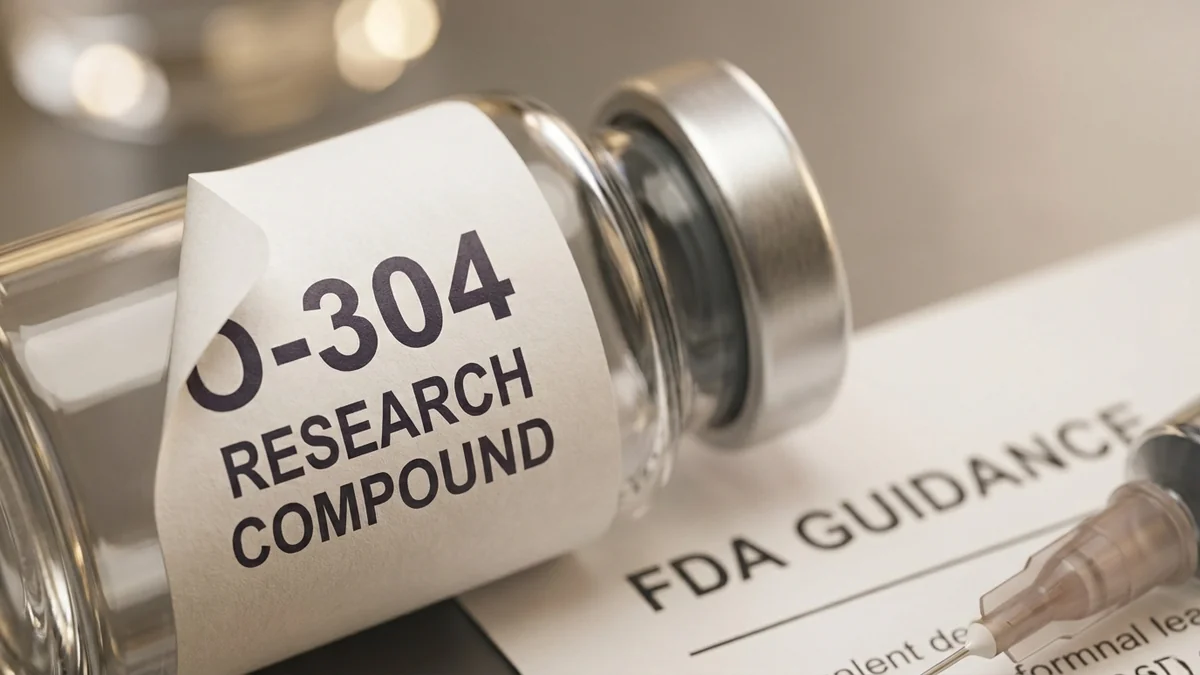
If you've come across O-304 — a synthetic small-molecule compound marketed around cellular senescence, epigenetic regulation, and collagen synthesis — and you're trying to figure out whether it's legal to use, prescribe, or purchase, here's your straight answer: O-304 is not FDA-approved for any human indication, and it is classified as a research-use-only compound. That has real legal consequences for patients, providers, and sellers, and this article walks through all of them.
The O-304 legality question matters because the compound is increasingly mentioned in longevity and anti-aging spaces, sometimes alongside peptides that do have legitimate clinical pathways. O-304 doesn't. Understanding the difference protects you — legally, financially, and medically.
Key Takeaways
- O-304 has no FDA approval for any human therapeutic indication as of March 2026. It is classified as a research-use-only compound, not a drug product.
- Compounding pharmacies cannot legally dispense O-304 to patients for human use. It has not been placed on any FDA bulk drug substance list that would permit 503A or 503B compounding.
- "Research use only" is not a legal loophole. Purchasing O-304 labeled as a research chemical does not protect you from FDA enforcement if the intent is human consumption.
- O-304 is not a DEA-scheduled controlled substance, but that doesn't make it legal for human use — it simply means possession isn't a criminal drug offense in the way that Schedule I substances are.
- Prescribing O-304 to a patient is not "off-label prescribing." Off-label use only applies to FDA-approved drugs. Prescribing an unapproved compound carries distinct and more serious legal and liability risks.
- No major regulatory body worldwide — including the EMA, MHRA, TGA, or Health Canada — has approved O-304 for human therapeutic use.
Regulatory Status at a Glance
| Category | Status | Detail |
|---|---|---|
| FDA Approval | ❌ Not Approved | No NDA, BLA, or any approved indication for human use |
| FDA Compounding (503A/503B) | ❌ Not Permitted | Not on any FDA bulk drug substance nominee list for compounding |
| DEA Scheduling | ✅ Not Scheduled | Not a controlled substance under the CSA |
| Prescription Availability | ❌ Not Available | Cannot be legally prescribed for human therapeutic use |
| Research Use | ⚠️ Research Only | Legal for in-vitro and preclinical laboratory research only |
| EU / EMA Status | ❌ Not Approved | No EMA marketing authorization |
| UK / MHRA Status | ❌ Not Approved | No MHRA authorization for human use |
| Australia / TGA Status | ❌ Not Approved | Not listed on the Australian Register of Therapeutic Goods (ARTG) |
| Canada / Health Canada | ❌ Not Approved | No Notice of Compliance issued |
Current FDA Status
O-304 is not FDA-approved for any indication. There is no New Drug Application (NDA), Biologics License Application (BLA), or Investigational New Drug (IND) approval on record for O-304 as a marketed therapeutic product available to the general public.[1]
The FDA classifies drug products by their approval pathway and intended use. O-304 doesn't fit into any approved category — it sits entirely outside the approved drug framework. That means it cannot be legally marketed, sold, or distributed as a treatment for any human condition, including the areas it's sometimes discussed in: cellular senescence, extracellular matrix remodeling, SIRT1 pathway modulation, or collagen synthesis.[2]
The compound is described in the literature as a synthetic small molecule developed to modulate cellular senescence-associated pathways, with proposed mechanisms involving DNA damage response signaling and SIRT1 activation. Its clinical evidence level is preclinical — meaning the available data comes from cell culture and animal studies, not human clinical trials.[3] There are no registered Phase I, II, or III clinical trials for O-304 listed on ClinicalTrials.gov as of March 2026.
What does "research only" mean in FDA terms? Under the Federal Food, Drug, and Cosmetic Act (FD&C Act), a substance intended for human therapeutic use must go through the FDA's drug approval process before it can be legally marketed.[1] O-304 has not done that. Labeling it "for research purposes only" or "not for human consumption" is a common tactic used by vendors to sidestep FDA jurisdiction — but the FDA evaluates the actual intended use of a product, not just its label.
Compounding Status
This is where a lot of confusion comes in, especially for patients who've seen other peptides available through compounding pharmacies. So let's be specific.
Under Section 503A of the FD&C Act, licensed pharmacists can compound drug products for individual patients based on a valid prescription — but only using substances that appear on the FDA's approved bulk drug substance list, or substances that are components of FDA-approved drugs.[1] Under Section 503B, outsourcing facilities can produce larger quantities of compounded drugs, again subject to FDA oversight and bulk substance requirements.
O-304 is not on any FDA bulk drug substance nominee list. It has not been nominated for Category 1 (approved for use in compounding), and it has not been evaluated and rejected as Category 2 (not appropriate for compounding). It simply hasn't entered that process at all. That means no licensed 503A pharmacy or 503B outsourcing facility can legally compound O-304 for human use, regardless of what a prescriber requests.
If you encounter a compounding pharmacy claiming to dispense O-304 for human therapeutic use, that's a significant red flag. You should verify the pharmacy's accreditation through the Pharmacy Compounding Accreditation Board (PCAB) and consult FDA.gov's list of approved bulk drug substances before proceeding.[1]
The compounding rules around peptides have tightened considerably since the FDA began its bulk drug substance review process. Several peptides that were previously available through compounding pharmacies — including some growth hormone secretagogues — have been removed from the market following FDA rulemaking. O-304 never entered that pathway in the first place.
For a broader understanding of how compounding law affects peptide access, see our guide to compounding pharmacy rules for peptide therapy and our overview of 503A vs. 503B compounding.
Enforcement Actions
The FDA, DEA, and FTC have each taken enforcement action against companies marketing unapproved compounds — including synthetic small molecules and research peptides — for human therapeutic use. The FDA's enforcement tools include Warning Letters, Import Alerts, and seizure actions under the FD&C Act.[1]
The Context available for this article does not include confirmed, documented enforcement actions specifically naming O-304 or a specific company marketing O-304. Accordingly, this section describes the general enforcement environment rather than specific cases.
The FDA has taken enforcement action against companies marketing unapproved research compounds for human use. Patients and providers should consult FDA.gov and the FDA's MedWatch program for current enforcement activity.[1]
What you should know about the enforcement pattern more broadly:
- The FDA's primary enforcement mechanism for unapproved compounds is the Warning Letter, which demands that a company cease marketing a product for human use. Failure to comply can escalate to product seizure and injunctive action.
- Import Alerts allow U.S. Customs and Border Protection to detain shipments of unapproved drug products at the border without physical examination of each package.[1]
- The FTC has jurisdiction over deceptive marketing claims, including health claims made for products that lack FDA approval.
- State pharmacy boards have their own enforcement authority and have taken action against pharmacies dispensing unapproved compounds.
The practical reality: enforcement in the research peptide space is not uniform or predictable. Some vendors operate for years before drawing regulatory attention. That doesn't mean the activity is legal — it means enforcement is resource-constrained. The legal risk is real and ongoing.
Prescription vs. Over-the-Counter vs. Research Use
Let's be clear about each of these categories as they apply to O-304.
Prescription: O-304 cannot be legally obtained by prescription for human therapeutic use in the United States. A prescription only authorizes dispensing of a drug that is either FDA-approved or legally compoundable. O-304 is neither.
Over-the-counter: O-304 is not available OTC. No OTC monograph covers it, and OTC status requires its own FDA review process.
Research use: This is the category under which O-304 is legally sold — but the legal protections here are narrow and specific. Research-grade O-304 can be legally purchased by qualified research institutions, university laboratories, and licensed researchers for in-vitro and preclinical studies. The key legal element is intent. When the intended use is laboratory research — not human administration — the compound occupies a different regulatory space.[2]
Here's where people get into trouble: buying O-304 from a research chemical supplier, receiving it with a "not for human consumption" label, and then injecting it or ingesting it personally doesn't make the activity legal. The FDA assesses the actual intended use of a product, and using a research-grade compound on yourself is human administration of an unapproved drug — full stop.[1]
Gray market products: O-304 sold through online vendors without clear institutional research credentials exists in a gray market. Buyers assume legal risk. The compound may be mislabeled, contaminated, or dosed inaccurately, since it's not subject to pharmaceutical-grade manufacturing standards (cGMP). There's no recourse if you're harmed by a gray market product, and you have no legal protection as a "patient."
International purchasing: Ordering O-304 from overseas suppliers for personal importation is subject to FDA and U.S. Customs enforcement. The FDA's personal importation policy does provide some discretion for individuals importing FDA-approved drugs for personal use — but O-304 is not FDA-approved, so that discretion does not apply.[1] Shipments can be seized at customs.
What "Off-Label" Actually Means
This distinction matters, and it's one that even some clinicians get wrong.
"Off-label prescribing" refers specifically to prescribing an FDA-approved drug for an indication, population, or dosage that the FDA hasn't specifically approved. Off-label prescribing is legal in the United States. Physicians have broad latitude to prescribe approved drugs based on their clinical judgment, even for uses not listed in the official labeling.[4]
O-304 has never been FDA-approved for any indication. That means prescribing it isn't off-label prescribing — it's prescribing an unapproved drug. These are legally and ethically different situations.
Prescribing an unapproved drug exposes a provider to:
- Liability under state medical practice acts. State medical boards can discipline physicians for prescribing unapproved compounds, particularly if a patient is harmed.
- Malpractice risk. If a patient is harmed by O-304, the prescribing physician cannot point to FDA approval or established dosing standards as a defense.
- Potential FDA enforcement. While the FDA generally exercises enforcement discretion over individual physicians, a pattern of prescribing unapproved compounds — especially in a clinical setting — can draw regulatory attention.
For providers working in the longevity and peptide therapy space, understanding this distinction is essential. The legal framework for prescribing semaglutide off-label for weight management is completely different from prescribing O-304, which has no approved foundation at all.
State-Level Variations
Federal FDA law sets the floor for drug regulation in the United States, but states add their own layers — and those layers matter for O-304's practical availability.
State pharmacy boards regulate the practice of pharmacy within each state and can adopt rules more restrictive than federal compounding law. Several state boards have issued guidance specifically addressing research peptides and unapproved compounds. Even if a compounding pharmacy believes it can legally prepare a compound under federal law, the state board may disagree and take disciplinary action.
Telemedicine prescribing has expanded access to peptide therapy clinics, but it doesn't change the underlying legality of what's being prescribed. A telemedicine provider cannot legally prescribe O-304 any more than an in-person provider can. States including Florida, California, and Texas have active pharmacy board oversight of compounding practices, and telemedicine platforms operating across state lines are subject to the laws of each state where the patient is located.
State-level enforcement of unapproved compound sales has been uneven, but states with robust consumer protection frameworks — California's CDPH, for example — have pursued action against vendors selling unapproved health products. If you're operating as a seller in a state with active enforcement, the risk profile is higher.
For a current look at how state regulations affect your peptide therapy options, our clinic finder lets you filter by state and shows clinics operating under verified legal frameworks.
International Status
O-304's regulatory status outside the United States is consistent: no major regulatory authority has approved it for human therapeutic use.
European Union / EMA: The European Medicines Agency has not issued a marketing authorization for O-304. Research-grade compound sales are regulated at the member state level, with varying enforcement.
United Kingdom / MHRA: The Medicines and Healthcare products Regulatory Agency has not authorized O-304 as a medicinal product. The UK's post-Brexit regulatory framework maintains its own approval pathway, and O-304 has not entered it.
Australia / TGA: The Therapeutic Goods Administration has not listed O-304 on the Australian Register of Therapeutic Goods (ARTG). Importing unapproved therapeutic goods into Australia for personal use is subject to TGA enforcement.[3]
Canada / Health Canada: No Notice of Compliance has been issued for O-304. Health Canada classifies unapproved drug products as subject to the Food and Drugs Act, and enforcement action is possible for importation and sale.
The practical takeaway for international buyers: the research-use-only framing doesn't provide meaningful legal protection in most jurisdictions. If you're using O-304 for human therapeutic purposes, you're likely violating drug regulations regardless of which country you're in.