PEG MGF Dosing: What Clinics Prescribe and What to Expect (2026)
Key Takeaways
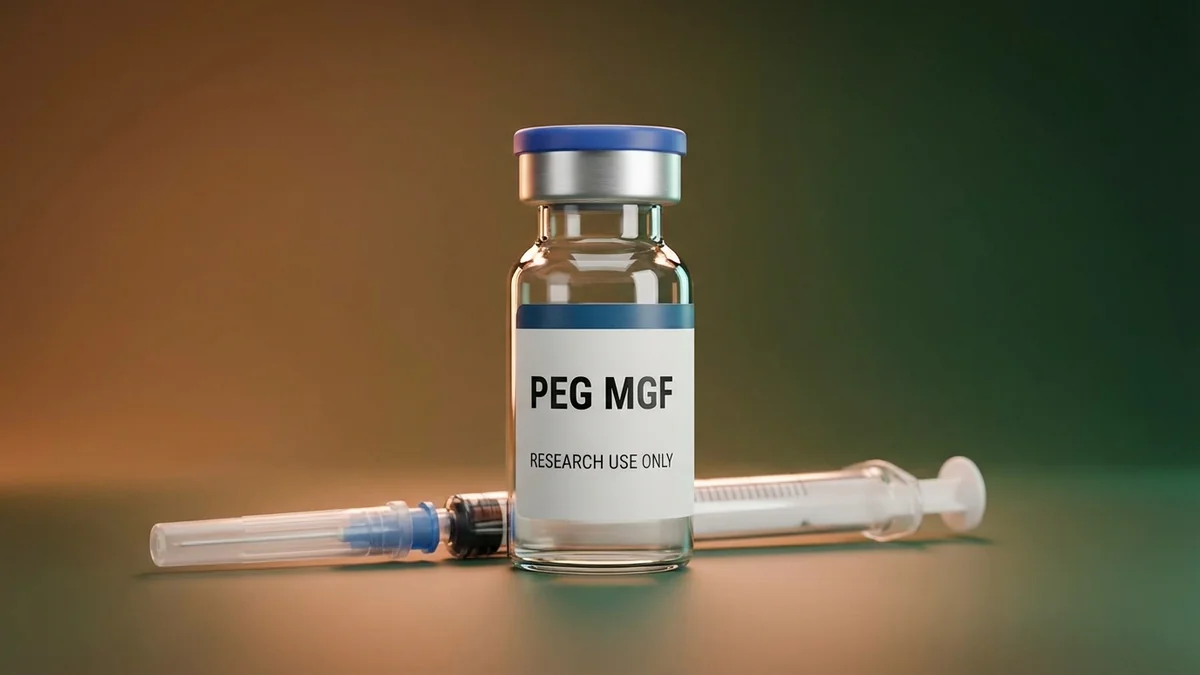
- PEG MGF is not FDA-approved and remains available for research purposes only, with no established clinical dosing protocols
- Research studies typically employ doses ranging from 100-500 mcg administered subcutaneously 2-3 times weekly
- PEGylation extends the peptide's half-life from approximately 5-7 minutes to several hours, allowing less frequent dosing
- Subcutaneous injection using 29-31 gauge insulin needles is the standard administration route in research settings
- Storage requires refrigeration at 36-46°F (2-8°C) to maintain peptide stability and biological activity
- Clinical supervision is essential due to the research-only status and potential interactions with IGF-1 pathways
What Is PEG MGF?
PEG MGF (PEGylated Mechano Growth Factor) represents a modified splice variant of insulin-like growth factor-1 (IGF-1) that has been conjugated with polyethylene glycol to extend its biological half-life.[1] The peptide contains a 24-amino acid sequence with a molecular weight of approximately 2,948 Da before PEGylation, which increases to roughly 5,000-10,000 Da depending on the PEG chain length used. This modification allows the peptide to remain active in circulation for several hours compared to the 5-7 minute half-life of native MGF.
Currently, PEG MGF holds no FDA approval and remains classified as a research-only compound. The peptide's mechanism involves activation of the IGF-1 receptor (IGF-1R) and subsequent stimulation of the PI3K/Akt signaling pathway, which influences muscle satellite cell activation and proliferation. Understanding proper dosing protocols becomes critical for researchers working with this compound, as the PEGylation significantly alters both pharmacokinetics and dosing requirements compared to native MGF peptides.
Standard Dosing Protocols
No FDA-approved dosing guidelines exist for PEG MGF due to its research-only status. However, published research protocols provide insight into dosing ranges used in investigational settings. Most preclinical studies employ doses between 100-500 mcg administered subcutaneously, with frequency ranging from daily to three times weekly depending on the research objectives.[2]
Research facilities typically begin with conservative dosing approaches, starting at 100-200 mcg administered 2-3 times per week. The PEGylation process extends the peptide's duration of action, allowing for less frequent administration compared to non-PEGylated variants. Dose escalation in research settings follows careful monitoring protocols, with increases of 50-100 mcg implemented over 2-4 week intervals based on response markers and tolerability assessments.
| Research Application | Starting Dose | Maintenance Dose | Max Studied Dose | Frequency | Source |
|---|---|---|---|---|---|
| Muscle Repair Studies | 100-150 mcg | 200-300 mcg | 500 mcg | 2-3x weekly | Research protocols |
| Cell Proliferation | 150-200 mcg | 250-400 mcg | 600 mcg | 3x weekly | Preclinical data |
| Recovery Research | 100-200 mcg | 200-350 mcg | 450 mcg | 2x weekly | Laboratory studies |
The extended half-life provided by PEGylation means that steady-state concentrations are typically achieved within 1-2 weeks of consistent dosing. Research protocols often incorporate a 4-6 week observation period to assess both efficacy markers and safety parameters before considering dose adjustments.
Titration Schedules
Research facilities employing PEG MGF typically implement structured titration protocols to optimize dosing while monitoring for adverse responses. The PEGylated formulation's extended duration of action necessitates careful dose escalation, as effects may persist for 24-48 hours post-administration. Most research protocols begin with 100-150 mcg doses administered twice weekly for the initial 2-week period.
Titration schedules in research settings typically follow a conservative approach, with dose increases of 50-100 mcg every 2-3 weeks based on response markers and tolerability assessments. The extended pharmacokinetic profile means that dose adjustments require longer observation periods compared to shorter-acting peptides. Research facilities often monitor IGF-1 levels, muscle protein synthesis markers, and inflammatory cytokines to guide titration decisions.
| Week | Dose (mcg) | Frequency | Notes |
|---|---|---|---|
| 1-2 | 100-150 | 2x weekly | Baseline assessment period |
| 3-4 | 150-200 | 2x weekly | Monitor for initial response |
| 5-6 | 200-250 | 2-3x weekly | Assess dose-response relationship |
| 7-8 | 250-300 | 3x weekly | Maintenance dose establishment |
| 9+ | 300-400 | 3x weekly | Long-term research protocols |
The PEGylation process creates a depot effect at injection sites, with peptide release occurring over several hours. This pharmacokinetic profile means that research subjects may experience effects for 24-48 hours post-injection, requiring careful timing of subsequent doses. Research protocols typically space injections at least 48-72 hours apart to prevent accumulation and potential adverse effects.
Administration Method
PEG MGF administration in research settings follows subcutaneous injection protocols using 29-31 gauge insulin needles with 0.5-1.0 mL capacity syringes. The peptide solution requires injection depths of 4-6 mm into subcutaneous tissue, typically administered at a 45-90 degree angle depending on the injection site and subject's body composition. Research facilities commonly rotate injection sites between the abdomen (2 inches from navel), anterior thigh, and posterior upper arm to prevent lipodystrophy.
Injection timing in research protocols typically occurs in the morning hours (6-10 AM) to align with natural growth hormone and IGF-1 circadian rhythms. The PEGylated formulation remains stable at room temperature for 2-4 hours, but storage requires refrigeration at 36-46°F (2-8°C) to maintain long-term stability. Reconstituted solutions typically maintain potency for 14-28 days when stored properly, though many research facilities prepare fresh solutions weekly.
The subcutaneous route provides bioavailability of approximately 70-85% compared to intravenous administration, with peak plasma concentrations occurring 2-4 hours post-injection due to the PEG modification. Research protocols emphasize proper injection technique, including skin preparation with alcohol swabs, pinching of subcutaneous tissue, and slow injection over 10-15 seconds to minimize discomfort and ensure complete delivery.
Storage protocols in research facilities require temperature monitoring systems to ensure peptide integrity. Freeze-thaw cycles significantly reduce biological activity, with studies showing 20-40% potency loss after a single freeze-thaw cycle. Research-grade PEG MGF typically arrives lyophilized and requires reconstitution with bacteriostatic water or sterile saline, with specific protocols varying based on the PEG chain length and formulation used.
Dosing by Use Case
Muscle Repair Research
Research protocols investigating muscle repair applications typically employ PEG MGF doses of 200-400 mcg administered subcutaneously 2-3 times weekly. The PEGylated formulation's extended half-life allows for sustained activation of satellite cells over 24-48 hour periods, potentially enhancing muscle regeneration processes. Research studies examining exercise-induced muscle damage often implement dosing protocols beginning 24-48 hours post-exercise to align with natural repair mechanisms.
Preclinical research suggests optimal dosing windows occur during the inflammatory phase of muscle repair, typically 24-72 hours post-injury or intense exercise. Research facilities monitoring creatine kinase levels, inflammatory markers, and muscle protein synthesis rates often observe dose-dependent responses up to 300-400 mcg, with diminishing returns at higher doses. The extended pharmacokinetic profile means that effects on satellite cell activation may persist for 48-72 hours post-administration.
Cell Proliferation Studies
Research investigating cellular proliferation effects typically employ higher dosing protocols, ranging from 300-500 mcg administered 3 times weekly. The PEG modification enhances tissue penetration and prolongs IGF-1 receptor activation, potentially amplifying proliferative responses compared to native MGF. Research protocols often monitor cell cycle markers, DNA synthesis rates, and proliferation indices to assess dose-response relationships.
Laboratory studies examining dose-dependent proliferation typically observe linear responses up to 400-500 mcg, with plateau effects at higher concentrations. The PEGylated formulation's ability to maintain receptor occupancy for extended periods may enhance downstream signaling through the PI3K/Akt pathway, though optimal dosing varies significantly based on cell type and experimental conditions.
Recovery Research Protocols
Research facilities investigating recovery applications typically implement lower dosing protocols, ranging from 150-300 mcg administered 2 times weekly. The extended duration of action provided by PEGylation may enhance recovery processes through sustained growth factor signaling over multiple days. Research protocols often measure recovery markers including muscle soreness scores, functional capacity assessments, and biochemical recovery indicators.
Studies examining recovery applications suggest that the timing of PEG MGF administration relative to exercise or injury significantly influences outcomes. Research protocols typically implement dosing within 6-12 hours post-exercise to align with natural recovery processes, with effects potentially lasting 48-96 hours due to the PEG modification.
Factors That Affect Dosing
Body weight significantly influences PEG MGF dosing in research settings, with protocols typically calculating doses based on 2-5 mcg per kilogram of body weight. Subjects weighing 70-90 kg commonly receive doses in the 200-400 mcg range, while larger individuals may require proportional adjustments up to 500-600 mcg. The subcutaneous administration route means that body fat percentage affects absorption kinetics, with leaner individuals typically achieving higher peak plasma concentrations.
Age-related factors influence dosing considerations due to changes in IGF-1 sensitivity and growth factor receptor expression. Research protocols involving older subjects (>50 years) often begin with 25-50% lower starting doses due to potentially enhanced sensitivity to growth factor signaling. Conversely, younger subjects may require higher maintenance doses to achieve comparable biological responses, though research data remains limited for age-specific dosing recommendations.
Concurrent medication use significantly impacts PEG MGF dosing protocols, particularly medications affecting growth hormone or IGF-1 pathways. Research facilities typically exclude subjects using insulin, growth hormone, or IGF-1 supplements due to potential additive effects and safety concerns. Corticosteroid use may require dose adjustments, as these medications can interfere with growth factor signaling and potentially reduce PEG MGF effectiveness.
Individual response variability represents a significant factor in dosing optimization, with research protocols documenting 2-3 fold differences in response to identical doses. Genetic polymorphisms affecting IGF-1 receptor expression, growth factor binding proteins, and downstream signaling pathways may contribute to this variability. Research facilities often implement response monitoring through biomarker assessments to guide individual dose adjustments.
What Happens If You Miss a Dose
Research protocols for PEG MGF typically provide specific guidance for missed doses due to the peptide's extended pharmacokinetic profile. If a scheduled dose is missed by less than 12 hours, research subjects are generally instructed to administer the dose as soon as remembered. However, if more than 12 hours have elapsed, most protocols recommend skipping the missed dose and resuming the regular schedule to prevent potential accumulation.
The PEGylated formulation's extended half-life of several hours means that doubling doses to "catch up" is contraindicated in research settings. Studies suggest that PEG MGF maintains biological activity for 24-48 hours post-administration, so missing a single dose may have minimal impact on overall research outcomes. Research facilities typically document missed doses and assess their impact on study endpoints and biomarker measurements.
Consecutive missed doses (>48 hours) may require protocol modifications in research settings, as the extended duration of action means that steady-state concentrations could be significantly affected. Research protocols often include provisions for dose re-initiation at reduced levels if multiple doses are missed, with gradual re-escalation over 1-2 weeks to restore target dosing levels.
Dosing Compared to Similar Peptides
PEG MGF dosing protocols differ significantly from related growth factor peptides due to the PEGylation modification and extended pharmacokinetic profile. Compared to native IGF-1, PEG MGF requires 50-75% lower doses due to enhanced stability and prolonged receptor occupancy. Native MGF typically requires daily administration at 100-200 mcg, while PEG MGF achieves comparable effects with 200-400 mcg administered 2-3 times weekly.
| Peptide | Typical Research Dose | Frequency | Route | Half-Life | Key Difference |
|---|---|---|---|---|---|
| PEG MGF | 200-400 mcg | 2-3x weekly | Subcutaneous | 4-8 hours | Extended duration |
| Native MGF | 100-200 mcg | Daily | Subcutaneous | 5-7 minutes | Rapid clearance |
| IGF-1 LR3 | 50-100 mcg | Daily | Subcutaneous | 20-30 hours | Longest half-life |
| CJC-1295 | 1-2 mg | 2x weekly | Subcutaneous | 6-8 days | GHRH analog |
| Ipamorelin | 200-300 mcg | 2-3x daily | Subcutaneous | 2 hours | GHRP receptor |
The PEGylation process creates unique dosing considerations compared to other growth factor peptides. While IGF-1 LR3 has a longer half-life (20-30 hours), PEG MGF's 4-8 hour duration provides a middle ground between rapid-acting native peptides and ultra-long-acting variants. This pharmacokinetic profile allows for less frequent dosing than native compounds while avoiding the prolonged exposure associated with longer-acting peptides.
Research protocols comparing PEG MGF to growth hormone secretagogues like CJC-1295 or ipamorelin reveal different dosing strategies due to distinct mechanisms of action. Growth hormone releasing peptides typically require more frequent dosing (daily to multiple times daily) but at lower individual doses, while PEG MGF's direct growth factor activity allows for higher doses administered less frequently.
Common Dosing Mistakes
Starting with excessive doses represents the most frequent error in PEG MGF research protocols, with some facilities beginning at 400-500 mcg without proper titration. The PEGylated formulation's extended duration of action means that high initial doses can produce prolonged effects lasting 48-72 hours, potentially leading to adverse responses. Research protocols emphasize starting at 100-200 mcg to assess individual tolerance and response patterns.
Inconsistent injection timing significantly impacts research outcomes due to PEG MGF's extended pharmacokinetic profile. Administering doses at irregular intervals can create unpredictable plasma concentrations and potentially interfere with natural circadian rhythms of growth factor signaling. Research facilities typically maintain strict dosing schedules with administration windows of ±2 hours to ensure consistent exposure patterns.
Improper storage conditions frequently compromise peptide potency, with temperature excursions above 46°F (8°C) causing significant degradation over time. Research facilities document 15-25% potency loss when PEG MGF is stored at room temperature for 24-48 hours, emphasizing the importance of continuous refrigeration. Freeze-thaw cycles represent another common storage error, with each cycle potentially reducing biological activity by 20-30%.
Ignoring injection site rotation leads to lipodystrophy and altered absorption patterns in research subjects receiving chronic PEG MGF administration. The PEGylated formulation can accumulate in subcutaneous tissue with repeated injections at the same site, creating nodules that affect absorption kinetics. Research protocols typically require rotation between at least 4-6 injection sites with minimum 1-inch spacing between injection points.
Failure to account for individual response variability represents a significant protocol error, with some research facilities applying uniform dosing without monitoring individual biomarkers. PEG MGF response can vary 2-3 fold between subjects due to genetic polymorphisms, baseline IGF-1 levels, and receptor sensitivity differences. Research protocols should incorporate response monitoring through IGF-1 measurements, muscle protein synthesis markers, or other relevant biomarkers to guide individual dose optimization.
What the Evidence Does Not Show
Current research data does not establish optimal PEG MGF dosing for specific populations, including elderly subjects, individuals with metabolic disorders, or those with varying baseline IGF-1 levels. Most preclinical studies employ healthy adult subjects within narrow age ranges (18-45 years), leaving significant gaps in dosing guidance for broader populations. The lack of population-specific data means that dosing protocols remain largely empirical rather than evidence-based.
Long-term safety data for PEG MGF dosing beyond 12-16 weeks remains unavailable, as most research studies employ short-term protocols lasting 4-12 weeks. The extended half-life provided by PEGylation raises questions about potential accumulation effects or long-term receptor desensitization that current research has not addressed. Chronic dosing protocols exceeding 6 months have not been systematically studied in controlled research settings.
Formal dose-response relationship studies comparing different PEG MGF dosing regimens remain limited, with most research employing single-dose protocols rather than systematic dose-ranging studies. The optimal balance between dose, frequency, and duration of treatment has not been established through controlled comparisons. This evidence gap makes it difficult to determine whether higher doses administered less frequently are equivalent to lower doses given more frequently.
Combination dosing protocols with other peptides or growth factors lack systematic investigation, despite potential synergistic effects. Research combining PEG MGF with growth hormone peptides, BPC-157, or other recovery-focused compounds remains largely anecdotal. The absence of formal interaction studies means that combination protocols rely on theoretical considerations rather than empirical evidence.
FAQ
What is the standard dose of PEG MGF?
No FDA-approved standard dose exists for PEG MGF, as it remains a research-only compound. Research protocols typically employ doses ranging from 200-400 mcg administered subcutaneously 2-3 times weekly. The PEGylated formulation's extended half-life of 4-8 hours allows for less frequent dosing compared to native MGF, which requires daily administration. Starting doses in research settings typically begin at 100-200 mcg with gradual escalation based on response monitoring and tolerability assessments.
How often do you take PEG MGF?
Research protocols typically administer PEG MGF 2-3 times weekly, with doses spaced at least 48-72 hours apart due to the extended duration of action provided by PEGylation. The peptide's half-life of 4-8 hours means that biological effects may persist for 24-48 hours post-injection, making daily dosing unnecessary and potentially counterproductive. Most research facilities implement Monday-Wednesday-Friday or Tuesday-Thursday-Saturday dosing schedules to maintain consistent exposure patterns while allowing adequate recovery time between doses.
Can you adjust the dose yourself?
PEG MGF dose adjustments should only occur under qualified medical supervision due to the research-only status and potential for adverse effects. The peptide's extended pharmacokinetic profile means that dose changes can have prolonged effects lasting 48-72 hours, requiring careful monitoring of response markers and safety parameters. Self-adjustment of doses outside of supervised research protocols is not recommended due to the lack of established safety data and potential for unpredictable responses.
What time of day should you take it?
Research protocols typically administer PEG MGF in the morning hours (6-10 AM) to align with natural circadian rhythms of growth hormone and IGF-1 secretion. The extended duration of action means that morning administration can provide sustained growth factor signaling throughout the day without interfering with nighttime growth hormone release. Some research facilities implement post-exercise dosing (within 2-6 hours) when investigating recovery applications, though optimal timing varies based on research objectives and individual response patterns.
What if you miss a dose?
If a PEG MGF dose is missed by less than 12 hours, research protocols typically recommend administering the dose as soon as remembered. However, if more than 12 hours have elapsed, most research facilities advise skipping the missed dose and resuming the regular schedule to prevent potential accumulation. The extended half-life of 4-8 hours means that doubling doses to compensate for missed administrations is contraindicated and may produce prolonged adverse effects lasting 48-96 hours.
Do men and women use the same dose?
Current research data does not establish sex-specific dosing differences for PEG MGF, with most protocols employing weight-based calculations of 2-5 mcg per kilogram regardless of sex. However, baseline IGF-1 levels and growth factor sensitivity may vary between males and females, particularly during different hormonal phases. Research facilities often monitor individual response markers rather than applying sex-specific protocols, as response variability appears more related to individual factors than sex-based differences.
How long should you take PEG MGF?
Research protocols typically employ PEG MGF for 8-16 week periods, though optimal treatment duration remains undefined due to limited long-term safety data. The PEGylated formulation's extended duration of action may allow for shorter treatment cycles compared to native peptides, but systematic studies comparing different treatment durations are lacking. Most research facilities implement 4-6 week assessment periods to evaluate response before considering treatment extension or modification.
Is a higher dose more effective?
Research data suggests that PEG MGF follows a dose-response relationship up to approximately 300-400 mcg, with diminishing returns at higher doses and potential for increased adverse effects. The extended half-life provided by PEGylation means that higher doses can produce prolonged exposure lasting 48-72 hours, potentially leading to receptor desensitization or adverse responses. Research protocols typically optimize dosing based on individual response markers rather than pursuing maximum tolerated doses, as effectiveness may plateau at moderate dose levels.
This content is for informational purposes only and does not constitute medical advice. Consult a licensed healthcare provider before starting any treatment.
References
- Targeted Polymeric Nanoparticles Based on Mangiferin for Enhanced Protection of Pancreatic β-Cells and Type 1 Diabetes Mellitus Efficacy. ACS Applied Materials & Interfaces. 2022. PMID: 35199981
- Polypeptide thermogels as a three dimensional culture scaffold for hepatogenic differentiation of human tonsil-derived mesenchymal stem cells. ACS Applied Materials & Interfaces. 2014. PMID: 25192309