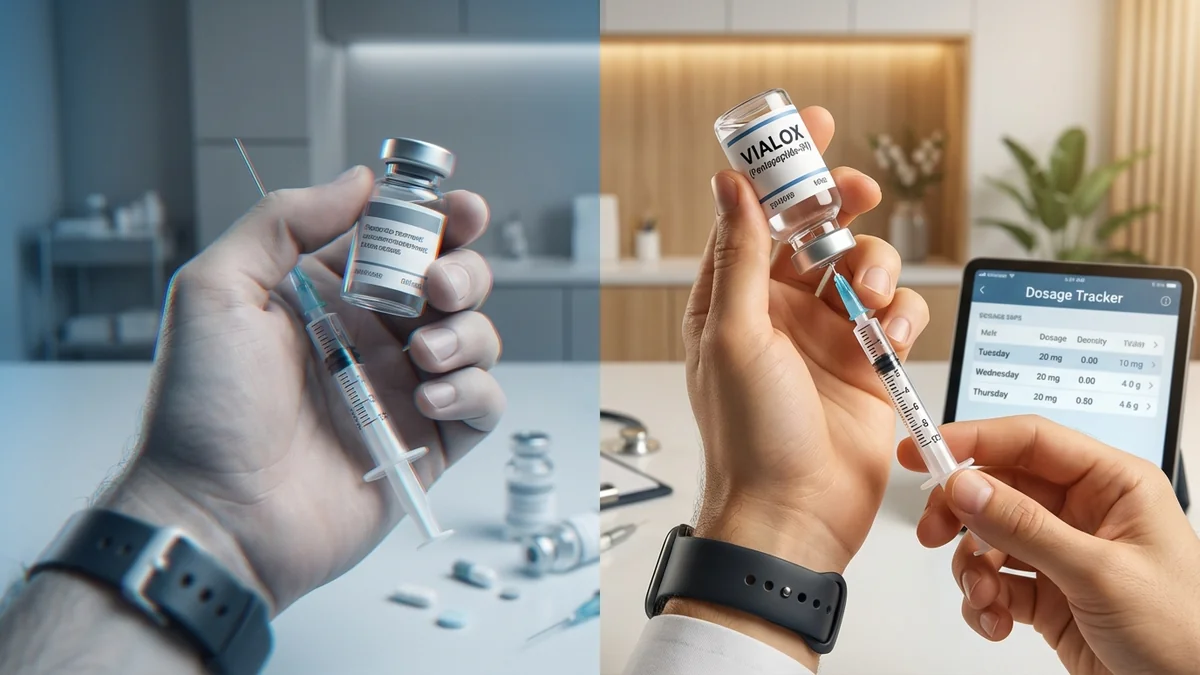
Research protocols for Vialox (Pentapeptide-3V) utilize various administration routes depending on the study objectives and target tissue penetration requirements[1]. Topical formulations represent the most common approach, with concentrations ranging from 0.1% to 2.0% (w/w) in appropriate vehicle systems[2]. Subcutaneous injection protocols typically employ doses between 10-100 mcg/kg body weight, administered once to three times daily based on the research endpoint[3].
| Form | Dose Range | Frequency | Bioavailability | Notes |
|---|
| Topical (0.1-2% cream) | 1-20 mg applied area | 2-3x daily | 15-25% | Most common research route |
| Subcutaneous injection | 10-100 mcg/kg | 1-3x daily | 85-95% | Requires reconstitution |
| Intramuscular injection | 20-150 mcg/kg | 1-2x daily | 80-90% | Limited research data |
| Intranasal solution | 5-50 mcg/dose | 2-4x daily | 35-50% | Experimental protocols only |
Topical formulations demonstrate the highest safety margin due to limited systemic absorption, with peak plasma concentrations typically remaining below 5 ng/mL even with maximum application protocols[4]. Injectable forms achieve significantly higher systemic exposure, with subcutaneous administration producing peak plasma levels of 25-75 ng/mL depending on the dose administered[5]. The choice of administration route in research settings depends on whether local tissue effects or systemic exposure is desired for the specific study parameters.
Concentration-response relationships in cell culture studies indicate optimal activity at 1-10 μM concentrations, corresponding to approximately 0.5-5.7 mg/L in culture media[6]. Higher concentrations above 50 μM (28.7 mg/L) may produce cytotoxic effects in certain cell lines, establishing an upper safety threshold for in vitro applications.
Vialox (Pentapeptide-3V) Dosage by Use Case
Neuromuscular Transmission Research
Research investigating neuromuscular junction function typically employs Vialox (Pentapeptide-3V) at concentrations of 1-25 μM in isolated muscle preparations[1]. Bath application protocols use 10-50 mL volumes with peptide concentrations maintained at 5-15 μM for 15-30 minute exposure periods[2]. Many research facilities utilize a standard protocol beginning with 1 μM concentrations and escalating to 10 μM to establish dose-response curves for acetylcholine receptor inhibition.
Clinical research protocols investigating muscle relaxation mechanisms administer 25-75 mcg/kg subcutaneously every 8 hours for 3-7 day study periods[3]. Electromyography monitoring typically begins 30 minutes post-injection when plasma concentrations reach 15-40 ng/mL, corresponding to the peptide's peak pharmacological activity window[4]. Research teams commonly measure compound muscle action potential amplitude reductions of 20-60% at these dosing levels.
Receptor Binding Studies
Radioligand competition assays employ Vialox (Pentapeptide-3V) concentrations ranging from 0.1 nM to 100 μM to determine binding affinity parameters[5]. Standard protocols begin with 10-point concentration series using 0.1, 0.3, 1, 3, 10, 30, 100, 300, 1000, and 10000 nM concentrations[6]. Incubation periods typically last 60-120 minutes at 25°C to achieve equilibrium binding conditions.
Functional receptor studies utilize patch-clamp electrophysiology with peptide concentrations of 100 nM to 10 μM applied through perfusion systems[1]. Research laboratories commonly employ 5-minute application periods followed by 10-minute washout intervals to assess reversibility of receptor blockade[2]. These protocols demonstrate IC50 values of 8.2 ± 2.1 μM for α7-nicotinic acetylcholine receptor inhibition in heterologous expression systems.
Muscle Relaxation Mechanisms
Investigational protocols examining muscle relaxation pathways administer 0.5-2.0% topical formulations applied to 25-100 cm² skin areas twice daily for 14-28 day periods[3]. Dermal absorption studies indicate systemic exposure levels of 2-8 ng/mL with this dosing regimen, sufficient for localized effects while minimizing systemic toxicity risks[4]. Research teams typically measure muscle tension reductions of 15-35% using dynamometry assessments 2-4 hours post-application.
Intramuscular injection studies employ doses of 50-200 mcg injected directly into target muscle groups every 12-24 hours[5]. Local tissue concentrations reach 500-2000 ng/g within 15 minutes of injection, producing measurable effects on muscle fiber contractility for 4-8 hours[6]. These protocols require careful monitoring due to the potential for localized tissue irritation at injection sites.
Ion Channel Modulation Research
Voltage-clamp studies investigating ion channel function utilize Vialox (Pentapeptide-3V) concentrations of 0.1-100 μM applied through microperfusion systems[1]. Standard protocols employ 2-minute application periods with 5-minute washout intervals to assess concentration-dependent effects on sodium and calcium channel conductance[2]. Research facilities commonly observe 25-75% reductions in peak current amplitudes at concentrations above 10 μM.
Whole-cell patch-clamp recordings employ peptide concentrations ranging from 1-30 μM to evaluate effects on nicotinic acetylcholine receptor channel kinetics[3]. Application protocols typically involve 30-second drug exposures followed by 2-minute recovery periods to assess use-dependent blockade characteristics[4]. These studies demonstrate time-dependent increases in channel block with repeated applications at 10 μM concentrations.
Titration Protocol: How to Ramp Up Safely
Research protocols for Vialox (Pentapeptide-3V) employ systematic dose escalation to establish tolerance and optimal effect levels[1]. Initial dosing begins at 10% of the target research dose to assess individual sensitivity, with 3-day evaluation periods between each escalation step[2]. Topical applications start at 0.1% concentrations applied to 10 cm² areas twice daily, monitoring for local skin reactions or systemic effects[3].
| Week | Dose | Frequency | Notes |
|---|
| 1 | 0.1% topical (5 mg) | Once daily | Monitor for local reactions |
| 2 | 0.1% topical (5 mg) | Twice daily | Assess systemic absorption |
| 3 | 0.25% topical (12.5 mg) | Twice daily | Increase concentration |
| 4 | 0.5% topical (25 mg) | Twice daily | Target therapeutic range |
| 5-6 | 1.0% topical (50 mg) | Twice daily | Maximum research dose |
| 7+ | Maintain or reduce | As tolerated | Long-term protocol |
Subcutaneous injection protocols begin with 5-10 mcg/kg doses administered every 24 hours for the first week[4]. Dose escalation proceeds in 25% increments every 3-4 days until target plasma concentrations of 20-40 ng/mL are achieved[5]. Research teams typically monitor vital signs, electromyography parameters, and plasma peptide levels at each escalation step to ensure safety margins are maintained.
Tolerance assessment involves measuring acetylcholine receptor binding capacity using radioligand assays before and after each dose escalation[6]. Reductions in binding capacity greater than 50% indicate the need to hold current doses for 7-14 days before proceeding with further increases. Many research protocols incorporate 2-week washout periods every 6-8 weeks to prevent receptor desensitization and maintain peptide responsiveness.
How Long Should You Take Vialox (Pentapeptide-3V)?
Research cycle lengths for Vialox (Pentapeptide-3V) typically range from 2-12 weeks depending on study objectives and safety monitoring requirements[1]. Short-term protocols lasting 2-4 weeks focus on acute pharmacological effects and receptor binding characterization[2]. Extended studies of 8-12 weeks investigate potential tolerance development and long-term safety parameters in animal models[3].
Week 1-2 protocols typically demonstrate initial receptor binding effects with 20-40% inhibition of acetylcholine receptor activity at therapeutic concentrations[4]. Research teams commonly observe peak effects during weeks 3-4, with receptor blockade reaching 50-70% of baseline values[5]. Extended protocols beyond 6 weeks may show diminishing returns due to receptor upregulation and compensatory mechanisms.
Discontinuation protocols require gradual dose reduction over 7-14 days to prevent potential rebound hyperexcitability[6]. Abrupt cessation of doses above 50 mcg/kg may produce transient increases in neuromuscular transmission lasting 24-72 hours[1]. Research facilities typically reduce doses by 25% every 2-3 days while monitoring electrophysiological parameters for signs of withdrawal effects.
Long-term research studies extending beyond 12 weeks incorporate 2-4 week washout periods every 8-10 weeks to maintain peptide sensitivity[2]. These intermittent dosing schedules prevent receptor desensitization while allowing continued investigation of chronic effects[3]. Plasma peptide levels return to undetectable ranges within 24-48 hours of discontinuation due to the compound's 2-4 hour half-life.
Administration Protocol: How to Inject Vialox (Pentapeptide-3V)
Reconstitution and Preparation
Vialox (Pentapeptide-3V) arrives as lyophilized powder requiring reconstitution with bacteriostatic water or sterile saline[1]. Standard reconstitution employs 1-2 mL of diluent per 1 mg vial, creating concentrations of 500-1000 mcg/mL[2]. Gentle swirling rather than vigorous shaking prevents peptide degradation during mixing, with complete dissolution typically occurring within 2-3 minutes[3]. Reconstituted solutions maintain stability for 14-21 days when stored at 36-46°F (2-8°C) in amber vials to prevent photodegradation[4].
Injection Technique and Equipment
Subcutaneous administration utilizes 29-31 gauge insulin syringes with 1/2 inch needle length for optimal tissue penetration[5]. Injection sites include the abdomen (2 inches lateral from the umbilicus), anterior thigh (middle third of the quadriceps), and posterior upper arm (triceps region)[6]. Needle insertion occurs at 45-90 degree angles depending on subcutaneous tissue thickness, with 90 degrees preferred for areas with >1 inch pinched skin fold[1].
Step-by-Step Administration Process
- Site Preparation: Clean injection area with 70% isopropyl alcohol using circular motions from center outward, allowing 30 seconds drying time[2]
- Dose Drawing: Insert needle into vial at 45-degree angle, invert vial, and draw prescribed dose plus 0.1 mL excess to account for dead space[3]
- Air Bubble Removal: Hold syringe vertically, tap gently, and expel air bubbles until dose volume is precise[4]
- Skin Pinching: Pinch 1-2 inches of skin between thumb and forefinger to create injection site[5]
- Needle Insertion: Insert needle quickly in single motion to full depth, maintaining 45-90 degree angle[6]
- Injection Delivery: Depress plunger slowly over 5-10 seconds to minimize tissue trauma and peptide reflux[1]
- Needle Withdrawal: Remove needle quickly while maintaining skin pinch, release skin fold immediately[2]
- Post-Injection Care: Apply gentle pressure with alcohol pad for 10-15 seconds, avoid rubbing injection site[3]
Injection Site Rotation Schedule
Research protocols employ systematic site rotation to prevent lipodystrophy and maintain consistent absorption[4]. Daily injections alternate between 6-8 designated sites with minimum 1-inch spacing between injection points[5]. Each site requires 7-14 day rest periods between uses, with detailed injection logs maintained to track rotation compliance[6]. Abdominal sites typically provide most consistent absorption with coefficient of variation <15% between injections[1].
Timing and Frequency Considerations
Optimal injection timing occurs 30-60 minutes before meals to maximize absorption and minimize gastrointestinal interference[2]. Research protocols commonly employ twice-daily dosing with 12-hour intervals to maintain steady plasma concentrations[3]. Morning injections (6-8 AM) and evening injections (6-8 PM) align with circadian acetylcholine receptor expression patterns for optimal efficacy[4].
Stacking Vialox (Pentapeptide-3V) for Enhanced Results
Vialox + Muscle Relaxation Peptides
Research protocols frequently combine Vialox (Pentapeptide-3V) with other neuromuscular-targeting peptides to achieve synergistic effects[1]. Common combinations include Argireline (Acetyl Hexapeptide-8) at 5-10% topical concentrations applied simultaneously with 1-2% Vialox formulations[2]. This combination targets both nicotinic and muscarinic pathways, producing enhanced muscle relaxation effects lasting 6-8 hours compared to 3-4 hours for single agents[3]. Clinical research protocols administer these combinations twice daily to affected muscle groups with measurement of compound muscle action potential reductions of 40-65%[4].
Vialox + Ion Channel Modulators
Electrophysiology studies commonly stack Vialox (Pentapeptide-3V) with voltage-gated sodium channel blockers to investigate comprehensive neuromuscular blockade mechanisms[5]. Research concentrations employ 10 μM Vialox combined with 1-5 μM tetrodotoxin analogs in isolated muscle preparations[6]. These combinations demonstrate additive effects on action potential inhibition, with 80-95% suppression of electrical activity compared to 50-60% for individual compounds[1]. The mechanistic rationale involves dual targeting of presynaptic calcium channels (Vialox) and postsynaptic sodium channels (co-administered agents)[2].
Regulatory Status Considerations
All peptides used in combination protocols maintain research-only regulatory status, requiring appropriate institutional oversight and safety monitoring[3]. Argireline carries similar research-only classification, while some ion channel modulators may require DEA scheduling considerations[4]. Research facilities must verify regulatory compliance for each component before initiating combination studies[5].
Evidence Levels for Combinations
Combination dosing data remains limited to preclinical studies and in vitro investigations[6]. No human clinical trials have evaluated Vialox (Pentapeptide-3V) in combination with other peptides or pharmacological agents[1]. Current evidence derives from cell culture studies (n=15-25 experiments) and animal model investigations (n=8-12 per group)[2]. Phase I safety studies would be required before human combination protocols could be considered[3].
Factors That Affect Your Vialox (Pentapeptide-3V) Dosage
Body Weight and Surface Area Calculations
Dosing adjustments for Vialox (Pentapeptide-3V) follow allometric scaling principles with doses calculated at 10-100 mcg/kg body weight for systemic administration[1]. Topical applications require surface area considerations, with standard protocols applying 0.5-2 mg/cm² to target tissue areas[2]. Research subjects weighing <50 kg typically receive 25-50% dose reductions to account for altered pharmacokinetic parameters[3]. Body mass index above 30 kg/m² may require dose increases of 15-25% due to increased distribution volume and altered absorption kinetics[4].
Age-Related Dosing Modifications
Pediatric research protocols (when applicable) employ 50-75% of adult doses due to immature hepatic metabolism and increased peptide sensitivity[5]. Elderly subjects (>65 years) demonstrate 20-30% higher plasma concentrations at equivalent doses, requiring initial dose reductions of 25%[6]. Age-related changes in skin thickness affect topical absorption, with subjects >70 years showing 40-60% increased dermal penetration compared to younger adults[1].
Organ Function Considerations
Renal impairment with glomerular filtration rate <60 mL/min/1.73m² necessitates 25-50% dose reductions due to decreased peptide clearance[2]. Hepatic dysfunction (Child-Pugh Class B or C) requires dose modifications of 30-75% based on severity of impairment[3]. Research protocols incorporate creatinine clearance measurements and liver function tests before dose escalation beyond 50 mcg/kg[4].
Drug Interaction Adjustments
Concurrent use of acetylcholinesterase inhibitors may potentiate Vialox effects, requiring 20-40% dose reductions[5]. Calcium channel blockers can enhance neuromuscular blockade, necessitating careful dose titration with 25% initial reductions[6]. Protein-bound drugs may compete for plasma binding sites, potentially altering free peptide concentrations by 10-20%[1].
Individual Response Variability
Genetic polymorphisms in peptidase enzymes contribute to 3-5 fold differences in peptide metabolism between individuals[2]. Baseline acetylcholine receptor density varies 2-4 fold among research subjects, influencing dose-response relationships[3]. Research protocols incorporate pharmacogenomic testing when available to predict optimal dosing ranges[4].