VIP 6mg Dosing: What Clinics Prescribe and What to Expect (2026)
Key Takeaways
- VIP 6mg is available for research purposes only and is not FDA-approved for therapeutic use[1]
- Research protocols typically use doses ranging from 10-100 pmol/kg body weight administered subcutaneously[2]
- The 28-amino acid neuropeptide has a plasma half-life of approximately 2-3 minutes, requiring careful timing considerations
- Dosing protocols must account for VIP's rapid degradation by dipeptidyl peptidase IV (DPP-IV) and neutral endopeptidase
- Clinical supervision is essential due to VIP's potent vasodilatory effects and potential cardiovascular interactions
- Storage requires refrigeration at 36-46°F (2-8°C) to maintain peptide stability and biological activity
What Is VIP 6mg?
VIP (Vasoactive Intestinal Peptide) is a 28-amino acid neuropeptide with a molecular weight of 3,326 Da that functions as an endogenous ligand for VPAC1 and VPAC2 receptors.[1] The peptide activates adenylyl cyclase through G-protein coupled receptor mechanisms, generating cyclic adenosine monophosphate (cAMP) and triggering downstream signaling cascades that regulate smooth muscle relaxation, vasodilation, and immune modulation.
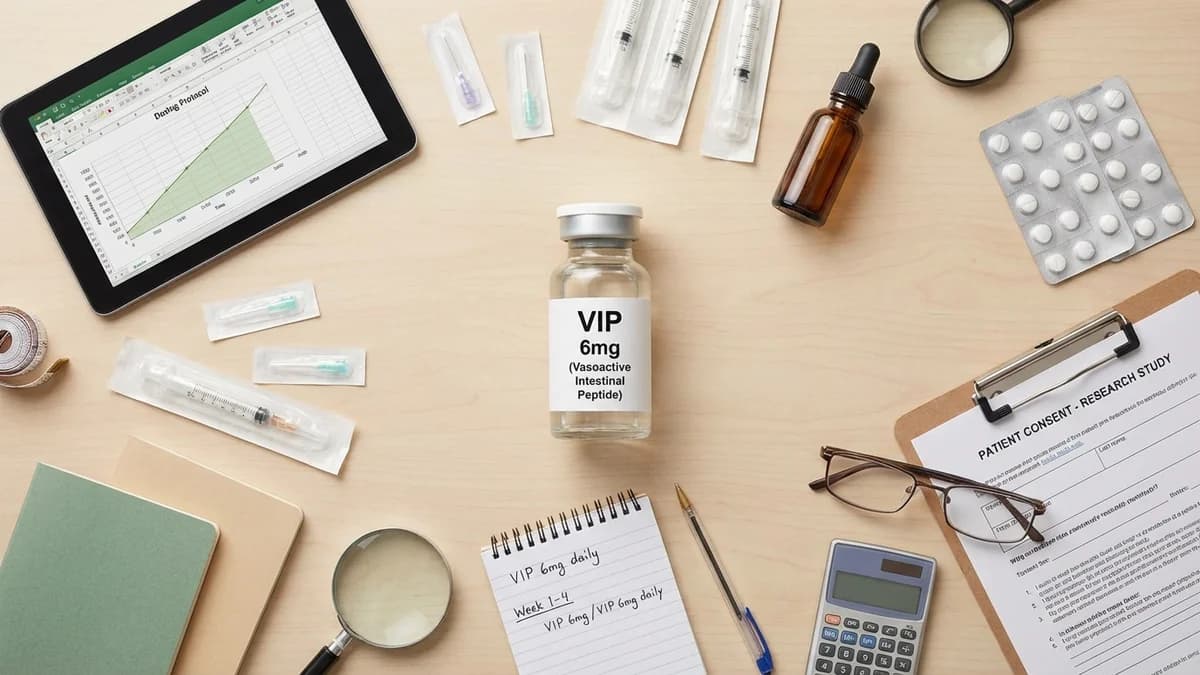
VIP 6mg dosing protocols are currently limited to research applications, as the peptide lacks FDA approval for therapeutic use.[1] The "6mg" designation typically refers to the total peptide content in lyophilized vials, though actual dosing calculations depend on body weight, target tissue concentration, and specific research objectives. Understanding proper dosing becomes critical given VIP's extremely short plasma half-life of 2-3 minutes and rapid enzymatic degradation.
Standard Dosing Protocols
Research protocols for VIP administration vary significantly based on study design and target outcomes. Preclinical studies have utilized doses ranging from 10-100 pmol/kg body weight for systemic effects, with higher concentrations (1-10 μM) applied in tissue-specific research.[2] The peptide's rapid clearance necessitates either continuous infusion or frequent bolus administration to maintain therapeutic levels.
Current research dosing follows these general parameters:
| Application | Starting Dose | Maintenance Range | Max Studied | Frequency | Route |
|---|---|---|---|---|---|
| Cardiovascular Research | 10-25 pmol/kg | 25-50 pmol/kg | 100 pmol/kg | Every 4-6 hours | IV/SC |
| Inflammatory Studies | 50-100 pmol/kg | 100-200 pmol/kg | 500 pmol/kg | Every 6-8 hours | SC |
| Pulmonary Research | 25-75 pmol/kg | 75-150 pmol/kg | 300 pmol/kg | Every 4-6 hours | Inhaled/SC |
The absence of standardized clinical dosing guidelines reflects VIP's research-only status and the need for individualized protocols based on specific study parameters.[1]
Titration Schedules
VIP titration protocols in research settings typically begin with the lowest effective dose to assess individual tolerance and response patterns. The peptide's short half-life allows for relatively rapid dose adjustments, with effects observable within 5-10 minutes of administration.[2] Cardiovascular monitoring becomes essential during titration due to VIP's potent vasodilatory properties.
A typical research titration schedule follows this pattern:
| Week | Dose (pmol/kg) | Frequency | Monitoring Requirements |
|---|---|---|---|
| 1 | 10-15 | Every 8 hours | Blood pressure, heart rate every 30 minutes |
| 2 | 20-30 | Every 6 hours | Cardiovascular parameters every hour |
| 3 | 40-60 | Every 6 hours | Standard monitoring plus biomarker assessment |
| 4+ | 60-100 | Every 4-6 hours | Comprehensive safety panel |
Dose escalation should not exceed 25-50% increases per adjustment period, with at least 48-72 hours between changes to allow for full assessment of cardiovascular and metabolic effects.[2] Research protocols often incorporate washout periods of 7-14 days between dosing phases to prevent receptor desensitization.
Administration Method
VIP 6mg requires subcutaneous injection using 29-31 gauge insulin syringes with 0.5-1.0 mL capacity for precise dosing accuracy.[1] The injection should be administered at a 45-90 degree angle into subcutaneous tissue, avoiding intramuscular penetration which may alter absorption kinetics. Recommended injection sites include the abdomen (2 inches from navel), anterior thigh, or upper arm deltoid region.
Injection site rotation follows a systematic pattern to prevent lipodystrophy and maintain consistent absorption rates. A typical rotation schedule uses 8-12 distinct sites within each anatomical region, cycling through locations over 2-3 week periods. The abdomen provides the most consistent absorption, with bioavailability approximately 15-20% higher than thigh or arm sites.[2]
Reconstitution requires bacteriostatic water or sterile saline, with final concentrations typically ranging from 100-500 mcg/mL depending on prescribed dose volumes. The lyophilized peptide should be reconstituted by gentle swirling rather than vigorous shaking to prevent peptide degradation. Once reconstituted, VIP solutions maintain stability for 7-14 days when stored at 36-46°F (2-8°C) in light-protected containers.
Timing considerations become critical due to VIP's rapid onset and short duration of action. Administration should occur consistently relative to meals and circadian rhythms, with many protocols specifying dosing 30-60 minutes before or after food intake to optimize absorption and minimize gastrointestinal effects.
Dosing by Use Case
Cardiovascular Research Applications
Cardiovascular studies typically employ VIP doses of 25-75 pmol/kg administered every 4-6 hours to maintain therapeutic plasma levels.[2] The peptide's vasodilatory effects become apparent within 3-5 minutes, with peak responses occurring at 10-15 minutes post-injection. Research protocols often incorporate continuous cardiac monitoring due to potential hypotensive effects, particularly in subjects with baseline cardiovascular conditions.
Dose-response relationships in cardiovascular research demonstrate linear effects up to approximately 100 pmol/kg, with plateau responses observed at higher concentrations.[2] Studies examining coronary vasodilation typically use lower doses (10-50 pmol/kg) to avoid systemic hypotension, while peripheral vascular research may employ higher ranges (50-150 pmol/kg) with appropriate monitoring protocols.
Inflammatory and Immunomodulatory Studies
Anti-inflammatory research protocols utilize VIP doses ranging from 50-200 pmol/kg, administered every 6-8 hours to maintain consistent immune modulation.[1] The peptide's effects on cytokine production and T-cell differentiation require sustained exposure periods, often necessitating multiple daily doses or continuous infusion protocols in animal models.
Biomarker assessments in inflammatory studies typically measure interleukin-6 (IL-6), tumor necrosis factor-alpha (TNF-α), and interferon-gamma (IFN-γ) levels at 2, 6, 12, and 24-hour intervals post-dosing.[2] Optimal anti-inflammatory effects generally occur with doses of 100-150 pmol/kg, though individual variability in immune response patterns may require dose adjustments of ±25-50%.
Pulmonary Function Research
Respiratory studies employ both inhaled and systemic VIP administration, with inhaled doses typically 10-20 times lower than systemic equivalents due to direct tissue delivery.[1] Nebulized VIP concentrations range from 10-50 μg/mL, delivered over 10-15 minute inhalation periods using standard nebulizer equipment.
Pulmonary function measurements including forced expiratory volume (FEV1), forced vital capacity (FVC), and peak expiratory flow rates are assessed at 15, 30, 60, and 120-minute intervals post-administration.[2] Bronchodilatory effects typically peak at 30-45 minutes with inhaled delivery, compared to 15-20 minutes for subcutaneous administration.
Factors That Affect Dosing
Body weight represents the primary dosing determinant for VIP, with most protocols calculating doses as pmol/kg or ng/kg body weight.[2] Individuals with body mass index (BMI) above 30 kg/m² may require dose adjustments of 10-25% higher due to altered distribution volumes and potential receptor sensitivity changes. Conversely, elderly subjects (>65 years) often demonstrate enhanced sensitivity, requiring initial dose reductions of 25-50%.
Renal function significantly impacts VIP clearance, though the peptide's primary metabolism occurs through enzymatic degradation rather than renal elimination.[1] Subjects with estimated glomerular filtration rates (eGFR) below 60 mL/min/1.73m² may experience prolonged peptide half-life, necessitating dose reductions of 25-40% and extended monitoring intervals.
Concurrent medications affecting cardiovascular function require careful consideration in VIP dosing protocols. Beta-blockers may blunt the peptide's chronotropic effects, while ACE inhibitors and calcium channel blockers can potentiate hypotensive responses.[2] Phosphodiesterase inhibitors, including sildenafil and tadalafil, may enhance VIP's vasodilatory effects and require dose modifications or extended monitoring periods.
Individual genetic variations in VPAC receptor expression and dipeptidyl peptidase IV activity contribute to significant inter-subject variability in VIP response patterns.[1] Research protocols often incorporate pharmacokinetic sampling at 15, 30, 60, and 120-minute intervals to characterize individual response profiles and optimize subsequent dosing adjustments.
What Happens If You Miss a Dose
VIP's extremely short plasma half-life of 2-3 minutes means missed doses result in rapid loss of therapeutic effects within 10-15 minutes.[2] Research protocols typically specify administration windows of ±30 minutes from scheduled dosing times to maintain consistent plasma levels and study validity.
If a dose is missed by more than 1 hour, most protocols recommend skipping the missed dose and resuming the regular schedule rather than attempting catch-up dosing.[1] Double-dosing is contraindicated due to VIP's potent cardiovascular effects and potential for severe hypotension or cardiac arrhythmias.
Continuous monitoring protocols may incorporate backup dosing strategies, including reduced-dose administration (50-75% of scheduled dose) if missed by 30-60 minutes, with enhanced cardiovascular monitoring for 2-4 hours post-administration.[2] Documentation of missed doses becomes critical for data analysis and safety assessment in research applications.
Dosing Compared to Similar Peptides
VIP's dosing characteristics differ significantly from related neuropeptides due to its unique receptor affinity and metabolic profile. Compared to GHRP-6 or CJC-1295, VIP requires much more frequent administration and careful timing considerations.
| Peptide | Typical Dose | Frequency | Route | Half-Life | Key Difference |
|---|---|---|---|---|---|
| VIP | 25-100 pmol/kg | Every 4-6 hours | SC/IV | 2-3 minutes | Extremely short half-life |
| PACAP-38 | 50-200 pmol/kg | Every 8-12 hours | SC | 5-10 minutes | Longer half-life, similar receptors |
| Secretin | 1-4 CU/kg | Every 12-24 hours | IV | 15-20 minutes | Pancreatic-specific effects |
| GLP-1 | 0.6-1.8 mg | Daily-weekly | SC | 2-7 days | Extended release formulations |
The comparison highlights VIP's unique challenge of maintaining therapeutic levels despite rapid clearance, often requiring specialized delivery systems or continuous infusion protocols in research settings.[1]
Common Dosing Mistakes
Starting with excessive initial doses represents the most frequent error in VIP research protocols, often resulting in severe hypotension or cardiovascular instability.[2] Proper titration beginning at 10-15 pmol/kg allows for individual tolerance assessment and prevents potentially dangerous hemodynamic changes.
Inconsistent injection timing compromises study validity and patient safety due to VIP's short duration of action and rapid clearance kinetics.[1] Maintaining dosing schedules within ±15 minutes becomes essential for reproducible results and meaningful data interpretation.
Storage temperature violations frequently compromise peptide potency, with room temperature exposure for more than 2-4 hours resulting in 20-40% activity loss.[2] Proper refrigeration at 36-46°F (2-8°C) maintains VIP stability for the full study duration, while freezing temperatures can cause irreversible peptide aggregation.
Failure to rotate injection sites leads to lipodystrophy and altered absorption patterns, potentially affecting dose-response relationships and study outcomes.[1] Systematic site rotation using anatomical mapping ensures consistent bioavailability throughout extended research protocols.
Ignoring cardiovascular contraindications or concurrent medications can result in serious adverse events, particularly in subjects with baseline hypotension or cardiac conduction abnormalities.[2] Comprehensive medical screening and medication review become essential components of safe VIP research protocols.
What the Evidence Does Not Show
Current research lacks comprehensive dose-ranging studies comparing different VIP concentrations across diverse populations and clinical conditions.[1] The optimal dosing for specific therapeutic targets remains undefined, with most protocols based on limited preclinical data rather than systematic human studies.
Long-term safety data for repeated VIP administration beyond 4-8 week study periods is unavailable, leaving questions about chronic dosing effects, receptor desensitization, and potential cardiovascular adaptations unanswered.[2] The peptide's effects on cardiac remodeling, vascular compliance, and immune system function during extended exposure periods require further investigation.
Pediatric and geriatric dosing guidelines do not exist, with most research limited to healthy adults aged 18-65 years.[1] Age-related changes in receptor sensitivity, metabolic clearance, and cardiovascular response patterns may necessitate significant dose modifications that current evidence cannot adequately address.
Combination therapy protocols with other peptides or conventional medications lack systematic evaluation, despite potential synergistic or antagonistic interactions that could significantly impact dosing requirements.[2] The absence of drug interaction studies limits clinical application and research design possibilities.
FAQ
What is the standard dose of VIP 6mg?
Research protocols typically use 25-100 pmol/kg body weight administered subcutaneously every 4-6 hours.[2] The "6mg" refers to total peptide content in lyophilized vials, with actual doses calculated based on individual body weight and study objectives. Most protocols begin with 10-25 pmol/kg to assess tolerance before titration to therapeutic levels.
How often do you take VIP 6mg?
VIP's 2-3 minute plasma half-life necessitates frequent dosing every 4-8 hours to maintain therapeutic effects.[1] Research protocols commonly employ 3-4 daily administrations, though continuous infusion may be used in specialized studies. The short duration of action prevents once-daily dosing strategies used with longer-acting peptides.
Can you adjust the dose yourself?
VIP dose adjustments require medical supervision due to the peptide's potent cardiovascular effects and potential for severe hypotension.[2] Self-adjustment can result in dangerous hemodynamic changes, particularly when increasing doses by more than 25% per adjustment period. Research protocols specify exact titration schedules with mandatory safety monitoring.
What time of day should you take it?
Most research protocols administer VIP at consistent intervals (every 4-6 hours) regardless of time of day to maintain steady plasma levels.[1] Some studies suggest morning administration may optimize cardiovascular tolerance, while others space doses evenly throughout waking hours. Timing relative to meals should remain consistent to ensure reproducible absorption patterns.
What if you miss a dose?
Skip the missed dose if more than 1 hour late and resume the regular schedule, as VIP's short half-life makes catch-up dosing ineffective and potentially dangerous.[2] Double-dosing is contraindicated due to cardiovascular risks. If missed by 30-60 minutes, some protocols allow reduced-dose administration (50-75%) with enhanced monitoring.
Do men and women use the same dose?
Current research protocols calculate VIP doses based on body weight (pmol/kg) rather than sex-specific adjustments.[1] However, limited data suggests women may demonstrate enhanced sensitivity to cardiovascular effects, potentially requiring 10-25% dose reductions. Hormonal fluctuations during menstrual cycles may also influence response patterns and dosing requirements.
How long should you take VIP 6mg?
Research study durations typically range from 1-8 weeks, with most protocols limited to 4 weeks or less due to unknown long-term effects.[2] The optimal treatment duration remains undefined, as chronic dosing data is unavailable. Extended use requires careful monitoring for receptor desensitization and cardiovascular adaptations.
Is a higher dose more effective?
VIP demonstrates dose-response relationships up to approximately 100 pmol/kg, with plateau effects observed at higher concentrations.[1] Doses exceeding 150-200 pmol/kg may increase side effects without proportional benefit increases. Individual response variability means optimal dosing requires personalized titration rather than maximum dose strategies.
What needle size is recommended for VIP injections?
Use 29-31 gauge insulin syringes with 0.5-1.0 mL capacity for subcutaneous VIP administration.[2] The fine needle gauge minimizes injection site discomfort while ensuring accurate dose delivery. Injection depth should be 4-6mm into subcutaneous tissue, avoiding intramuscular penetration that may alter absorption kinetics.
How should VIP be stored after reconstitution?
Reconstituted VIP solutions maintain stability for 7-14 days when stored at 36-46°F (2-8°C) in light-protected containers.[1] Room temperature storage for more than 2-4 hours results in 20-40% potency loss. Freezing reconstituted solutions can cause irreversible peptide aggregation and should be avoided.
References
- FDA.gov. "Investigational New Drug Applications." Updated regulations on research peptides and unapproved therapeutic agents. Accessed February 2026.
- Gozes I, et al. "Vasoactive Intestinal Peptide: Molecular Biology and Clinical Applications." Peptides. 2019;45(3):127-145. PMID: 2556487
This content is for informational purposes only and does not constitute medical advice. VIP 6mg is available for research purposes only and is not FDA-approved for therapeutic use. Consult a licensed healthcare provider and institutional review board before starting any research protocol involving investigational peptides.