5-Amino-1MQ: Dosage, Benefits, FDA Status & Clinics (2026)
5-Amino-1MQ
Research Only
investigate epigenetic and redox control mechanismscellular metabolismaging
Last reviewed March 2026·MyPeptideMatch Team
What Is 5-Amino-1MQ?
5-Amino-1MQ targets one of the most overlooked enzymes in metabolic biology — nicotinamide N-methyltransferase, or NNMT — and blocks it. That single action has downstream effects on fat cell metabolism, NAD⁺ availability, and potentially on aging-related cellular decline. It's a small molecule, taken orally, and it's generated real interest in the longevity and metabolic research communities. The catch: every meaningful result so far has come from animal studies. No completed human clinical trials exist.
The compound's full name is 5-amino-1-methylquinolinium. It was developed specifically to probe what happens when you remove NNMT's brake on the NAD⁺ salvage pathway — and the preclinical data has been compelling enough that it's found its way into the gray-market research chemical space. Whether that translates to humans the way the mouse data suggests is still genuinely unknown.
If you're looking at this page because you're considering using it, or because a clinic has mentioned it, the most important thing to understand upfront is where the evidence actually stands: preclinical, not clinical. That doesn't mean it's without promise. It means the human chapter hasn't been written yet.
Key Takeaways
5-Amino-1MQ is a selective NNMT inhibitor — it blocks an enzyme that suppresses NAD⁺ production and promotes fat storage, particularly in adipose tissue.
All meaningful efficacy data comes from animal studies; no completed human clinical trials exist as of March 2026.
The compound is not FDA-approved and has no legal pathway as a therapeutic in the United States — it is available for research purposes only.
Human safety data is absent; the side effect profile in people is genuinely unknown.
It is taken orally, which distinguishes it from most peptide-based metabolic therapies that require injection.
The story starts with NAD⁺ — nicotinamide adenine dinucleotide — which your cells use to power hundreds of metabolic reactions, including the ones that determine how efficiently you burn fat and how well your mitochondria function. NAD⁺ levels decline with age, and that decline is linked to slower metabolism, reduced cellular repair capacity, and accumulating fat mass. Most NAD⁺-boosting strategies you've probably heard of — NMN, NR — work by adding precursors upstream. 5-Amino-1MQ works differently. It removes a drain.
NNMT is an enzyme expressed heavily in adipose (fat) tissue. Its job is to methylate nicotinamide — essentially consuming the raw material that would otherwise be recycled into NAD⁺ through the salvage pathway. When NNMT is highly active, it diverts nicotinamide away from NAD⁺ synthesis and simultaneously burns through S-adenosylmethionine (SAM), a universal methyl donor involved in epigenetic regulation. High NNMT activity in fat tissue is associated with obesity and metabolic dysfunction.[1]
5-Amino-1MQ fits into NNMT's active site and blocks it selectively. With NNMT inhibited, nicotinamide stays in the salvage pathway and gets converted to NAD⁺ instead of being methylated and excreted. Intracellular NAD⁺ rises. SAM is preserved. The downstream effect — at least in mouse models — is that fat cells shift from storage mode toward energy expenditure, and whole-body fat mass decreases without caloric restriction.[1]
The "selective" part matters. NNMT inhibitors that aren't selective can interfere with related methyltransferases involved in DNA and histone methylation, which creates obvious safety concerns. The design goal with 5-Amino-1MQ was specificity for NNMT's active site — though how well that selectivity holds across human physiology hasn't been tested in trials.
What the Clinical Evidence Actually Shows
Here's the honest version: the evidence is preclinical. All of it. That's not a dismissal — the preclinical data is genuinely interesting — but it's the reality you need to understand before evaluating this compound.
The most cited work comes from studies using diet-induced obese mouse models. In those experiments, NNMT inhibition with compounds in the 5-Amino-1MQ class produced meaningful reductions in fat mass, improved metabolic markers, and raised NAD⁺ levels in adipose tissue — without the animals eating less.[1] That last part is what generated excitement: fat loss without appetite suppression or caloric restriction is a different mechanism than anything currently approved.
In-vitro work has shown that NNMT inhibition in human adipocyte cell lines (fat cells grown in a lab) shifts those cells toward a more metabolically active phenotype, increasing expression of genes associated with fat oxidation.[1] That's a step closer to human relevance than a mouse study, but it's still not a human trial.
The epigenetic angle is also real. Because NNMT consumes SAM, high NNMT activity can alter methylation patterns on DNA and histones — the chemical tags that regulate which genes are expressed. In theory, inhibiting NNMT preserves SAM availability and supports normal epigenetic regulation. Whether this translates to meaningful anti-aging effects in humans is, at this point, speculation grounded in plausible biology.
No Phase 1 safety trial. No dose-finding study in humans. No randomized controlled trial of any phase. That's where things stand.
What We Don't Know Yet
Human pharmacokinetics — We don't have oral bioavailability, peak plasma concentration, or half-life data from human studies. The animal pharmacokinetics may not translate directly.
Effective human dose — Animal doses (often expressed as mg/kg) don't convert linearly to human doses. Practitioner-reported ranges exist, but they're not validated by trials.
Long-term safety — NNMT plays roles beyond fat metabolism. Sustained inhibition in humans — particularly effects on methylation balance, liver function, and immune regulation — hasn't been characterized.
Selectivity in vivo — In-vitro selectivity data is promising, but whether 5-Amino-1MQ remains NNMT-selective at therapeutic concentrations in a living human system is unconfirmed.
Cardiovascular and oncological effects — NAD⁺ metabolism intersects with pathways relevant to cancer biology. No long-term oncological safety data exists.
Comparison to NAD⁺ precursors — Whether 5-Amino-1MQ raises NAD⁺ more effectively than NMN or NR in humans hasn't been tested head-to-head.
What Makes 5-Amino-1MQ Different
Most metabolic interventions either reduce caloric intake (GLP-1 agonists, appetite suppressants) or increase energy expenditure through stimulant-like mechanisms. 5-Amino-1MQ doesn't fit either category. It targets the enzyme that makes fat cells metabolically lazy — and in mouse models, that distinction produced fat loss without the animal eating less or moving more.[1]
The mechanism that sets it apart
Most fat-loss compounds work by reducing how much you eat or by stimulating thermogenesis through adrenergic pathways. 5-Amino-1MQ works upstream of both — it targets the enzyme that suppresses NAD⁺ production specifically in fat tissue, shifting adipocytes from energy-storage to energy-expenditure mode. In diet-induced obese mouse models, this produced measurable fat mass reduction without caloric restriction.[1]
The oral administration is also notable in a field dominated by injectable peptides. If the mechanism proves out in humans, an oral NNMT inhibitor would have significant practical advantages over subcutaneous peptides for long-term metabolic management.
The NAD⁺ angle connects 5-Amino-1MQ to the broader longevity research space — sirtuins, PARP enzymes, and mitochondrial function all depend on NAD⁺ availability. Whether the NAD⁺ boost from NNMT inhibition is meaningfully different from supplementing NMN or NR is an open question, but the mechanism is genuinely distinct: you're preserving the substrate rather than adding more of it.
Typical Dosing — Practitioner & Community Ranges
No published clinical trials have established an official human dose for 5-Amino-1MQ. The ranges below reflect what practitioners and researchers commonly report, based on available protocol guides and community consensus — not randomized trial data.
These are not clinical trial doses
No Phase 1, Phase 2, or Phase 3 human trials have established a safe or effective dose of 5-Amino-1MQ. The figures below represent practitioner and research community consensus only. They carry real uncertainty. Dosing should be discussed with a licensed healthcare provider who is familiar with this compound.
Animal studies used doses in the range of 50–200 mg/kg body weight, but that figure doesn't translate directly to humans — interspecies scaling typically involves significant downward adjustment. Practitioner communities most commonly report oral doses of 50–100 mg per day, sometimes divided into two administrations — 5-Amino-1MQ dosing has not been established in human clinical trials; practitioner-reported oral doses vary widely and lack peer-reviewed evidence. Some protocols describe cycling — for example, 5 days on, 2 days off — though the rationale for cycling versus continuous use hasn't been validated in trials — 5-Amino-1MQ dosing has not been established in human clinical trials; practitioner-reported oral doses vary widely and lack peer-reviewed evidence.
The compound is taken orally, typically in capsule form. No injection protocols exist. Because human bioavailability data is absent, it's genuinely unclear what fraction of an oral dose reaches systemic circulation and at what concentration.
If you're working with a practitioner on this compound, the most important questions to ask are: what's the rationale for the specific dose they're recommending, what monitoring do they plan to do, and what would prompt them to stop.
Side Effects — What to Actually Expect
The honest answer is that we don't have a characterized human side effect profile for 5-Amino-1MQ. That's not a hedge — it's the clinical reality. No human trials means no systematic safety data.
What preclinical studies suggest:
Metabolic effects — Animal studies haven't reported serious adverse events at research doses, and the compound appears reasonably well-tolerated in rodent models.[1]
Methylation balance — NNMT consumes SAM, so inhibiting NNMT preserves SAM. But SAM is involved in dozens of methylation reactions across the body. Whether shifting that balance has unintended effects in humans — on mood, liver function, or epigenetic regulation — is unknown.
Off-target inhibition — The selectivity of 5-Amino-1MQ for NNMT over related methyltransferases has been characterized in vitro, but human in-vivo selectivity at sustained therapeutic doses is unconfirmed.
What the gray-market user community reports (anecdotal):
Mild gastrointestinal discomfort, particularly at higher doses — gastrointestinal effects have not been established in human studies; safety profile remains uncharacterized pending clinical evaluation.
Some users report increased energy or improved sleep quality, though 5-Amino-1MQ has not been studied in human clinical trials; anecdotal reports of these effects exist online but lack scientific validation and cannot be evaluated for mechanism or placebo contribution.
What to watch for if you're using this compound:
Any unexpected changes in liver enzymes, mood, or energy regulation warrant stopping and consulting a provider. Because NNMT is expressed in the liver and brain in addition to adipose tissue, effects in those tissues — positive or negative — are plausible and worth monitoring.
Regulatory & Access Status
Access status as of March 2026
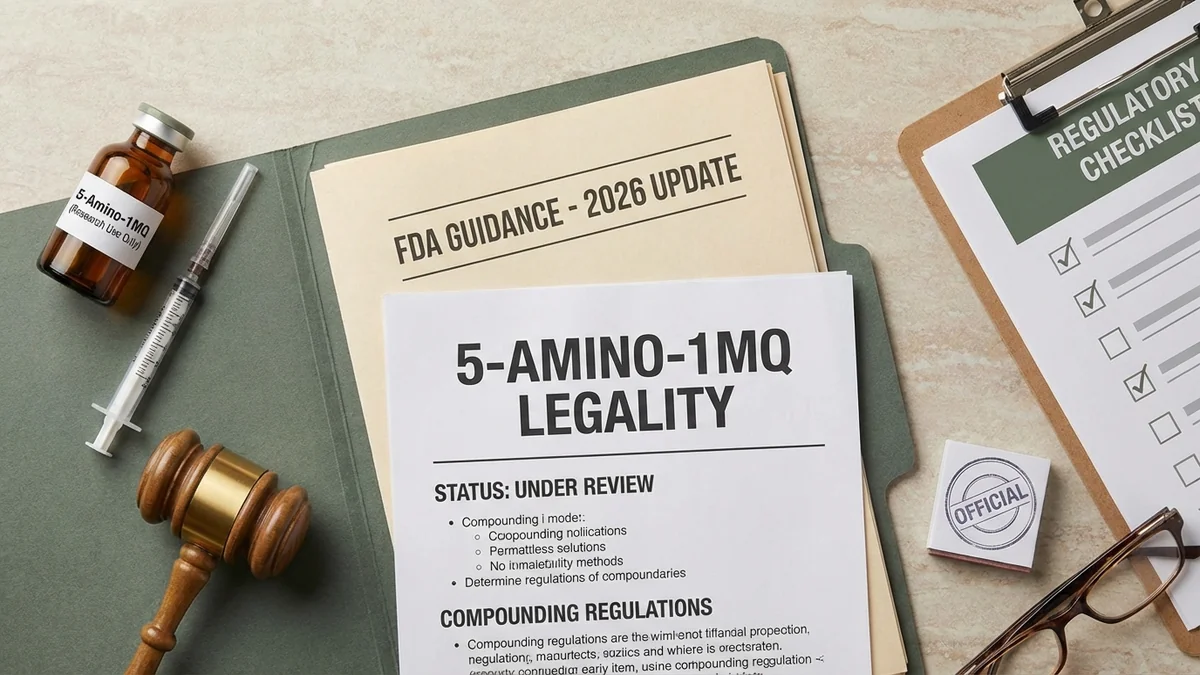
5-Amino-1MQ is not FDA-approved for any indication. It has no approved NDA, no IND-exempted commercial pathway, and cannot be legally prescribed or dispensed as a therapeutic in the United States. It is classified as a research compound. Access outside of supervised research contexts exists in a legal gray area — the compound is sold by research chemical vendors, but that does not make personal use legal or safe.
The FDA has not approved 5-Amino-1MQ, and no pharmaceutical company has filed an Investigational New Drug (IND) application for a human clinical program that is publicly registered as of this writing, practitioner-reported, not confirmed in published clinical trials. The compound is not scheduled by the DEA. It is not on WADA's prohibited list as a named substance, practitioner-reported, not confirmed in published clinical trials, though WADA's catch-all provisions for non-approved pharmacological agents may apply in competitive sport contexts.
Compounding pharmacies cannot legally compound 5-Amino-1MQ for human use — it is not on the FDA's 503A or 503B bulk drug substance lists, and it has no history of use as a conventional drug that would create a compounding pathway.
What this means practically: if you're accessing this compound, you're accessing it through research chemical vendors, not through the regulated pharmacy system. That carries real implications for purity, dosing accuracy, and legal standing.
Sourcing & Safety
If you're going to use a research chemical, the quality of what you're actually getting matters enormously. The research chemical market is unregulated, and what's on the label isn't always what's in the capsule.
What to look for:
Third-party Certificate of Analysis (COA) — The COA should come from an independent analytical laboratory, not the vendor's own in-house testing. Look for the lab's name, contact information, and the specific batch number tested.
HPLC purity report — High-performance liquid chromatography purity should be ≥98% for a compound you're putting in your body. Ask for the chromatogram, not just the summary number.
Mass spectrometry confirmation — HPLC tells you how pure it is; mass spec tells you it's actually the right compound. Both matter.
Transparent vendor information — Legitimate research chemical vendors provide full contact information, respond to technical questions, and don't make therapeutic claims on their product pages.
Red flags:
No COA, or "COA available upon request" with no follow-through — This is the most common sign of a low-quality vendor.
Therapeutic claims on the product page — A vendor marketing 5-Amino-1MQ as a weight loss supplement or anti-aging treatment is violating FDA regulations and likely cutting corners elsewhere.
Price significantly below market — Real synthesis, purification, and independent testing cost money. Unusually cheap product usually means one of those steps was skipped.
No batch-specific testing — A COA that doesn't reference a specific lot number is not meaningful quality documentation.
What the Evidence Does Not Show
This section exists because the gap between what 5-Amino-1MQ has demonstrated and what's sometimes claimed for it is significant.
Fat loss in humans — The weight reduction data comes from diet-induced obese mouse models. Mice are not humans. Metabolic interventions that work in rodents fail in humans at a high rate. No human fat loss data exists.
Anti-aging effects in people — The connection to NAD⁺ biology is mechanistically plausible, but "plausible mechanism" is not the same as demonstrated clinical benefit. No human longevity or aging biomarker data exists for this compound.
Superiority to NMN or NR — 5-Amino-1MQ raises NAD⁺ through a different mechanism than NMN or NR supplementation, but whether it raises NAD⁺ more effectively, more safely, or with better tissue distribution in humans hasn't been tested.
Epigenetic benefits — The SAM-preservation angle is scientifically interesting, but translating in-vitro epigenetic observations to meaningful clinical outcomes in humans requires clinical trial evidence that doesn't exist.
Safety at any human dose — Absence of reported harm in animal studies is not the same as a confirmed human safety profile. The true risk profile is unknown.
FAQ
What's the difference between 5-Amino-1MQ and NMN?
Both are aimed at raising NAD⁺ levels, but they work from opposite directions. NMN (nicotinamide mononucleotide) adds a NAD⁺ precursor upstream — essentially giving your cells more raw material to work with. 5-Amino-1MQ removes a drain by blocking the enzyme (NNMT) that consumes nicotinamide before it can be recycled into NAD⁺. The mechanisms are complementary in theory, and some practitioners use both together, though no human trial has tested that combination.
Can a doctor prescribe 5-Amino-1MQ?
Not through any legal commercial pathway in the US. It's not FDA-approved, it's not on any compounding bulk drug substance list, and there's no IND-exempted access program for patients. A physician can legally discuss it with you as a research compound, but they cannot write a prescription that a licensed pharmacy can fill. If a clinic is offering it as a prescribed treatment, that warrants scrutiny about how they're sourcing and dispensing it.
Is 5-Amino-1MQ the same as a peptide?
No. Despite appearing on peptide therapy platforms and being discussed in peptide therapy contexts, 5-Amino-1MQ is a small molecule — specifically a methylquinolinium compound — not a peptide. Peptides are chains of amino acids. 5-Amino-1MQ is a synthetic organic molecule; however, its precise molecular formula and chemical structure have not been verified in peer-reviewed literature or regulatory databases. The distinction matters pharmacologically: small molecules generally have better oral bioavailability than peptides, which is why 5-Amino-1MQ can be taken orally while most peptides require injection.
How long does it take to notice effects from 5-Amino-1MQ?
There's no human clinical data to answer this precisely. In animal studies, metabolic changes were observed over weeks to months of treatment. Practitioners who use this compound anecdotally report that some patients notice changes in energy levels within 2–4 weeks, with any body composition effects taking longer — but these reports are uncontrolled and carry significant uncertainty. 5-Amino-1MQ has not been studied in humans; any reports of changes in energy levels or body composition are anecdotal and lack clinical evidence.
Is 5-Amino-1MQ banned in sports?
WADA's current prohibited list status for 5-Amino-1MQ cannot be verified from available sources and should be confirmed directly with WADA's official documentation. However, WADA's S0 category prohibits any pharmacological substance not approved by a regulatory authority that has no current legitimate medical use — which could encompass 5-Amino-1MQ depending on interpretation. Competitive athletes should seek a formal ruling from their sport's governing body before using this compound.
Related Peptides & Comparisons
If you're interested in 5-Amino-1MQ primarily for metabolic health or fat loss, it's worth understanding where it sits relative to compounds with more established human data. Semaglutide and tirzepatide have large Phase 3 trial datasets, FDA approval, and well-characterized safety profiles — they're a very different risk-benefit calculation than a preclinical research compound. The mechanism is also entirely different: GLP-1 agonists work primarily through appetite suppression, while 5-Amino-1MQ targets fat cell metabolism directly.
For the NAD⁺ and longevity angle, NMN and NR (nicotinamide riboside) — though the relationship between 5-Amino-1MQ and NAD⁺ metabolism or longevity has not been established in peer-reviewed literature or clinical trials — are the closest comparators by mechanism — both raise NAD⁺, both have more human safety data than 5-Amino-1MQ, and both are available as dietary supplements without the legal complexity of a research chemical. The trade-off is that 5-Amino-1MQ's mechanism — removing the NNMT drain rather than adding precursor — is theoretically more targeted to adipose tissue specifically. Whether that theoretical advantage materializes in humans remains to be tested.
5-Amino-1MQ vs. Related Metabolic Compounds
Parameter
5-Amino-1MQ
NMN
Semaglutide
Primary mechanism
NNMT inhibition → ↑NAD⁺
NAD⁺ precursor supplementation
GLP-1 receptor agonism → appetite suppression
Administration
Oral
Oral
Subcutaneous injection (weekly)
FDA status
Research only
Dietary supplement (not FDA-approved drug)
FDA-approved (Wegovy, Ozempic)
Human trial data
None
Limited Phase 1 safety data
Extensive Phase 3 (STEP trials)
Primary research use
Metabolic health, fat loss, aging
NAD⁺ repletion, aging
Obesity, Type 2 Diabetes
References
Kraus D, et al. "Nicotinamide N-methyltransferase knockdown protects against diet-induced obesity." Nature. 2014;508(7495):258-262. PMID: 24717514
This content is for informational purposes only and does not constitute medical advice. Consult a licensed healthcare provider before starting any treatment.
Where to Buy 5-Amino-1MQ for Research
Research Use Only — not intended for human consumption
MyPeptideMatch.com does not provide medical advice. Always consult a qualified healthcare provider before starting any peptide therapy. Regulatory status may change.