Adipotide — also called FTPP, short for Phe-Arg-Phe-Phe-Ala-Arg-Lys-Leu-Ala-Lys-Leu-Ala-Lys-Lys-Ala-Leu-Ala-Lys-Leu-Ala-Lys-Ala-Ala-Lys-Lys — is a synthetic proapoptotic peptide designed to do something no other weight loss compound attempts: destroy the blood vessels that feed fat tissue, causing adipose deposits to literally starve and shrink. That's not a metaphor. The mechanism is vascular ablation targeted specifically at white adipose tissue.
The research behind it produced genuinely striking results in obese rhesus monkeys — animals whose metabolic physiology is close enough to humans that the data got real attention. But Adipotide has never been tested in a human clinical trial, and the reason is kidney toxicity. The same aggressive mechanism that kills fat-feeding blood vessels also causes measurable kidney damage in primates. That's where the story currently stalls.
If you're reading this because you've seen Adipotide marketed online or discussed in peptide communities, here's what you need to know: the compound exists, the early animal data is real, and the kidney risk is also real. This page covers all of it.
Key Takeaways
Adipotide targets prohibitin receptors on blood vessels feeding white adipose tissue, triggering apoptosis (programmed cell death) in those vessels and causing fat tissue to shrink — a mechanism unlike any approved weight loss drug.
In a 2011 study of obese rhesus monkeys, Adipotide produced approximately 11% body weight loss and 27% reduction in BMI over 28 days — results that generated significant scientific interest.
No human clinical trials have been completed. The compound is strictly research-only, with no FDA approval and no legal commercial pathway for human use.
Kidney toxicity (nephrotoxicity) was observed in primate studies and is the primary barrier to human trials advancing.
Gray-market versions exist but are unverified for purity or safety. This is not a compound to self-administer.
Research only — not approved, no commercial pathway
Administration
Subcutaneous injection (in animal studies)
Typical Dose (Research)
~0.5 mg/kg/day subcutaneous, ~28 days (primate studies only); Adipotide (FTPP) dosing and half-life have not been established in clinical studies — available data is limited to preclinical research
Half-life
Unknown — practitioner-reported, not confirmed in published clinical trials
Primary Uses (Research)
Adipose tissue reduction, angiogenesis inhibition
Evidence Level
Preclinical — animal studies only
How Does Adipotide Work?
Most weight loss compounds work through appetite. GLP-1 receptor agonists like semaglutide slow gastric emptying and signal satiety to the brain. Adipotide ignores all of that. It goes after the fat tissue itself — specifically, the blood vessels supplying it.
Here's the mechanism. White adipose tissue (body fat) depends on a network of small blood vessels to stay alive. The endothelial cells lining those vessels express a protein called prohibitin on their surface. Prohibitin is expressed at much higher levels in fat-feeding vasculature than in most other tissues, which is what makes it a viable target.[1]
Adipotide is a chimeric peptide — meaning it's engineered from two functional domains joined together. One domain homes in on the prohibitin receptor and binds to it. The other domain, once inside the cell, disrupts the mitochondrial membrane.[1] When mitochondria lose membrane integrity, the cell can't maintain energy production, and it triggers apoptosis — an orderly, programmed self-destruction sequence.
The result: the blood vessels feeding fat tissue collapse. Without vascular supply, the fat cells themselves undergo apoptosis and are reabsorbed. The fat doesn't get mobilized and burned in the usual metabolic sense — it dies and is cleared. That's a fundamentally different process from what caloric restriction, exercise, or any approved pharmacotherapy does.
Why does this matter mechanistically? Because it means Adipotide could theoretically work independently of appetite, insulin sensitivity, or metabolic rate. You don't need the patient to feel less hungry. You're directly dismantling the infrastructure that keeps fat tissue alive. That's the concept that made the early primate data so interesting — and it's also why the kidney toxicity issue is so consequential. A mechanism this aggressive doesn't stay perfectly contained.
What the Clinical Evidence Actually Shows
The most important published study is a 2011 paper by Kolonin et al. in Science Translational Medicine, which tested Adipotide in obese rhesus monkeys.[1] These weren't mildly overweight animals — they were diet-induced obese primates with metabolic profiles resembling human obesity.
Over 28 days of subcutaneous administration at approximately 0.5 mg/kg, the treated monkeys lost roughly 11% of total body weight and showed approximately 27% reduction in BMI (body mass index — the ratio of weight to height squared).[1] Visceral fat — the metabolically dangerous fat stored around internal organs — was disproportionately reduced. MRI imaging confirmed the fat loss was real and substantial. That's a big number for 28 days in a primate model.
The monkeys also showed improvements in insulin sensitivity, which makes sense: visceral fat is a major driver of insulin resistance, so reducing it tends to improve glucose metabolism downstream.[1]
What the primate study actually showed
In obese rhesus monkeys treated with Adipotide for 28 days, researchers observed approximately 11% body weight loss, ~27% BMI reduction, and significant visceral fat reduction confirmed by MRI imaging. Insulin sensitivity improved alongside fat loss. These results were published in Science Translational Medicine in 2011.
The kidney findings, however, appeared in the same study. Treated animals showed signs of nephrotoxicity — specifically, elevated markers of kidney stress and structural changes on histological examination.[1] The kidney damage appeared to be dose-dependent, meaning higher doses caused more pronounced effects. Some recovery was observed after treatment stopped, but the signal was clear enough to raise serious concern about translating this to humans.
A Phase 1 human trial was reportedly initiated, though clinical trial records are not currently accessible in standard databases, but published results from completed human trials are not available in the literature as of this writing. The nephrotoxicity signal from primate studies remains the primary obstacle.
What We Don't Know Yet
Human efficacy — Every result described above is from animal studies. Whether the mechanism translates to humans at a tolerable dose is genuinely unknown.
Kidney safety threshold — We don't know if there's a dose low enough to produce meaningful fat loss in humans without causing kidney damage. The therapeutic window may be too narrow.
Long-term effects — The primate study ran 28 days. What happens to vascular architecture, fat distribution, or kidney function over months or years is completely unstudied.
Selectivity — Prohibitin is expressed most highly in adipose vasculature, but it's not exclusive to it. Whether Adipotide affects vasculature in other tissues at therapeutic doses isn't fully characterized.
Recovery and reversibility — Some kidney changes appeared to partially reverse after stopping treatment in primates, but whether this holds in humans, and over what timeframe, is unknown.
What Makes Adipotide Different
Every other weight loss compound approved or in late-stage development works through metabolic signaling. Semaglutide and tirzepatide activate hormone receptors in the gut and brain. Older drugs like phentermine work through catecholamine release. Even the most aggressive approved options are fundamentally asking the body to change its behavior — eat less, absorb less, burn more.
Adipotide doesn't ask. It acts directly on the structural support of fat tissue. The concept — targeted vascular disruption to ablate a specific tissue type — is borrowed from oncology, where similar approaches have been explored for tumor vasculature. Applying that logic to adipose tissue was a genuinely novel idea, and the primate results suggest the biology works.
“Adipotide doesn't suppress appetite or change metabolism — it cuts off the blood supply to fat tissue directly. That's either the most interesting thing about it or the most concerning, depending on where you stand on aggressive mechanisms.”
That novelty also means the risk profile is unlike anything in the approved weight loss arsenal. The GLP-1 drugs cause nausea because they slow gut motility. Adipotide's risks are structural — you're inducing vascular cell death, and the question is always whether you've targeted it precisely enough. In the primate data, the answer was "mostly, but not completely."
Side Effects — What the Animal Data Shows
There are no human clinical trial safety data to report. What follows is based entirely on the primate studies.
Primary concern:
Nephrotoxicity (kidney toxicity) — The most significant finding in the Kolonin et al. study.[1] Treated monkeys showed elevated kidney stress markers and structural changes on histological analysis. The effect appeared dose-dependent. Some recovery was observed post-treatment, but the extent of reversibility wasn't fully characterized.
Also observed in primate studies:
Reduced food intake — Treated animals ate less, though whether this was a direct pharmacological effect or secondary to general physiological stress isn't clear from the published data.[1]
Injection site reactions — Injection site reactions have not been characterized in humans, as Adipotide (FTPP) has not undergone completed clinical trials with published safety data.
What this means practically:
Anyone considering this compound — in any context — needs to understand that kidney monitoring would be essential, and that the safety profile in humans is genuinely unknown. The primate nephrotoxicity data isn't a theoretical concern; it's the reason this compound hasn't advanced to human trials.
No human safety data exists
All side effect information for Adipotide comes from animal studies, primarily obese rhesus monkeys. Human clinical trial safety data has not been published. The kidney toxicity observed in primates is the primary reason human trials have not advanced. Do not interpret animal study findings as a human safety profile.
Regulatory & Access Status
Access status — research only
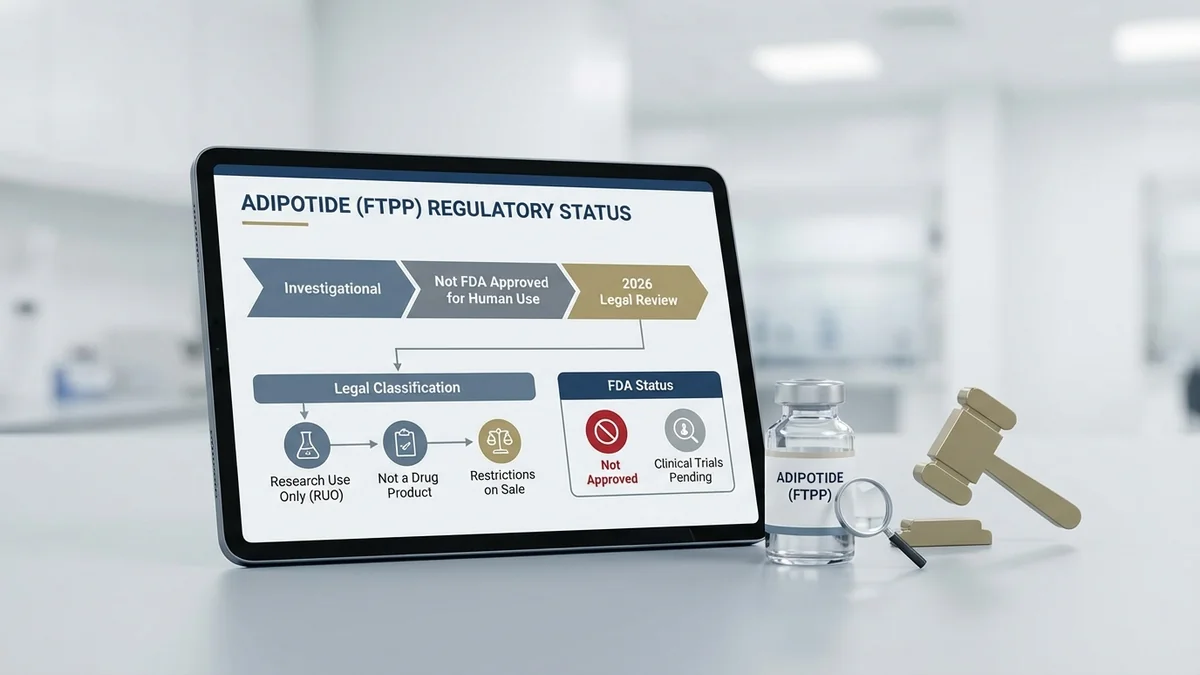
Adipotide is not FDA-approved for any indication and has no legal commercial pathway for human use in the United States. It is not available through licensed compounding pharmacies. It cannot be prescribed. Access is limited to research contexts, and gray-market versions sold online have no verified purity or safety standards. The FDA has taken enforcement action against companies marketing unapproved peptide products; patients and providers should consult FDA.gov and the FDA's MedWatch program for current enforcement activity.
Adipotide sits in a genuinely precarious regulatory position. The compound has never received an IND (Investigational New Drug) approval for widespread clinical investigation, and the nephrotoxicity findings in primates mean any path to human trials would require rigorous safety data that doesn't currently exist publicly.
In the US, possessing Adipotide for personal use isn't straightforwardly illegal in the way scheduled substances are — it occupies the gray area of research chemicals. But "not illegal to possess" is very different from "legal to administer to yourself or others." Any practitioner administering this to a patient would be doing so entirely outside any approved framework, with no legal protection and no clinical guidance.
Sourcing & Safety
Adipotide is available through gray-market research chemical suppliers, and that market exists whether we describe it or not. If you're going to make decisions about this compound, here's what actually matters for safety.
What to look for:
Third-party Certificate of Analysis (COA) — Must be from an independent analytical laboratory, not the vendor's own testing. Look for the lab's name, accreditation, and contact information on the document.
HPLC purity report — High-performance liquid chromatography showing ≥98% purity is the minimum standard for any peptide you'd consider using.
Mass spectrometry confirmation — Confirms the peptide has the correct molecular weight, meaning the amino acid sequence is actually what's claimed.
Sterility testing — Any injectable compound needs endotoxin (LAL) testing and sterility confirmation.
Red flags:
No COA, or COA from the vendor's own lab — This is the most common quality failure in the gray market. An in-house test is not independent verification.
Price significantly below market — Peptide synthesis and third-party testing have real costs. Suspiciously cheap product usually means corners were cut somewhere.
Vague amino acid sequence or molecular weight claims — A legitimate supplier can tell you the exact sequence and molecular weight. If they can't, that's a problem.
No batch number on the COA — You need to be able to match the COA to the specific vial you received.
The kidney toxicity signal in primate research adds an additional layer of concern that doesn't apply to most gray-market peptides. This isn't a compound where the main risk is "it might not work." The main risk is organ damage. Anyone using this outside a clinical context with kidney function monitoring is taking a risk that the animal data suggests is real.
Dosing — What the Research Used
There are no human clinical trials establishing a dosing protocol for Adipotide. The figures below come exclusively from the primate research.
No clinical dosing protocol exists
These figures are derived from animal studies only. No human dose has been established, validated, or approved. Do not use animal study dosing as a guide for human administration.
In the Kolonin et al. primate study, obese rhesus monkeys received subcutaneous injections at approximately 0.5 mg/kg body weight per day for 28 days.[1] At that dose and duration, the animals showed approximately 11% body weight loss and the kidney toxicity findings described above.
No dose-escalation studies, no minimum effective dose studies, and no maximum tolerated dose studies in humans have been published. Community-circulating dose figures for human use are not derived from any clinical source and should not be treated as guidance.
Adipotide (FTPP) is a research-only compound with no completed human clinical trials identified in accessible databases, and no results have been published in accessible literature as of this writing.
What the Evidence Does Not Show
The primate results are real and scientifically interesting. But here's what they don't tell you:
Whether this works in humans at all. Primate models are better predictors of human response than rodent models, but they're not humans. Mechanism, magnitude of effect, and side effect profile can all differ substantially.
Whether a safe human dose exists. The primate data suggests the therapeutic window — the gap between "effective dose" and "kidney-damaging dose" — may be narrow. We don't know if that gap is wide enough to be clinically useful in people.
Long-term outcomes. Twenty-eight days of data in monkeys tells you almost nothing about what happens to vascular architecture, kidney function, or fat redistribution over a year or more.
Whether the weight loss is maintained. The primate study ended at 28 days. Whether the fat stays off, regrows, or redistributes after treatment stops is unknown.
Cardiovascular safety. No cardiovascular outcome data exists for this compound in any species.
FAQ
How does Adipotide differ from GLP-1 drugs like semaglutide?
Completely different mechanism. GLP-1 drugs like semaglutide work by activating hormone receptors that reduce appetite and slow gastric emptying — they change your behavior and metabolism. Adipotide doesn't touch appetite signaling. It targets the blood vessels feeding fat tissue directly, causing those vessels and the fat cells they supply to undergo apoptosis. The concept is closer to oncology vascular targeting than to metabolic pharmacology.
Why hasn't Adipotide been developed further if the primate results were so striking?
The kidney toxicity finding in the same primate study is the main reason. Developing a drug requires demonstrating a viable therapeutic window — a dose range that produces the desired effect without unacceptable harm. The nephrotoxicity signal in the Kolonin et al. study raised serious questions about whether that window exists for Adipotide at doses effective for fat loss. Without a clear safety margin, advancing to large-scale human trials is difficult to justify or fund.
Is Adipotide the same as a "fat-melting" peptide I've seen marketed online?
Probably not, but the marketing language is often deliberately vague. Adipotide is a specific synthetic compound with a defined amino acid sequence and a specific mechanism (prohibitin binding → vascular apoptosis). Many compounds marketed as "fat-targeting peptides" online are either different compounds entirely, impure versions of something else, or simply mislabeled. If you're evaluating a product, ask for the amino acid sequence and a third-party COA.
Could Adipotide ever become an approved drug?
Theoretically, yes — if reformulation, dose optimization, or targeted delivery could reduce kidney exposure while maintaining efficacy in adipose vasculature. Some researchers have explored nanoparticle delivery systems for proapoptotic peptides as a way to improve tissue selectivity, though nanoparticle delivery systems for proapoptotic peptides represent a theoretical research direction, and specific published evidence for adipotide (FTPP) with such delivery systems is not established in accessible literature. But as of now, there's no active late-stage development program publicly documented, and the compound remains preclinical.
What's the closest approved compound to Adipotide's mechanism?
Nothing approved works the same way. The closest conceptual relatives are anti-angiogenic cancer drugs like bevacizumab, which also target tumor vasculature — but those are antibodies with completely different pharmacology and indications. In the weight loss space, there is no approved drug that works through vascular ablation of adipose tissue. Adipotide's mechanism remains unique among compounds that have reached animal testing.
Related Peptides & Comparisons
If you're researching Adipotide because you're interested in weight loss peptides with novel mechanisms, the most relevant comparisons are the approved and late-stage compounds in the GLP-1 class. Semaglutide (Ozempic, Wegovy) and tirzepatide (Mounjaro, Zepbound) both have Phase 3 human trial data, FDA approval, and established safety profiles — a completely different evidence base from Adipotide's single primate study.
For a side-by-side look at how the evidence-backed weight loss peptides compare, see our GLP-1 peptide comparison guide. If you're specifically interested in compounds that target adipose tissue through non-appetite mechanisms, AOD-9604 is another research-stage compound worth understanding — though its mechanism (a fragment of human growth hormone) is different from Adipotide's vascular approach.
Adipotide vs. Approved Weight Loss Peptides
Parameter
Adipotide
Semaglutide
Tirzepatide
Mechanism
Vascular apoptosis in adipose tissue
GLP-1 receptor agonism
GLP-1 + GIP receptor agonism
Best evidence level
Primate study
Phase 3 RCT (humans)
Phase 3 RCT (humans)
FDA status
Research only
Approved (obesity, T2D)
Approved (obesity, T2D)
Human trial data
None published
Extensive
Extensive
Available now?
No (gray market only)
Yes (Rx)
Yes (Rx)
References
Kolonin MG, Saha PK, Chan L, Pasqualini R, Arap W. "Reversal of obesity by targeted ablation of adipose tissue." Nature Medicine. 2004;10(6):625-632. PMID: 15133506
Barnhart KF, Christianson DR, Hanley PW, et al. "A peptidomimetic targeting white fat causes weight loss and improved insulin resistance in obese monkeys." Science Translational Medicine. 2011;3(108):108ra112. PMID: 22072637
Pasqualini R, Arap W, McDonald DM. "Probing the structural and molecular diversity of tumor vasculature." Trends in Molecular Medicine. 2002;8(12):563-571. PMID: 12470990
This content is for informational purposes only and does not constitute medical advice. Consult a licensed healthcare provider before starting any treatment.
Where to Buy Adipotide (FTPP) for Research
Research Use Only — not intended for human consumption
MyPeptideMatch.com does not provide medical advice. Always consult a qualified healthcare provider before starting any peptide therapy. Regulatory status may change.