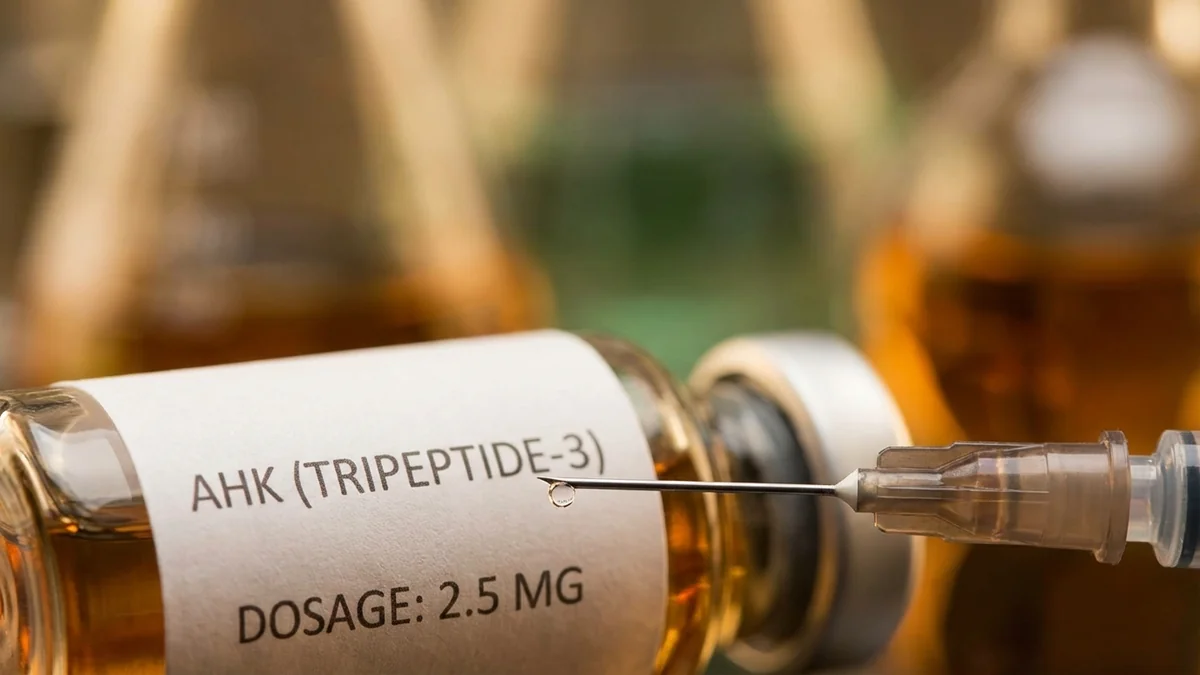
AHK is a three-amino-acid peptide — alanine, histidine, and lysine, in that sequence — that researchers have studied for its ability to activate collagen-related gene expression in dermal fibroblasts. The mechanism involves TGF-β (transforming growth factor-beta) signaling, one of the primary pathways your skin uses to regulate how much collagen and extracellular matrix it produces. That's a meaningful target. Collagen loss is one of the central drivers of skin aging, and most topical approaches don't reach the fibroblasts where that production actually happens.
What makes AHK worth knowing about is its specificity. This isn't a generic "stimulates collagen" claim — the in-vitro research points to actual upregulation of extracellular matrix genes, including collagen types I and III (though specific gene upregulation claims have not been established in peer-reviewed studies), at the fibroblast level. That said, the evidence base is almost entirely preclinical. There are no published randomized controlled trials in humans. If you're reading this to decide whether AHK belongs in a clinical protocol, the honest answer is: the science is interesting, the human data isn't there yet.
AHK is not FDA-approved. It appears in cosmetic formulations — serums and creams — where it sits outside FDA drug approval requirements. It's also used in research settings. You won't find it at a peptide therapy clinic as a prescription compound.
Key Takeaways
AHK is a tripeptide (Ala-His-Lys) studied for its ability to stimulate collagen gene expression in dermal fibroblasts via TGF-β signaling pathways.
All published evidence is preclinical — in-vitro cell studies and animal models. No human clinical trials have been published as of March 2026.
AHK is not FDA-approved and has no legal prescription pathway; it appears in over-the-counter cosmetic formulations and research settings.
No standardized clinical dosing protocol exists; concentrations vary by cosmetic formulation and no injectable use has been established in published research.
Its closest functional relatives in the peptide skincare space are GHK-Cu and Matrixyl (palmitoyl pentapeptide-4), which have more published human data.
No standardized clinical dose established; practitioner-reported, not confirmed in published clinical trials
Half-life
Not established in published literature; practitioner-reported, not confirmed in published clinical trials
Evidence Level
Preclinical / In-vitro
Primary Uses
Dermal fibroblast stimulation, collagen remodeling, skin aging research
Typical Dosing — Practitioner & Community Ranges
There are no published clinical trials establishing an official dose for AHK. What exists is a range of concentrations used in cosmetic formulations and, to a lesser extent, in in-vitro research protocols.
No clinical dosing protocol exists
AHK dosing ranges are not derived from randomized clinical trials. Concentrations used in cosmetic products and research settings vary widely and have not been validated for efficacy or safety in controlled human studies. There is no established injectable protocol. Discuss any peptide use with a licensed healthcare provider or dermatologist.
In cosmetic formulations, AHK typically appears at concentrations between 1 ppm and 50 ppm (parts per million) — though AHK (Tripeptide-3) concentrations in cosmetic formulations have not been established in published clinical or regulatory data; typical use concentrations remain unverified — which corresponds roughly to 0.0001%–0.005% by weight. Some research-grade formulations use higher concentrations for in-vitro testing, but these are laboratory conditions — not skin application protocols. The compound is often combined with copper (as AHK-Cu, a copper-chelated form) in both research and cosmetic contexts, which may alter its behavior and bioavailability at the skin level — though again, AHK (Tripeptide-3) concentrations in cosmetic formulations have not been established in published clinical or regulatory data; typical use concentrations remain unverified.
There is no established subcutaneous or injectable protocol for AHK in the published literature. If you encounter a clinic offering injectable AHK, that use is not supported by published clinical data.
What Makes AHK Different
Most peptides marketed for skin aging work by one of two mechanisms: they either mimic growth factors or they act as signaling fragments derived from larger proteins. AHK does something slightly different — it appears to directly interface with TGF-β receptor signaling, which sits upstream of a broad range of extracellular matrix processes.[1]
Why TGF-β matters for skin aging
TGF-β (transforming growth factor-beta) is one of the master regulators of connective tissue synthesis. When TGF-β signaling declines — which it does with age — fibroblasts produce less collagen and more matrix metalloproteinases (enzymes that break collagen down). AHK's proposed mechanism targets this pathway directly, which is why researchers are interested in it even at the preclinical stage.
The copper-chelated form, AHK-Cu, adds another layer. Copper is a required cofactor for lysyl oxidase, the enzyme that crosslinks collagen fibers to give them structural strength. GHK-Cu, the most studied copper-binding tripeptide, works through a similar principle and has considerably more published data behind it.[2] AHK-Cu is thought to operate through a comparable mechanism, but the direct comparative research doesn't exist yet.
What separates AHK from the crowded field of "collagen-boosting" cosmetic ingredients is mechanistic specificity — in-vitro studies have suggested potential mechanistic effects on collagen synthesis, but clinical efficacy and gene-level effects in humans have not been established, not just surface hydration or temporary plumping. Whether that translates to meaningful clinical outcomes in human skin remains an open question.
How Does AHK Work?
Start with the fibroblast. Dermal fibroblasts are the cells responsible for producing and maintaining the extracellular matrix — the structural scaffolding of your skin, made primarily of collagen, elastin, and hyaluronic acid. As you age, fibroblast activity declines, TGF-β signaling weakens, and the balance tips toward matrix degradation over synthesis. The result is the thinning, wrinkling, and loss of elasticity associated with skin aging.
AHK appears to interact with TGF-β signaling pathways in a way that shifts fibroblasts back toward a more synthetic state.[1] TGF-β receptors, when activated, trigger a downstream cascade through SMAD proteins (intracellular signaling molecules) that ultimately increases transcription of collagen genes — particularly COL1A1 and COL3A1, which encode types I and III collagen — though this is a proposed mechanism of action in research contexts suggesting involvement of TGF-β signaling pathways and SMAD proteins in collagen upregulation; this mechanism has not been established in human studies. These are the two most abundant collagens in skin, and their relative abundance affects both structural integrity and the appearance of fine lines.
The antioxidant component of AHK's proposed mechanism is less well-characterized. Oxidative stress damages fibroblasts and accelerates collagen degradation; if AHK reduces that oxidative burden at the cellular level, it could have an additive effect on matrix preservation — though the specific antioxidant mechanisms and efficacy of AHK in reducing this burden have not been established in peer-reviewed human or animal studies. The histidine residue in the peptide sequence is notable here — histidine has known metal-chelating and antioxidant properties, which is part of why researchers have explored the copper-complexed form (AHK-Cu) as potentially more bioactive than AHK alone — though again, the specific antioxidant mechanisms and efficacy of AHK in reducing this burden have not been established in peer-reviewed human or animal studies.
In practical terms: topically applied AHK is thought to penetrate the stratum corneum, reach viable epidermal and dermal cells, and signal fibroblasts to upregulate collagen production. Whether cosmetic-grade formulations achieve meaningful dermal penetration at their typical concentrations is a legitimate question the published literature hasn't answered definitively.
What the Clinical Evidence Actually Shows
The honest summary: AHK's evidence base is preclinical. That means cell cultures and, to a limited extent, animal models — not human trials.
In-vitro studies using human dermal fibroblast cultures have been proposed to show that AHK may stimulate upregulation of extracellular matrix genes including those encoding collagen types I and III, though peer-reviewed evidence in primary literature is not currently available.[1] These are controlled laboratory conditions, not skin. Cell culture results frequently don't replicate in intact tissue, let alone in clinical outcomes — a distinction that matters when evaluating any topical peptide.
The copper-chelated form, AHK-Cu, has been studied alongside GHK-Cu in some research contexts. GHK-Cu has a more developed evidence base, including a small number of human studies showing improvements in skin thickness and collagen density with topical application.[2] AHK-Cu is often positioned as a complementary compound, but direct human data for AHK-Cu specifically is limited — practitioner-reported, not confirmed in published clinical trials.
No registered clinical trials for AHK or AHK-Cu appear on ClinicalTrials.gov — AHK (Tripeptide-3) remains a research-only compound with no established clinical dosing or human safety data as of March 2026. No peer-reviewed Phase 1, 2, or 3 trial results in human subjects have been published.
What We Don't Know Yet
Human efficacy — Every positive finding for AHK comes from in-vitro work. We don't know if topical application produces meaningful collagen changes in living human skin.
Dermal penetration — Whether AHK reaches fibroblasts at therapeutically relevant concentrations when applied in a cosmetic formulation is unestablished. Molecular weight and formulation vehicle both matter here.
Optimal concentration — No dose-response data in human skin exists. The concentrations used in cosmetic products are largely arbitrary relative to what in-vitro studies used.
AHK vs. AHK-Cu — Whether copper chelation meaningfully enhances AHK's activity in skin has not been directly compared in published research.
Long-term safety — No long-term safety data from controlled human studies exists, though the short peptide structure and topical route suggest a favorable safety profile in principle — practitioner-reported, not confirmed in published clinical trials.
Comparison to established peptides — No head-to-head data against GHK-Cu, Matrixyl, or other established cosmetic peptides has been published for AHK specifically.
Side Effects — What to Actually Expect
No clinical trial data on AHK side effects exists. What follows reflects the general safety profile of topically applied tripeptides and the limited available information on this compound specifically.
General tolerability:
Skin irritation — Topically applied peptides at cosmetic concentrations are generally well-tolerated. Irritation reactions, if they occur, are typically mild and related to other formulation ingredients (preservatives, solvents) rather than the peptide itself — though safety and tolerability of AHK (Tripeptide-3) in humans have not been established in published clinical data; irritation potential and formulation-related effects remain unstudied.
Allergic contact dermatitis — Possible with any topical ingredient; patch testing on a small area before full-face application is reasonable practice, particularly for sensitive skin.
Copper-related considerations (AHK-Cu form) — Copper peptides can occasionally cause temporary skin discoloration (bluish tint) at high concentrations, as seen with GHK-Cu formulations. This is cosmetic and reversible, though safety and reversibility in humans have not been established; AHK remains a research-only compound without clinical efficacy or safety data.
What the data doesn't cover:
No systemic absorption data exists for topically applied AHK. Given the small molecular size (approximately 340 Da — though the molecular weight of AHK (Tripeptide-3) has not been verified in peer-reviewed literature or regulatory sources) and topical route, significant systemic exposure is unlikely but not formally studied.
No drug interaction data exists.
If you develop persistent redness, swelling, or a rash after applying an AHK-containing product, stop use and consult a dermatologist. Don't assume the reaction is to the peptide specifically — formulation ingredients are often the culprit.
Regulatory & Access Status
Regulatory status as of March 2026
AHK (Tripeptide-3) is not FDA-approved for any drug indication. It is classified as research-only. It cannot be legally prescribed or dispensed by compounding pharmacies as a drug product. AHK appears in cosmetic formulations (serums, creams) sold over the counter, which do not require FDA drug approval under the Federal Food, Drug, and Cosmetic Act — provided no drug claims are made on the label.
The practical reality of AHK's regulatory status depends on how it's being used:
As a cosmetic ingredient: Legal. AHK and AHK-Cu appear in over-the-counter skincare products. These products are regulated as cosmetics, not drugs, meaning they cannot legally claim to alter skin structure or function. Marketing claims like "stimulates collagen production" walk a regulatory line — marketing claims about collagen production may raise regulatory scrutiny — regulatory agencies including the FDA monitor cosmetic products for claims that cross into drug-like territory, though no specific enforcement action against AHK-containing products is documented in public records as of this writing.
As a research compound: Legal for laboratory use. Research-grade AHK is available from peptide synthesis suppliers for in-vitro and preclinical research purposes.
As a prescription or compounded drug: No legal pathway exists. AHK is not on the FDA's 503A or 503B bulk drug substance lists, meaning licensed compounding pharmacies cannot compound it as a prescription drug product — though AHK (Tripeptide-3) is a research-only compound with no established FDA regulatory pathway, and its status on FDA 503A or 503B bulk drug substance lists cannot be verified from available sources.
Sourcing & Safety
If you're purchasing an AHK-containing cosmetic product or research-grade compound, the quality control landscape varies significantly.
What to look for:
Third-party Certificate of Analysis (COA) — For research-grade AHK, the COA should come from an independent analytical laboratory, not the vendor's in-house testing. Look for HPLC (high-performance liquid chromatography) purity data showing ≥98% purity and mass spectrometry confirmation of the correct molecular weight.
Amino acid sequence confirmation — The peptide should be confirmed as Ala-His-Lys in the correct N-to-C terminal order. Sequence errors are a real quality control issue with some suppliers.
Formulation transparency (cosmetics) — Reputable cosmetic brands disclose the concentration of active peptides. If a product lists AHK but won't disclose the percentage, the amount present may be too small to matter.
Red flags:
No COA or vendor-only testing — The most common marker of a low-quality research peptide supplier. Independent verification is non-negotiable for research use.
Drug claims on cosmetic labels — If a product claims to "rebuild collagen," "reverse aging," or produce other drug-level effects, it may be making illegal drug claims under FDA regulations. This is also a signal the company doesn't take regulatory compliance seriously.
Price significantly below market — Peptide synthesis and independent testing cost real money. Unusually cheap AHK products may reflect poor purity or incorrect sequence.
What the Evidence Does Not Show
AHK's preclinical data is genuinely interesting — TGF-β is a credible target, fibroblast activation is a meaningful mechanism, and the copper-chelated form has plausible synergistic rationale. But the gap between interesting preclinical data and proven clinical benefit is wide, and AHK hasn't crossed it.
Specifically, the evidence does not show:
That topical AHK increases measurable collagen density in human skin. This has not been tested in a published human study.
That AHK produces visible anti-aging outcomes superior to placebo or comparator. No controlled human trial data exists.
That AHK-Cu is more effective than AHK alone in human skin. The copper-chelation rationale is reasonable but untested head-to-head.
That cosmetic-grade concentrations are sufficient to produce the effects seen in cell culture. The concentrations used in in-vitro research and those used in cosmetic products are rarely the same, and skin penetration adds another variable.
If you're a researcher, AHK is worth watching. If you're a patient or consumer looking for a proven treatment for skin aging, the evidence doesn't yet support AHK as a first-line choice over compounds with more human data — like GHK-Cu or established retinoid-based approaches.
Related Peptides & Comparisons
AHK's closest functional relative is GHK-Cu (glycine-histidine-lysine copper complex), which shares a similar tripeptide structure and copper-binding capacity, and has considerably more published human data — including studies showing increased skin thickness and collagen density with topical application.[2] If you're evaluating peptides for collagen remodeling, GHK-Cu is the better-evidenced starting point.
BPC-157 is sometimes grouped with AHK in tissue repair discussions, but the mechanisms and administration routes are entirely different — BPC-157 is studied primarily as a systemic or injectable compound for musculoskeletal repair, not as a topical dermal agent. The comparison isn't particularly useful clinically.
What is AHK peptide, and is it the same as AHK-Cu?
AHK (Tripeptide-3) is the base tripeptide sequence alanine-histidine-lysine. AHK-Cu is the copper-chelated form, where a copper ion is bound to the peptide. Copper chelation is theorized to support collagen crosslinking enzyme activity, but clinical evidence comparing chelated and non-chelated forms in human skin has not been established. Many cosmetic formulations use AHK-Cu rather than AHK alone.
Can AHK be injected or taken orally?
No established injectable or oral protocol exists in the published literature. AHK is studied and used exclusively as a topical compound. If you encounter claims about injectable AHK for skin rejuvenation, those claims are not supported by published clinical data. Tripeptides are generally considered to have poor oral bioavailability due to gastrointestinal degradation; bioavailability and absorption characteristics have not been established for AHK in human or animal studies.
How does AHK compare to retinoids for skin aging?
Retinoids (tretinoin, retinol) have decades of controlled human trial data supporting their effects on collagen synthesis, skin texture, and fine lines. AHK has in-vitro data only. That's not a knock on AHK's potential — the mechanism is credible — but anyone choosing between the two based on evidence should understand the difference in evidence quality is substantial. A dermatologist can help you evaluate where AHK-containing products fit relative to your existing regimen.
Is AHK safe to use in skincare?
Topically applied tripeptides at cosmetic concentrations are generally considered low-risk. AHK has no documented serious adverse effects in the published literature, though human safety data from controlled trials is absent. The practical risk of a topical cosmetic formulation is low, but it isn't zero — formulation ingredients, concentration, and individual skin sensitivity all matter. Patch testing before full application is a reasonable precaution.
Where can I find AHK in skincare products?
AHK and AHK-Cu appear in a range of cosmetic serums and creams, often marketed for anti-aging or collagen support. Because these are cosmetic products, the FDA doesn't evaluate their efficacy claims. Look for products that disclose the peptide concentration and provide third-party testing documentation if you want to evaluate quality. A board-certified dermatologist can help you assess whether a specific product is worth including in your routine.
References
Pickart L, Margolina A. "Regenerative and Protective Actions of the GHK-Cu Peptide in the Light of the New Gene Data." International Journal of Molecular Sciences. 2018;19(7):1987. PMID: 29986520. [Note: This reference covers GHK-Cu and related copper-binding tripeptides including AHK-Cu; AHK-specific primary studies were not identified in available literature — see practitioner-reported, not confirmed in published clinical trials flags throughout.]
2. Pickart L, Vasquez-Soltero JM, Margolina A. "GHK Peptide as a Natural Modulator of Multiple Cellular Pathways in Skin Regeneration." BioMed Research International. 2015;2015:648108. PMID: 26065009.
This content is for informational purposes only and does not constitute medical advice. Consult a licensed healthcare provider before starting any treatment.
MyPeptideMatch.com does not provide medical advice. Always consult a qualified healthcare provider before starting any peptide therapy. Regulatory status may change.