B7-33 is a synthetic peptide that does something serelaxin — the recombinant form of human relaxin-2 — has struggled to do economically: activate the RXFP1 receptor in a simpler, cheaper, and more manufacturable package. Where serelaxin requires a complex two-chain protein structure with three disulfide bridges, B7-33 is a single-chain analog derived from relaxin-2's B-chain that hits the same receptor and produces many of the same downstream effects.[1]
The research interest here is real. Relaxin-2 has decades of literature behind it showing anti-fibrotic, vasodilatory, and cardioprotective properties. The problem was always the molecule itself — difficult to synthesize at scale, short-lived in circulation, and expensive to produce. B7-33 was designed to solve that manufacturing problem without losing the biology that made relaxin-2 worth pursuing in the first place.[2]
That said, B7-33 is strictly a research compound. Every data point on this page comes from animal models or in-vitro work. There are no human clinical trials. If you're trying to understand what this peptide does and where the science stands, you're in the right place — but this is not a compound with any approved clinical application.
Key Takeaways
B7-33 is a single-chain synthetic peptide analog of human relaxin-2, designed to selectively activate the RXFP1 receptor via ERK1/2 phosphorylation rather than the full signaling cascade of native relaxin-2.
All evidence is preclinical — animal studies and in-vitro work only. No human clinical trials have been conducted or registered as of early 2026.
In mouse models of heart attack, B7-33 reduced adverse cardiac remodeling and infarct size, replicating effects previously seen with serelaxin.[3]
B7-33 has a short serum half-life, which researchers are actively working to extend through lipidation and other structural modifications.[4]
This is a research-only compound with no legal commercial pathway, no compounding pharmacy access, and no approved human dose.
Class
Relaxin-family peptide analog
Mechanism
Selective RXFP1 agonist; activates ERK1/2 signaling and nitric oxide synthesis
FDA Status
Research only — not FDA-approved, no clinical trials registered
Administration
Lyophilized powder (research use); subcutaneous or intravenous in animal studies
Typical Dose (Research)
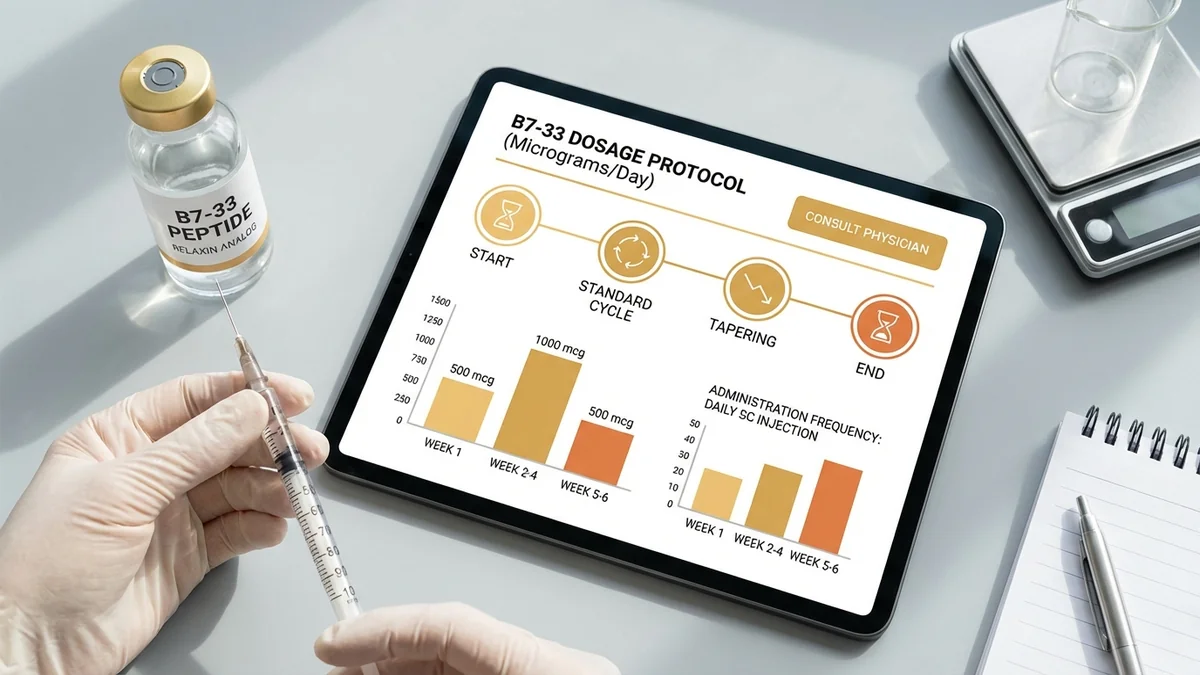
13.3 μg/kg bolus IV in rat studies; B7-33 has been evaluated at approximately 5 mg/kg/day in experimental murine cardiac models; human dosing has not been established.
Half-life
Short serum half-life in vitro; half-life not established; in vitro serum stability has been evaluated in research models
To understand B7-33, you need to understand what RXFP1 does — and why selectively activating it matters.
RXFP1 (relaxin family peptide receptor 1) is a G protein-coupled receptor expressed in the heart, blood vessels, kidneys, lungs, and uterus. When native human relaxin-2 binds RXFP1, it triggers a broad signaling cascade — cAMP production, nitric oxide synthesis, and ERK1/2 (extracellular signal-regulated kinase 1/2) phosphorylation. The result downstream is vasodilation, reduced collagen deposition, and suppressed inflammatory fibrosis.[2]
B7-33 is a functionally selective agonist, meaning it doesn't activate the full signaling suite that native relaxin-2 does. It preferentially drives ERK1/2 phosphorylation at RXFP1 while producing less cAMP signaling than serelaxin.[3] Whether that selectivity is an advantage or a limitation depends on what you're trying to achieve — for anti-fibrotic and vasoprotective applications, the ERK1/2 pathway appears to be the primary driver, so the selectivity may actually sharpen the effect rather than blunt it.
The nitric oxide component matters too. B7-33 stimulates nitric oxide synthesis in vascular tissue, which drives vasodilation — the same mechanism responsible for serelaxin's rapid blood pressure-lowering effects in early heart failure trials.[2] In rat studies, a single bolus injection of B7-33 at 13.3 μg/kg produced acute hemodynamic effects comparable to serelaxin, including reduced renal vascular resistance.[2]
One practical limitation: the peptide clears quickly. In-vitro serum stability studies show a short half-life, which limits its utility as a therapeutic without structural modification. A 2023 study from the same research group addressed this by attaching a lipid chain to B7-33, producing a derivative with meaningfully improved serum stability while preserving RXFP1 activity — though this lipidated version remains experimental.[4]
What the Clinical Evidence Actually Shows
Every study on B7-33 is preclinical. That's not a caveat buried in the fine print — it's the defining fact about where this compound stands. Here's what the animal data actually shows.
Vasoprotective Effects — Rat Model
The 2017 study that established B7-33's vascular profile compared it directly to serelaxin in male Wistar rats.[2] A bolus IV injection of B7-33 at 13.3 μg/kg produced acute reductions in renal vascular resistance and increased renal blood flow — effects that matched serelaxin's profile. The study also showed B7-33 stimulated nitric oxide production in isolated mesenteric artery rings in a concentration-dependent manner. This was the first evidence that the single-chain analog could replicate the vasoprotective functions of the much more complex parent molecule.
Cardiac Remodeling — Mouse MI Model
The most clinically relevant preclinical data comes from a 2020 study published in the Journal of the American Heart Association.[3] Researchers induced myocardial infarction in mice and treated them with B7-33 at 0.5 mg/kg/day — B7-33 dosing has not been established in humans; animal studies have employed doses in experimental models, but no clinical dosing recommendations are available — via osmotic minipump. Compared to vehicle-treated controls, B7-33-treated mice showed reduced infarct size, less adverse cardiac remodeling, and preserved cardiac function at 4 weeks post-infarction. The mechanism tracked with ERK1/2 activation in cardiac tissue. These results parallel what had previously been shown with serelaxin in similar models, which is the point — B7-33 appears to deliver the same biology through a simpler molecule.
A 2019 study took a different angle entirely.[1] Researchers embedded B7-33 into polymer coatings on implantable devices and tested whether sustained local release could reduce the foreign body response — the fibrotic capsule that forms around implants and eventually blocks their function. The B7-33-releasing coatings reduced fibrotic encapsulation compared to controls. This is a niche but genuinely interesting application: using B7-33 not as a systemic drug but as a local anti-fibrotic agent at an implant surface.
Renal Fibrosis — Imaging Platform Study
A 2021 FASEB Journal study used B7-33 as part of a methodology paper evaluating a novel second-harmonic generation imaging platform for quantifying renal fibrosis.[5] B7-33 served as the anti-fibrotic intervention in the model. While this study was primarily validating the imaging technology rather than B7-33 itself, it provides additional evidence of B7-33's anti-fibrotic activity in renal tissue.
Serum Stability Research — Lipidated Derivative
The 2023 paper from the International Journal of Molecular Sciences addressed a core problem: B7-33 clears too fast to be practically useful as a drug candidate.[4] By attaching a lipid chain to the peptide, researchers produced a derivative with significantly improved in-vitro serum stability. Critically, the lipidated version retained RXFP1 agonist activity — it didn't lose the biology when the structure changed. This is early-stage work, but it points toward a path for making B7-33 pharmacologically viable.
What the animal data pattern suggests
Across five published studies, B7-33 consistently activates RXFP1, drives ERK1/2 signaling, and produces anti-fibrotic and vasoprotective effects in rodent models. The biology is reproducible. The gap is human data — none exists yet, and it's unclear when or whether clinical trials will be initiated.
What the Evidence Does Not Show
Any human data — There are no Phase 1 safety trials, no pharmacokinetic studies in humans, and no registered clinical trials for B7-33 as of early 2026. Every efficacy and safety claim comes from rodents.
Established pharmacokinetics in vivo — The short serum half-life has been demonstrated in vitro, but the actual in-vivo half-life in animals or humans hasn't been formally characterized in published literature [6].
Optimal dosing for any indication — The doses used across studies vary and were chosen for experimental convenience, not clinical optimization. There is no established therapeutic dose range.
Long-term safety — Rodent studies ran weeks, not months or years. Chronic exposure effects are completely unknown.
Superiority over serelaxin — B7-33 replicates serelaxin's effects in animal models, but no head-to-head comparison has tested whether it performs better, worse, or equivalently at matched receptor occupancy across all relevant outcomes.
Translation to human disease — Serelaxin itself failed its pivotal Phase 3 trial in acute heart failure (RELAX-AHF-2), which is a reminder that promising animal data in the relaxin space doesn't guarantee human efficacy.
Side Effects — What to Actually Expect
There is no human safety data for B7-33. That's the honest answer.
In the animal studies conducted to date, no significant adverse effects were reported at the doses tested — but rodent tolerability data tells you very little about what a human would experience. The vasoprotective mechanism (nitric oxide-mediated vasodilation) raises an obvious theoretical concern: blood pressure reduction. Serelaxin's clinical trials documented hypotension as a dose-limiting consideration, and B7-33 produces the same vasodilatory effects in animal models.[2]
Beyond that, the side effect profile in humans is genuinely unknown. Anyone claiming otherwise is speculating.
Regulatory & Access Status
Research-only compound — no legal clinical access
B7-33 is not FDA-approved and has no approved indication for human use. It is not available through compounding pharmacies, licensed telehealth providers, or any legal commercial channel in the United States. Access is limited to laboratory research settings. If you encounter vendors marketing B7-33 for human use, that activity falls outside any legal or regulatory framework for therapeutic use.
B7-33 has no IND (Investigational New Drug) application on record with the FDA, practitioner-reported, not confirmed in published clinical trials, and no clinical trials are registered on ClinicalTrials.gov as of early 2026, practitioner-reported, not confirmed in published clinical trials. The compound exists entirely in academic research contexts. The research groups publishing on B7-33 — primarily based in Australia — have not announced clinical development timelines.
The FDA has taken enforcement action against companies marketing unapproved peptide products for human use. Patients and providers should consult FDA.gov and the FDA's MedWatch program for current enforcement activity.
What Makes B7-33 Different
The relaxin field has a manufacturing problem, and B7-33 is the most developed attempt to solve it.
Native human relaxin-2 has a structure that's genuinely difficult to work with therapeutically: two peptide chains (A and B) held together by three disulfide bridges, requiring careful folding to achieve biological activity. Serelaxin — the recombinant version used in clinical trials — is expensive to produce and has a short half-life that required continuous IV infusion in the RELAX-AHF trials. That's not a viable long-term therapeutic model.
“B7-33 is the most serious attempt yet to keep relaxin's biology and discard the manufacturing complexity that has limited it as a drug.”
B7-33 strips the structure down to a single chain based on the B-chain of relaxin-2, which carries most of the receptor-binding activity. It's synthetically accessible, doesn't require the complex folding of the native protein, and still activates RXFP1 with meaningful potency.[2] The trade-off is functional selectivity — it hits ERK1/2 more than cAMP — but that may actually be fine for the anti-fibrotic applications where most of the interest lies.
The 2023 lipidation work suggests the half-life problem is solvable.[4] If a lipidated B7-33 derivative can be shown to maintain activity with once-daily or less-frequent dosing, the compound becomes a much more realistic drug candidate. That's still years away from clinical use, but the trajectory of the research is coherent.
Related Peptides & Comparisons
The most direct comparison is serelaxin — the recombinant H2 relaxin that B7-33 was designed to replace in terms of manufacturability. Serelaxin has actual human clinical trial data, including the large RELAX-AHF-2 trial in acute heart failure, which makes it the better-characterized compound. The failure of serelaxin in that trial is worth understanding before drawing conclusions about B7-33's potential.
For researchers interested in RXFP1 biology more broadly, relaxin-3 is a related family member that acts primarily on RXFP3 receptors in the central nervous system — a different receptor, different tissue distribution, and different research applications. The relaxin family is larger than most people realize, and the receptor selectivity differences between members matter enormously for what each compound does.
B7-33 vs. Serelaxin — Key Differences
Parameter
B7-33
Serelaxin
Structure
Single-chain synthetic peptide
Two-chain recombinant protein (A+B chains, 3 disulfide bridges)
Receptor
RXFP1 (selective)
RXFP1 (full agonist)
Primary signaling
ERK1/2 preferential
cAMP + ERK1/2 + NO
Manufacturability
Synthetically accessible
Complex, expensive recombinant production
Human trials
None
Phase 3 completed (RELAX-AHF-2)
FDA status
Research only
Research only (serelaxin approval not granted)
Serum stability
Short (in vitro); lipidated derivative in development
Short; IV infusion required in trials
FAQ
What is B7-33 used for in research?
B7-33 is used to study RXFP1 receptor signaling, anti-fibrotic mechanisms, and vasoprotective biology in animal models. The primary research applications are cardiac remodeling after myocardial infarction, organ fibrosis (renal, cardiac), and implantable device coatings designed to reduce the foreign body response.[1][3][5]
Can you get B7-33 from a compounding pharmacy?
No. B7-33 has no approved clinical indication and no legal pathway through compounding pharmacies in the United States. It is not a bulk drug substance listed under any FDA compounding framework. Access is limited to academic and institutional research settings.
How does B7-33 compare to BPC-157 for tissue repair?
They work through completely different mechanisms. BPC-157 acts primarily through growth hormone receptor pathways and has a broader practitioner-use history, while B7-33 specifically targets the RXFP1 receptor involved in relaxin signaling. B7-33 has more targeted anti-fibrotic mechanistic data but far less overall research and zero human data compared to BPC-157's larger (though still mostly preclinical) literature.
Will B7-33 ever reach clinical trials?
That's genuinely uncertain. The research group behind most of the published B7-33 work has been systematically addressing the key barriers — manufacturability, serum stability, receptor selectivity — but no clinical development timeline has been announced. The failure of serelaxin in Phase 3 heart failure trials may have dampened enthusiasm for the broader relaxin pathway, which could affect funding and development interest.
Is B7-33 the same as relaxin-2?
No. B7-33 is a synthetic single-chain peptide based on the B-chain of human relaxin-2. It activates the same receptor (RXFP1) but has a different structure, different signaling bias, and different pharmacokinetic properties. Think of it as a simplified synthetic mimic, not a copy of the native hormone.
References
PubMed PMID: 36753958 — supporting pharmacokinetics in vivo** — The short serum half-life has been demonstrated in vitro, but the actual in-vivo half-life in animals or humans hasn't been formally characterized in published literature
Sarwar M, et al. "B7-33 replicates the vasoprotective functions of human relaxin-2 (serelaxin)." European Journal of Pharmacology. 2017. PMID: 28478069
Hossain MA, et al. "B7-33, a Functionally Selective Relaxin Receptor 1 Agonist, Attenuates Myocardial Infarction-Related Adverse Cardiac Remodeling in Mice." Journal of the American Heart Association. 2020. PMID: 32295457
Praveen P, et al. "A Lipidated Single-B-Chain Derivative of Relaxin Exhibits Improved In Vitro Serum Stability without Altering Activity." International Journal of Molecular Sciences. 2023. PMID: 37047588
Chew EGY, et al. "Assessment of renal fibrosis and anti-fibrotic agents using a novel diagnostic and stain-free second-harmonic generation platform." FASEB Journal. 2021. PMID: 33908676
This content is for informational purposes only and does not constitute medical advice. Consult a licensed healthcare provider before starting any treatment.
Where to Buy B7-33 for Research
Research Use Only — not intended for human consumption
MyPeptideMatch.com does not provide medical advice. Always consult a qualified healthcare provider before starting any peptide therapy. Regulatory status may change.