Epithalon: Dosage, Benefits, FDA Status & Clinics (2026)
Epithalon
Research
Telomerase Activator
Anti-AgingLongevityTelomere Support
Last reviewed September 2026·MyPeptideMatch Team
What Is Epithalon?
Epithalon is a synthetic tetrapeptide — just four amino acids: Alanine-Glutamic acid-Aspartic acid-Glycine (Ala-Glu-Asp-Gly) — and it's one of the only compounds ever shown to activate telomerase in human somatic cells in a laboratory setting.[1] That's the headline. Telomerase is the enzyme that rebuilds the protective caps at the ends of your chromosomes, and its activity declines sharply as you age. Most of your cells stopped making it decades ago.
The compound was developed in Russia in the 1980s by Vladimir Khavinson at the St. Petersburg Institute of Biogerontology, derived from a larger natural peptide called Epithalamin that originates in the pineal gland.[2] Khavinson's team spent decades studying its effects on aging, cancer suppression, and longevity in animal models. The research base is real — but it's almost entirely preclinical, and that distinction matters enormously when you're trying to figure out what this compound actually does in a living person.
If you're here because you've heard Epithalon can "reverse aging" or "reset your biological clock," the honest answer is: the mechanism is plausible, the animal data is interesting, and the human data is thin. Here's what we actually know.
Key Takeaways
Epithalon is a 4-amino acid synthetic peptide (Ala-Glu-Asp-Gly) that activates telomerase — the enzyme that maintains telomere length — in human cell cultures.
The most compelling evidence comes from in-vitro and animal studies; no large-scale randomized human clinical trials have been published.
In transgenic mice, Epithalon extended average lifespan by 13.5% and reduced breast adenocarcinoma incidence in a published study.
Epithalon has no FDA approval and no legal commercial pathway in the US — it is a research compound only.
Practitioner-reported dosing protocols exist but are not derived from clinical trial data; anyone using this compound is operating in a research context.
Synthetic analog of pineal gland peptide Epithalamin
Typical Dosing — Practitioner & Community Ranges
There are no published randomized clinical trials establishing an official dose for Epithalon in humans. The only published dosing data comes from animal studies and practitioner-reported protocols.
Not clinical dosing data
The dose ranges below are not derived from human randomized controlled trials. The animal study used 1 mg subcutaneously 5 times per week.[3] Practitioner-reported human protocols vary. These figures represent what has been documented in available research and practitioner literature — not an established clinical standard. Dosing should be discussed with a licensed healthcare provider who has experience with this compound.
In the most frequently cited animal study, female transgenic mice received 1 mg subcutaneously, 5 times per week, beginning at 2 months of age and continuing until death.[3] That's a continuous, long-term protocol — not a short course.
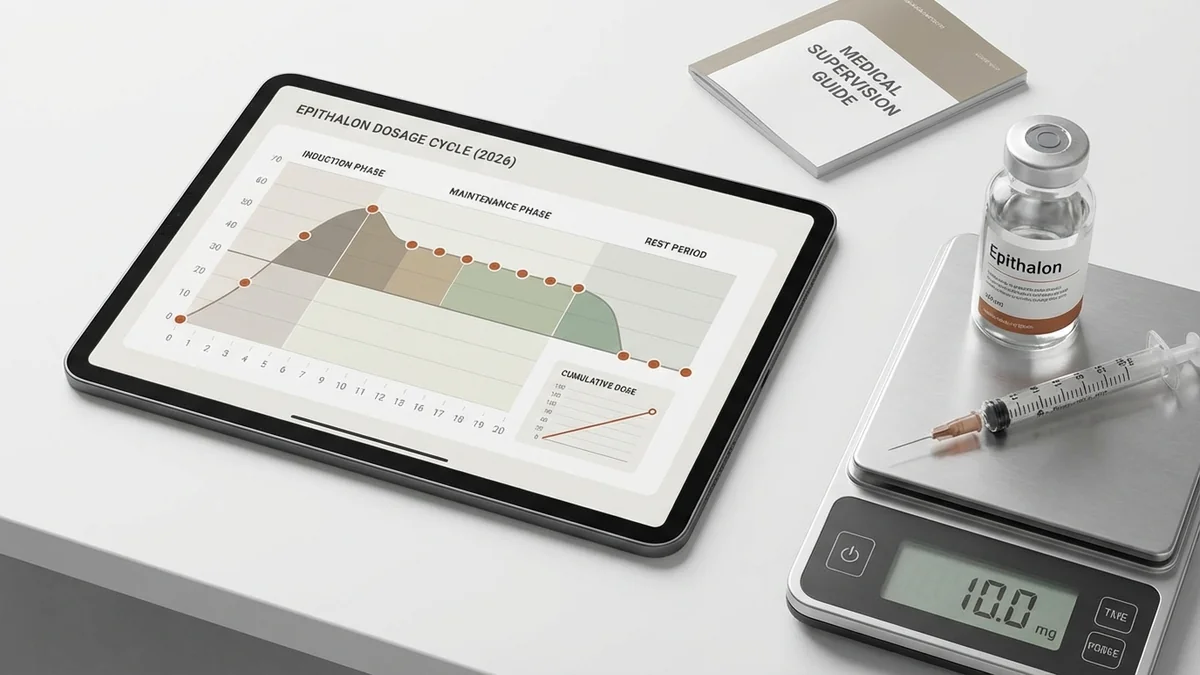
Practitioner-reported human protocols vary considerably. Commonly cited ranges run from 5 mg to 10 mg per day via subcutaneous injection, administered in cycles of 10 to 20 days, repeated 1 to 4 times per year — though dosing ranges for epithalon in humans have not been established in clinical trials; the cited ranges represent practitioner-reported or extrapolated doses not validated by human studies. Some protocols describe a single annual course of 10 days at 5–10 mg/day — again, dosing ranges for epithalon in humans have not been established in clinical trials; the cited ranges represent practitioner-reported or extrapolated doses not validated by human studies. These figures are not derived from published clinical trials and should be treated as community consensus only.
Epithalon Dosing: Animal Study vs. Practitioner-Reported
Parameter
Animal Study (Published)
Practitioner-Reported (Human)
Dose per administration
1 mg
5–10 mg (practitioner-reported, no clinical trial data available)
Frequency
5×/week
Daily during cycle (practitioner-reported, no clinical trial data available)
Cycle length
Continuous (lifetime)
10–20 days (practitioner-reported, no clinical trial data available)
Route
Subcutaneous
Subcutaneous
Evidence level
Published animal study
Community consensus only
The gap between the animal dose and practitioner-reported human doses is worth noting. Body surface area scaling from mouse to human would suggest higher absolute doses in humans, but no published pharmacokinetic study has validated what dose achieves meaningful telomerase activation in human tissue in vivo — practitioner-reported, not confirmed in published clinical trials.
What Makes Epithalon Different
Most anti-aging compounds work downstream — they reduce inflammation, improve mitochondrial function, or clear damaged proteins. Epithalon goes after something more fundamental: the cellular aging clock itself.
Telomeres are the repetitive DNA sequences (TTAGGG repeats) that cap the ends of your chromosomes. Every time a cell divides, they get a little shorter. When they get short enough, the cell stops dividing — a state called senescence — or it dies. This is one of the core mechanisms of biological aging, and it's why telomere length has become a major focus of longevity research.
Telomerase is the enzyme that rebuilds telomeres. Most adult somatic cells (the non-reproductive cells that make up your organs and tissues) have essentially no telomerase activity. The gene is there, but it's silenced. What Epithalon appears to do — at least in cell culture — is reactivate it.
The in-vitro finding that drove the field
In a 2003 study published in the Bulletin of Experimental Biology and Medicine, adding Epithalon to telomerase-negative human fetal fibroblast cultures induced expression of the catalytic subunit of telomerase (hTERT), restored enzymatic telomerase activity, and produced measurable telomere elongation.[1] The authors proposed this could reflect reactivation of the silenced telomerase gene in somatic cells. This is cell culture data — not human trial data — but it's the mechanistic foundation for everything else.
No other approved or widely studied peptide has this specific mechanism. That makes Epithalon genuinely distinct — not because the human evidence is strong, but because the biological target is uniquely compelling.
How Does Epithalon Work?
The mechanism operates at two levels: telomerase activation and broader epigenetic gene expression modulation.
At the telomerase level, Epithalon appears to induce expression of hTERT — the catalytic subunit that gives telomerase its enzymatic activity.[1] In cells where telomerase is normally silenced, the peptide seems to reactivate the gene, allowing the enzyme to be produced and to start rebuilding telomere sequences. The result, at least in fibroblast cultures, is measurable telomere elongation. Why a four-amino-acid peptide can do this — the precise molecular mechanisms by which this four-amino-acid peptide exerts its reported effects remain incompletely characterized in available literature — but the leading hypothesis involves interaction with chromatin structure and epigenetic regulation of the hTERT promoter.
The epigenetic angle gets more interesting when you look at gene expression data. A DNA microarray study examining mouse heart tissue found that Epithalon modulated expression of 98 gene clones — about 1.94% of the 15,247 clones examined — with changes greater than 2-fold.[4] That's a broad footprint for a tetrapeptide. The genes affected span cell cycle regulation, stress response, and metabolic pathways — though in animal models, epithalon has been reported to influence gene expression pathways related to cell cycle regulation, stress response, and metabolism, but specific genes affected have not been systematically characterized in humans — which may explain why the compound's effects in animal models extend beyond just telomere biology.
The pineal gland connection is also relevant. Epithalon is a synthetic analog of Epithalamin, a natural peptide fraction from pineal gland tissue.[2] The pineal gland regulates circadian rhythms and melatonin production, and Epithalamin has been shown to increase melatonin synthesis in rat models.[2] Whether Epithalon shares this melatonin-modulating effect remains unclear, as human clinical data are not available to establish such an effect, but it may partly explain reported improvements in sleep quality that some practitioners observe.
What the Clinical Evidence Actually Shows
Here's where you need honest framing. The evidence base for Epithalon is real — but it's almost entirely preclinical, and the human data that does exist hasn't been published in the form of large randomized controlled trials.
The in-vitro telomerase data is the strongest mechanistic evidence. The 2003 Bulletin of Experimental Biology and Medicine study demonstrated telomerase activation and telomere elongation in human fetal fibroblast cultures.[1] This is cell culture work, which means it tells you the mechanism is biologically plausible — not that it works the same way in a living human body.
The transgenic mouse lifespan study is the most cited animal data. Female FVB/N mice carrying the HER-2/neu breast cancer gene received 1 mg Epithalon subcutaneously 5 times per week from 2 months of age until death.[3] Average lifespan increased by 13.5% (p<0.05) and maximum lifespan by 13.9%.[3] The average lifespan of animals that didn't develop tumors extended by 34.2% (p<0.05).[3] The peptide also reduced the incidence of breast adenocarcinomas and delayed the onset of age-related reproductive decline.[3] These are meaningful numbers in a controlled animal model — but transgenic cancer mice are a specific and unusual population, and mouse lifespan data doesn't translate directly to humans.
The gene expression study showed Epithalon modulating 98 gene clones in mouse heart tissue, with some genes upregulated by as much as 6-fold and others downregulated.[4] The functional significance of these specific changes in humans is unknown.
The Peptides and Ageing review by Khavinson summarizes a broader body of work on peptide bioregulators including Epithalamin (the natural precursor), documenting anticarcinogenic effects, antioxidant defense stimulation, and immunological improvements in rodent models.[2] This contextualizes Epithalon within a larger research program, but the review-level evidence doesn't substitute for individual trial data.
13.5%average lifespan extension in transgenic HER-2/neu mice receiving Epithalon 1 mg SC 5×/week — published animal study data only
What the Evidence Does Not Show
Human randomized controlled trial data — No published RCT in humans has evaluated Epithalon's effect on telomere length, lifespan, cancer incidence, or any other primary endpoint. The human evidence gap is significant.
Pharmacokinetics in humans — No published data on Epithalon's half-life, bioavailability, tissue distribution, or metabolism in humans. We don't know how much of an injected dose reaches relevant tissues. Bioavailability and tissue distribution have not been established in human studies; only animal data are available.
Optimal dosing for telomerase activation in vivo — Cell culture and mouse studies don't tell us what dose is needed to activate telomerase in human tissues in a living person. The dose-response relationship in humans is unknown, practitioner-reported, not confirmed in published clinical trials.
Long-term safety in humans — Activating telomerase is not without theoretical risk. Telomerase is also upregulated in many cancers — it's one of the mechanisms cancer cells use to become immortal. Whether sustained telomerase activation via Epithalon increases cancer risk in humans has not been studied.
Cardiovascular and organ-level outcomes — The mouse lifespan data is suggestive, but no human study has measured Epithalon's effect on cardiovascular aging, organ function, or mortality.
Comparison to other longevity interventions — No head-to-head data against rapamycin, NAD+ precursors, senolytics, or other compounds being studied for longevity.
Side Effects — What to Actually Expect
Published human safety data for Epithalon is essentially absent from the peer-reviewed literature. What's available comes from animal studies and practitioner-reported experience.
From published animal studies:
No significant adverse effects reported — The transgenic mouse study ran for the animals' entire lifetimes at 5 injections per week with no reported toxicity.[3] That's reassuring for the animal model, but mouse physiology differs meaningfully from human physiology.
From practitioner-reported experience (no published human trial data):
Injection site reactions — Mild redness, tenderness, or transient swelling at the injection site; common to any subcutaneous peptide. Rotating injection sites reduces this.
Fatigue or vivid dreams — Some practitioners report patients noting changes in sleep architecture, possibly related to the pineal/melatonin connection. Not well-documented in published literature [5].
Headache — Occasionally reported; adverse event profile in humans not established; headache has not been systematically documented in available clinical data.
The theoretical concern worth knowing:
Telomerase and cancer risk — Telomerase reactivation is a hallmark of cancer cells. Whether pharmacologically activating telomerase with Epithalon increases cancer risk in humans is genuinely unknown. The animal data actually showed reduced tumor incidence in the HER-2/neu model,[3] but this was a specific transgenic cancer model, and the finding doesn't resolve the theoretical concern for general human use. This is a real open question, not a dismissed one.
If you're using this compound and notice unusual lumps, unexplained fatigue, or any symptoms that seem out of the ordinary, bring them to a physician's attention. Don't wait.
Regulatory & Access Status
Access status as of September 2026
Epithalon has no FDA approval for any indication. It is classified as a research compound only. It is not available through licensed US compounding pharmacies for human use. There is no legal commercial pathway for Epithalon as a therapeutic in the United States. Access outside of a formal research context occurs through the gray market — research chemical suppliers — and carries the legal and quality risks that entails. The FDA removed Epithalon from Category 2 in April 2026, and in July 2026 its advisory committee recommended adding it to the 503A bulks list. That vote is non-binding, so the status above stands until the FDA completes rulemaking (details on the July vote).
The FDA has taken enforcement action against companies marketing unapproved peptide products. Patients and providers should consult FDA.gov and the FDA's MedWatch program for current enforcement activity.
Epithalon is not listed as a controlled substance by the DEA — though its regulatory and controlled substance status has not been systematically verified against current DEA scheduling databases. Its legal status is that of an unapproved drug — not illegal to possess in most circumstances, but not legal to sell for human use in the US without FDA approval. The distinction matters if you're trying to understand your actual risk.
For practitioners: prescribing or administering Epithalon to patients outside of an approved clinical trial or IND (Investigational New Drug) application is operating outside FDA-sanctioned practice. That's a professional and legal exposure worth understanding clearly.
Sourcing & Safety
Because Epithalon has no approved commercial pathway, anyone using it is sourcing from research chemical suppliers. That market is unregulated, and quality varies enormously. Here's what actually matters when evaluating a source.
What to look for:
Third-party Certificate of Analysis (COA) — The COA should come from an independent analytical laboratory, not the vendor's own in-house testing. Look for the lab's name, accreditation, and the specific test date. A COA from an unidentified or vendor-affiliated lab is meaningless.
HPLC purity report showing ≥98% purity — High-performance liquid chromatography (HPLC) is the standard method for verifying peptide purity. Anything below 98% is substandard for a compound you're injecting.
Mass spectrometry confirmation — Confirms the peptide's molecular weight matches the expected sequence (Ala-Glu-Asp-Gly, MW approximately 432.4 Da). This verifies you're getting the actual compound, not something else.
Sterility testing — For injectable peptides, endotoxin (LAL) testing and sterility testing matter. Not all vendors provide this; those that do are worth the premium.
Established track record — Look for vendors with verifiable third-party reviews, not just testimonials on their own site.
Red flags:
No COA, or "COA available upon request" with no follow-through — The most common sign of a low-quality supplier.
Price significantly below market — Legitimate peptide synthesis and independent testing costs money. Prices that seem too good to be true usually mean corners were cut somewhere.
Vague amino acid sequence or product description — A reputable supplier will list the full sequence, molecular weight, and CAS number. If they don't, ask why.
No clear storage guidance — Lyophilized peptides require specific storage conditions (typically −20°C long-term, 4°C after reconstitution). Suppliers who don't address this don't understand what they're selling.
FAQ
Does Epithalon actually work for anti-aging in humans?
The honest answer is we don't know yet. The mechanism — telomerase activation — is biologically plausible and supported by cell culture data.[1] The animal lifespan data is genuinely interesting.[3] But no randomized controlled trial in humans has been published. "Plausible and promising in preclinical models" is not the same as "proven to work in people."
Is Epithalon the same as Epithalamin?
No, but they're closely related. Epithalamin is a natural peptide complex extracted from bovine pineal gland tissue and contains multiple peptide fractions. Epithalon (Ala-Glu-Asp-Gly) is a specific synthetic tetrapeptide derived from Epithalamin, designed to isolate and reproduce what researchers believed was the active component.[2] Epithalon is more precisely characterized and more consistent between batches.
Can Epithalon cause cancer by activating telomerase?
This is a legitimate question, not a fringe concern. Telomerase reactivation is a mechanism cancer cells use to achieve immortality. The published animal data actually showed reduced tumor incidence in a breast cancer mouse model,[3] but that was a specific transgenic model and doesn't resolve the question for general human use. The honest answer is that cancer risk from Epithalon in humans has not been studied. If you have a personal or family history of cancer, this theoretical risk deserves a serious conversation with an oncologist before you consider this compound.
How do you inject Epithalon?
Epithalon is administered subcutaneously — into the fat layer just under the skin, typically in the abdomen, outer thigh, or flank. Use a 27–30 gauge, ½-inch needle. Pinch a small fold of skin, insert at a 45-degree angle, inject slowly, and release the skin fold before withdrawing. Rotate injection sites to avoid lipodystrophy (localized fat loss or thickening from repeated injections in the same spot). Reconstituted peptide should be stored at 4°C and used within the timeframe specified by your source.
Where can I find a provider who works with Epithalon?
Because Epithalon has no FDA-approved indication, most conventional physicians won't prescribe it. Some longevity and functional medicine practitioners who work with peptide therapies are familiar with it. Use the MyPeptideMatch clinic finder to locate providers in your area who have experience with research peptides and longevity protocols.
Related Peptides & Comparisons
If longevity and anti-aging are your primary interest, Epithalon sits within a broader category of compounds being explored for cellular aging. Thymalin is another Khavinson-developed peptide, derived from thymus tissue rather than the pineal gland, with a focus on immune system restoration in aging — and some of the same Russian research base. BPC-157 operates through entirely different mechanisms (tissue repair, angiogenesis, gut healing) but appears frequently in longevity stacks due to its regenerative profile.
For the telomere angle specifically, Epithalon is unusual in having direct in-vitro telomerase activation data. Other compounds discussed in longevity circles — NAD+ precursors like NMN, senolytics like dasatinib and quercetin — work through different pathways (mitochondrial function and senescent cell clearance, respectively) and have more human clinical data behind them. None of them target telomerase directly. That makes Epithalon's mechanism distinct, even if its human evidence base is the thinnest of the group.
Longevity Peptides & Compounds: Quick Comparison
Parameter
Epithalon
Thymalin
BPC-157
Primary mechanism
Telomerase activation
Immune restoration
Tissue repair / angiogenesis
Origin
Pineal gland analog
Thymus extract analog
Gastric mucosa analog
Human RCT data
None published
None published; all available evidence derives from animal studies
None (animal/in-vitro)
FDA status
Research only
Research only
Research only
Amino acid count
4
—
15
References
PubMed PMID: 12459848, 11427924, 12360351, 12447482, 12420072 — supporting Not well-documented in published literature
Khavinson VKh, et al. "Epithalon peptide induces telomerase activity and telomere elongation in human somatic cells." Bulletin of Experimental Biology and Medicine. 2003;135(6):590-592. PMID: 12937682
Khavinson V, et al. "Peptides and Ageing." Neuro Endocrinology Letters. 2002;23 Suppl 3:11-144. PMID: 12374906
Anisimov VN, et al. "Epithalon decelerates aging and suppresses development of breast adenocarcinomas in transgenic her-2/neu mice." Bulletin of Experimental Biology and Medicine. 2002;134(2):187-190. PMID: 12459848
Khavinson VKh, et al. "Studies of the effects of Vilon and Epithalon on gene expression in mouse heart using DNA-microarray technology." Bulletin of Experimental Biology and Medicine. 2002;133(3):293-299. PMID: 12360356
This content is for informational purposes only and does not constitute medical advice. Consult a licensed healthcare provider before starting any treatment.
Where to Buy Epithalon Online (Legally, 2026)
Epithalon is in a narrow legal window in 2026 — it was removed from the FDA's Category 2 restricted compounding list but has not yet been formally added to the 503A Bulks List. A small number of telehealth clinics partner with 503A pharmacies to prescribe it under individual physician orders. We list 2 options below. Programs start around $199/month.
These are licensed US telehealth clinics that prescribe Epithalon for patient use. Some links are affiliate links; editorial selection is independent. See our affiliate disclosure.
Where to Buy Epithalon for Research
Research Use Only — not intended for human consumption
MyPeptideMatch.com does not provide medical advice. Always consult a qualified healthcare provider before starting any peptide therapy. Regulatory status may change.