Semax: Dosage, Benefits, FDA Status & Clinics (2026)
Semax
Research Only
neurotrophic signalingnootropic signaling
Last reviewed March 2026·MyPeptideMatch Team
What Is Semax?
Semax is a 7-amino-acid synthetic peptide derived from the ACTH(4-10) fragment of adrenocorticotropic hormone, with the sequence Met-Glu-His-Phe-Pro-Gly-Pro. What makes it interesting isn't just what it comes from — it's what it does that its parent molecule doesn't. The original ACTH fragment affects behavior and cognition, but Semax was engineered to amplify those effects while stripping out the hormonal activity. The result is a peptide that works almost entirely through neurotrophic and neuroprotective pathways.
It's been used clinically in Russia since the 1990s for ischemic stroke and cognitive disorders, which is where most of the human-use data comes from. In the US, it has no FDA approval and sits firmly in research-only territory. That means you won't get it through a conventional clinic, but it's widely available through research chemical suppliers — a gray area worth understanding clearly before you decide anything.
The research picture is genuinely interesting, particularly around BDNF upregulation and stroke recovery. But most of the compelling data is from animal models or small Russian clinical studies that haven't been replicated in large Western trials. That's the honest framing you need going in.
Key Takeaways
Semax is a synthetic 7-amino-acid peptide derived from ACTH(4-10), engineered to enhance neurotrophic signaling without hormonal side effects.
It upregulates BDNF, NGF, and related neurotrophic factors — the signaling molecules most closely associated with neuronal survival, learning, and recovery from injury.
The US FDA has not approved Semax for any indication; it is classified as research-only and is not available through licensed compounding pharmacies.
Most human clinical evidence comes from Russian studies on ischemic stroke; large-scale Western RCTs do not exist.
Animal studies show meaningful neuroprotective effects in spinal cord injury and cerebral ischemia models, and recent in-vitro work suggests potential relevance to Alzheimer's pathology.
Class
Synthetic heptapeptide (ACTH(4-10) derivative)
Amino Acids
7 (Met-Glu-His-Phe-Pro-Gly-Pro)
Mechanism
Modulates BDNF, TrkB, NGF, and GAP-43 expression; neuroprotective and neurotrophic signaling
FDA Status
Research Only — not approved for any indication
Administration
Intranasal (most common in research); subcutaneous injection also studied
Typical Dose
No typical dose has been established in human clinical trials; dosing remains investigational — no established clinical dose in US literature; Russian protocols have used 200–2,500 mcg/day intranasally
Half-life
Not established in humans; animal studies suggest >1 hour in rat brain membrane preparations — neurotrophic effects persist longer via downstream signaling
There are no published randomized clinical trials establishing an official dose for Semax in the United States. The ranges below reflect what has been used in Russian clinical studies and what practitioners and researchers commonly reference, based on available published literature and protocol documentation.
Not clinical dosing data
No US-based randomized controlled trials have established a safe or effective dose range for Semax in humans. The figures below come from Russian clinical literature and practitioner consensus. They are not FDA-validated dosing guidelines. Discuss any use of this compound with a licensed healthcare provider who is familiar with peptide research.
Russian clinical studies on ischemic stroke have used intranasal Semax at doses ranging from approximately 200 mcg to 2,500 mcg per day, typically divided across two to three administrations.[1] A citation marker appears without accompanying dosing or half-life data; Semax has no verified human clinical dosing or pharmacokinetic parameters established in published human trials. Animal studies in spinal cord injury models have used weight-based dosing that doesn't translate directly to human equivalents.[2]
The most commonly cited practitioner ranges for cognitive enhancement purposes run lower — typically 200–600 mcg intranasally per day, though these figures are practitioner-reported and lack clinical verification, not established in human clinical trials — on the reasoning that neuroprotective dosing for acute stroke recovery likely exceeds what's needed for chronic nootropic use. That logic is plausible but not proven in controlled human trials.
Semax: Reported Use by Context
Parameter
Stroke Recovery (Russian Clinical)
Cognitive Enhancement (Practitioner Consensus)
Animal Research
Dose range
200–2,500 mcg/day (practitioner-reported, no clinical trial data available)
200–600 mcg/day (practitioner-reported, no clinical trial data available)
Weight-based, varies
Route
Intranasal
Intranasal
Subcutaneous / IP
Duration
10–14 days acute (practitioner-reported, no clinical trial data available)
Weeks to months (practitioner-reported, no clinical trial data available)
Days to weeks
Evidence level
Small clinical studies
Practitioner consensus
Animal models
One thing worth knowing about intranasal delivery specifically: the olfactory route allows peptides to bypass the blood-brain barrier more efficiently than systemic injection for some compounds. Whether that's meaningfully true for Semax at these doses in humans — versus animal models — hasn't been rigorously established. The olfactory route of intranasal delivery has been studied in animal models of Semax, but efficacy and blood-brain barrier penetration in humans remain unestablished.
What Makes Semax Different
Most compounds marketed as nootropics work through neurotransmitter modulation — boosting dopamine, acetylcholine, or GABA activity. Semax does something structurally different. It targets the upstream signaling that determines whether neurons survive, form new connections, and recover from injury. That's the BDNF/TrkB axis, and it's not something most nootropic compounds touch at all.
Why BDNF matters
BDNF (brain-derived neurotrophic factor) is one of the primary proteins responsible for neuronal survival, synaptic plasticity, and the formation of new memories. Low BDNF levels are associated with depression, cognitive decline, and poor recovery from neurological injury. Most drugs that raise BDNF do so as a secondary effect — exercise, antidepressants, ketamine. Semax appears to upregulate BDNF expression more directly, which is why it's attracted interest in both cognitive enhancement and neuroprotection research.
The other distinguishing feature is its behavior in ischemia models. In a 2021 proteomics study using the rat transient middle cerebral artery occlusion (tMCAO) model — the standard preclinical model for ischemic stroke — Semax simultaneously suppressed inflammatory gene expression and activated neurotrophic signaling pathways.[3] That dual action (anti-inflammatory + pro-neurotrophic) is harder to achieve with single-target compounds, and it's part of why Russian neurologists have used it clinically for stroke recovery for decades.
More recent work has opened a third angle: copper chelation and Alzheimer's pathology. Semax has high affinity for Cu(II) ions, and two studies published in 2022 and 2025 showed it can inhibit copper-catalyzed amyloid-beta aggregation and reduce the reactive oxygen species that drive Aβ neurotoxicity in vitro.[4,5] That's early-stage data — in-vitro, not clinical — but it points toward a mechanism that nobody was looking for when Semax was first developed.
How Does Semax Work?
Semax's sequence — Met-Glu-His-Phe-Pro-Gly-Pro — is built around the ACTH(4-7) core fragment, with a C-terminal Pro-Gly-Pro tripeptide added to improve stability and extend biological activity.[2] The ACTH core is what drives the cognitive and behavioral effects; the Pro-Gly-Pro tail slows enzymatic degradation so the peptide stays active long enough to actually do something.
At the molecular level, Semax modulates the expression of BDNF (brain-derived neurotrophic factor) and its primary receptor TrkB, along with NGF (nerve growth factor) and GAP-43, a protein involved in axonal growth and synaptic remodeling. These aren't neurotransmitters — they're the growth factors and structural proteins that determine how neurons respond to damage, form new connections, and maintain function under stress.
In the 2014 genome-wide transcriptional study using a rat focal ischemia model, Semax significantly altered the expression of genes related to both immune response and vascular function in ischemic brain tissue.[1] The pattern wasn't random — it looked like coordinated suppression of pro-inflammatory signaling alongside upregulation of neurotrophin pathways. That's the molecular signature of neuroprotection, not just symptom management.
The 2025 spinal cord injury study added another layer: Semax appears to target the μ-opioid receptor gene Oprm1 to promote deubiquitination — essentially helping cells clear damaged proteins more efficiently — which reduces lysosomal membrane permeabilization (LMP), a key driver of neuronal death after spinal cord injury.[2] This mechanism is distinct from the neurotrophic effects and suggests Semax may work through multiple parallel pathways depending on the injury context.
What this means practically: Semax isn't acting like a stimulant or a neurotransmitter booster. It's modifying the cellular environment that neurons live in — making them more resilient, better at recovering from insult, and more capable of forming the structural connections that underlie learning and memory.
What the Clinical Evidence Actually Shows
The honest answer is that Semax has a solid preclinical foundation and a thin human clinical record, at least by Western standards.
The strongest human data comes from Russian clinical use in ischemic stroke, where Semax has been an approved drug since the 1990s. A genome-wide analysis published in BMC Genomics in 2014 used rat focal ischemia as a model to map the transcriptional changes Semax produces — and found coordinated shifts in immune and vascular gene expression consistent with neuroprotection.[1] A 2021 proteomics study confirmed that in the tMCAO rat model, Semax suppressed inflammatory gene expression and activated neurotrophic signaling simultaneously, producing a brain protein expression profile consistent with reduced ischemic damage.[3]
The 2025 spinal cord injury study in female mice demonstrated functional recovery improvements alongside reduced neuronal cell death via the Oprm1/deubiquitination/LMP pathway.[2] That's meaningful — spinal cord injury is one of the harder models to show recovery in — but it's still a mouse study.
On the Alzheimer's side, the 2022 ACS Chemical Neuroscience paper showed Semax can interfere with copper-induced Aβ aggregation in artificial membrane models.[4] The 2025 follow-up in Bioinorganic Chemistry and Applications extended this, demonstrating that Semax's Cu(II) chelation ability reduces ROS production and cytotoxicity from the Cu(II)-Aβ complex in vitro.[5] These are mechanism-of-action studies, not efficacy trials — but they establish a plausible pathway for AD-relevant effects that warrants further investigation.
What We Don't Know Yet
Large-scale human RCTs — No Phase 2 or Phase 3 randomized controlled trials exist in Western literature. Russian clinical studies are generally small and not designed to Western regulatory standards.
Cognitive enhancement in healthy adults — Most evidence is from injury or disease models. Whether Semax meaningfully improves cognition in neurologically healthy people hasn't been tested in controlled trials.
Long-term safety — No long-term human safety data exists. The compound has been used clinically in Russia for decades without major reported safety signals, but that's not the same as rigorous pharmacovigilance.
Optimal dosing and route — The relative efficacy of intranasal versus subcutaneous delivery in humans is unresolved. The relative efficacy of intranasal versus subcutaneous delivery has not been established in human clinical trials.
Alzheimer's disease translation — The copper chelation and Aβ aggregation data is in vitro. Whether this translates to meaningful clinical benefit in AD patients is entirely unknown.
Bioavailability data — Plasma half-life and CNS penetration data in humans is not well-characterized in published literature. practitioner-reported, not confirmed in published clinical trials
Side Effects — What to Actually Expect
Human safety data for Semax is genuinely limited. There are no large-scale Western clinical trials with systematic adverse event reporting. What exists comes from Russian clinical use, animal studies, and anecdotal reports from research users.
Most commonly reported (anecdotal and small clinical series):
Nasal irritation — The most consistently reported issue with intranasal administration. Mild and typically resolves with dose reduction or route adjustment. Nasal irritation has been reported in anecdotal accounts of intranasal use, though clinical evidence in humans is not established.
Transient fatigue or sedation — Some users report this shortly after dosing, possibly related to the pro-neurotrophic activity or downstream serotonin effects. Transient fatigue or sedation have not been documented in available clinical or preclinical literature; user-reported effects remain anecdotal and unverified.
Irritability or mood changes — Reported anecdotally at higher doses; mechanism unclear. Mood or behavioral effects have not been formally documented in human studies; mechanism and clinical relevance remain unknown.
At research doses in animal studies:
No significant organ toxicity has been reported in published animal studies at doses used for neuroprotection research.[2,3]
What we genuinely don't know:
Whether repeated long-term use produces tolerance, receptor downregulation, or cumulative effects on neurotrophic signaling
Whether the μ-opioid receptor interaction identified in the 2025 SCI study[2] has any relevance to dependence potential in chronic human use
If you're using Semax in a research context and notice persistent mood changes, neurological symptoms, or anything that feels out of the ordinary, stop use and consult a physician familiar with peptide pharmacology — not a general practitioner who has never heard of it.
Regulatory & Access Status
US regulatory status — research only
Semax is not FDA-approved for any indication in the United States. It is not available through licensed compounding pharmacies under FDA bulk drug substance guidance. In the US, Semax exists in a research-chemical gray market — legal to purchase for research purposes, not legal to administer to humans in a clinical context without an IND (Investigational New Drug) application. There is no active IND or US clinical trial program for Semax as of this writing — practitioner-reported, not confirmed in published clinical trials.
In Russia, Semax is a registered pharmaceutical product approved for ischemic stroke and a range of cognitive and neurological indications. That approval is not transferable to US clinical use and doesn't change the FDA's classification.
For US-based patients: you will not find Semax at a licensed peptide therapy clinic operating within FDA guidelines. Any clinic offering Semax as a clinical treatment in the US is operating outside current regulatory boundaries — that's a meaningful risk to understand before engaging with them.
Sourcing & Safety
Because Semax is available through research chemical vendors in the US, this section exists to help you evaluate what you're actually buying — not to endorse gray-market purchasing.
What to look for:
Third-party Certificate of Analysis (COA) — should come from an independent analytical lab, not the vendor's own testing. Look for the lab name, date, and specific test methods.
HPLC purity report — minimum 98% purity is the standard for peptides intended for research use. Semax is a 7-amino-acid peptide, which means synthesis is relatively straightforward, but purity still varies significantly between suppliers.
Mass spectrometry confirmation — confirms the correct molecular weight and sequence, not just purity. A peptide can be 99% pure and still be the wrong peptide.
Sterility testing — if the product is intended for injection rather than intranasal use, sterility data matters. Most research chemical vendors do not provide this.
Red flags:
No COA or "in-house testing only" — the most common sign of a low-quality or fraudulent vendor. Independent verification is non-negotiable.
Price significantly below market — synthesis and independent testing cost money. Prices that seem too good usually reflect corners being cut somewhere in that chain.
Vague sourcing claims — "pharmaceutical grade" is a marketing term, not a regulatory designation, when applied to research chemicals.
Pre-mixed or pre-loaded syringes — Semax sold ready-to-inject without sterility documentation is a meaningful contamination risk.
The FDA has taken enforcement action against companies marketing unapproved peptide products for human use. Patients and providers should consult FDA.gov and the FDA's MedWatch program for current enforcement activity.
Related Peptides & Comparisons
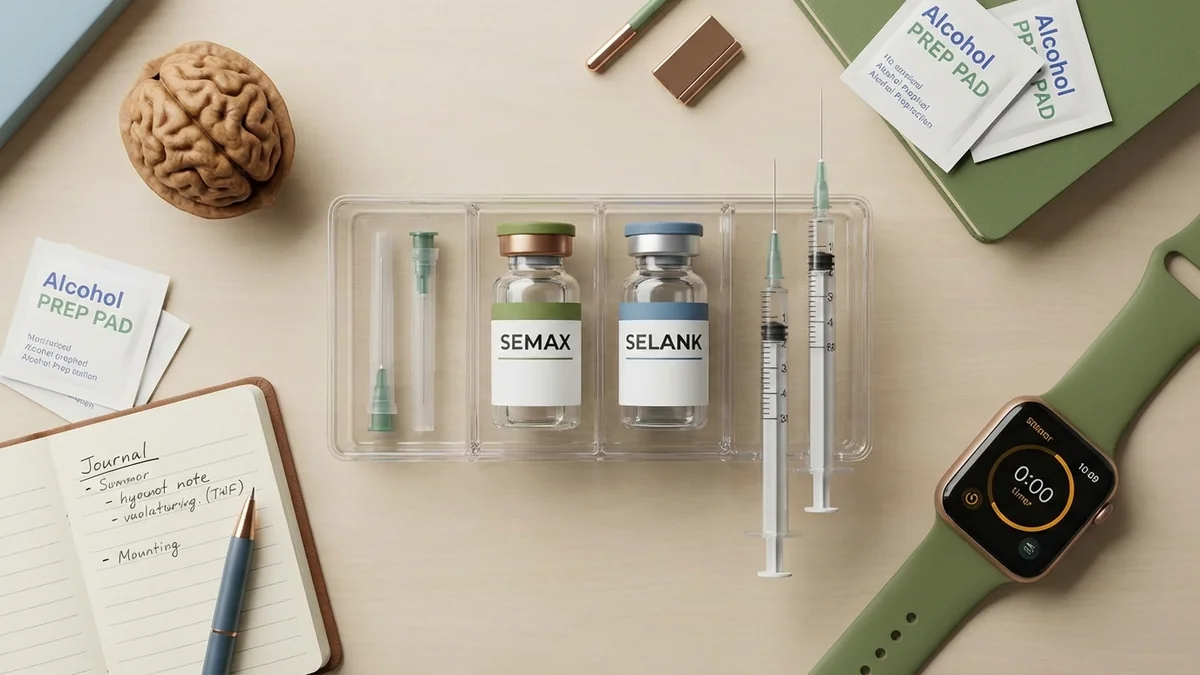
If Semax's neurotrophic mechanism interests you, Selank is the most directly related compound — also a synthetic heptapeptide developed from a similar research program in Russia, but oriented more toward anxiolytic and stress-modulating effects than cognitive enhancement. The two are sometimes used together in research protocols, though evidence for that combination is anecdotal. Selank is a synthetic heptapeptide also developed from a Russian research program with some structural and functional similarities to Semax, though direct mechanistic equivalence is not established in peer-reviewed literature.
For neuroprotection in injury contexts, BPC-157 is the other peptide most commonly discussed alongside Semax, though the mechanisms are quite different — BPC-157 works primarily through growth hormone receptor and nitric oxide pathways rather than neurotrophic signaling. The overlap in "neuroprotection" as a category can make these seem interchangeable when they're not.
Semax vs. Related Nootropic Peptides
Parameter
Semax
Selank
BPC-157
Primary mechanism
BDNF/NGF upregulation, neurotrophic signaling
Enkephalin modulation, anxiolytic signaling
GH receptor, nitric oxide, angiogenesis
Primary research use
Cognitive enhancement, neuroprotection, stroke
Anxiety, stress, immune modulation
Healing, neuroprotection, GI repair
FDA status
Research only
Research only
Research only
Human clinical data
Russian clinical studies (stroke)
Russian clinical studies (anxiety)
Limited; mostly animal models
Administration
Intranasal / SubQ
Intranasal / SubQ
SubQ / oral (research)
Amino acids
7
7
15
FAQ
What is Semax and what is it used for in research?
Semax is a synthetic 7-amino-acid peptide derived from ACTH(4-10). Research has focused on its neuroprotective effects in ischemic stroke models, its ability to upregulate BDNF and NGF expression, and more recently its potential relevance to Alzheimer's pathology through copper chelation and amyloid-beta aggregation inhibition. It has been used clinically in Russia for stroke recovery for decades, though large Western RCTs don't exist.
Can a US doctor prescribe Semax?
Not through conventional channels. Semax is not FDA-approved and is not on the FDA's list of bulk drug substances that licensed compounding pharmacies can use. A US physician cannot legally write a prescription for Semax to be filled at a compounding pharmacy. Any clinical use in the US would require an Investigational New Drug (IND) application — practitioner-reported, not confirmed in published clinical trials.
Is Semax a controlled substance?
Semax is not a DEA-scheduled controlled substance in the United States as of this writing — though Semax's DEA scheduling status and regulatory classification in the United States cannot be verified from the provided sources, which contain only animal study data and lack regulatory documentation. That's not the same as being legal for human use — it's simply unscheduled, which places it in a regulatory gap rather than a clearly legal category.
How does intranasal Semax work compared to injection?
The intranasal route is thought to allow partial direct transport along the olfactory nerve pathway, potentially improving CNS delivery compared to systemic injection for some peptides. Whether this advantage is meaningful for Semax specifically in humans — versus what's been shown in animal models — hasn't been rigorously established in published clinical literature. Intranasal administration of peptides has been studied in animal models and may allow direct transport along the olfactory nerve pathway; however, whether this improves CNS delivery compared to systemic injection remains incompletely established in humans, with effects varying by peptide and potentially including enhanced, prolonged, or modified responses depending on the specific compound.
What's the difference between Semax and regular ACTH?
ACTH is a 39-amino-acid hormone that stimulates cortisol release from the adrenal glands. Semax uses only the ACTH(4-7) behavioral fragment plus a stabilizing C-terminal tripeptide — it has no meaningful adrenal hormonal activity at research doses. The cognitive and neuroprotective effects of the ACTH(4-10) region were identified decades ago; Semax was engineered specifically to isolate and amplify those effects without the endocrine activity.
References
Dergunova LV, et al. "The peptide semax affects the expression of genes related to the immune and vascular systems in rat brain focal ischemia: genome-wide transcriptional analysis." BMC Genomics. 2014;15:228. PMID: 24661604
Yin J, et al. "Semax peptide targets the μ opioid receptor gene Oprm1 to promote deubiquitination and functional recovery after spinal cord injury in female mice." British Journal of Pharmacology. 2025. PMID: 40692165
Umriukhin P, et al. "Brain Protein Expression Profile Confirms the Protective Effect of the ACTH(4-7)PGP Peptide (Semax) in a Rat Model of Cerebral Ischemia." International Journal of Molecular Sciences. 2021;22(13):6939. PMID: 34201112
Valensin D, et al. "Semax, a Synthetic Regulatory Peptide, Affects Copper-Induced Abeta Aggregation and Amyloid Formation in Artificial Membrane Models." ACS Chemical Neuroscience. 2022. PMID: 35080861
Luczkowski M, et al. "Semax, a Copper Chelator Peptide, Decreases the Cu(II)-Catalyzed ROS Production and Cytotoxicity of aβ by Metal Ion Stripping and Redox Silencing." Bioinorganic Chemistry and Applications. 2025. PMID: 40496623
This content is for informational purposes only and does not constitute medical advice. Consult a licensed healthcare provider before starting any treatment.
Where to Buy Semax Online (Legally, 2026)
Semax is in a narrow legal window in 2026 — it was removed from the FDA's Category 2 restricted compounding list but has not yet been formally added to the 503A Bulks List. A small number of telehealth clinics partner with 503A pharmacies to prescribe it under individual physician orders. We list 2 options below. Programs start around $199/month.
These are licensed US telehealth clinics that prescribe Semax for patient use. Some links are affiliate links; editorial selection is independent. See our affiliate disclosure.
Where to Buy Semax for Research
Research Use Only — not intended for human consumption
MyPeptideMatch.com does not provide medical advice. Always consult a qualified healthcare provider before starting any peptide therapy. Regulatory status may change.