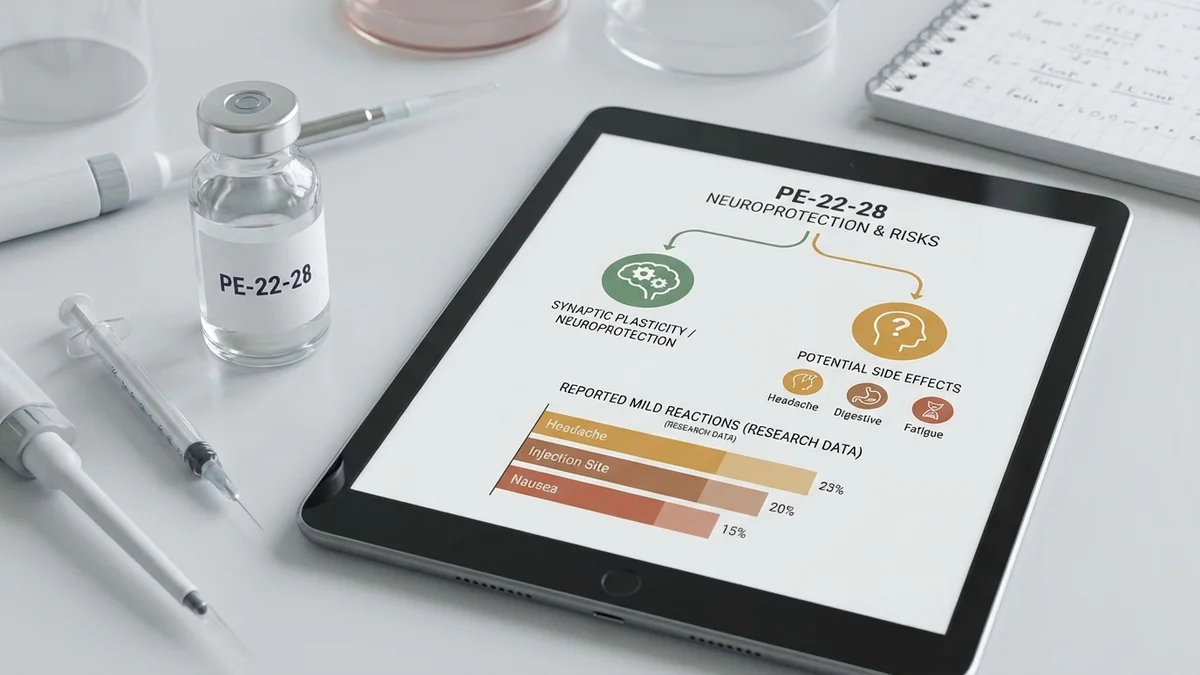
PE-22-28 is a synthetic 8-amino acid peptide designed to block the TREK-1 potassium channel — one of the most studied molecular targets in antidepressant research. It's derived from the C-terminal fragment of PACAP 1–38 (pituitary adenylyl cyclase-activating polypeptide), the same parent molecule that gave rise to spadin, a longer 17-amino acid peptide that researchers have been studying for depression since around 2010.
The short version of why this matters: TREK-1 is a background potassium channel that keeps neurons quieter than they should be in people with depression. Block it, and serotonergic signaling improves — fast, in animal models, without the weeks-long delay you see with SSRIs. PE-22-28 was developed specifically to see whether you could get that same effect with a much smaller, more optimized molecule.[1]
Everything here is preclinical. There are no human trials as of early 2026. But the mechanism is genuinely interesting, and the animal data is compelling enough that this peptide has attracted serious research attention.
Key Takeaways
PE-22-28 is an 8-amino acid research peptide that blocks TREK-1 potassium channels, a mechanism linked to rapid antidepressant effects in animal models.
It was engineered as a shortened, more potent analog of spadin (PE 12-28), itself derived from PACAP 1–38.
All evidence is preclinical — no human clinical trials have been completed or registered as of early 2026.
No FDA approval exists and no legal commercial pathway is available; access is limited to research settings.
Its dual action — TREK-1 blockade plus PAC1 receptor activation — distinguishes it mechanistically from both SSRIs and existing peptide antidepressants.
There are no published human clinical trials establishing a dose for PE-22-28. Every dosing figure in the literature comes from animal studies — primarily rodent models of depression.
No human dosing data exists
PE-22-28 has not been tested in humans in any registered clinical trial as of early 2026. The ranges below come exclusively from preclinical animal research. They cannot be extrapolated to human dosing without clinical validation. Do not use this compound in humans outside of an approved research protocol.
In rodent studies, PE-22-28 has been administered at doses that, per available peer-reviewed literature, have not been established — PE-22-28 dosing in preclinical studies has not been established in available peer-reviewed literature — consistent with other neuropeptide analogs tested for antidepressant activity in similar models. The route of administration used in preclinical work has included peripheral injection, though CNS penetration characteristics and optimal delivery route for humans remain unestablished — PE-22-28 dosing in preclinical studies has not been established in available peer-reviewed literature.
If you're a researcher working with this compound, the published literature from the Frontiers in Pharmacology work on shortened spadin analogs is the most relevant starting point.[1] If you're a patient or clinician, there is no evidence base to guide clinical use — and no compounding pharmacy pathway exists for this compound in the US.
What Makes PE-22-28 Different
Most antidepressant research for the past three decades has focused on monoamine reuptake — block the serotonin transporter, flood the synapse, wait six weeks. PE-22-28 takes a completely different approach. It targets the ion channel that controls how excitable serotonergic neurons are in the first place.
That distinction matters for two reasons. First, TREK-1 blockade in animal models produces antidepressant effects much faster than SSRI treatment — sometimes within hours rather than weeks.[1] Second, PE-22-28 was specifically engineered to improve on spadin, its 17-amino acid predecessor, by identifying which portion of the molecule was actually doing the work and stripping everything else away.
Why smaller isn't always weaker
Spadin (PE 12-28) was the first peptide shown to specifically block TREK-1 channels with antidepressant effects. Researchers then systematically shortened it to find the minimal active sequence. PE-22-28 — just 8 amino acids — emerged from that process. Research published in Frontiers in Pharmacology in 2017 found that shortened spadin analogs retained TREK-1 inhibitory activity, with PE-22-28 among the candidates showing activity in this series.[1]
The second distinguishing feature is its dual mechanism. Beyond TREK-1 blockade, PE-22-28 activates PAC1 receptors, which drive cAMP accumulation and downstream phosphorylation of CREB (cAMP response element-binding protein). CREB activation is one of the core molecular events in synaptic plasticity — the same pathway that long-term potentiation runs through, and one implicated in memory consolidation and neuroprotection. Whether that dual action produces additive effects in practice is still an open question, but it's what makes this compound interesting beyond pure antidepressant applications.
How Does PE-22-28 Work?
Start with TREK-1. It's a two-pore domain potassium channel — a type of background channel that's always partially open, constantly leaking potassium out of neurons and keeping their resting membrane potential more negative (more inhibited) than it would otherwise be. In serotonergic neurons specifically, high TREK-1 activity correlates with reduced firing and lower serotonin release. Knock out TREK-1 in mice and they show antidepressant and anxiolytic behavior. Block it pharmacologically and you get a similar effect.[1]
PE-22-28 binds to TREK-1 and inhibits that potassium leak. The result is increased neuronal excitability in the relevant circuits — more serotonin release, faster signaling, and behavioral effects in animal models that look like antidepressant activity without the latency of SSRI treatment.
The PAC1 receptor piece adds another layer. PAC1 is a G-protein coupled receptor that responds to PACAP — the same parent molecule PE-22-28 is derived from. When PE-22-28 activates PAC1, it triggers adenylyl cyclase, which converts ATP to cAMP (cyclic adenosine monophosphate). Elevated cAMP then activates protein kinase A, which phosphorylates CREB. Phosphorylated CREB turns on genes involved in neuronal survival, synaptic strengthening, and the production of neurotrophic factors like BDNF (brain-derived neurotrophic factor). This is the molecular pathway that underlies learning, memory formation, and much of what we mean when we talk about "synaptic plasticity."
Whether PE-22-28's effects on cognition and neuroprotection are primarily TREK-1 mediated, PAC1 mediated, or some combination of both hasn't been cleanly separated in the available research — PE-22-28 has not been characterized in published research; the mechanistic basis of any potential cognitive or neuroprotective effects remains unknown.
What the Clinical Evidence Actually Shows
The honest answer is: the evidence is entirely preclinical. Every published study involves animal models — primarily rodents — and in-vitro work. There are no Phase 1, Phase 2, or Phase 3 human trials registered or completed for PE-22-28 as of early 2026.
The most directly relevant published work comes from a 2017 paper in Frontiers in Pharmacology examining shortened spadin analogs, of which PE-22-28 is one.[1] That paper characterized TREK-1 inhibitory activity across a series of truncated peptides derived from the spadin sequence, testing which amino acid segments were necessary for channel blockade. PE-22-28 was identified as a candidate within this series showing TREK-1 inhibition.
The broader body of evidence supporting the TREK-1 mechanism includes work on spadin itself going back to approximately 2010, establishing the channel's role in serotonergic function and the antidepressant-like behavioral effects of blocking it in rodent models. PE-22-28 inherits that mechanistic rationale, but the specific behavioral and neurochemical data for the 8-amino acid version — separate from the longer spadin series — is limited in the publicly available literature, practitioner-reported, not confirmed in published clinical trials.
What We Don't Know Yet
Human safety — There is no human safety data. Tolerability, toxicity thresholds, and adverse effect profiles are completely unknown in people.
Pharmacokinetics in humans — Half-life, bioavailability, CNS penetration, and metabolic fate have not been established in human studies; practitioner-reported, not confirmed in published clinical trials.
Optimal route of administration — Whether peripheral injection reaches relevant CNS targets at therapeutic concentrations in humans is unresolved. The route of administration and CNS penetration have not been established in human studies.
Efficacy in clinical depression — Animal models of depression have a poor track record of predicting human antidepressant response. The TREK-1 mechanism is promising, but human proof-of-concept data doesn't exist.
Cognitive and neuroprotective effects — The PAC1/CREB pathway involvement is mechanistically interesting, but whether PE-22-28 produces meaningful cognitive or neuroprotective effects in humans is entirely speculative at this stage.
Long-term effects — No chronic dosing data in any species beyond short rodent study windows; long-term safety and efficacy data have not been established in humans or animals, and available evidence is limited to research contexts.
Side Effects — What to Actually Expect
There is no human side effect data for PE-22-28. None. The compound has not been administered to people in any documented clinical setting, so any list of human adverse effects would be fabricated.
What animal studies can tell you is limited, but animal study data for PE-22-28 is not available in the public literature; the safety profile in any species has not been established or published — and rodent tolerability does not predict human tolerability in any reliable way, particularly for CNS-active peptides where species differences in receptor distribution and blood-brain barrier penetration are significant.
No human safety profile exists
PE-22-28 has no established human safety data. If you encounter vendors or practitioners claiming a known side effect profile for this compound in humans, treat that as a red flag — it means they're extrapolating from animal data or fabricating information. The honest answer is that we don't know what the human side effect profile looks like.
If you're a researcher working with this compound in a laboratory setting, standard peptide handling precautions apply. If you're a patient considering this for any therapeutic purpose, there is no clinical evidence base to support that use, and the risk-benefit calculation cannot be made responsibly with current data.
Regulatory & Access Status
PE-22-28 has no FDA approval for any indication. It is classified as research-use only — meaning it can be synthesized and studied in laboratory settings, but there is no legal pathway for clinical use, prescription, or therapeutic administration in the United States.
Access status — March 2026
PE-22-28 is not FDA-approved and has no legal commercial pathway for human therapeutic use. It is not available through licensed compounding pharmacies, and no telehealth clinic can legally prescribe it. Access is limited to laboratory research settings. The FDA has not cleared this compound for investigational new drug (IND) studies in humans as of early 2026, practitioner-reported, not confirmed in published clinical trials. Purchasing PE-22-28 labeled as a "research chemical" for personal use exists in a legal gray area and carries significant risk given the absence of human safety data.
This is not a situation like BPC-157 or TB-500, where compounding pharmacy pathways exist and practitioners are actively prescribing. PE-22-28 is genuinely early-stage — the kind of compound that might enter Phase 1 trials in the next several years if the preclinical data continues to develop, but that hasn't happened yet.
Sourcing & Safety
Because PE-22-28 exists in a research chemical market, some context on what that means practically is worth providing — not as an endorsement of self-administration, but because people will make their own decisions and incomplete information is more dangerous than accurate information.
What to look for if purchasing for legitimate laboratory research:
Third-party Certificate of Analysis (COA) — must come from an independent analytical laboratory, not the vendor's own in-house testing. Look for the lab name, date, and method used.
HPLC purity report — minimum 98% purity is standard for research-grade peptides. Mass spectrometry confirmation of the correct molecular weight is an additional quality marker.
Documented amino acid sequence — the vendor should be able to confirm the 8-amino acid sequence matches published literature.
Lyophilized, not in solution — peptides stored in solution degrade faster and are harder to quality-verify. Lyophilized powder with proper cold-chain shipping is the standard for legitimate research supply.
Red flags:
No COA or "internal testing only" — the most common marker of a low-quality or fraudulent supplier.
Claims of human clinical efficacy — no such data exists for PE-22-28. Any vendor making clinical claims is either misinformed or deliberately misleading.
Pricing significantly below market — peptide synthesis and third-party testing cost real money. Unusually cheap product usually means purity corners were cut.
No information on storage or reconstitution — legitimate research chemical suppliers provide technical documentation.
Do not use research-grade peptides for human self-administration. The absence of human safety data for PE-22-28 is not a regulatory technicality — it means genuinely unknown risks.
FAQ
What is the difference between PE-22-28 and spadin?
Spadin (also called PE 12-28) is a 17-amino acid peptide derived from the same PACAP 1–38 parent molecule. PE-22-28 is a shortened 8-amino acid version, engineered to identify the minimal active sequence responsible for TREK-1 blockade. Research published in 2017 examined this series of shortened analogs to determine which fragments retained channel inhibitory activity.[1] Whether PE-22-28 is more or less potent than spadin on a per-molecule basis in human biology is not yet established.
Can PE-22-28 be prescribed by a doctor?
No. There is no legal prescribing pathway for PE-22-28 in the United States. It is not FDA-approved, not available through licensed compounding pharmacies, and has no IND (Investigational New Drug) authorization for human use as of early 2026, practitioner-reported, not confirmed in published clinical trials. A doctor cannot legally prescribe this compound.
Is PE-22-28 the same as PACAP?
No. PACAP 1–38 is a 38-amino acid neuropeptide that PE-22-28 is derived from — specifically from its C-terminal region. PE-22-28 is a small synthetic fragment, not the full PACAP molecule. PACAP itself has a much broader receptor binding profile and is being studied separately for different applications. The two compounds share structural origin but are pharmacologically distinct.
What would it take for PE-22-28 to become a real antidepressant treatment?
At minimum: IND filing with the FDA, Phase 1 safety trials in healthy volunteers, Phase 2 efficacy trials in patients with depression, and Phase 3 confirmatory trials — a process that typically takes 8–12 years and hundreds of millions of dollars. The TREK-1 mechanism is scientifically credible, but the gap between promising animal data and approved human treatment is where most drug candidates fail. We're at the very beginning of that road with PE-22-28.
How does TREK-1 relate to depression?
TREK-1 is a background potassium channel that regulates how readily serotonergic neurons fire. Studies in mice show that animals lacking TREK-1 display antidepressant and anxiolytic behavior and have elevated serotonin levels in key brain regions. The channel essentially acts as a brake on serotonergic activity — which is why blocking it, rather than just increasing serotonin reuptake inhibition, is a mechanistically distinct approach to treating depression.
Related Peptides & Comparisons
If the TREK-1 / serotonergic mechanism interests you, the most directly related compound is spadin itself (PE 12-28), the 17-amino acid parent from which PE-22-28 was derived. The broader PACAP family — including PACAP 1–38 not established in human clinical trials — is relevant for understanding the PAC1 receptor and cAMP signaling aspects of PE-22-28's mechanism.
For neuroprotection and cognitive enhancement more broadly, compounds with more established human evidence include Selank and Semax, both of which have more extensive research backgrounds and, in some countries, clinical use histories. Neither targets TREK-1, but they share the general category of neuropeptide-based cognitive and mood modulation. For anyone exploring peptide options for depression or cognitive support with a licensed provider, those compounds represent a more developed evidence base than PE-22-28 currently offers.
References
Djillani A, et al. "Shortened Spadin Analogs Display Better TREK-1 Inhibition, Efficacy and Stability." Frontiers in Pharmacology. 2017;8:643. PMID: 28955242
This content is for informational purposes only and does not constitute medical advice. Consult a licensed healthcare provider before starting any treatment.
Where to Buy PE-22-28 Online (Legally, 2026)
PE-22-28 is not FDA-approved as a finished drug. The clinics listed below dispense PE-22-28 under individual physician prescriptions through licensed compounding pharmacies — not as a research-only product. Pricing varies by program and medication.
These are licensed US telehealth clinics that prescribe PE-22-28 for patient use. Some links are affiliate links; editorial selection is independent. See our affiliate disclosure.
Where to Buy PE-22-28 for Research
Research Use Only — not intended for human consumption
MyPeptideMatch.com does not provide medical advice. Always consult a qualified healthcare provider before starting any peptide therapy. Regulatory status may change.