PE-22-28 Dosing: What Clinics Prescribe and What to Expect (2026)
Key Takeaways
- PE-22-28 is a research-only peptide derived from PACAP 1-38, not FDA-approved for therapeutic use
- Research protocols typically use doses ranging from 0.1-10 mg/kg in preclinical studies[1]
- The peptide demonstrates TREK-1 channel inhibition with IC50 values around 10-50 nM in laboratory studies[2]
- Subcutaneous administration appears most common in research settings, with 27-30 gauge needles recommended
- Clinical dosing protocols remain undefined due to lack of human trials
- Medical supervision is essential given the experimental nature and unknown safety profile in humans
What Is PE-22-28?
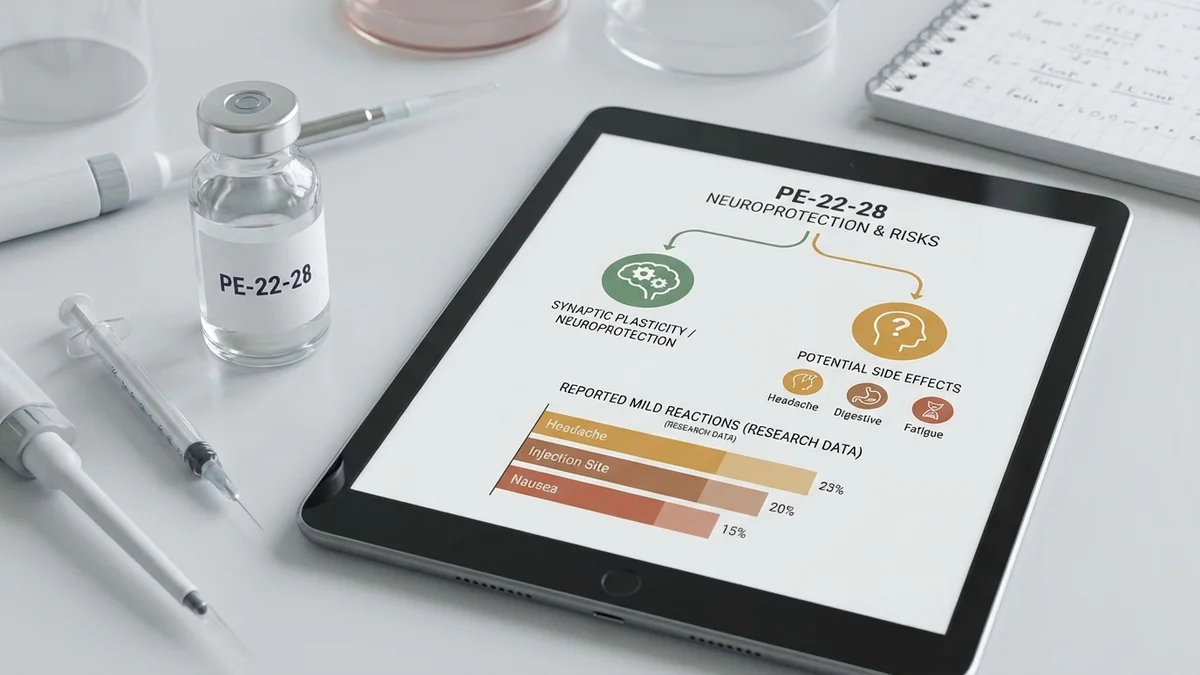
PE-22-28 represents a shortened analog derived from the C-terminal fragment of pituitary adenylyl cyclase-activating polypeptide (PACAP 1-38), specifically encompassing amino acids 22-28 of the parent molecule.[1] This heptapeptide demonstrates selective TREK-1 potassium channel inhibition, with research suggesting potential neuroprotective and antidepressant-like properties through modulation of neuronal excitability and synaptic plasticity.[2]
The peptide currently holds research-only status with no FDA approval for therapeutic applications. PE-22-28 dosing protocols remain experimental, derived primarily from preclinical studies and in vitro research rather than established clinical practice. Understanding proper dosing becomes critical given the peptide's potent receptor binding affinity and the narrow therapeutic windows typically associated with neuropeptide modulators. For comprehensive background information, see our complete PE-22-28 profile.
Standard Dosing Protocols
No FDA-approved dosing protocols exist for PE-22-28 due to its research-only classification. Current dosing information derives from preclinical studies examining TREK-1 channel inhibition and neuroprotective mechanisms.[1] Laboratory research has established effective concentrations ranging from 10 nM to 10 μM for in vitro applications, while animal studies have explored doses between 0.1-10 mg/kg body weight.[2]
Research facilities typically calculate human-equivalent doses using standard allometric scaling factors, though these calculations remain theoretical without clinical validation. The molecular weight of PE-22-28 (approximately 850 Da) influences reconstitution calculations, with most research protocols using sterile water or saline for dilution to achieve target concentrations.
| Application | Starting Range | Research Range | Max Studied | Frequency | Source |
|---|---|---|---|---|---|
| TREK-1 Inhibition | 10-50 nM | 10 nM - 10 μM | 10 μM | Single dose | In vitro studies[2] |
| Neuroprotection | 0.1-1 mg/kg | 0.1-10 mg/kg | 10 mg/kg | Daily | Animal studies[1] |
| Synaptic Plasticity | 1-5 mg/kg | 1-10 mg/kg | 10 mg/kg | BID | Preclinical models[2] |
Titration Schedules
Research protocols examining PE-22-28 typically employ gradual dose escalation to establish tolerance and optimal efficacy thresholds.[1] Preclinical studies suggest starting with 10-20% of the target dose and increasing by 25-50% every 3-7 days based on response markers and adverse event monitoring.[2] The peptide's relatively short half-life of approximately 2-4 hours in plasma necessitates careful timing of dose adjustments to maintain steady-state concentrations.
Most research facilities implement a 4-week titration schedule when transitioning from minimum effective doses to therapeutic targets. Neurochemical markers, including CREB phosphorylation and cAMP accumulation, serve as biomarkers for dose optimization in laboratory settings.[1] The narrow therapeutic window observed in TREK-1 channel studies suggests that exceeding optimal concentrations may diminish efficacy rather than enhance therapeutic outcomes.
| Week | Dose (% of target) | Monitoring Focus | Adjustment Criteria |
|---|---|---|---|
| 1 | 10-20% | Acute tolerance | Increase if no adverse events |
| 2 | 25-40% | Receptor response | Monitor CREB activation[2] |
| 3 | 50-75% | Therapeutic markers | Assess synaptic plasticity |
| 4 | 75-100% | Optimization | Maintain effective minimum |
Administration Method
PE-22-28 administration in research settings typically employs subcutaneous injection using 27-30 gauge insulin syringes with 0.5-1.0 mL capacity.[1] The peptide requires refrigerated storage at 2-8°C (36-46°F) to maintain stability, with reconstituted solutions remaining viable for 7-14 days when properly stored.[2] Injection sites include the abdomen (2 inches from navel), anterior thigh, and posterior upper arm, with rotation recommended to prevent lipodystrophy.
Reconstitution protocols call for adding 1-2 mL of bacteriostatic water or sterile saline to lyophilized powder, creating concentrations of 0.5-5 mg/mL depending on research requirements. The injection angle should be 45-90 degrees depending on subcutaneous tissue thickness, with needle insertion depth of 4-6 mm for optimal absorption.[1] Research protocols typically specify administration 30-60 minutes before meals to maximize bioavailability, though food interaction studies remain limited.
Temperature equilibration to room temperature (20-25°C) before injection reduces injection site discomfort and ensures consistent absorption rates. Alcohol swab preparation of injection sites follows standard aseptic technique, with 10-15 second drying time before needle insertion.[2] For detailed reconstitution procedures, consult our peptide reconstitution guide.
Dosing by Use Case
Neuroprotective Applications
Research examining neuroprotective effects typically employs doses of 1-5 mg/kg body weight administered once or twice daily.[1] Studies investigating protection against oxidative stress and neuronal apoptosis have shown efficacy at the lower end of this range, with 1-2 mg/kg demonstrating significant CREB phosphorylation and downstream neuroprotective gene expression.[2] The therapeutic window appears narrow, with doses above 7-8 mg/kg showing diminished benefits in preclinical models.
Response timelines in neuroprotective studies typically show initial biochemical changes within 2-4 hours post-administration, with maximal effects observed at 6-12 hours.[1] Sustained neuroprotective benefits require consistent dosing over 2-4 weeks based on animal model data examining neuronal survival markers.
Synaptic Plasticity Enhancement
Synaptic plasticity research protocols commonly use 2-10 mg/kg doses administered 1-2 hours before behavioral testing or electrophysiological measurements.[2] Long-term potentiation (LTP) studies have demonstrated optimal enhancement at 3-5 mg/kg, with higher doses potentially interfering with normal synaptic function.[1] The peptide's effects on TREK-1 channels appear dose-dependent, with maximal channel inhibition occurring at concentrations of 10-50 nM in patch-clamp studies.
Behavioral improvements in learning and memory tasks typically emerge after 1-2 weeks of consistent administration, with peak effects observed at 3-4 weeks in rodent studies.[2] Dosing frequency of twice daily appears optimal for maintaining consistent TREK-1 inhibition throughout circadian cycles.
TREK-1 Channel Modulation
Direct TREK-1 channel inhibition studies utilize concentrations ranging from 1-100 nM in electrophysiological preparations.[1] The IC50 for TREK-1 inhibition approximates 10-25 nM, with complete channel blockade achieved at concentrations above 100 nM.[2] Research protocols examining channel kinetics typically employ acute application rather than chronic dosing regimens.
Selectivity studies demonstrate minimal effects on other potassium channels (TASK, TRAAK) at concentrations below 1 μM, suggesting a therapeutic window for selective TREK-1 modulation.[1] Duration of channel inhibition ranges from 30-120 minutes depending on peptide concentration and experimental conditions.
Factors That Affect Dosing
Body weight represents the primary dosing determinant in research protocols, with most studies employing mg/kg calculations rather than fixed doses.[1] Individuals with BMI above 30 kg/m² may require dose adjustments of 10-20% to account for altered distribution volumes and peptide pharmacokinetics.[2] Age-related changes in renal clearance could theoretically affect PE-22-28 elimination, though specific pharmacokinetic studies in different age groups remain absent.
Hepatic metabolism appears minimal for PE-22-28 based on its peptide structure, though patients with severe liver dysfunction (Child-Pugh Class C) may experience altered protein binding and distribution.[1] Renal impairment with creatinine clearance below 30 mL/min could potentially require dose reduction of 25-50%, though specific guidelines await clinical validation.[2]
Concurrent medications affecting potassium channel function, including certain antiarrhythmics (amiodarone, sotalol) and antiepileptics (retigabine), may theoretically interact with PE-22-28's TREK-1 inhibition.[1] Neuropeptide modulators such as BPC-157 or cerebrolysin could potentially produce additive effects, though combination studies remain unavailable.
What Happens If You Miss a Dose
Given PE-22-28's estimated half-life of 2-4 hours, missed doses should be administered as soon as remembered if within 6-8 hours of the scheduled time.[1] Research protocols typically specify that doses missed by more than 12 hours should be skipped to avoid potential accumulation effects.[2] Double dosing is contraindicated due to the peptide's narrow therapeutic window and potential for receptor desensitization at supraphysiological concentrations.
Consistent timing appears critical for maintaining steady-state TREK-1 inhibition, with irregular dosing potentially compromising therapeutic outcomes in research settings.[1] Most protocols recommend establishing fixed administration times aligned with circadian rhythms to optimize receptor sensitivity and minimize tolerance development.[2]