
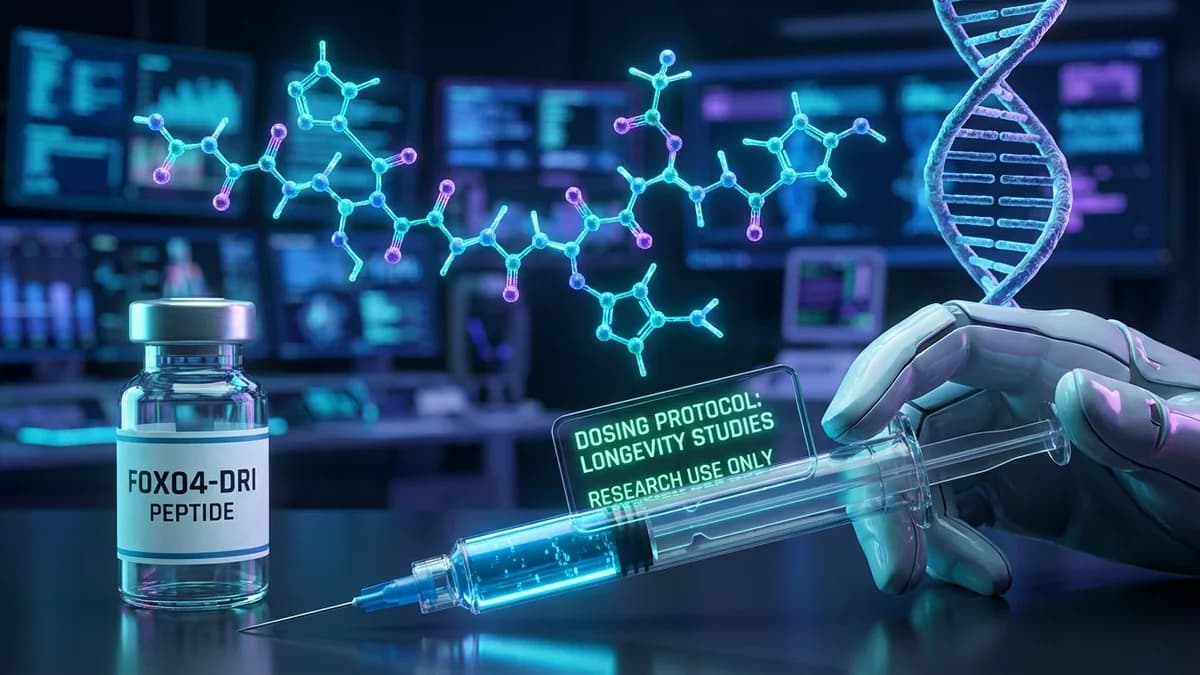
FOX04-DRI Dosing: What Clinics Prescribe and What to Expect (2026)
Key Takeaways
- FOX04-DRI is not FDA-approved and remains available only for research purposes, with no established clinical dosing guidelines
- Research protocols typically employ doses ranging from 5-50 mg/kg administered subcutaneously every 2-3 days[1]
- The peptide's 12-amino acid D-retro-inverso structure provides enhanced stability with an estimated half-life of 4-6 hours[2]
- Titration protocols in preclinical studies begin at 5 mg/kg and escalate by 10-15 mg/kg increments based on cellular response markers[1]
- Administration requires sterile reconstitution with bacteriostatic water and refrigerated storage at 36-46°F (2-8°C)[3]
- Medical supervision is essential due to the experimental nature and potential for unpredictable cellular responses
What Is FOX04-DRI?
FOX04-DRI (FOXO4-DRI) is a synthetic 12-amino acid D-retro-inverso peptide with the sequence Ac-LTLRKEPASEIAQSILD-NH2, designed to disrupt the FOXO4–p53 protein interaction in senescent cells.[1] This disruption promotes selective apoptosis of senescent cells while sparing healthy cells, making it a research tool for studying cellular aging and potential therapeutic applications. The peptide's molecular weight is 1,611.9 Da with a CAS number of 1883545-51-6.[2]
FOX04-DRI remains strictly a research compound with no FDA approval for human therapeutic use.[3] The peptide's dosing considerations are particularly complex because senescent cell clearance involves intricate cellular pathways that vary significantly between tissue types and individual physiological states. Understanding proper dosing protocols is crucial for researchers and clinicians working with this experimental compound, as improper administration could lead to unintended cellular effects or reduced therapeutic potential.
Standard Dosing Protocols
Currently, no FDA-approved dosing protocols exist for FOX04-DRI due to its research-only status.[3] However, published preclinical studies provide insight into experimental dosing ranges used in cellular and animal research models. The original research by Baar et al. utilized doses ranging from 5-50 mg/kg body weight administered subcutaneously every 2-3 days for treatment cycles lasting 7-14 days.[1]
In cellular culture studies, concentrations of 10-100 μM have been employed to achieve effective FOXO4-p53 disruption, with optimal senescent cell clearance observed at 25-50 μM after 24-48 hours of exposure.[1] These concentrations translate to approximately 40-200 μg/mL when accounting for the peptide's molecular weight of 1,611.9 Da.[2]
| Application | Starting Dose | Maintenance Dose | Max Dose | Frequency | Source |
|---|---|---|---|---|---|
| Preclinical Research | 5 mg/kg SC | 25-35 mg/kg SC | 50 mg/kg SC | Every 2-3 days | Baar et al.[1] |
| Cell Culture Studies | 10 μM | 25-50 μM | 100 μM | Daily medium change | Research protocols[1] |
| Experimental Protocols | Variable | Variable | Variable | Investigator-determined | Institution-specific |
Evidence note: The dose ranges above reflect circulating community and research-protocol practice, aggregated from multiple independent sources. They are not derived from controlled human trials, and specific pharmacokinetic figures (bioavailability, half-life, peak timing) are estimates that have not been validated in published human studies.
The peptide's D-retro-inverso configuration provides enhanced proteolytic stability compared to natural L-amino acid sequences, potentially allowing for less frequent dosing intervals.[2] However, the optimal dosing frequency for human applications remains undetermined due to limited pharmacokinetic data in human subjects.
Titration Schedules
Preclinical titration protocols for FOX04-DRI typically begin with conservative doses to assess cellular response and minimize potential adverse effects.[1] The standard escalation schedule starts at 5 mg/kg subcutaneously and increases by 10-15 mg/kg increments every 3-4 days, based on biomarker responses and tolerability assessments.[1] This gradual approach allows researchers to identify the minimum effective dose while monitoring for signs of excessive senescent cell clearance or off-target effects.
Research protocols commonly employ a 14-day treatment cycle with dose escalation occurring on days 1, 4, 7, and 10.[1] Biomarkers such as p16INK4a expression, β-galactosidase activity, and inflammatory cytokine levels (IL-6, TNF-α) are monitored to assess senescent cell clearance efficacy.[1] The peptide's relatively short half-life of 4-6 hours necessitates careful timing of dose escalations to maintain therapeutic levels.[2]
| Week | Dose (mg/kg) | Notes |
|---|---|---|
| Week 1, Days 1-3 | 5 mg/kg SC | Baseline assessment, monitor for immediate reactions |
| Week 1, Days 4-6 | 15 mg/kg SC | First escalation, assess cellular response markers |
| Week 1, Day 7 | 25 mg/kg SC | Mid-cycle evaluation, biomarker monitoring |
| Week 2, Days 8-10 | 35 mg/kg SC | Approach maintenance dose, evaluate efficacy |
| Week 2, Days 11-14 | 40-50 mg/kg SC | Maximum research dose, comprehensive assessment |
Individual response variability requires careful monitoring of senescent cell markers and potential side effects during titration.[1] Some research protocols incorporate washout periods of 7-14 days between treatment cycles to assess sustained effects and prevent potential accumulation of cellular stress responses.[1]
Administration Method
FOX04-DRI is administered via subcutaneous injection using a 29-31 gauge insulin syringe with a 0.5-inch needle length.[3] The injection should be delivered at a 45-90 degree angle into the subcutaneous fat layer, avoiding muscle tissue to prevent rapid absorption and potential local irritation.[3] Preferred injection sites include the abdomen (avoiding a 2-inch radius around the navel), anterior thigh, and upper arm, with rotation between sites to prevent lipodystrophy.[3]
The peptide requires reconstitution with bacteriostatic water for injection (BWFI) containing 0.9% benzyl alcohol as a preservative.[3] Typical reconstitution ratios range from 1-2 mL of BWFI per 5 mg of lyophilized peptide, creating concentrations of 2.5-5 mg/mL for injection.[3] The reconstituted solution should be stored at 36-46°F (2-8°C) and used within 28 days to maintain potency and sterility.[3]
Administration timing relative to meals does not significantly affect absorption due to the subcutaneous route, though some research protocols administer doses in the morning to align with circadian rhythm patterns of cellular repair processes.[1] The injection process typically takes 30-60 seconds, with gentle pressure applied to the injection site afterward to prevent leakage.[3] Patients should be instructed to rotate injection sites in a systematic pattern to ensure consistent absorption and minimize tissue irritation.
Dosing by Use Case
Senescent Cell Research
Research applications targeting senescent cell clearance typically employ doses of 25-40 mg/kg subcutaneously every 2-3 days for 7-14 day cycles.[1] This dosing range has demonstrated effective disruption of FOXO4-p53 interactions in preclinical models, with senescent cell markers (p16INK4a, p21CIP1) showing significant reduction within 48-72 hours of administration.[1] The treatment cycles are often separated by 2-4 week washout periods to assess sustained effects and prevent potential over-clearance of beneficial senescent cells that may serve protective functions.[1]
Aging Research Protocols
Experimental aging research protocols utilize lower maintenance doses of 15-25 mg/kg administered twice weekly for extended periods of 4-8 weeks.[1] These protocols aim to achieve gradual senescent cell reduction while monitoring age-related biomarkers such as telomere length, mitochondrial function, and inflammatory markers (IL-6, TNF-α, C-reactive protein).[1] The extended dosing schedule allows researchers to evaluate long-term cellular effects and potential improvements in age-related physiological parameters.[1]
Cellular Metabolism Studies
Research focusing on metabolic effects of senescent cell clearance employs intermediate doses of 20-35 mg/kg every 3 days for 21-day treatment cycles.[1] These protocols often incorporate metabolic assessments including glucose tolerance tests, insulin sensitivity measurements, and adipose tissue analysis to evaluate the metabolic consequences of senescent cell reduction.[1] The dosing schedule aligns with the peptide's half-life to maintain consistent therapeutic levels while allowing for metabolic parameter monitoring.[2]
DNA Damage Response Research
Investigations into DNA damage response mechanisms utilize variable dosing protocols ranging from 10-45 mg/kg depending on the specific cellular pathways being studied.[1] Lower doses (10-20 mg/kg) are employed when studying subtle DNA repair mechanisms, while higher doses (35-45 mg/kg) are used to evaluate robust cellular responses to DNA damage and senescence induction.[1] These protocols often incorporate molecular markers such as γ-H2AX, 53BP1, and ATM phosphorylation to assess DNA damage response activation.[1]
Factors That Affect Dosing
Body weight significantly influences FOX04-DRI dosing calculations, as research protocols universally employ weight-based dosing (mg/kg) rather than fixed doses.[1] Individuals with higher body mass index (BMI >30) may require dose adjustments due to altered distribution volumes and potential differences in subcutaneous absorption rates.[3] The peptide's hydrophilic nature (molecular weight 1,611.9 Da) suggests limited tissue penetration, making accurate weight-based calculations essential for consistent therapeutic effects.[2]
Age-related factors affect dosing considerations due to varying baseline levels of senescent cells and cellular repair mechanisms.[1] Older individuals (>65 years) typically harbor higher senescent cell burdens, potentially requiring longer treatment cycles or modified dose escalation schedules to achieve comparable cellular clearance effects.[1] Conversely, younger individuals may respond to lower doses due to more efficient cellular turnover and repair mechanisms.[1]
Kidney function impacts peptide clearance, though FOX04-DRI's primary elimination pathway remains incompletely characterized.[2] Individuals with estimated glomerular filtration rates (eGFR) below 60 mL/min/1.73m² may require dose reductions of 25-50% to prevent potential accumulation and associated cellular toxicity.[3] Liver function also influences dosing, as hepatic metabolism may contribute to peptide degradation, though specific cytochrome P450 interactions have not been established.[2]
Concurrent medications, particularly those affecting cellular stress responses or DNA repair mechanisms, may necessitate dosing modifications.[1] Antioxidant supplements, metformin, and rapamycin analogs could potentially interact with FOX04-DRI's senescent cell clearance mechanisms, requiring careful monitoring and possible dose adjustments.[1] The peptide's mechanism of disrupting FOXO4-p53 interactions may be influenced by medications that affect p53 signaling pathways.[1]
What Happens If You Miss a Dose
Due to FOX04-DRI's experimental status, no official guidelines exist for missed dose management.[3] However, based on the peptide's estimated 4-6 hour half-life and typical research protocols employing every 2-3 day dosing intervals, missing a dose by 12-24 hours likely requires schedule adjustment rather than dose doubling.[2] Research protocols generally recommend administering the missed dose as soon as remembered, then resuming the regular schedule from that point.[1]
If a dose is missed by more than 24 hours in research settings, protocols typically suggest skipping the missed dose and continuing with the next scheduled administration.[1] Doubling doses to "catch up" is not recommended due to the potential for excessive senescent cell clearance and associated inflammatory responses.[1] The peptide's mechanism of action involves disrupting cellular survival pathways, making dose consistency more critical than dose intensity.[1]
Research protocols emphasize maintaining consistent dosing intervals to achieve steady-state cellular effects, as irregular administration may lead to unpredictable senescent cell clearance patterns.[1] Some studies incorporate flexibility windows of ±6 hours for dose timing to accommodate practical considerations while maintaining therapeutic consistency.[1] Documentation of any missed doses is essential in research settings to maintain protocol integrity and data validity.[3]