Humanin is a short peptide, 24 amino acids long, made from instructions in your mitochondria, the parts of your cells that produce energy. Japanese researchers discovered it in 2001 in brain tissue from a person with Alzheimer's disease, where it protected nerve cells from dying.[1]
Since then, humanin has been studied in cells and animals for brain, heart and metabolic health. It has never been tested as a treatment in people. It's sold online as a research peptide for longevity, and it isn't approved anywhere.
- Humanin is a 24-amino-acid peptide your mitochondria make naturally. Levels in your blood change with age.
- Most of the promising animal results used HNG, a version about 1,000 times more potent in the lab, not the natural humanin most vendors sell.
- No human trial has given humanin as a treatment. Human data only measure the humanin you already make.
- In one mouse study, humanin made breast cancer grow and spread faster.
- It isn't approved anywhere, and it's banned in tested sports under WADA's unapproved-substance rule.
- Online users report 500 mcg a day or 5 mg twice a week. No dose has been tested.
| What it is | 24-amino-acid mitochondrial-derived peptide |
| Sequence | MAPRGFSCLLLLTSEIDLPVKRRA |
| Common vial | 10 mg |
| Route | Injection under the skin (online use) |
| Human treatment trials | None |
| FDA status | Not approved anywhere |
| In sport | Prohibited at all times (WADA S0) |
What Is Humanin?
Humanin belongs to a small family called mitochondrial-derived peptides. Most of your genes sit in your cell's nucleus, but your mitochondria carry a small genome of their own. Humanin is coded within one of those mitochondrial genes. Its sister peptide, MOTS-c, comes from a neighboring gene.
Researchers found humanin while screening for anything that could stop nerve cells dying from Alzheimer's-related genes. Humanin blocked cell death caused by several different Alzheimer's genes and by amyloid beta, the protein that clumps in Alzheimer's brains.[1]
Humanin vs HNG (S14G-humanin)
HNG, also written S14G-humanin or Gly14-humanin, is humanin with one amino acid changed. In lab tests it's about 1,000 times more potent than natural humanin.[5] Many of the animal studies that made humanin famous used HNG or other analogs. Vendors sell "humanin" and "HNG" separately, and the doses are not interchangeable.
Humanin vs MOTS-c
Both peptides come from mitochondrial genes, but they're studied for different things. Humanin is studied mainly for protecting cells in the brain and heart. MOTS-c, a 16-amino-acid peptide, is studied mainly for metabolism and exercise. WADA names MOTS-c on its banned list; humanin is caught by a broader rule instead (see legal status below).
How Humanin Works
Humanin protects cells from programmed cell death, called apoptosis. Researchers have found several ways it does this:
- Blocking Bax. Bax is a protein that triggers cell death by moving into the mitochondria. Humanin stops that move.[2]
- Cell-surface receptors. Humanin binds a receptor complex on nerve cells that switches on survival signals,[3] and it also acts on a receptor called FPRL1, which amyloid beta uses too.[4]
- Insulin sensitivity. In rats, humanin delivered into the brain made the body more sensitive to insulin. The same paper found humanin levels fall with age in people and mice.[6]
What People Use Humanin For
Each of these uses rests on animal or lab research:
- Longevity and healthy aging. In mice, HNG given twice a week improved several markers of metabolic health, and extra humanin made worms live longer.[7]
- Brain health and memory. In aged mice, humanin improved memory,[8] and in mice given amyloid beta to impair memory, HNG prevented memory problems.[5]
- Heart protection. In mice, HNG reduced heart damage after a blocked artery in a dose-dependent way, with the biggest effect at 2 mg/kg.[9]
- Blood vessels. In mice prone to clogged arteries, a humanin analog given daily for 16 weeks protected the artery lining and shrank plaque.[10]
- Fatigue and energy. Some people take it with MOTS-c for fatigue. There's no research on this.
The Research Behind Humanin
Human research on humanin has only measured the humanin people already make. No one has given it to people as a treatment.
| Study | Who | What they found |
|---|---|---|
| Centenarian families[7] | Children of people who lived to 100 | Much higher blood humanin than people of the same age |
| Gene variant study[8] | Two human groups | A gene variant linked to lower humanin was tied to faster cognitive aging |
| Aging cohort[11] | 693 people, ages 21 to 113 | Levels were highest in centenarians, but higher levels predicted shorter survival among the oldest |
| Exercise study[12] | Healthy adults | Endurance exercise raised blood humanin; weight training didn't |
| Mouse heart study[9] | Mice | HNG cut heart damage after a heart attack |
| Mouse cancer study[13] | Mice with breast cancer | Humanin sped tumor growth and spread |
Humanin and age don't line up neatly. Some studies find levels fall with age.[6] Others find the highest levels in centenarians, yet among the very old, higher humanin was linked to dying sooner.[11] So it's not clear that raising your humanin is helpful.
Native humanin doesn't spread well in the body. In rats, injected humanin reached the blood and liver but couldn't be detected in the brain or heart.[14] That matters if you're injecting it for brain benefits.
Is Humanin Legal?
Humanin isn't approved as a drug anywhere in the world. In the US, it isn't a legal dietary supplement, and it's not on the list of substances compounding pharmacies may use.[15] It's sold only as a research chemical labeled not for human use.
In sports, humanin isn't named on the WADA list, but the S0 rule bans any substance with no current approval by any government health authority for human use, at all times.[16] Humanin has no approval anywhere, so it falls under that rule.
If you want longevity care under medical supervision, you can find a peptide clinic near you.
Humanin Dosage
No tested human dose
Humanin has never been given to people in a clinical trial, so there is no proven dose. The numbers below are what online users report. Talk to a licensed clinician before you inject anything.
What users report: about 500 mcg a day under the skin, or 5 mg twice a week. Some people do 2 to 5 mg a day for 10 days. Many report feeling nothing.
What animal studies used: HNG at 2 mg/kg in mice,[9] or a twice-weekly HNG schedule.[7] Because HNG is about 1,000 times more potent in the lab, these doses don't translate to natural humanin.
Humanin dosage chart (10 mg vial)
| Dose | Units with 2 mL BAC water | Units with 1 mL BAC water |
|---|---|---|
| 250 mcg | 5 units | 2.5 units |
| 500 mcg | 10 units | 5 units |
| 1 mg | 20 units | 10 units |
| 5 mg | 100 units | 50 units |
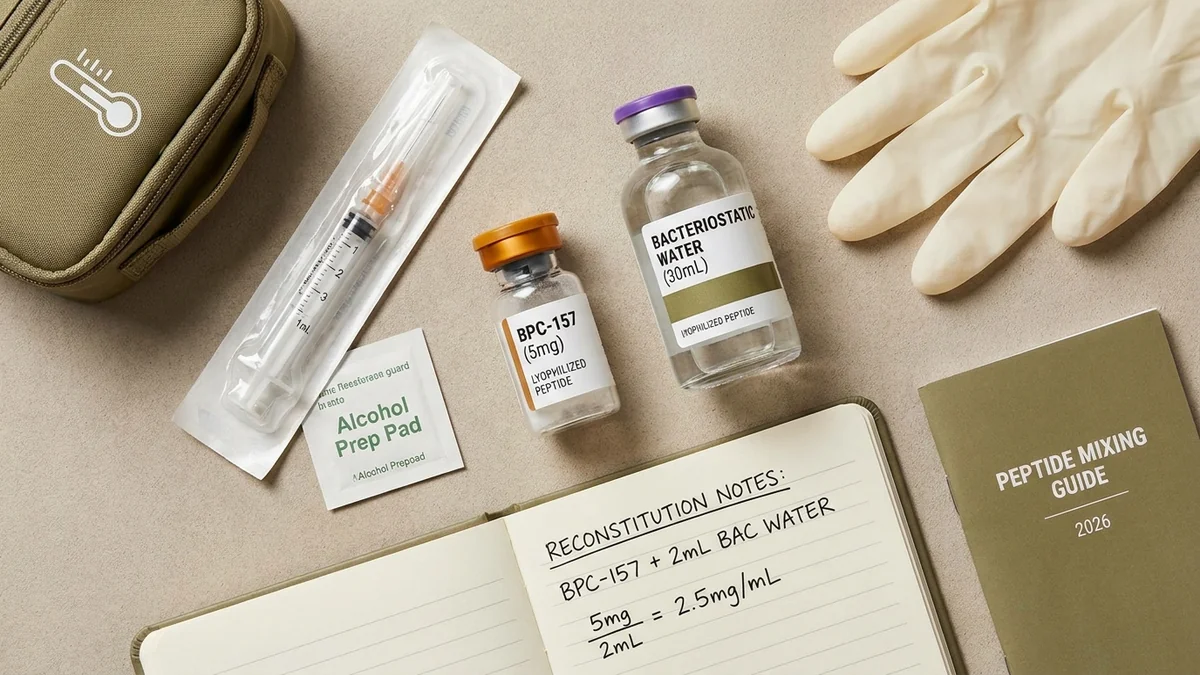
With 2 mL of bacteriostatic (BAC) water, each unit on a U-100 insulin syringe holds 50 mcg, which makes small doses easier to measure. At 500 mcg a day, a 10 mg vial lasts 20 days. At 5 mg twice a week, it lasts one week. Use our peptide calculator for other volumes, and the reconstitution guide for mixing steps.
Humanin Side Effects
There's no human safety data, because humanin has never been tested as a treatment. Animal studies with humanin analogs didn't report obvious toxicity.
The main known risk: cancer growth. In a 2020 study of mice with triple-negative breast cancer, humanin made tumors grow faster, increased spread to the lungs and weakened the effect of chemotherapy. The authors wrote that caution should be taken when using humanin for other conditions.[13] Since humanin protects cells from dying, it may protect cancer cells too.
Other unknowns:
- How long it lasts in your body and where it goes. In rats, it didn't reach the brain or heart.[14]
- Effects on insulin and the IGF-1 system, which humanin interacts with.[6]
- Product quality. Research peptides aren't made to drug standards, and sourcing clean humanin is a common complaint.
Who should avoid it: anyone with cancer or a history of it, anyone pregnant or breastfeeding, anyone under 18 and athletes who are drug tested.
Frequently Asked Questions
What is humanin? A 24-amino-acid peptide made from mitochondrial genes, discovered in 2001 for protecting nerve cells.
What is the difference between humanin and HNG? HNG has one amino acid changed and is about 1,000 times more potent in the lab. Most animal studies used HNG.
What is the difference between humanin and MOTS-c? Both come from mitochondrial genes. Humanin is studied for cell protection; MOTS-c for metabolism and exercise.
Has humanin been tested in humans? Not as a treatment. Human studies only measured natural levels.
What is the humanin dose? No dose has been tested. Users report 500 mcg a day or 5 mg twice a week.
How many units is 500 mcg of humanin? With a 10 mg vial and 2 mL of BAC water, 500 mcg is 10 units.
Does humanin cause cancer? In one mouse study, it made breast tumors grow and spread faster. Avoid it if you have cancer or a history of it.
What are the side effects of humanin? There's no human safety data. The main known risk is the tumor finding in mice.
Is humanin FDA approved? No. It isn't approved anywhere.
Is humanin banned in sports? Yes, under WADA's rule for unapproved substances.
Do humanin levels predict longevity? The data point both ways, so nobody knows whether raising it helps.
References
- Hashimoto Y, Niikura T, Tajima H, et al. A rescue factor abolishing neuronal cell death by a wide spectrum of familial Alzheimer's disease genes and Abeta. Proc Natl Acad Sci U S A. 2001;98(11):6336-6341. PMID: 11371646
- Guo B, Zhai D, Cabezas E, et al. Humanin peptide suppresses apoptosis by interfering with Bax activation. Nature. 2003;423(6938):456-461. PMID: 12732850
- Hashimoto Y, Kurita M, Aiso S, Nishimoto I, Matsuoka M. Humanin inhibits neuronal cell death by interacting with a cytokine receptor complex or complexes involving CNTF receptor alpha/WSX-1/gp130. Mol Biol Cell. 2009;20(12):2864-2873. PMID: 19386761
- Ying G, Iribarren P, Zhou Y, et al. Humanin, a newly identified neuroprotective factor, uses the G protein-coupled formylpeptide receptor-like-1 as a functional receptor. J Immunol. 2004;172(11):7078-7085. PMID: 15153530
- Tajima H, Kawasumi M, Chiba T, et al. A humanin derivative, S14G-HN, prevents amyloid-beta-induced memory impairment in mice. J Neurosci Res. 2005;79(5):714-723. PMID: 15678515
- Muzumdar RH, Huffman DM, Atzmon G, et al. Humanin: a novel central regulator of peripheral insulin action. PLoS One. 2009;4(7):e6334. PMID: 19623253
- Yen K, Mehta HH, Kim SJ, et al. The mitochondrial derived peptide humanin is a regulator of lifespan and healthspan. Aging (Albany NY). 2020;12(12):11185-11199. PMID: 32575074
- Yen K, Wan J, Mehta HH, et al. Humanin prevents age-related cognitive decline in mice and is associated with improved cognitive age in humans. Sci Rep. 2018;8(1):14212. PMID: 30242290
- Muzumdar RH, Huffman DM, Calvert JW, et al. Acute humanin therapy attenuates myocardial ischemia and reperfusion injury in mice. Arterioscler Thromb Vasc Biol. 2010;30(10):1940-1948. PMID: 20651283
- Oh YK, Bachar AR, Zacharias DG, et al. Humanin preserves endothelial function and prevents atherosclerotic plaque progression in hypercholesterolemic ApoE deficient mice. Atherosclerosis. 2011;219(1):65-73. PMID: 21763658
- Conte M, Ostan R, Fabbri C, et al. Human aging and longevity are characterized by high levels of mitokines. J Gerontol A Biol Sci Med Sci. 2019;74(5):600-607. PMID: 29955888
- von Walden F, Fernandez-Gonzalo R, Norrbom J, et al. Acute endurance exercise stimulates circulating levels of mitochondrial-derived peptides in humans. J Appl Physiol (1985). 2021;131(3):1035-1042. PMID: 34351816
- Moreno Ayala MA, Gottardo MF, Zuccato CF, et al. Humanin promotes tumor progression in experimental triple negative breast cancer. Sci Rep. 2020;10(1):8542. PMID: 32444831
- Chin YP, Keni J, Wan J, et al. Pharmacokinetics and tissue distribution of humanin and its analogues in male rodents. Endocrinology. 2013;154(10):3739-3744. PMID: 23836030
- U.S. Food and Drug Administration. Bulk drug substances nominated for use in compounding under section 503A. Updated May 14, 2026. fda.gov
- World Anti-Doping Agency. The 2026 Prohibited List, section S0. wada-ama.org
This information is for educational purposes only and does not constitute medical advice. Always consult a qualified healthcare provider before starting any peptide therapy. Regulatory status may change.