KLOW, also sold as the KLOW stack, is a blend of four peptides in one vial: GHK-Cu, BPC-157, TB-500 and KPV. The standard vial holds 80 mg. It is the GLOW blend with KPV added, and it's sold as a "repair" blend for injuries, joints, gut issues and skin.
Nobody has tested KLOW as a blend. Each ingredient has some research behind it, mostly in animals, and only BPC-157 and the full thymosin beta-4 protein have any human data at all. KLOW is sold for research use only and is not FDA approved.
- KLOW is GHK-Cu, BPC-157, TB-500 and KPV in one vial. The common 80 mg vial is 50 mg GHK-Cu plus 10 mg of each of the others.
- People use it for injury recovery, joint and tendon pain, gut issues and skin. None of these uses has been tested with KLOW itself.
- Redness, itching or stinging where you inject is the most reported side effect. Some people also report tiredness.
- KLOW is not FDA approved, and BPC-157 and TB-500 are banned in tested sports.
- User protocols start at 2 mg of blend a day and build to 4 to 6 mg. No study has tested any dose.
| What it is | Four-peptide blend: GHK-Cu, BPC-157, TB-500, KPV |
| Common vial | 80 mg (50 mg GHK-Cu, 10 mg each BPC-157, TB-500, KPV) |
| Route | Injection under the skin |
| Typical cycle | 4 to 12 weeks, then a break |
| Human trials of the blend | None |
| FDA status | Not approved; sold for research use only |
| In sport | BPC-157 and TB-500 are prohibited |
What Is KLOW?
KLOW combines four peptides that are also sold on their own. The common 80 mg vial holds 50 mg of GHK-Cu and 10 mg each of BPC-157, TB-500 and KPV, so GHK-Cu makes up more than half of every dose.
KLOW is sold as a "repair" blend. The idea is that four peptides acting in different ways will do more together than any one alone. That has never been tested.
Once mixed, the liquid is blue. That color comes from the copper in GHK-Cu and is expected. Don't use it if it turns cloudy or has particles in it.
What People Use KLOW For
Here's what each ingredient is used for, and how much evidence stands behind it:
- Injuries, tendons and joints (BPC-157 and TB-500). This is the main reason people buy KLOW. BPC-157 has a large body of animal research, mostly on gut healing, and in lab studies it helped rat tendon cells grow, survive and move.[1][2] In one clinic's chart review, most patients who got BPC-157 injections for knee pain said their pain improved, but there was no comparison group.[3] TB-500 is a short piece of thymosin beta-4, a protein that helps cells move into a wound and form new blood vessels in lab and animal studies.[6][7]
- Gut inflammation (KPV, BPC-157). KPV is a three-amino-acid fragment of a hormone called alpha-MSH. In two mouse models of colitis, it reduced inflammation.[8] It has not been tested in people.
- Skin, hair and wrinkles (GHK-Cu). GHK-Cu is a copper peptide used in skin creams. Reviews of its skin effects are mostly by researchers tied to a company that sells it, and the human data are from creams, not injections.[9]
- General recovery and "anti-aging." These claims rest on the same animal research. There is no human evidence for KLOW as an anti-aging treatment.
The Research Behind KLOW
No one has published a study of KLOW itself. Here's the best evidence for each ingredient:
| Ingredient | Best human evidence | Main animal and lab findings |
|---|---|---|
| BPC-157 | Three small reports from one research group, 2 to 16 people each, no control groups[3][4][5] | Gut healing and blood vessel growth in rats; tendon cell growth in lab studies[1][2] |
| TB-500 | None for the fragment. The full thymosin beta-4 protein was tested as a gel in a 73-person trial[7] | Cell movement, blood vessel growth and wound repair[6] |
| KPV | None | Less inflammation in two mouse colitis models[8] |
| GHK-Cu | Skin creams only | Skin repair; changes in gene activity in lab data[9][10] |
BPC-157 in people. A Florida clinic group published all three human reports. In a 2021 chart review, 14 of 16 patients who got knee injections containing BPC-157 said their pain improved. Eleven of the 12 who got BPC-157 alone reported relief.[3] In a 2024 report, 10 of 12 women with interstitial cystitis said their symptoms fully resolved after one procedure in which 10 mg was injected around the inflamed part of the bladder.[4] In a 2025 safety pilot, two adults got 10 mg and then 20 mg by IV, with no side effects and no changes in blood tests.[5] None of these had a placebo group, and patients knew what they got.
Thymosin beta-4 in people. In a Phase 2 trial of 73 people with venous leg ulcers, a thymosin beta-4 gel was as safe as placebo. The authors said the 0.03% dose might speed healing and that about a quarter of patients could heal completely within three months. That was a hint, not proof.[7] That trial used the full protein on the skin. TB-500, the fragment in KLOW, has no human data.[11]
KPV and GHK-Cu. In mice with colitis, KPV led to faster recovery, better weight regain and less inflammation in the colon.[8] GHK-Cu research is mostly on skin. One review reports it changes the activity of thousands of human genes in lab data, but those are cell studies, and its authors are tied to a company that sells copper peptides.[9][10]
Is KLOW Legal?
KLOW is not FDA approved for any use. It is sold online as a "research chemical," labeled not for human use.
That may change for three of its four ingredients. In July 2026, the FDA's Pharmacy Compounding Advisory Committee voted narrowly to recommend adding BPC-157, KPV and TB-500 to the list of substances compounding pharmacies can use.[12] FDA scientists had argued against it, and the vote is only advice. As of mid-October 2026, the FDA had not started the rulemaking needed to add them, though reports say it is weighing an interim policy that would let pharmacies compound them sooner.[13] Injectable GHK-Cu was not part of that vote. Our breakdown of the July 2026 FDA panel vote covers what happens next.
In sports, BPC-157 is prohibited at all times as an unapproved substance.[14] WADA's list names thymosin beta-4 and its derivatives, including TB-500, as banned.[15] If you get drug tested, KLOW can cost you your eligibility.
If you want peptide therapy under medical care, you can find a peptide clinic near you.
KLOW vs GLOW and Other Peptide Stacks
GLOW is the stack people compare KLOW to most, and the only difference is KPV. The Wolverine stack is the simpler option, with just BPC-157 and TB-500.
| KLOW | GLOW | Wolverine | |
|---|---|---|---|
| GHK-Cu | 50 mg | 50 mg | None |
| BPC-157 | 10 mg | 10 mg | 10 mg |
| TB-500 | 10 mg | 10 mg | 10 mg |
| KPV | 10 mg | None | None |
| Typical vial | 80 mg | 70 mg | 20 mg |
| Why people pick it | Repair plus gut and inflammation | Repair and skin | Injury repair only |
Is KLOW or GLOW better? Neither has been tested, so no one can say one works better. People choose KLOW when gut inflammation is part of the reason they're using it, and GLOW when the goal is skin or injury recovery without the extra peptide. The KPV evidence is from mice, so whether it adds anything in people is unknown. See our GLOW blend page for more.
KLOW vs the Wolverine stack. GHK-Cu makes up most of every KLOW dose, so BPC-157 and TB-500 are only a quarter of it. If injury repair is your only goal, that's the trade-off: Wolverine gives you those two peptides without the copper.
KLOW vs taking each peptide separately. A blend locks the ratio. Separate vials let you set each dose, for example more BPC-157 without more copper. The cost is more vials and more injections.
KLOW Dosage
These are not prescribed doses
No study has tested KLOW in people, so there is no proven dose. The amounts below are what online protocols and users commonly report. Talk to a licensed clinician before you inject anything.
KLOW dose per day
The most common plan is a slow build:
- Weeks 1 and 2: 2 mg of blend a day
- Weeks 3 and 4: 4 mg a day
- Weeks 5 to 8: up to 6 mg a day, if the lower doses were well tolerated
Because KLOW is a fixed blend, you can't raise one ingredient without raising all four. At 2 mg of blend, you get 1.25 mg of GHK-Cu and 250 mcg each of BPC-157, TB-500 and KPV. That 250 mcg matches what people commonly take of BPC-157 on its own.
KLOW dosage chart (80 mg vial, 3 mL BAC water)
Mixing an 80 mg vial with 3 mL of BAC water gives 26.7 mg of blend per mL. Each unit on a U-100 insulin syringe then holds about 0.27 mg of blend.
| Units on syringe | Total blend | GHK-Cu | BPC-157, TB-500, KPV (each) |
|---|---|---|---|
| 5 units | 1.33 mg | 0.83 mg | 167 mcg |
| 7.5 units | 2 mg | 1.25 mg | 250 mcg |
| 10 units | 2.67 mg | 1.67 mg | 333 mcg |
| 15 units | 4 mg | 2.5 mg | 500 mcg |
| 22.5 units | 6 mg | 3.75 mg | 750 mcg |
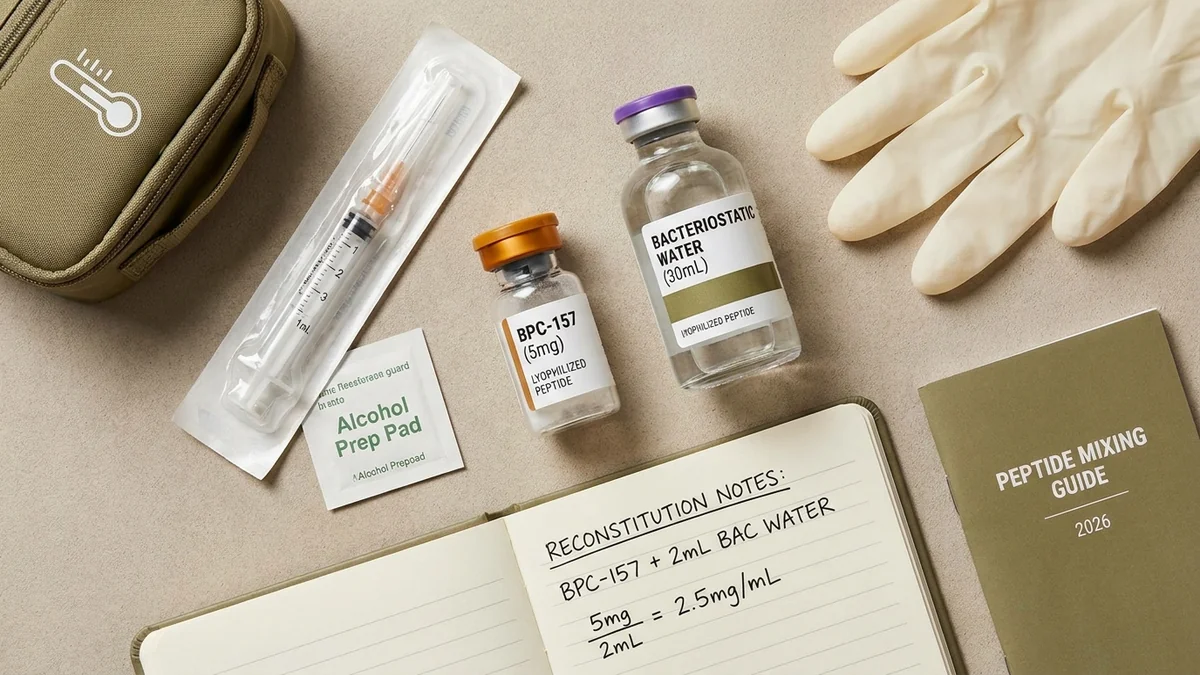
If you mix the vial with 2 mL of BAC water instead, each unit holds 0.4 mg of blend: 5 units is 2 mg, 10 units is 4 mg and 15 units is 6 mg. Whole numbers are easier to read on most syringes than half units.
These numbers only work for the 50/10/10/10 blend. Some sellers offer KLOW in other ratios, such as 40 mg vials with 10 mg of each peptide. Check your label and use our peptide calculator if yours is different.
For timing, vial life and cycle length, see the questions below. Dosing also has its own page, our KLOW dosage guide, and the reconstitution guide walks through mixing step by step.
KLOW Side Effects
KLOW has never been studied for safety, so there's no list of side effects from trials. Here's what users report, and what the human studies of its ingredients found.
What users report most:
- Redness, itching, swelling or stinging where you inject. This is the most common complaint. Copper peptides are known to irritate the skin, and GHK-Cu is the largest part of each dose.
- Tiredness or sleepiness, mostly in the first weeks
- Headache
- Nausea
- Flushing
Does KLOW make you tired? Some people say yes. No study has measured it, and nobody knows which ingredient would cause it. Moving your dose to the evening is the usual fix. If the tiredness doesn't fade, stop and talk to a doctor.
What the ingredient studies found: In the small human reports on BPC-157, which involved 2 to 16 people each, the authors reported no side effects.[3][4][5] In a trial of 73 people with leg ulcers, a thymosin beta-4 gel was about as safe as placebo.[7] These studies were small and short, and none of them tested an injected four-peptide blend.
The bigger unknowns:
- Long-term safety. No one has followed KLOW users over years.
- Product quality. Research peptides are not made to drug standards, so what's in the vial may not match the label.
- Growth effects. BPC-157 and thymosin beta-4 promote new blood vessel growth in lab and animal studies.[1][7] That's a theoretical worry if you have cancer or a history of it.
Who should avoid it: anyone pregnant or breastfeeding, anyone under 18, anyone with cancer or a history of it, people with Wilson's disease or another copper disorder, and athletes who are drug tested.
Frequently Asked Questions
What is KLOW peptide? KLOW is a blend of GHK-Cu, BPC-157, TB-500 and KPV in one vial, usually 80 mg total. It's the GLOW blend with KPV added. It is sold for research use only.
How much KLOW should I take per day? Most protocols start at 2 mg of blend a day and build to 4 to 6 mg. At 3 mL of BAC water, 2 mg is 7.5 units. These numbers come from user protocols, not studies.
What is the best time to take KLOW? No study has compared times. Pick a time you can keep. If it makes you tired, take it in the evening.
How long does an 80 mg vial of KLOW last? About 40 days at 2 mg a day, 20 days at 4 mg a day, and about 13 days at 6 mg a day.
How often do you take KLOW? Once a day is most common. Some people split it into two shots or take weekends off.
Is KLOW or GLOW better? Neither has been tested head to head. KLOW adds KPV for gut inflammation; GLOW skips it.
How long is a KLOW cycle? Usually 4 to 12 weeks, then a 2 to 8 week break. No study has tested cycle length.
Why is KLOW blue? The copper in GHK-Cu turns the solution blue. That's normal.
How long does it take KLOW to work? No research answers this. Online timelines are guesses.
Is KLOW FDA approved? No. It's not approved for any use. An FDA advisory panel backed compounding three of its ingredients in July 2026, but the FDA hasn't acted on that yet. BPC-157 and TB-500 are banned in tested sports.
References
- Sikiric P, Seiwerth S, Rucman R, et al. Stable gastric pentadecapeptide BPC 157: novel therapy in gastrointestinal tract. Curr Pharm Des. 2011;17(16):1612-1632. PMID: 21548867
- Chang CH, Tsai WC, Lin MS, Hsu YH, Pang JH. The promoting effect of pentadecapeptide BPC 157 on tendon healing involves tendon outgrowth, cell survival, and cell migration. J Appl Physiol. 2011;110(3):774-780. PMID: 21030672
- Lee E, Padgett B. Intra-articular injection of BPC 157 for multiple types of knee pain. Altern Ther Health Med. 2021;27(4):8-13. PMID: 34324435
- Lee E, Walker C, Ayadi B. Effect of BPC-157 on symptoms in patients with interstitial cystitis: a pilot study. Altern Ther Health Med. 2024;30(10):12-17. PMID: 39325560
- Lee E, Burgess K. Safety of intravenous infusion of BPC157 in humans: a pilot study. Altern Ther Health Med. 2025;31(5):20-24. PMID: 40131143
- Goldstein AL, Hannappel E, Kleinman HK. Thymosin beta4: actin-sequestering protein moonlights to repair injured tissues. Trends Mol Med. 2005;11(9):421-429. PMID: 16099219
- Guarnera G, DeRosa A, Camerini R. The effect of thymosin treatment of venous ulcers. Ann N Y Acad Sci. 2010;1194:207-212. PMID: 20536470
- Kannengiesser K, Maaser C, Heidemann J, et al. Melanocortin-derived tripeptide KPV has anti-inflammatory potential in murine models of inflammatory bowel disease. Inflamm Bowel Dis. 2008;14(3):324-331. PMID: 18092346
- Pickart L, Vasquez-Soltero JM, Margolina A. GHK peptide as a natural modulator of multiple cellular pathways in skin regeneration. Biomed Res Int. 2015;2015:648108. PMID: 26236730
- Pickart L, Margolina A. Regenerative and protective actions of the GHK-Cu peptide in the light of the new gene data. Int J Mol Sci. 2018;19(7):1987. PMID: 29986520
- U.S. Food and Drug Administration. Certain bulk drug substances for use in compounding that may present significant safety risks. fda.gov
- AJMC. FDA panel backs 6 peptides for compounding. 2026. ajmc.com
- Dresser JC, Asebey EJ. Trump administration's proposed peptide enforcement discretion policy: what compounding pharmacies and peptide suppliers need to know. Frier Levitt. October 14, 2026. frierlevitt.com
- U.S. Anti-Doping Agency. BPC-157: experimental peptide creates risk for athletes. usada.org
- World Anti-Doping Agency. The Prohibited List. wada-ama.org
This information is for educational purposes only and does not constitute medical advice. Always consult a qualified healthcare provider before starting any peptide therapy. Regulatory status may change.